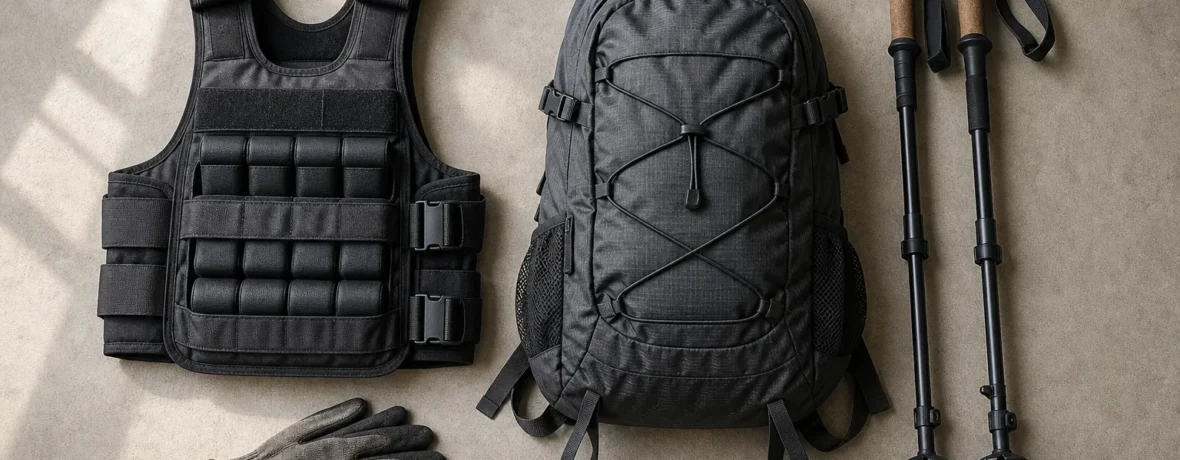
For hiking fitness, rucking is better than a weighted vest if you need to carry 20-40 lb [9-18 kg] on real trails. A weighted vest is better for short walks, stairs, and bodyweight strength with 5-20 lb [2-9 kg]. Choose the vest for simplicity; choose the rucksack for mountain carryover.
The difference is not just where the weight sits. It changes your posture, stride, breathing, hot spots, and how closely the workout matches a loaded hike. A vest hugs your torso. A rucksack hangs from your shoulders and hips. One feels tidy. The other feels like backpacking because it is closer to backpacking.
Is a weighted vest or rucksack better for hiking training?
A rucksack is better for most hiking training because it matches the job: carrying gear on your back over uneven ground.
If your goal is to feel stronger on climbs, handle a weekend pack, or stop getting crushed by the first 2 miles [3.2 km] of uphill trail, train with a pack. Your shoulders, traps, hips, feet, and low back all learn the same pattern you will use outdoors. That matters. A treadmill walk in a weighted vest can build fitness, but it will not teach your body how a pack shifts when you step over roots, descend loose gravel, or tighten a hip belt before a climb.
A weighted vest still earns a place. It shines when you want a compact load for walking, stair climbing, step-ups, squats, lunges, and pushups. It keeps weight close to your center of mass, so you can move more naturally than you can with a sloppy daypack. For short, frequent workouts before work, after dinner, or during a lunch break, a vest is hard to beat.
| Training goal | Better choice | Why |
|---|---|---|
| Backpacking or long day hikes | Rucksack | Closest match to trail load, shoulder pressure, hip belt use, and pack sway |
| Short fitness walks | Weighted vest | Fast to put on, balanced, low fuss |
| Hill repeats and stairs | Either | Vest feels cleaner; rucksack gives better hiking carryover |
| Bodyweight strength circuits | Weighted vest | Does not swing around during squats, lunges, and pushups |
| Testing real gear | Rucksack | Lets you dial straps, hip belt, load placement, and footwear |
What is the difference between a weighted vest and rucking?
A weighted vest loads your torso; rucking loads a pack on your back.
That simple difference changes the whole feel. A weighted vest spreads weight across your chest and back. The load sits high and tight. There are no dangling straps, no hip belt, and no pack body bouncing against your spine. Good vests feel like a heavy hug. Bad ones rub your ribs and make deep breathing feel cramped.
Rucking means walking with weight in a backpack or purpose-built rucksack. The weight usually sits behind you, often higher between the shoulder blades if packed well. With a hiking pack, some of that weight transfers through the hip belt to your pelvis. With a frameless daypack or military-style ruck, more weight rides on your shoulders.
Here is the practical split:
- Weighted vest: better balance, less pack bounce, easier indoor training, quicker setup.
- Rucksack: better hiking specificity, adjustable load, gear practice, longer-session comfort when fitted well.
- Weighted vest: usually limited by fixed plate sizes or small weight pockets.
- Rucksack: can carry water, layers, food, sandbags, books, or your actual trail kit.
If you hike, the rucksack teaches more useful lessons. If you train general fitness and want less clutter, the vest is cleaner.
Is rucking better than a weighted vest for building endurance?
Rucking is usually better for hiking endurance because you can train longer with trail-specific weight.
Endurance for hiking is not just lungs. It is feet that stay calm after 90 minutes, calves that keep working on climbs, hips that do not fold under load, and shoulders that tolerate straps. Rucking trains those pieces together. That is why it feels brutally honest. If your pack fit is bad, you find out. If your shoes rub under load, you find out. If your downhill legs need work, you find out before the trip instead of halfway down the mountain.
A weighted vest can still build strong aerobic capacity. It makes a normal walk harder without forcing you to move faster. That can help when running bothers your joints or you want a low-skill conditioning tool. The CDC adult physical activity guidelines recommend 150 minutes of moderate-intensity aerobic activity per week plus 2 days of muscle-strengthening activity. Loaded walking can help you build toward those minutes if you progress gradually.
For endurance, duration beats ego. A 45-minute walk with 15 lb [6.8 kg] that leaves you ready to train again is more useful than a 25-minute sufferfest with 40 lb [18 kg] that makes your knees bark for 4 days.
Is a weighted vest better than a backpack for walking?
A weighted vest is often better for neighborhood walking, but a backpack is better for hiking preparation.
On pavement, a vest feels smooth. The weight is symmetrical. You do not need to pack it carefully. You do not have a bottle, jacket, or dumbbell shifting around. For flat walking, stairs, treadmill work, and short steep road climbs, that clean fit is the big selling point.
A backpack wins when the walk is part of a hiking plan. You need to learn how your pack rides after 30, 60, and 120 minutes. You need to know whether your hip belt slips, whether your shoulder straps bite, and whether your loaded pack changes your stride. A weighted vest hides all of that.
If you only have a normal daypack, pack it smart:
- Put dense weight high and close to your back.
- Wrap hard items in a towel or puffy layer so they do not dig into your spine.
- Use the sternum strap if the pack has one.
- Tighten compression straps to reduce bounce.
- Do not let weight sag at the bottom like a sack of wet laundry.
A backpack with a hip belt beats a school bag once the load climbs past light training weight. The better the fit, the longer you can train without fighting the pack.
How much weight should you use for weighted vest vs rucking?
Start with 5-10% of your body weight for a vest and 10-15% for rucking if you are already walking comfortably.
That is a starting point, not a badge. If you weigh 180 lb [82 kg], that means 9-18 lb [4-8 kg] in a vest or 18-27 lb [8-12 kg] in a rucksack. If you are new, coming back from injury, or carrying extra fatigue from running or lifting, start lighter. Your connective tissue needs time. Your ego does not get a vote.
Weighted vests can feel intense with less load because the weight presses around your chest and torso. Rucks can handle heavier loads, but only if the pack fits and your walking mechanics stay clean. Heavy rucks also punish poor downhill form fast.
Use this simple progression:
- Week 1: Walk 20-30 minutes with 5-10% body weight.
- Week 2: Add 5-10 minutes to one session, not more weight.
- Week 3: Add 2.5-5 lb [1-2 kg] if your feet, knees, hips, and back feel normal.
- Week 4: Hold the same weight and add hills or stairs.
- Week 5 and beyond: Increase only one variable at a time: weight, time, speed, or elevation.
For hiking, you rarely need heroic loads in training. Most people get more from consistent walks with 15-30 lb [7-14 kg] than from occasional grind sessions with 50 lb [23 kg]. Train to arrive durable, not wrecked.
Which burns more calories: weighted vest or rucking?
The higher total workload burns more calories, so rucking usually wins when it uses more weight, hills, or longer duration.
Calories are driven by body size, speed, grade, load, terrain, temperature, and fitness. A 30-minute flat walk with a 10 lb [4.5 kg] vest will not match a 75-minute hilly ruck with 25 lb [11 kg]. But if the load, pace, and time are similar, the difference may be smaller than people expect.
Do not pick the tool only by calorie burn. That road gets silly fast. Pick the tool you can repeat. Repeatable training changes your hiking. Brutal one-offs mostly create sore calves and laundry.
For fat loss or general health, loaded walking is still only one lever. The NIH MedlinePlus exercise and physical fitness guide groups endurance, strength, balance, and flexibility as useful parts of a complete routine. A vest or ruck can support that routine, but it does not replace sleep, food, recovery, or strength work.
Is rucking bad for your knees or back?
Rucking is not automatically bad for your knees or back, but too much load too soon can irritate both.
Most problems come from progression errors. Too heavy. Too fast. Too far. Too much downhill. Bad shoes. A pack hanging low and pulling you backward. Stack two or three of those together and your body will complain.
Watch your form. You want a tall posture, quiet feet, and a stride that looks like walking, not lunging. Shorten your stride on climbs. On descents, slow down before your knees start acting like brakes on a runaway truck.
Red flags during loaded walking include:
- Sharp pain that changes your gait
- Numbness, tingling, or weakness
- Joint swelling after training
- Back pain that travels down the leg
- Foot pain that gets worse as the session continues
Shin pain deserves respect too. Mayo Clinic describes shin splints as pain along the shinbone that can become ongoing if training stress keeps piling up; their shin splints guide recommends seeing a doctor when rest, ice, and pain relievers do not help. Keep the load light if your lower legs are already cranky from running, jumping, or steep downhill hiking.
When to see a doctor
See a doctor before loaded walking if you have chest pain, unexplained shortness of breath, fainting, major balance problems, or a medical condition that affects exercise tolerance.
Also get medical advice if loaded walks trigger sharp pain, symptoms that travel into an arm or leg, numbness, weakness, swelling, or pain that does not improve with rest. Mayo Clinic’s back pain guidance lists warning signs such as unexplained weight loss, bladder changes, cancer history, and other symptoms that call for faster medical attention.
This is training advice, not a diagnosis. If your body sends a warning flare, stop loading it and get help from a qualified clinician.
How do you choose between a weighted vest and a rucksack?
Choose the tool that matches your next trail goal.
If your next goal is a loaded day hike, backpacking trip, hut-to-hut route, hunting pack-out, or mountain approach, use a rucksack. You need specific practice. Your body should know the feel of straps, pack sway, hip-belt pressure, and stepping down under load.
If your next goal is general conditioning, weight loss support, lunch-break walks, stair laps, or bodyweight strength, use a vest. It is fast and tidy. You can keep it by the door and get moving before your brain starts negotiating.
Here is the plain-English decision tree:
- Pick a weighted vest if you want short, simple workouts under 45 minutes.
- Pick a rucksack if you are training for hikes longer than 6 miles [9.7 km].
- Pick a weighted vest if you will mix walking with squats, lunges, step-ups, and pushups.
- Pick a rucksack if you need to test shoes, socks, poles, layers, snacks, and pack fit.
- Pick a weighted vest if storage space is tight.
- Pick a rucksack if you already own a comfortable hiking pack.
What should you look for in a weighted vest?
Look for a snug fit, adjustable load, full breathing room, and no bounce.
A good vest should stay put when you walk downhill or climb stairs. It should not slam your collarbones, scrape your neck, or squeeze your ribs so tightly that you take shallow breaths. Fixed-weight vests are simple, but adjustable vests give you more room to progress.
Useful weighted vest features include:
- Small weight jumps, ideally 2.5-5 lb [1-2 kg]
- Wide shoulder contact without neck rubbing
- Secure closures that do not loosen while walking
- Reflective details if you walk near roads
- A shape that allows normal arm swing
Avoid loading a vest so heavily that your posture collapses. If your head juts forward, your ribs flare, or your low back arches hard, reduce the weight. The vest should make walking harder, not uglier.
What should you look for in a rucksack?
Look for a pack that holds weight high, close, stable, and comfortable.
For hiking training, your best ruck may already be your hiking pack. That is especially true if it has a frame, padded hip belt, sternum strap, and compression straps. You do not need a tactical-looking brick carrier unless you like that style. Trail comfort beats parking-lot toughness.
Rucksack setup checklist:
- Use a pack size that matches the load; do not put 20 lb [9 kg] in a floppy oversized bag.
- Place heavy items between your shoulder blades, close to your back.
- Pad hard weight with clothing or a towel.
- Tighten compression straps so the load does not sway.
- Adjust the hip belt so it wraps the top of your hips, not your stomach.
- Keep shoulder straps snug but not crushing.
- Use trekking poles for steep descents if they help you move smoothly.
Water works as training weight because you can dump it if needed. Sandbags, weight plates, books, and rice bags also work, but hard edges need padding. Nothing ruins a walk like a metal plate thumping your spine every step.
What is the best workout plan for weighted vest vs rucking?
The best plan uses 2 loaded walks, 2 strength sessions, and at least 1 easy unloaded walk each week.
You do not need daily punishment. You need steady stress, recovery, and legs that come back stronger. The CDC recommends muscle-strengthening work for adults 2 days per week, and that fits perfectly with hiking prep when paired with loaded walking.
| Day | Workout | Notes |
|---|---|---|
| Monday | Strength | Squats, hinges, step-ups, rows, carries |
| Tuesday | Loaded walk | 20-45 minutes, easy to moderate pace |
| Wednesday | Easy walk or rest | No load; let feet and joints recover |
| Thursday | Strength | Lunges, calf raises, core, upper back |
| Friday | Rest | Mobility if it feels good |
| Saturday | Longer ruck or vest walk | 45-90 minutes; use hills if hiking is the goal |
| Sunday | Easy walk | Keep it relaxed |
For a weighted vest, add step-ups and stairs carefully. For a rucksack, add terrain. Grass, dirt, gravel, roots, and hills teach your feet more than flat concrete does. Keep one session easy enough that you could hold a conversation. Make the other session a little more focused with hills, distance, or a slightly heavier pack.
What mistakes should you avoid with loaded walking?
The biggest mistake is adding weight, distance, speed, and hills in the same week.
That is how a useful training tool becomes a shin-splint machine. Progress one dial at a time. If you add 5 lb [2 kg], keep distance and pace steady. If you add hills, keep the load steady. If you walk longer, do not chase speed.
Avoid these common mistakes:
- Starting too heavy: Your first session should feel almost too easy.
- Ignoring foot care: Loaded walking increases friction. Test socks early.
- Using bad posture: Stay tall. Do not lean back against the pack.
- Training only uphill: Downhill strength matters for hiking knees.
- Skipping strength work: Strong legs and hips make loaded walking safer.
- Never practicing with real gear: A vest will not reveal pack-fit problems.
The right amount of soreness is mild and short-lived. You should feel trained, not tenderized.
So, which is better: weighted vest or rucksack?
Rucksack for hiking. Weighted vest for simple fitness. That is the clean answer.
If you are preparing for trails, especially with elevation gain or an overnight pack, train with a rucksack most of the time. Use the gear you will actually carry. Learn where it rubs. Learn how much water you drink. Learn how your shoes feel when your pack is not empty.
If your goal is to make walking harder without turning every outing into a gear session, buy or borrow a weighted vest. Keep it light enough that your stride stays smooth. Use it for short walks, stairs, and strength circuits.
The best setup for many hikers is both: a weighted vest for weekday convenience and a rucksack for weekend specificity. If you only want one, choose the one that looks most like your goal. Trails reward specific preparation.
Related reading
- Weighted Vest Benefits for Hikers
- Hiking With a Weighted Vest: Benefits and Risks
- What Is Rucking? A Beginner's Guide
- Is Rucking Good for You? Benefits and Risks
FAQ
Can I use a weighted vest instead of a rucksack?
Yes, you can use a weighted vest instead of a rucksack for general conditioning. For backpacking or long loaded hikes, a rucksack is better because it trains pack fit, shoulder pressure, hip-belt use, and load movement.
How heavy should my ruck be for hiking training?
Start around 10-15% of your body weight if you already walk regularly. Build slowly toward the actual weight you plan to carry on trail, adding only 2.5-5 lb [1-2 kg] at a time.
Is a weighted vest good for uphill hiking?
Yes, a weighted vest can help with uphill hiking fitness. A rucksack is still more specific if your real hikes involve carrying food, water, layers, and emergency gear on your back.
Should beginners start with a vest or a ruck?
Beginners should start with the option that feels easiest to control. A light vest is simple for short walks, while a lightly loaded daypack is better if the beginner is training for an actual hike.
How many times per week should I do loaded walks?
Start with 1-2 loaded walks per week. Add unloaded walks and 2 strength sessions so your legs, hips, back, and feet adapt without getting hammered every day.
Can rucking replace leg day?
No, rucking should not fully replace leg strength training. It builds durable hiking legs, but squats, step-ups, lunges, hinges, calf raises, and core work train ranges and muscles that walking alone may miss.