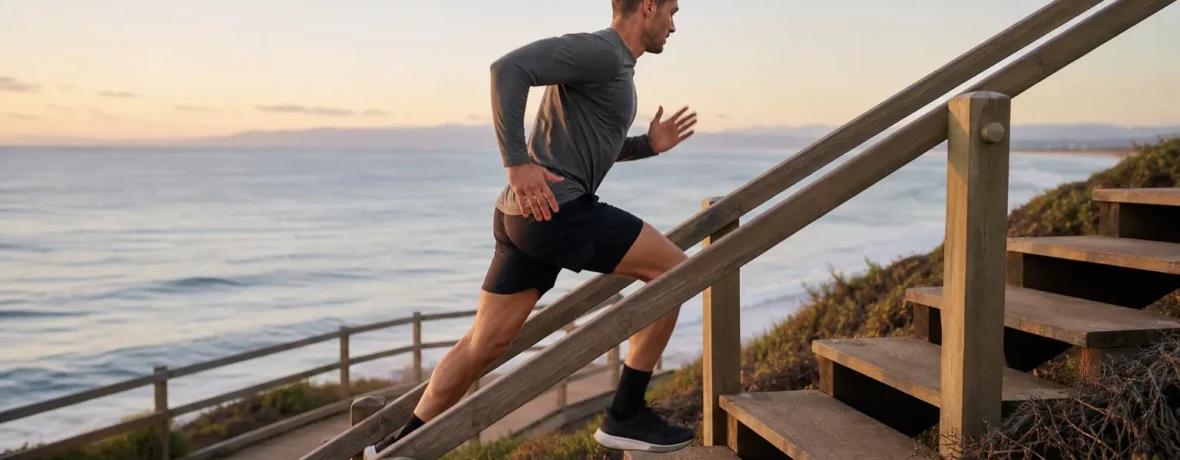
Yes, you can prepare at sea level, but you cannot fully acclimatize there. Train 8–12 weeks with 3–5 cardio sessions, 2 strength sessions, and 1 loaded stair or hill workout weekly, then pair that fitness with a gradual ascent plan.
Can you train for high altitude hiking at sea level?
Yes, you can train the body you bring to altitude, but you cannot fake thin air completely.
Sea-level training gives you a bigger aerobic base, stronger legs, tougher feet, better pack tolerance, and smarter pacing. That matters. A hiker who can walk uphill for hours with a loaded pack at sea level is not magically immune to altitude sickness, but they usually have more room to slow down without falling apart.
Here is the catch: altitude adaptation is specific. Your body needs time at elevation to adjust to lower oxygen pressure. The CDC Yellow Book guidance on high-altitude travel describes high altitude as 8,000–12,000 ft [2,438–3,658 m], very high altitude as 12,000–18,000 ft [3,658–5,486 m], and extreme altitude as higher than 18,000 ft [5,486 m]. Sea-level intervals and treadmill climbs do not give you the same adaptation as sleeping higher.
So the goal is not to “beat” altitude. The goal is to arrive fit enough that the hike itself is not the main stressor. Then you let acclimatization do its job.
| What sea-level training can improve | What it cannot replace | Best workaround |
|---|---|---|
| Aerobic endurance | True acclimatization | Arrive 1–3 days early when your route allows |
| Leg strength and downhill control | Lower oxygen pressure at elevation | Use conservative pacing above 8,000 ft [2,438 m] |
| Pack comfort and foot durability | Individual altitude tolerance | Build flexible summit plans and turnaround rules |
| Confidence on long climbs | Protection from altitude illness | Know symptoms and stop ascending if they appear |
How to prepare for high altitude hiking before you leave home
Prepare by building fitness first, then planning your altitude exposure like part of the route.
Start with the calendar. Count backward from your trip date and give yourself 8–12 weeks if you are already active. If you are coming off the couch, give yourself longer. High-altitude hiking punishes rushed preparation: weak calves, sore knees, hot spots, poor pacing, and a pack that feels friendly for 2 miles [3.2 km] but evil by mile 9 [14.5 km].
Your prep should cover five jobs:
- Aerobic base: easy runs, brisk walks, cycling, rowing, or incline treadmill work.
- Climbing strength: step-ups, lunges, squats, calf raises, and loaded carries.
- Descending durability: controlled lower-body strength so your quads and knees survive the way down.
- Pack tolerance: regular walking with the same pack weight and footwear you plan to use.
- Altitude plan: travel timing, sleep elevation, rest days, and bailout options.
If your trail starts high, sleep lower when possible and move up gradually. The CDC travel page on high altitudes advises that people with altitude illness should not go higher until symptoms are gone. That single rule is more useful than any heroic summit pep talk.
How to train for altitude hiking when you have no mountains nearby
Use stairs, treadmills, bridges, parking garages, and weighted walking to copy the workload, not the elevation.
You do not need alpine terrain to get brutally prepared. You need repeatable vertical effort. A staircase in an office building can train your lungs. A treadmill at 12–15% incline can train your uphill hiking rhythm. A flat neighborhood walk with a 25 lb [11 kg] pack can train your shoulders, hips, and feet.
Use this weekly framework for 8–12 weeks:
- Do 2–3 easy aerobic sessions. Keep them conversational. Start with 30–45 minutes and build toward 60–90 minutes.
- Do 1 harder uphill session. Use stairs, treadmill incline, or hill repeats. Work in controlled intervals: steady, hard, recover, repeat.
- Strength train twice per week. Prioritize legs, hips, calves, core, and single-leg control.
- Take 1 long loaded walk or hike weekly. Build time before weight. Add pack load slowly.
- Practice your trip pace. Walk slower than you want to. At altitude, patience is speed.
- Recover on purpose. Keep at least 1 full rest day each week. Tired training does not equal better training.
Your hardest sea-level workout should feel like a controlled grind, not a collapse. If you finish every stair session wrecked, you are mostly practicing suffering. High-altitude hiking rewards efficiency: short steps, steady breathing, no surges, and no ego racing above treeline.
What is the best 8-week sea-level training plan for a high-altitude hike?
The best plan builds volume first, then pack weight and climbing intensity.
Use this as a template, then adjust for your current fitness and trip difficulty. If you miss a workout, do not cram it into the next day. Just continue. Consistency beats panic.
| Weeks | Focus | Key workouts | Pack work |
|---|---|---|---|
| 1–2 | Base building | 3 easy cardio sessions, 2 strength sessions | 1 walk with a light pack for 45–75 minutes |
| 3–4 | Climbing strength | 1 stair or incline session, 2 easy cardio sessions, 2 strength sessions | 1 loaded hike or walk for 75–120 minutes |
| 5–6 | Specific endurance | 1 longer incline session, 1 tempo effort, 2 easy sessions, 2 strength sessions | 1 long pack day for 2–4 hours |
| 7 | Peak workload | Longest stair or hill session, longest loaded hike, 1–2 easy sessions | Use your planned trip pack weight |
| 8 | Taper | Short easy cardio, light strength, mobility | Short walk in trip shoes; no last-minute heroics |
For strength sessions, keep the moves simple:
- Step-ups on a stable box or bench
- Goblet squats or bodyweight squats
- Reverse lunges
- Romanian deadlifts or hip hinges
- Standing calf raises and bent-knee calf raises
- Side planks, dead bugs, and farmer carries
Train the downhill, too. Slow step-downs, lunges, and controlled eccentric work help prepare your quads for long descents. Many hikers obsess over the climb, then get chewed up on the way back to the trailhead.
How much cardio do you need for high-altitude hiking?
You need enough cardio to move uphill for hours while staying below your redline.
For most hikers, that means 3–5 aerobic sessions per week during the main training block. Two or three should be easy. One can be harder. One can be long. If you are training for a single big day, build toward a long effort that lasts at least half the expected time of your hike. If your target hike is 8 hours, a 4-hour loaded training walk is a useful benchmark.
Do not turn every session into a test. At altitude, the hiker who can keep breathing under control wins. Easy cardio teaches your body to keep moving without burning matches. Hard intervals have a place, but they are spice, not the meal.
Good cardio options at sea level include:
- Incline treadmill hiking at 8–15%
- Stair climbing with and without a pack
- Fast walking on rolling roads
- Trail running if your joints tolerate it
- Cycling for low-impact aerobic volume
- Rowing or elliptical work when weather is ugly
During uphill sessions, practice the “all-day gear.” You should be able to speak in short sentences. If you can only grunt, slow down. If you are gasping at sea level, altitude will not be kinder.
Should you use an altitude mask or altitude tent?
An altitude mask is not a shortcut to acclimatization, and an altitude tent is a serious tool that needs careful planning.
Most training masks restrict airflow. They may make breathing feel harder, but they do not lower oxygen pressure the same way real altitude does. That means they are poor stand-ins for hiking at 10,000–14,000 ft [3,048–4,267 m]. Spend your money first on shoes, pack fit, training consistency, and arriving early.
Altitude tents and hypoxic systems are different. They can simulate lower-oxygen environments, but they also add cost, sleep disruption, and complexity. The Wilderness Medical Society discusses simulated altitude exposure in its clinical practice guidelines for acute altitude illness, but gradual ascent remains the core prevention strategy. If you are considering a tent because your trip is high, remote, or expensive, talk with a clinician familiar with altitude medicine and build a conservative itinerary anyway.
How do you pace yourself at high altitude after training at sea level?
Start slower than feels necessary, then stay there longer than your ego wants.
The first hour sets the tone. Many sea-level hikers blow up early because the trail feels manageable at the start. Then the headache, nausea, heavy legs, and shallow breathing arrive higher up. Do not chase your sea-level pace. Use short steps, keep your breathing calm, and pause before you need to.
Use these field rules:
- Take smaller steps on climbs than you use at sea level.
- Keep snack and water breaks short but regular.
- Avoid sprinting to catch a group.
- Do not ignore a new headache, poor coordination, confusion, unusual breathlessness, or vomiting.
- Turn around early enough that descent still feels safe.
The Mayo Clinic overview of altitude sickness lists symptoms such as headache, nausea, fatigue, dizziness, and shortness of breath. Severe symptoms can become dangerous quickly. Your training plan should include the mental skill of calling it when the mountain says no.
What should you pack for a high-altitude hike?
Pack for colder weather, stronger sun, slower movement, and a possible turnaround.
Altitude changes the margin. Weather can flip fast. UV exposure increases. A mild breeze during a hard climb can feel pleasant, then turn nasty when you stop. Your kit should keep you moving, warm, hydrated, and able to descend safely.
- Broken-in hiking shoes or boots
- Moisture-wicking socks plus a spare pair
- Layering system: base layer, insulating layer, wind or rain shell
- Warm hat and lightweight gloves
- Sun hat, sunglasses, and sunscreen
- Map, offline route, and backup navigation
- Headlamp with fresh batteries or charge
- Enough water capacity for the route and conditions
- Electrolytes and easy-to-eat snacks
- First-aid kit and blister supplies
- Emergency blanket or bivy
- Trekking poles for long climbs and descents
Train with this gear before the trip. A pack that rubs your collarbone on a 40-minute neighborhood walk will not become charming at 12,000 ft [3,658 m].
When to see a doctor
See a doctor before your trip if you have medical conditions, prior altitude illness, or a route that goes high fast.
This is not a place for internet bravado. The CDC recommends that travelers with conditions such as coronary artery disease, chronic pulmonary disease, preexisting low oxygen levels, obstructive sleep apnea, or sickle cell trait consult a physician familiar with high-altitude medical issues before travel. Ask early, not the week you fly.
You should also talk with a clinician if you have had severe altitude sickness before, take medications that affect breathing, have had recent chest pain or fainting, are pregnant, or plan to sleep above 8,000 ft [2,438 m] without time to acclimatize. Some travelers use prescription medication for prevention or emergency treatment, but that decision belongs with a qualified medical professional. Do not self-prescribe.
During the trip, get medical help urgently if symptoms are severe, worsening, or include confusion, trouble walking straight, chest tightness, a persistent cough, blue lips, or breathlessness that does not improve with rest. If altitude illness is suspected and symptoms are not improving, descent is the priority.
What should you do during the final week before your hike?
Taper, sleep, hydrate, and stop trying to gain fitness at the last second.
The final week is for sharpening, not cramming. Cut training volume. Keep a few short walks and light mobility sessions. Do not test new shoes, new insoles, new foods, or a surprise weighted stair marathon. Fresh legs beat sore pride.
Your final-week checklist:
- Confirm the route, turnaround points, and bailout options.
- Check the weather from official local forecasts.
- Pack and repack until you know where everything lives.
- Trim toenails 2–3 days before the hike.
- Sleep as well as your travel schedule allows.
- Avoid hard alcohol the night before going high.
- Eat familiar foods and bring familiar snacks.
If you can arrive early, do it. A rest day near the trailhead can be more valuable than one more sweaty treadmill session at sea level. Fitness opens the door. Acclimatization gets you through it.
Related reading
- How to Train for a Long-Distance Hike
- How to Train for Backpacking With a Loaded Pack
- How to Train for Kilimanjaro
- How to Train for the Everest Base Camp Trek
FAQ
Can you acclimate to high altitude at sea level?
No, not fully. You can build fitness at sea level, but true acclimatization requires exposure to lower oxygen pressure or carefully managed simulated altitude.
How long does it take to train for high-altitude hiking?
Plan on 8–12 weeks if you already walk, hike, run, or cycle regularly. If you are starting from very low fitness, give yourself several months so your joints, feet, and tendons can adapt safely.
What is the fastest way to get ready for altitude?
The fastest useful approach is consistent aerobic training, loaded uphill practice, and early arrival at elevation. Last-minute hard workouts will not create acclimatization and can leave you tired when you need fresh legs.
Does running help with high-altitude hiking?
Yes, running can help your aerobic engine. Still, add hiking-specific work with a pack, stairs, incline walking, and downhill strength because running alone does not train pack comfort or slow uphill grind.
What are the warning signs of altitude sickness?
Common warning signs include headache, nausea, dizziness, fatigue, poor sleep, and unusual shortness of breath. More serious red flags include confusion, trouble walking, worsening breathlessness, persistent cough, chest symptoms, or symptoms that do not improve with rest or descent.
Should you keep hiking if you have a headache at altitude?
Do not keep ascending with a new altitude-related headache, especially if it comes with nausea, dizziness, weakness, or poor coordination. Rest, monitor symptoms, and descend if symptoms worsen or fail to improve.