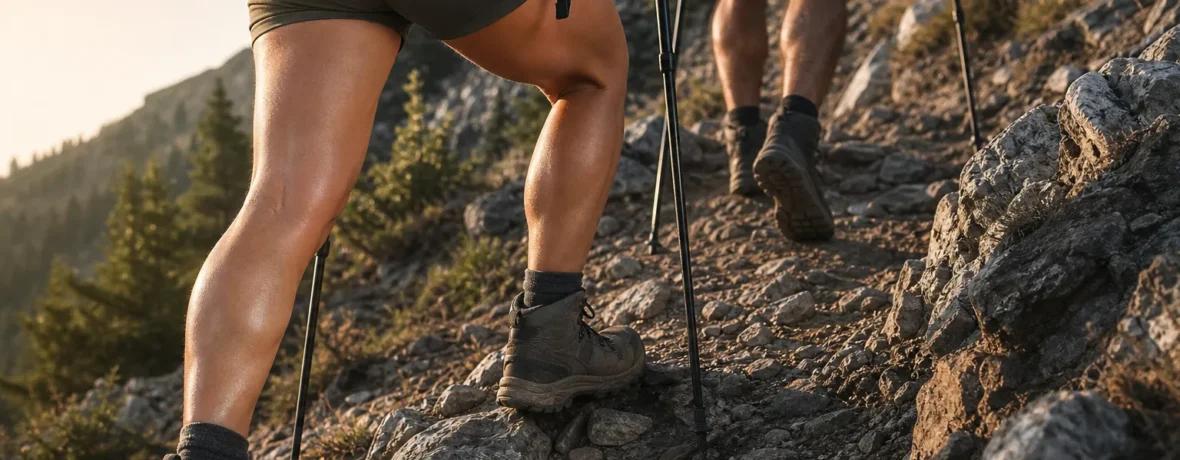
Yes, hiking can build muscle, especially in your calves, quads, hamstrings, glutes, and core, if the trail is steep, your pack has weight, and you increase the challenge over time. Flat 2-mile walks mostly build endurance. Hill repeats, stairs, and loaded hikes can drive real strength gains.
Does hiking build muscle or just burn calories?
Hiking builds some muscle, but it is not the same as lifting weights.
Think of hiking as strength-endurance training. Your muscles work for hundreds or thousands of repeated steps, not 8 heavy reps under a barbell. That repeated work can make your legs firmer, stronger, and more resistant to fatigue, especially if you are new to hiking or coming back after time off.
The main muscle-building trigger is progressive overload: your body has to face a harder job than last time. On trail, that can mean more elevation gain, a heavier pack, rougher terrain, faster climbing, longer uphill stretches, or shorter rest breaks. If every hike is the same easy loop, your body adapts and muscle growth slows.
The CDC adult physical activity guidelines separate aerobic activity from muscle-strengthening work and recommend 2 days each week of strengthening activities for all major muscle groups. Hiking can help, but most hikers still benefit from simple resistance training off trail.
Does hiking build leg muscle?
Yes, hiking builds leg muscle best when you climb, descend, and carry weight.
Your legs do different jobs on different parts of the trail. Uphill hiking asks your quads, glutes, calves, and hamstrings to push your body upward. Downhill hiking makes your quads brake your body with every step. That braking work can leave you sore after a steep descent because the muscle is lengthening under load.
Flat hiking mostly trains your calves and lower-leg stabilizers while building stamina. It can help beginners gain leg strength, but it will not challenge trained legs for long. Add incline and the story changes fast.
Here is the trail-to-muscle breakdown:
| Trail feature | Main muscles worked | Best use |
|---|---|---|
| Long uphill grade | Glutes, quads, calves | Building climbing strength |
| Steep downhill | Quads, hips, calves | Training control and knee-friendly braking |
| Rocky or rooty trail | Feet, ankles, hips, core | Improving balance and stabilizer strength |
| Loaded pack | Legs, glutes, back, core | Building full-body trail strength |
Does hiking build glutes?
Yes, steep hiking can build your glutes.
Your glutes work hardest when your hip extends behind you. That happens every time you step up onto a rock, climb stairs, or drive uphill with a strong push through the heel and midfoot. A mellow sidewalk-grade trail will not light them up the same way.
To make hiking more glute-focused, choose routes with sustained climbs, use trekking poles lightly instead of pulling yourself uphill, and take deliberate steps instead of shuffling. Big step-ups work, but do not force huge strides all day. Your knees and hip flexors may complain before your glutes get stronger.
If your glutes never feel engaged on climbs, shorten your stride, lean slightly from the ankles, and push the ground behind you. Keep your chest tall. If you bend at the waist and stare at your boots, your lower back may take work your hips should handle.
Does hiking build core strength?
Yes, hiking trains your core as a stabilizer, not as a six-pack machine.
Your core keeps your torso steady while your legs move under you. It works harder when the trail is uneven, when you step over logs, when you cross loose gravel, or when your pack shifts on your back. Add trekking poles and your shoulders, lats, and obliques join the party.
That said, hiking alone will not replace planks, carries, dead bugs, side planks, or loaded strength work. Trail core strength is practical. It helps you stay upright, resist twisting, and keep your stride together late in the day.
The National Institute on Aging describes strength exercises as movements that make muscles contract against resistance. A backpack, gravity, and rough ground all add resistance, but they are harder to control than dumbbells or machines.
How do you hike for muscle growth?
Use hills, load, and progression.
Random hard hikes will make you tired. Planned hikes make you stronger. Start with a workload your joints can handle, then increase one variable at a time. Not two. Not five. One.
- Pick a climbing route. Choose a trail with steady elevation gain instead of only flat miles.
- Add pack weight slowly. Start with water, layers, food, and safety gear before adding training weight.
- Use hill repeats. Climb hard for 2 to 5 minutes, walk down under control, and repeat 3 to 6 times.
- Train descents. Step quietly, keep knees soft, and control speed instead of pounding downhill.
- Recover between hard hikes. Give sore legs 24 to 48 hours before another steep or loaded session.
- Strength train twice weekly. Squats, step-ups, lunges, calf raises, hip hinges, and carries pair well with hiking.
The Mayo Clinic strength training guide explains that resistance work helps build stronger muscles and bones. For hikers, that matters on climbs, descents, scrambles, and long backpacking days.
What muscles does hiking work most?
Hiking works the lower body first, then the core and upper back.
Your quads handle step-ups and downhill braking. Your glutes power climbs. Your calves push off and stabilize your ankles. Your hamstrings help extend the hip and support the knee. Your hip abductors keep your knees from caving inward on uneven ground.
Your core, spinal erectors, traps, and shoulders work harder with a pack. Trekking poles add more upper-body rhythm, but they will not build big arms. For that, you still need pushing and pulling strength work.
- Quads: climbing, stepping up, descending
- Glutes: steep grades, stairs, high steps
- Hamstrings: hip extension and knee support
- Calves: push-off, balance, long climbs
- Core: posture, pack control, rotation control
- Upper back: pack support and pole use
Can hiking replace leg day?
No, not if your goal is maximum muscle growth.
Hiking can be your outdoor leg-conditioning day. It can build durable trail legs. It can make stairs feel easier and long climbs less ugly. But gym-based leg training gives you cleaner progressive overload, heavier resistance, and better control through full ranges of motion.
If you want bigger legs and stronger hiking performance, combine both. Use hiking for endurance, climbing skill, and real-world toughness. Use strength training for the heavy work: squats, deadlifts, step-ups, split squats, calf raises, and loaded carries.
A strong weekly setup could look like this:
- 1 steep hike or hill-repeat session
- 1 longer easy hike or brisk walk
- 2 strength sessions for legs, hips, core, and upper body
- 1 to 2 rest or mobility days
When to see a doctor
See a doctor if pain is sharp, persistent, worsening, or linked with swelling, numbness, chest pain, fainting, or shortness of breath that feels unusual for you.
Do not try to “train through” symptoms that change your gait or make you limp. A sore quad after downhill hiking is common; joint pain that gets worse every mile is a stop sign.
If you have heart disease, diabetes, a recent injury, dizziness, pregnancy concerns, or a long break from exercise, get medical guidance before hard climbs or loaded pack training. The NIH MedlinePlus exercise and physical fitness resources are a solid starting point for general exercise safety, but they are not a substitute for personal care.
Related reading
- Does Walking Build Muscle?
- Does Rucking Build Muscle?
- Does the StairMaster Build Glutes?
- Does Incline Walking Build Glutes?
FAQ
How long does it take to build muscle from hiking?
Beginners may feel stronger within 2 to 4 weeks, but visible muscle changes usually take longer. You need consistent hiking, enough recovery, and harder routes over time.
Is uphill hiking better than flat hiking for muscle?
Yes, uphill hiking is better for muscle because it adds resistance through gravity. Your glutes, quads, and calves work harder with every step.
Will hiking make my legs bigger?
Hiking can make your legs more muscular, but large size gains are more likely with strength training. Steep hikes and a loaded pack help, while flat walking mainly builds endurance.
Is hiking good for glutes or just calves?
Hiking is good for glutes when the trail climbs. On flat ground, your calves tend to do more of the steady work.
Should I lift weights if I hike every week?
Yes, lifting weights helps fill the gaps hiking leaves behind. Two weekly strength sessions can improve power, joint support, and pack-carrying ability.
Can hiking build muscle after 50?
Yes, hiking can help maintain and build functional strength after 50, especially with hills and consistency. Pair it with resistance training for better results across all major muscle groups.