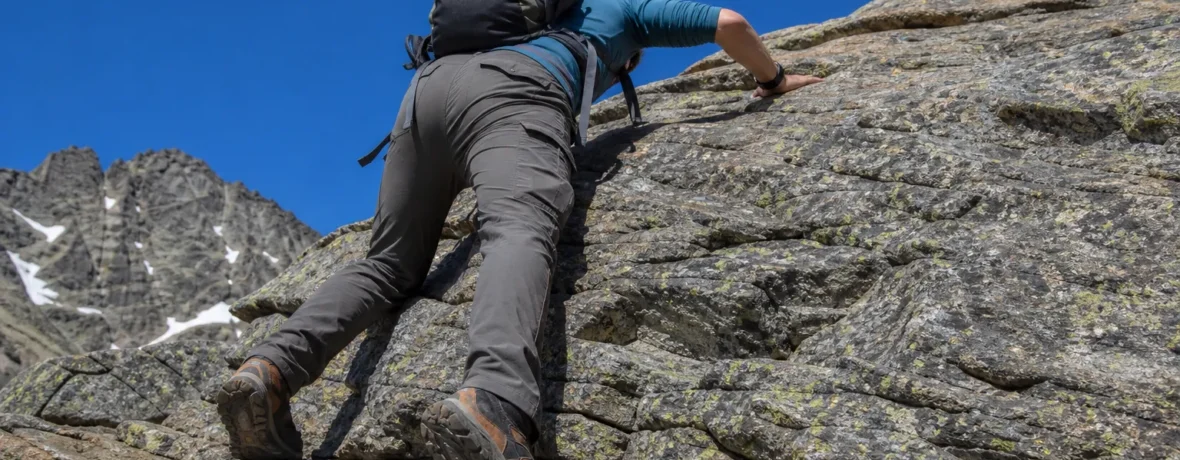
What is scrambling in hiking? Scrambling is the middle ground between hiking and rock climbing, where you use your hands for balance or upward movement on steep, rocky terrain. In the U.S., it usually means Class 2, Class 3, or Class 4 terrain; Class 5 is technical climbing and needs climbing skills.
What is scrambling in hiking?
Scrambling is hiking that gets handsy.
You are still moving through mountain terrain under your own power, often without a rope, but the trail has stopped behaving like a trail. You might be climbing over boulders, edging along a rocky ridge, using your palms on slabs, or pulling yourself up short rock steps.
The National Park Service describes scrambling as movement over 2nd-, 3rd-, and 4th-class rocky terrain. That’s a useful U.S. definition because it ties scrambling to the Yosemite Decimal System, the rating scale many American hikers see in route descriptions.
Think of it this way: hiking is mostly feet. Scrambling is feet plus hands. Climbing is hands, feet, rope systems, and a much higher penalty for mistakes.
Is scrambling the same as rock climbing?
No, scrambling is not the same as rock climbing.
Scrambling sits between hiking and technical climbing. The rock may be steep, exposed, and awkward, but the movement is usually less vertical than roped climbing. You may use your hands for balance, stability, and short upward moves, yet you are not usually placing protection or belaying every pitch.
The line can blur fast. A Class 3 route can turn into Class 4 if you wander off route. A wet Class 4 slab can feel like easy Class 5 climbing. That’s why good scramblers pay close attention to routefinding, weather, and the downclimb. Getting up is only half the job.
The British Mountaineering Council calls scrambling the space between walking and climbing, with harder scrambles sometimes needing ropes and mountaineering skills. That same idea applies in the U.S., even though the grading language is different.
What are scrambling grades?
Scrambling grades tell you how technical and exposed the terrain gets.
In the U.S., you’ll usually see the Yosemite Decimal System. In the U.K., guidebooks often use Grade 1, Grade 2, and Grade 3 for scrambles. Don’t treat grades like guarantees. Rock quality, snow, routefinding, fatigue, and weather can make a “moderate” scramble feel nasty.
| Grade | What it feels like | Typical gear mindset | Best for |
|---|---|---|---|
| Class 1 | Normal trail hiking with little or no hand use | Standard hiking kit | Hikers building fitness |
| Class 2 | Rough off-trail terrain, talus, boulders, occasional hands for balance | Hiking poles may help; helmet in loose terrain | First step into scrambling |
| Class 3 | Frequent hand use, steeper rock, real route choices | Helmet strongly recommended; rope may be carried by some parties | Confident hikers with good movement skills |
| Class 4 | Exposed scrambling or easy climbing where a fall may be severe | Helmet, climbing judgment, and sometimes a rope | Experienced scramblers and climbers |
Class 5 is technical rock climbing. If a route description says Class 5, don’t assume you can “just scramble it.” That means climbing territory, even if the number after the decimal looks low.
How do you scramble safely?
Move slowly, keep three points of contact, and don’t climb anything you can’t downclimb.
Good scrambling technique is calm and deliberate. Speed comes later. Rushing over loose rock is how people kick stones onto partners, miss route markers, and climb themselves into a corner.
- Look before you move. Scan 10 to 30 ft [3 to 9 m] ahead. Pick the easiest line, not the most heroic one.
- Use three points of contact. Keep two feet and one hand, or two hands and one foot, connected to the rock when the terrain steepens.
- Test holds before trusting them. Pull down, not out. Loose blocks can shift when you yank sideways.
- Keep your weight over your feet. Your legs are stronger than your arms. Stand up on footholds instead of dragging yourself upward.
- Face into the rock when needed. On steeper downclimbs, turn around and climb down like a ladder.
- Give each other space. On loose gullies, don’t stack directly below another hiker.
- Call “rock” immediately. If you dislodge a stone, shout once, loud and sharp.
Use small steps. Keep your hips close to the rock. If you feel your elbows flaring and your grip tightening, pause. Fear burns energy fast.
What gear do you need for scrambling?
You need hiking gear plus protection for your head, hands, feet, and routefinding.
Start with the Mountaineers Ten Essentials: navigation, light, sun protection, first aid, knife or repair kit, fire starter, shelter, extra food, extra water, and extra clothes. For scrambling, add gear that matches rock, exposure, weather, and remoteness.
- Helmet: Smart on Class 3 terrain and above, and on any loose gully or crowded route.
- Footwear with grip: Approach shoes, sticky-soled hiking shoes, or firm boots depending on terrain.
- Gloves: Useful on rough granite, sharp limestone, cold rock, and abrasive boulder fields.
- Navigation: Map, compass, GPS app, and downloaded route notes. Batteries die. Screens crack.
- Emergency layers: Wind shell, insulation, hat, and rain gear. A ridge can turn cold in minutes.
- Small first-aid kit: Include blister care, bandages, and supplies for cuts and scrapes.
- Headlamp: Scrambling in the dark is slow, stressful, and much riskier.
Trekking poles help on approaches and scree descents, but stow them when you need both hands. Dangling poles can snag at the worst possible time.
How hard is scrambling for beginners?
Beginner scrambling can be manageable, but exposure changes everything.
A short Class 2 boulder field may feel playful. A narrow Class 3 ridge with a 500 ft [152 m] drop beside it may freeze strong hikers in place. Fitness helps, but scrambling is more about movement, judgment, and comfort with heights.
Good first scrambles have solid rock, simple routefinding, low exposure, dry conditions, and an easy way to retreat. Go with someone who already knows the route. Choose a day with stable weather. Start early so you are not making downclimb decisions at dusk.
Avoid learning on wet slabs, loose gullies, snow-covered rock, or routes described as “serious,” “exposed,” “no-fall,” or “routefinding-intensive.” Those are not beginner words.
When should you turn around on a scramble?
Turn around before the terrain becomes harder than your skills.
The best scramblers are not fearless. They are picky. They know when the route, weather, group, or gut feeling says no.
- You cannot clearly see the next safe move.
- You are unsure you can downclimb what you just climbed.
- Rock is wet, icy, loose, or covered in fresh snow.
- Someone in the group is shaking, silent, or making sloppy moves.
- Thunderheads are building or wind is increasing on a ridge.
- You are behind schedule and still have the hardest section ahead.
- The route has drifted into Class 4 or Class 5 terrain unexpectedly.
Turning around is not failure. It is route management. Mountains do not hand out prizes for stubbornness.
How do you reduce impact while scrambling?
Stay on durable surfaces and avoid creating new scars.
Scrambling often leaves established trails, which makes your choices matter. Rock, gravel, sand, and snow are generally more durable than fragile plants or cryptobiotic soil. The Leave No Trace guidance on durable surfaces is especially useful for off-trail travel.
Spread out only when the surface can handle it. In fragile alpine or desert terrain, stick to existing routes where possible. Don’t trundle rocks for fun. Don’t build cairns unless they are needed for safety and allowed by the land manager. Pack out tape, snack wrappers, and broken gear.
Related reading
- How Long Is the Appalachian Trail? Miles, States and Time
- How to Plan a Camping Trip
- Where Does the Appalachian Trail Start and End?
- How to Start Camping: A Beginner's Guide
FAQ
Is scrambling dangerous?
Yes, scrambling can be dangerous if the terrain is exposed, loose, wet, or beyond your skill level. The risk comes from falls, rockfall, routefinding errors, weather changes, and difficult downclimbing.
Do you need a rope for scrambling?
Not always. Many Class 2 and Class 3 scrambles are done without a rope, but some Class 4 terrain and harder Grade 2 or Grade 3 scrambles may require rope skills depending on the party and conditions.
What is the difference between Class 2 and Class 3 scrambling?
Class 2 usually means rough terrain where your hands may help with balance. Class 3 means you use your hands more often for upward movement, and the consequences of a fall are usually higher.
Can beginners try scrambling?
Yes, beginners can try easy scrambling if they choose low-exposure terrain in dry weather and go with an experienced partner. Start with Class 2 routes before moving into Class 3.
Are hiking boots or approach shoes better for scrambling?
Approach shoes usually grip rock better, while hiking boots offer more support on long approaches, scree, mud, and snow patches. Pick the shoe for the whole route, not just the fun rocky section.
What should you practice before a harder scramble?
Practice foot placement, downclimbing, routefinding, and moving with three points of contact. Also practice turning around early, because that skill matters more than pride when the terrain gets serious.