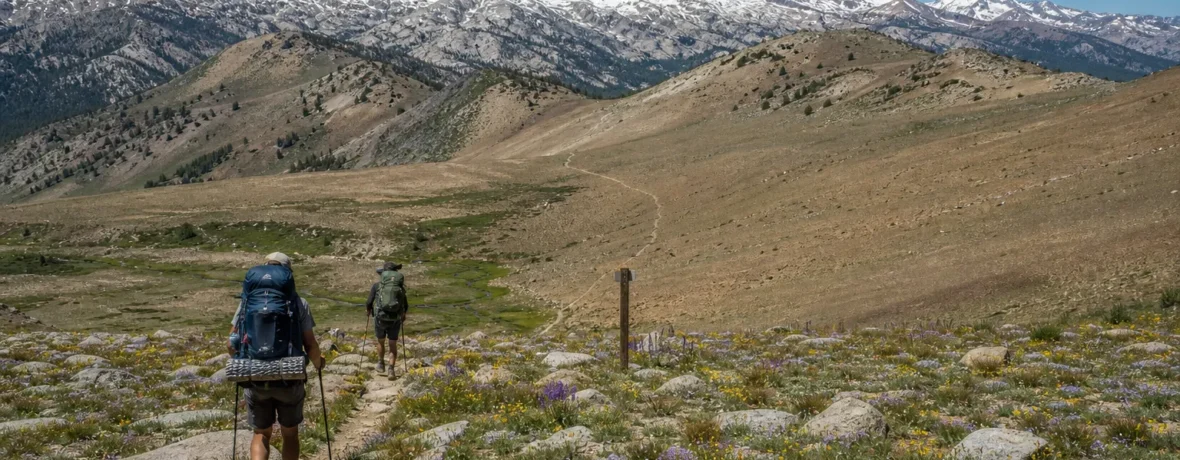
How long is the Pacific Crest Trail? The PCT is commonly listed as 2,650 miles [4,265 km] from Mexico to Canada, while the Pacific Crest Trail Association’s current trail data gives 2,655.84 miles [4,274 km]. Most thru-hikers need 4.5 to 6 months, depending on pace, snow, heat, fires, permits, and rest days.
How long is the Pacific Crest Trail?
The short answer: 2,650 miles [4,265 km] is the standard public number, and 2,655.84 miles [4,274 km] is the current best trail-data estimate.
That split answer is normal. The PCT is not a paved line painted on a warehouse floor. It moves. Trail crews rebuild damaged tread. Land managers route hikers around hazards. Fires, washouts, bridges, erosion, and restoration work can all nudge the mileage up or down.
As of November 2026, the Pacific Crest Trail Association’s PCT data page lists 2,655.84 miles as the latest best estimate. The older rounded number, 2,650 miles, still appears on many official pages because it is simple, familiar, and close enough for big-picture planning.
The trail runs through three states:
| State | PCT miles | What that means for you |
|---|---|---|
| California | 1,691.7 miles [2,722.5 km] | The longest state, with desert, Sierra, and Northern California terrain. |
| Oregon | 455.2 miles [732.6 km] | The shortest state and often the fastest for thru-hikers. |
| Washington | 505.7 miles [813.8 km] | Steep, wet, rugged, and packed with big mountain views. |
Those state figures come from PCTA’s regional mileage page, which still uses the familiar 2,650-mile framework. Your app, paper map, GPS track, and guidebook may disagree by several miles. Do not let that mess with your head. On a trail this long, the difference between 2,650 and 2,655.84 miles is less than one average thru-hiker day.
How long does it take to hike the PCT?
Most thru-hikers take 4.5 to 6 months to hike the PCT.
The question “how long does it take to hike the pct” has a pace answer and a real-life answer. The pace answer is simple math. Divide 2,655.84 miles by your average hiking miles per day. The real-life answer adds zero days, town chores, injury niggles, smoke, snow, heat, full resupplies, permit dates, family calls, and the occasional day when your body says, “Nope.”
| Average hiking pace | Trail days for 2,655.84 miles | Likely calendar time with rest days |
|---|---|---|
| 15 miles/day [24 km/day] | 178 hiking days | 6 to 6.5 months |
| 20 miles/day [32 km/day] | 133 hiking days | 5 to 5.5 months |
| 25 miles/day [40 km/day] | 107 hiking days | 4 to 4.5 months |
New thru-hikers often start at 10 to 15 miles [16 to 24 km] per day in Southern California, then build. By Northern California and Oregon, strong hikers may string together 20- to 30-mile [32- to 48-km] days when trail grade, weather, and food carries cooperate.
But big miles are not free. Push too hard early and you can torch your feet, knees, sleep, and appetite before the Sierra. A smart PCT pace usually ramps up instead of exploding out of Campo.
How many miles per day do you need to hike the PCT?
You need to average 15 to 22 miles [24 to 35 km] per hiking day for a normal thru-hike window.
If you want to finish in six months, 15 miles [24 km] per hiking day can work, especially if you limit town time. If you want to finish in five months, plan around 18 to 20 miles [29 to 32 km] per hiking day once your legs settle in. If you want to finish in four months, you are looking at a serious endurance push with many 25-mile [40-km] days.
Use this simple planning sequence:
- Pick your time window. Count the days between your start date and the date you need to be done.
- Subtract non-hiking days. Include town zeros, storm days, travel days, gear repairs, and at least a few unplanned stops.
- Divide 2,655.84 miles by your hiking days. That gives your required trail pace.
- Check the result against reality. If the number scares you on paper, it will hurt more with a pack on.
- Build a flexible plan. Your first 700 miles [1,127 km] should not require heroic daily mileage.
Example: if you have 160 calendar days and expect 18 non-hiking days, you have 142 hiking days. Divide 2,655.84 by 142 and you get 18.7 miles [30.1 km] per hiking day. That is a solid, realistic thru-hiker pace for a prepared backpacker.
Where does the Pacific Crest Trail start and end?
The PCT runs between the U.S.-Mexico border near Campo, California, and the U.S.-Canada border in northern Washington.
Northbound hikers, called NOBOs, usually start at the Southern Terminus near Campo and walk north through California, Oregon, and Washington. Southbound hikers, called SOBOs, start near the Northern Terminus and walk south. Flip-floppers hike the trail in pieces during one season, often to work around snow, fire, permit dates, or personal schedules.
On paper, the line is clean. In the field, you still need to get to and from remote border country. The northern end is not a drive-up trailhead. Many hikers access it from Hart’s Pass on the U.S. side, then hike to the monument and back out, depending on current border and access rules.
How hard is the PCT compared with its mileage?
The PCT is hard because it stacks distance, elevation, weather, logistics, and repetition for months.
The number looks huge, and it is. But the real grind is the daily reset: wake up, pack up, climb, filter, eat, descend, repeat. Then do it again tomorrow. And next week. And next month.
You cross desert heat, long dry stretches, high Sierra passes, volcanic Oregon, and the steep North Cascades. A single section can feel easy for half a day, then punish you with snow, mosquitoes, blown-down trees, or a 20-mile [32-km] food-and-water carry.
Expect these pressure points:
- Southern California: heat, sun exposure, water planning, early-season storms, and big elevation swings.
- Sierra Nevada: snow travel, creek crossings, high passes, bear-canister logistics, and cold nights.
- Northern California: heat, smoke risk, long forest miles, and mental fatigue.
- Oregon: faster tread, mosquitoes, lava rock, wildfire detours, and tempting town food.
- Washington: steep climbs, rain, colder nights, shorter fall days, and a real deadline before winter weather.
When should you start the Pacific Crest Trail?
Northbound hikers usually start in spring, while southbound hikers usually start after early-summer snow conditions improve in Washington.
For a northbound thru-hike, the classic window is March through May. Start too early and you may reach the Sierra before snow conditions are manageable. Start too late and Southern California heat can be brutal, with less time to reach Canada before autumn storms.
For a southbound thru-hike, hikers often wait until the North Cascades become more passable. That can mean late June or July, but snowpack changes every year. A heavy snow year can slow everything down. A low snow year can open options sooner. Fire season can also rearrange the plan fast.
Check official sources before you lock travel. The PCTA maintains a PCT closures page for current trail closures and alerts, and land-management agencies may post additional local orders.
Do you need a permit to hike the PCT?
Yes, you need permits for many overnight PCT trips, and long continuous trips have a streamlined PCT Long-distance Permit option.
As of November 2026, the PCT Long-distance Permit is for hikers and riders traveling 500 or more continuous miles [805 km] along the PCT in a single trip. It is issued by the Pacific Crest Trail Association under U.S. Forest Service authorization on behalf of multiple agencies.
As of November 2026, PCTA’s long-distance permit system lists a limit of 50 permits per day for northbound trips starting south of Sonora Pass, with no permits for northbound trips starting south of Sonora Pass in June. If your trip is shorter than 500 continuous miles [805 km], you plan with local permits instead.
Do not treat permits as an afterthought. Your start date shapes your weather, resupply plan, Sierra timing, and finish window. Get the permit piece right before you buy a flight, ship boxes, or promise anyone you will be home by a specific weekend.
Can you hike the PCT in sections instead of one thru-hike?
Yes, section hiking the PCT is a practical way to complete the trail over multiple trips or years.
Section hiking can be smarter than forcing a thru-hike into a life that does not have five open months. You can hike Oregon in one push, tackle Washington over several summers, or chip away at California one resupply stretch at a time.
The trade-off is logistics. A thru-hiker mostly keeps moving in one direction. A section hiker has to solve trailhead transportation again and again. You may also hit prime sections at crowded times, or land in permit systems designed around local trailheads instead of one continuous journey.
Still, section hiking gives you control. You can choose better weather windows, skip unhealthy pressure, and spend more time in the places that grab you.
What should you plan before hiking the PCT?
Plan your pace, permits, resupply, gear, health, and exit options before you start.
You do not need a spreadsheet for every granola bar from Mexico to Canada. You do need a plan that can survive contact with the trail. Aim for flexible, not fragile.
- Mileage plan: Know your required average and where you can slow down.
- Permit plan: Match your permit to your real start date and direction.
- Resupply plan: Identify long carries, tricky towns, and places where mailing a box makes sense.
- Water plan: Treat desert water reports as planning tools, not guarantees.
- Snow plan: Learn basic snow travel before the Sierra or North Cascades.
- Fire plan: Check closures, smoke, and evacuation routes often.
- Health plan: Know when to rest, bail, or get medical help.
- Money plan: Budget for gear replacements, town food, lodging, laundry, transport, and surprise expenses.
When to see a doctor
Get medical help right away for confusion, fainting, severe breathing trouble, chest pain, signs of heat stroke, signs of hypothermia, or symptoms that worsen instead of improving with rest.
The PCT puts you in heat, cold, altitude, smoke, and remote terrain. You cannot diagnose yourself by vibes. The CDC lists confusion, dizziness, nausea, weakness, heavy sweating, and high body temperature among heat-illness warning signs, with urgent care needed for severe symptoms; review the CDC’s heat-related illness guidance before hiking hot sections.
Cold can be just as serious. Shivering, exhaustion, fumbling hands, slurred speech, drowsiness, and confusion can signal hypothermia, and the CDC says to seek immediate medical attention for signs of hypothermia in its hypothermia guidance.
For high-altitude travel, the CDC Yellow Book summarizes Wilderness Medical Society guidance on gradual ascent and says travelers with heart, lung, sleep-breathing, or sickle-cell-related conditions should talk with a clinician familiar with altitude before high-altitude trips; see the CDC’s high-altitude travel guidance. If symptoms at altitude are severe, getting lower and getting help beats trying to tough it out.
Related reading
- How Long Is the Appalachian Trail? Miles, States and Time
- Where Does the Appalachian Trail Start and End?
- How Long Does It Take to Hike the Appalachian Trail?
- How Long Is the Colorado Trail and How Long Does It Take?
FAQ
How many miles is the Pacific Crest Trail exactly?
The current best estimate is 2,655.84 miles [4,274 km]. The commonly published length is 2,650 miles [4,265 km], because the route changes as trail work, reroutes, and data updates happen.
Can a beginner hike the whole PCT?
Yes, a beginner can hike the whole PCT if they prepare seriously and learn fast. Start with shakedown trips, dial in your gear, build walking durability, and treat the first month as a controlled ramp-up instead of a race.
How many people finish the PCT each year?
Completion numbers are not a perfect count because finishers self-report and not every hiker reports. Use PCTA finisher lists and visitor-use information as a rough indicator, not a scoreboard.
Is the PCT longer than the Appalachian Trail?
Yes, the PCT is longer than the Appalachian Trail by several hundred miles. The PCT is commonly listed at 2,650 miles [4,265 km], while the Appalachian Trail’s official mileage changes year to year and is shorter.
What is the fastest realistic PCT thru-hike for a normal strong hiker?
Four months is fast for a strong, prepared hiker with few long town stops. That pace usually requires repeated 25-mile [40-km] days, efficient resupply, good health, cooperative weather, and minimal delays.
Do PCT miles in apps match official mileage?
Not always. Apps, maps, GPS tracks, and guidebooks can use different trail data or update schedules, so small mileage differences are normal. Pick one primary system for planning, then stay flexible when signs, closures, or reroutes disagree.