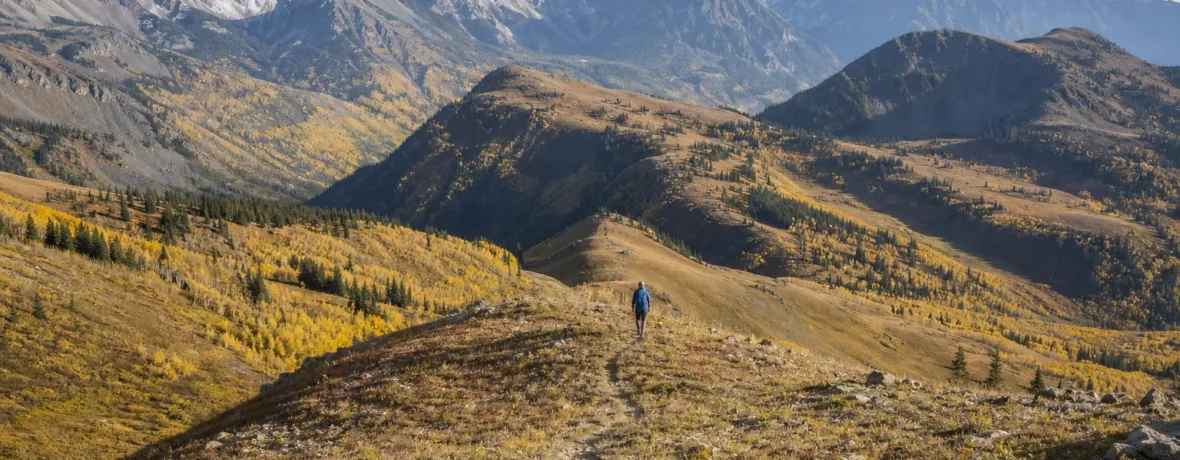
The answer depends on your route: 486 miles [782 km] via Collegiate East or 491 miles [790 km] via Collegiate West. The full Colorado Trail system totals 567 miles [912 km] when both Collegiate routes are counted. Most thru-hikers take 4 to 6 weeks.
How long is the Colorado Trail?
The Colorado Trail is 486 or 491 end-to-end miles [782 or 790 km], depending on which Collegiate route you choose.
That’s the number you should use for a Denver-to-Durango thru-hike. The route starts at Waterton Canyon southwest of Denver and finishes at Junction Creek near Durango, or the reverse if you hike northbound. The Colorado Trail Foundation also lists 567 total trail miles [912 km] because the trail system includes both the Collegiate East and Collegiate West options in the middle of the state, not because a standard end-to-end hike requires all 567 miles. See the Colorado Trail Foundation’s trail overview for the official system mileage.
Think of it this way: the CT is one long line with a big loop-like choice through the Collegiate Peaks. You pick the east side or the west side. If you hike both, you are no longer doing the standard thru-hike; you are adding the full Collegiate Loop.
How long does it take to hike the Colorado Trail?
Most hikers take 4 to 6 weeks to hike the Colorado Trail.
That range is the sweet spot for a normal backpacking pace with resupply stops, town chores, weather delays, sore feet, and at least a few meals that did not come from a zip-top bag. The Colorado Trail Foundation FAQ gives the same 4-to-6-week estimate for the average thru-hike.
A fast hiker with a dialed-in kit might finish in 25 to 30 days. A steadier first-time thru-hiker may need 35 to 42 days. If you like long town stops, side trips, hot springs, fourteeners, or sleeping past sunrise, plan closer to 6 weeks.
Your finish date is shaped by three things more than anything else:
- Daily mileage: A 12-mile [19 km] average feels very different from an 18-mile [29 km] average at 10,000 feet [3,048 m].
- Zero days: Full rest days in trail towns can save a hike, but they add up fast.
- Weather: Lightning, hail, snowfields, heat, smoke, and mud can slow your day to a crawl.
How many miles a day do you need to hike?
You need to average 12 to 18 miles [19 to 29 km] per hiking day for a typical CT thru-hike.
That does not mean every day looks the same. Your first week may be shorter while your legs, feet, lungs, and shoulders adjust. Later, when the pack feels normal and town food is calling, 20-mile [32 km] days may happen without drama. Then the San Juans remind you who is in charge.
| Average pace | Time on trail | Best fit |
|---|---|---|
| 10 miles/day [16 km/day] | 49 days for Collegiate West | Section-style pace, newer backpackers, longer breaks |
| 14 miles/day [23 km/day] | 35 days for Collegiate West | Classic thru-hike rhythm with town stops |
| 18 miles/day [29 km/day] | 28 days for Collegiate West | Fit hikers with lighter packs and shorter stops |
Do the math with your real hiking style, not your best day ever. A 20-mile [32 km] day near home on low trails does not equal a 20-mile day above treeline with thunderheads building by lunch. Build a schedule with room to breathe.
Which route is longer: Collegiate East or Collegiate West?
Collegiate West is longer than Collegiate East by 5 miles [8 km] end to end.
The choice comes between Twin Lakes and the South Junction near Fooses Creek. Collegiate East is the older route and keeps you closer to Buena Vista, Mount Princeton Hot Springs, and lower terrain. Collegiate West is higher, more exposed, and more dramatic, with long stretches shared with the Continental Divide Trail. The Colorado Trail Foundation Collegiate East/West page lists Collegiate East at 78.3 miles [126 km] and Collegiate West at 84.8 miles [136 km].
| Route choice | End-to-end CT mileage | What it feels like |
|---|---|---|
| Collegiate East | 486 miles [782 km] | Shorter, lower, more town access |
| Collegiate West | 491 miles [790 km] | Higher, wilder, more exposed |
| Both routes / Collegiate Loop add-on | 567 trail-system miles [912 km] | For hikers adding the full loop, not a standard thru-hike |
Should you hike southbound or northbound?
Most hikers should go southbound from Denver to Durango.
Southbound gives you a gentler ramp into the big elevations. You start lower, gain fitness as you go, and hit the biggest San Juan scenery near the end when your trail legs are stronger. It also lines up well with the usual summer snowmelt pattern if you start in July.
Northbound is not wrong. It can be quieter, and finishing near Denver is logistically handy for some hikers. But northbound throws you into serious elevation fast out of Durango, including terrain above 12,000 feet [3,658 m] early in the hike. If you live at sea level, that can feel brutal.
When is the best time to hike the Colorado Trail?
The main Colorado Trail thru-hiking season is July, August, and September.
The Colorado Trail Foundation’s season guidance, as of November 2026, recommends starting no earlier than July 1 for most long-distance travelers and finishing no later than September 30. Snowpack drives that advice. High passes can hold snow into early summer, and early winter storms can hit before October settles in.
Here’s the practical version:
- June: Possible for lower segments, risky for a full thru-hike unless you are ready for snow travel and flexible dates.
- July: Big wildflowers, more water, more thunderstorms, more hikers.
- August: Strong thru-hike month with warm days, active monsoon patterns, and busy trail towns.
- September: Cooler, quieter, shorter days, colder nights, and a sharper weather edge.
- October through May: Not a normal thru-hiking window. Snow travel, avalanche terrain, and route-finding become the trip.
Do you need permits to hike the Colorado Trail?
You do not need one trail-wide permit for the Colorado Trail.
As of November 2026, the Colorado Trail Foundation says hikers do not need a permit for the trail as a whole, but wilderness areas use free self-issue permits at Forest Service stations. Fill one out when you reach the station, leave the required copy, and carry your copy through that wilderness area.
Segment 12 on Collegiate East also crosses Clear Creek Reservoir State Wildlife Area for a short stretch. As of November 2026, Colorado Parks and Wildlife says people 16 or older need a valid hunting or fishing license or State Wildlife Area pass to access that SWA, and camping is limited to designated areas. If you are simply walking through, check current CPW and Colorado Trail Foundation guidance before you go, because access details have changed in recent years.
How hard is the Colorado Trail?
The Colorado Trail is hard because it is long, high, and rarely flat.
The trail climbs nearly 90,000 vertical feet [27,432 m] over the full route, crosses six wilderness areas, and spends long stretches near or above 10,000 feet [3,048 m]. The average elevation is 10,300 feet [3,139 m], and the high point is 13,271 feet [4,045 m] near Coney Summit.
Distance is only half the story. The CT also asks you to manage:
- Long climbs with a full food carry
- Afternoon lightning above treeline
- Cold rain and hail in summer
- Dry stretches where water planning matters
- Remote sections with limited cell service
- Big temperature swings from hot sun to freezing nights
None of that means you need to be a superhero. It means you need to train, start conservatively, carry the right layers, and make decisions before the sky turns black.
Can beginners hike the Colorado Trail?
Yes, beginners can hike the Colorado Trail if they prepare like backpackers, not day hikers.
A first thru-hike on the CT is possible, but it is not a casual walk with a big backpack. You should be comfortable pitching your shelter in bad weather, treating water, reading maps, managing food carries, and calling an audible when storms or your body say “not today.”
Before you commit to the full trail, do this:
- Take two overnight trips with your full kit. One easy, one with real climbing.
- Hike back-to-back days. Single-day fitness is not the same as trail durability.
- Test your shoes and socks. Blisters can end a big dream in three days.
- Practice water treatment. Do it when you are tired, cold, and hungry.
- Carry five days of food once. Your pack feels different when it is truly loaded.
- Build a bailout plan. Know which trailheads and towns sit near each segment.
What should you plan before setting your schedule?
Plan your pace, resupply, season, route choice, and exit options before you book travel.
A Colorado Trail schedule does not need to be a spreadsheet prison. Still, you need a structure. The miles are too high, the towns are too spaced out, and the weather is too punchy for a shrug-and-send approach.
Use this checklist before you pick a start date:
- Choose direction: Southbound is the standard pick for most hikers.
- Choose Collegiate East or West: Decide early, but stay flexible if weather changes.
- Set a daily-mileage range: Use a low number for week one, then build.
- Mark resupply towns: Common stops include Breckenridge/Frisco, Leadville, Buena Vista, Salida, Lake City, Silverton, and Durango.
- Add zero-day padding: Add at least 3 to 5 non-hiking days to a thru-hike schedule.
- Check current conditions: Snowpack, fires, blowdowns, and closures can change your plan.
- Download offline maps: Your phone is useful only if the maps are saved and the battery is alive.
When to see a doctor
See a doctor before your hike if you have heart, lung, sleep, blood, or altitude-related medical concerns.
The Colorado Trail spends enough time above 8,000 feet [2,438 m] that altitude can affect strong hikers, not just untrained ones. The CDC’s high-altitude travel guidance says people with underlying medical conditions should talk with a clinician familiar with altitude before high-elevation travel.
During the hike, do not push higher if you develop altitude symptoms that are getting worse. Descend and seek medical help urgently if you or a hiking partner has confusion, trouble walking straight, severe shortness of breath at rest, chest tightness, blue or gray lips, or a cough with frothy sputum. This is not a place to “tough it out.”
Related reading
- How Long Is the Appalachian Trail? Miles, States and Time
- Where Does the Appalachian Trail Start and End?
- Dispersed Camping in Colorado: Best Areas and Rules
- How Long Does It Take to Hike the Appalachian Trail?
FAQ
How many days does the Colorado Trail take?
The Colorado Trail usually takes 28 to 42 days. Faster hikers may finish in under 30 days, while hikers who want more rest, town time, or side trips should plan closer to 6 weeks.
Is the Colorado Trail 486 or 567 miles?
It is both, depending on what you mean. A standard end-to-end hike is 486 miles [782 km] via Collegiate East or 491 miles [790 km] via Collegiate West, while the full trail system is 567 miles [912 km] when both Collegiate routes are included.
Can you hike the Colorado Trail in 30 days?
Yes, you can hike the Colorado Trail in 30 days if you average 16 to 17 miles [26 to 27 km] per day with limited zeros. That pace is realistic for fit hikers with efficient systems, but it leaves less room for storms, injuries, and long town stops.
What is the hardest part of the Colorado Trail?
For many hikers, the hardest part is the combination of high elevation and sustained climbing in the later trail sections. Collegiate West and the San Juans can feel especially demanding because of exposure, weather, altitude, and distance between easy exits.
Do you need a bear canister on the Colorado Trail?
A bear canister is not required trail-wide as a single blanket rule. You still need to store food responsibly every night, and local land managers may have specific food-storage rules, so check current regulations for the segments you plan to hike.
What is the best direction to hike the Colorado Trail?
Southbound from Denver to Durango is best for most hikers. It gives you a more gradual climb into altitude, a smoother fitness ramp, and a classic finish in the San Juan Mountains.