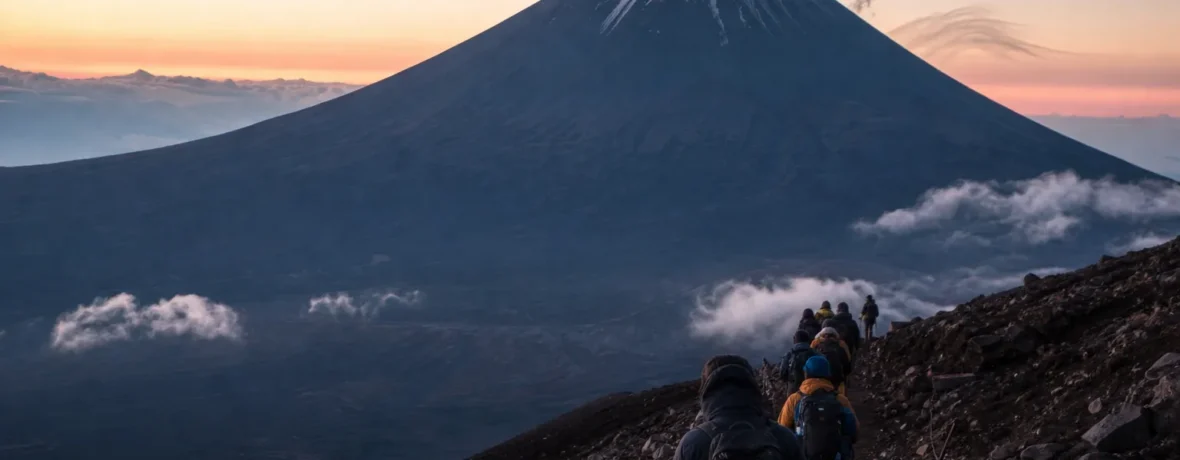
Yes. You can hike Mt. Fuji during the official summer climbing season, usually early July to September 10. In 2026, the Yoshida Trail opened July 1 to September 10; Fujinomiya and Gotemba opened July 10. Outside season, summit trails are closed and unsafe.
Can you hike Mt Fuji without a guide?
Yes, you can hike Mt. Fuji without a guide during the official season if you use an open trail, follow entry rules, and come prepared.
This is not a technical climb. You do not need ropes, glacier gear, or rock-climbing skills in summer. You do need fitness, patience, warm layers, rain gear, a headlamp, cash, water, and the good sense to turn around when the mountain says no.
Mt. Fuji is 12,388 feet [3,776 meters] high. Most hikers start from a 5th Station trailhead, which cuts the climb down to a long, high-altitude slog rather than a sea-to-summit expedition. Still, the air is thin, the weather flips fast, and the upper mountain is volcanic rock and loose grit. Treat it like a real mountain, not a sightseeing stop.
If you have never hiked at altitude, struggle with pacing, or plan to climb at night for sunrise, a guide can be a smart move. Not because the trail is impossible to follow in good weather, but because crowds, darkness, fatigue, and altitude make simple mistakes easier.
Can you hike Mount Fuji outside the official season?
No, not as a regular hiker; outside the official season, summit trails are closed.
The Official Website for Mt. Fuji Climbing says all trails to the summit are closed outside the climbing season, and the route above the 5th Station is prohibited from use under the Road Act. As of November 2026, the official site also warns that violations may be punished by imprisonment for six months or less or a fine of 300,000 yen or less.
That may sound harsh until you see what closes with the season: mountain huts, toilets, first-aid stations, trail maintenance, and most transport support. Snow, ice, violent wind, rockfall, and whiteout conditions can turn Fuji into a mountaineering objective. If you are asking this question as a traveler planning a Japan trip, your answer is simple: go in season.
When is Mount Fuji hiking season?
The normal climbing window is early July through September 10, with exact dates depending on the trail and snow conditions.
As of November 2026, the official Mt. Fuji facility schedule listed these 2026 trail openings: Yoshida and Subashiri from July 1 to September 10, and Fujinomiya and Gotemba from July 10 to September 10. The start can be delayed by weather or remaining snow, so always check the official site before booking flights, huts, or buses.
The best practical window for most hikers is mid-July through late August. By then, more huts and buses are running, the trail is usually fully set up, and the weather pattern is more summer-like. The tradeoff is crowds. If you want fewer people, weekdays in early July or early September can feel calmer, but early July may still have snow patches and late-season facilities may close before the final trail date.
Which Mount Fuji trail should you choose?
Choose Yoshida for the easiest logistics, Fujinomiya for the shortest route, Subashiri for a quieter forested start, and Gotemba only if you want the longest, hardest standard route.
Mt. Fuji has four main summer trails. They start from different sides of the mountain, use different 5th Stations, and have different levels of hut support. The official route comparison gives the following trailhead elevations, hiking distances, and estimated hiking times, not including rests.
| Trail | Best for | Official distance and time | What to expect |
|---|---|---|---|
| Yoshida | First-time Fuji hikers and Tokyo access | Ascent 4.2 miles [6.8 km], 6 hr 10 min; descent 4.3 miles [7.0 km], 3 hr 35 min | Most huts, separate ascent/descent routes, heavy crowds, good sunrise views from the trail |
| Fujinomiya | Shortest summit route | Ascent 2.7 miles [4.3 km], 5 hr 10 min; descent 2.7 miles [4.3 km], 2 hr 40 min | Steep, rocky, same path up and down, highest 5th Station at 7,874 feet [2,400 m] |
| Subashiri | A less crowded lower trail | Ascent 4.3 miles [6.9 km], roughly 7 hr; descent 3.9 miles [6.2 km], roughly 4 hr | Forest at the start, volcanic gravel higher up, merges with Yoshida near the upper mountain |
| Gotemba | Strong hikers who want distance | Ascent 6.5 miles [10.5 km], roughly 9 hr; descent 5.2 miles [8.4 km], roughly 4 hr | Longest route, lowest start, fewer huts, big sandy descent |
For most visitors, Yoshida is the cleanest choice. It has the most services, the simplest public transport, and the biggest hut network. That does not make it easy. It makes it manageable.
Fujinomiya looks tempting because it is short, but short on Fuji means steep. Your knees will notice the descent. Subashiri gives you a more natural-feeling lower trail before joining the crowds higher up. Gotemba is a big day even for fit hikers; do not pick it just because you dislike crowds.
Do you need a permit, reservation, or fee for Mount Fuji?
Yes, you need to follow the entry system for your trail, and hiking fees applied in 2026.
As of November 2026, the Yamanashi notice for the Yoshida Trail listed a 4,000 yen hiking fee per person per visit. The Yoshida 5th Station gate closed from 2 p.m. to 3 a.m., except for mountain hut guests, and also closed when the daily climber count reached 4,000. Reservations were optional, but without one you could be blocked if the daily cap filled.
As of November 2026, the Shizuoka notice for Fujinomiya, Gotemba, and Subashiri listed a 4,000 yen hiking fee and a required mountain entry permit through the Shizuoka Prefecture FUJI NAVI system. Shizuoka did not set a daily climber limit for those three routes in 2026.
These systems can change season by season. Before you pay for a hut or bus, check the current official page for your exact trail. Do not rely on old blog posts, forum threads, or screenshots from a previous summer.
Can you climb Mount Fuji in one day?
Yes, but an overnight hut plan is safer and more comfortable for most hikers.
A one-day climb from the 5th Station is possible if you are fit, acclimatize well, start early, and keep moving. On Yoshida, the official moving-time estimate from Fuji Subaru Line 5th Station is over 10 hours round trip without rest. Add food stops, toilet lines, photos, crowds, summit time, and slower movement at altitude, and your day gets long fast.
The famous sunrise plan usually works better with a hut. You hike to the 7th or 8th Station, eat, sleep badly but at least lie down, then climb before dawn. It still feels rough. It is far better than the “bullet climb” style: starting at night, skipping sleep, hitting the summit at sunrise, and staggering down tired.
Yamanashi’s 2026 confirmation rules told climbers not to attempt overnight climbs without staying in mountain huts. That rule targets the exact behavior that causes misery on Fuji: no rest, poor gear, thin air, darkness, and a summit fever mindset.
How hard is hiking Mount Fuji?
Mt. Fuji is strenuous rather than technical.
The difficulty comes from altitude, weather, length, crowding, and footing. You gain thousands of vertical feet on volcanic terrain. The upper sections can be rocky and slow. Descents can be dusty, slippery, and brutal on knees. The summit can feel like winter before sunrise even when Tokyo is sweating.
The official climbing site states that temperatures drop with elevation and that summit temperatures before sunrise can fall near 32°F [0°C] even in summer. Wind makes it feel colder. If you plan to wait for sunrise, pack like you will be standing still in freezing conditions, because you might be.
Train with uphill hikes, stairs, loaded walks, and long descents. If your legs are only used to flat sidewalks, Fuji will collect payment on the way down.
What should you pack for Mount Fuji?
Pack for cold, wet, dark, dusty, high-altitude hiking.
Fuji has huts and some services in season, but you should not climb as if someone else will solve your problems. Bring your own layers, lights, water, snacks, and weather protection.
- Sturdy hiking shoes or boots with good traction
- Rain jacket and rain pants, not just a poncho
- Warm midlayer, insulated jacket, hat, and gloves
- Headlamp with spare batteries or a backup light
- 2 liters of water, plus cash to buy more if needed
- High-calorie snacks you can eat while moving
- Sunglasses, sunscreen, and a brimmed hat
- Dust mask or buff for the descent
- Trekking poles for the long downhill
- Cash in yen for toilets, huts, food, and emergencies
- Offline map or official Mt. Fuji app
- Small first-aid kit and any personal medications
- Trash bag; carry your trash off the mountain
Do not wear cotton as your main mountain layer. Once it is wet, it stays wet. Fuji wind will find that mistake quickly.
How do you plan a Mount Fuji hike step by step?
Plan the trail, transport, fee, hut, gear, and turnaround rules before you leave Tokyo, Kyoto, or wherever you are staying.
- Pick your trail. Choose Yoshida for the simplest first Fuji climb, unless your Japan route makes another trail more practical.
- Check official opening dates. Trail dates, road access, gate hours, and facilities can change after storms or snow.
- Reserve a mountain hut if climbing overnight. Hut space is limited, and sunrise dates sell out fast.
- Complete the entry process. Use the current official reservation or pre-registration system for your trail.
- Book transport to the correct 5th Station. Fuji has multiple 5th Stations. Going to the wrong one can wreck your day.
- Pack for summit cold. Summer at sea level does not mean summer on the summit.
- Start slow. If you feel great at the lower stations, good. Keep that pace boring anyway.
- Turn around for bad weather or worsening symptoms. The summit is optional. Getting down is mandatory.
What rules do hikers need to follow on Mount Fuji?
Stay on the trail, pay required fees, carry out trash, use toilets, and follow gate or entry instructions.
As of November 2026, official Yoshida Trail rules included carrying proper cold-weather clothing, separate rain gear, and proper footwear; avoiding bullet climbs; staying on the trail; not taking lava or plants; not writing graffiti; taking trash home; and recognizing falling-rock and volcanic risks.
Those rules are not decoration. Fuji handles huge crowds in a short season. One person cutting a switchback, kicking rocks, leaving trash, or pushing past a gate adds risk for everyone below them.
What altitude and weather risks should you know?
Altitude sickness, hypothermia, wind, lightning, and falls are the main hazards for summer hikers.
The CDC says altitude illness symptoms often begin 2 to 12 hours after arriving at high elevation or after ascending higher. Common warning signs include headache, nausea, dizziness, fatigue, and poor sleep. The CDC Yellow Book guidance on high-altitude travel says travelers with medical conditions such as coronary artery disease, chronic pulmonary disease, sleep apnea, or sickle cell trait should consult a physician familiar with high-altitude issues before high-elevation travel.
Do not keep climbing if symptoms are getting worse. Rest, descend, and get help if needed. No sunrise is worth pushing through confusion, severe weakness, trouble breathing at rest, or loss of coordination.
Cold is the other sneaky problem. You may sweat on the climb, then freeze while waiting near the crater. The Mayo Clinic hypothermia first-aid guidance says to call emergency services if you suspect hypothermia. On Fuji, that means taking shivering, slurred speech, clumsiness, confusion, and slow breathing seriously.
When to see a doctor
See a doctor before climbing if you have a heart, lung, blood, sleep-breathing, or serious chronic medical condition.
Also get medical advice if you have had severe altitude illness before, are pregnant, are recovering from a recent illness, or are unsure whether your medications and altitude mix well. This article cannot diagnose you or clear you for a 12,388-foot [3,776-meter] climb.
During the hike, seek urgent help if you or someone in your group has confusion, trouble walking straight, shortness of breath at rest, chest pain, blue lips, fainting, severe persistent vomiting, or signs of hypothermia. Descend when it is safe to do so and alert hut staff, trail staff, or emergency services.
Related reading
- How Long Does It Take to Hike Mt Fuji?
- How Long Is the Appalachian Trail? Miles, States and Time
- How to Plan a Camping Trip
- Where Does the Appalachian Trail Start and End?
FAQ
Can beginners hike Mount Fuji?
Yes, fit beginners can hike Mt. Fuji in season, especially on the Yoshida Trail. You should still train, book a hut if doing sunrise, and bring proper cold and rain gear.
How long does it take to hike Mt. Fuji?
Most 5th Station summit hikes take a full day or an overnight trip. Official moving-time estimates range from roughly 8 hours round trip on Fujinomiya to more than 10 hours on Yoshida, not counting breaks.
Can you hike Mt. Fuji without staying in a hut?
Yes, a day hike is possible if you start early and are fit. For sunrise climbs, staying in a hut is the better plan because overnight “bullet climbs” are discouraged and can be unsafe.
Do you need oxygen for Mount Fuji?
Most hikers do not need bottled oxygen for Mt. Fuji. If altitude symptoms worsen, the better response is to stop ascending, descend, and seek help rather than masking symptoms and pushing higher.
What is the easiest trail up Mount Fuji?
Yoshida is usually the easiest choice for first-time visitors because it has the most huts, services, and transport options. It is still a strenuous high-altitude hike with crowds, cold, and a long descent.
Can you see sunrise without reaching the summit?
Yes, you can see sunrise from high on the Yoshida Trail because it faces northeast. This can be a smart backup if crowds, weather, or altitude slow you down before the top.