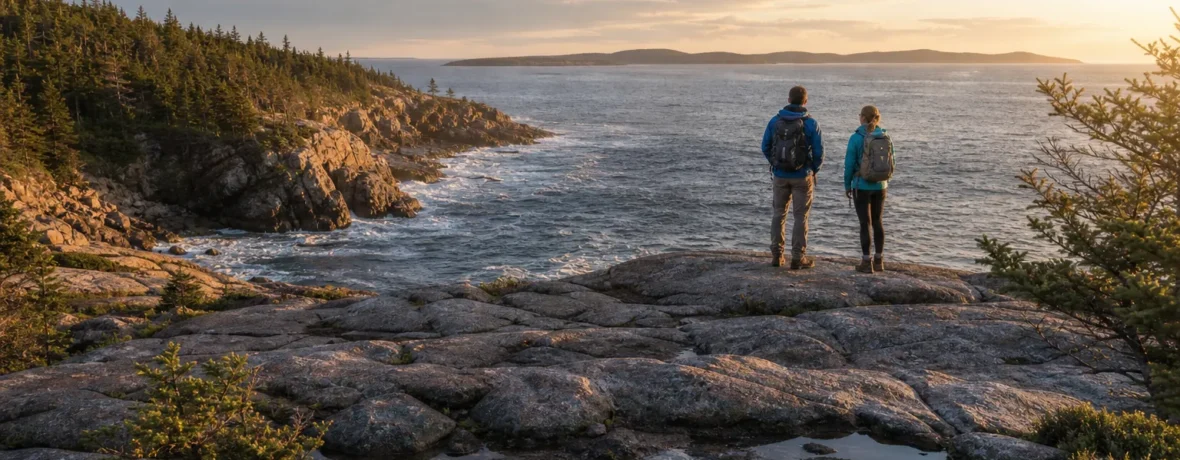
Spend 1 to 3 days hiking granite peaks, walking the coast, catching Cadillac Mountain at sunrise or sunset, and exploring Jordan Pond, Ocean Path, the carriage roads, and Bar Harbor’s tide-linked Bar Island.
What to do in Acadia National Park if you only have one day?
Start early, hit one summit, walk the coast, and save an easy view for sunset. Acadia rewards a tight plan because the park’s famous places sit close together on Mount Desert Island, but parking and weather can eat your day fast.
- Start before sunrise at Cadillac Mountain. Drive if you have the required seasonal vehicle reservation, or hike if you are fit, equipped, and comfortable moving in the dark. As of November 2026, the National Park Service listed a year-round entrance pass requirement for Acadia, and it listed 2026 Cadillac Summit Road vehicle reservations from May 20 through October 25, sold online only through Recreation.gov. Check Acadia fees and passes on the NPS site. (nps.gov)
- Walk Ocean Path from Sand Beach toward Otter Point. This gives you cliffs, surf, Thunder Hole, and classic pink granite without needing a hard climb.
- Pick one real hike. Choose Beehive Loop for exposure, Gorham Mountain for a moderate summit, or Jordan Pond Path for a lake-and-mountain loop.
- Eat or rest near Jordan Pond. The pond, the Bubbles, and nearby carriage roads make this one of the park’s best low-effort scenery stops.
- End with sunset at Bass Harbor Head, Cadillac Mountain, or a west-side overlook. The west side is quieter than the Sand Beach corridor, especially late in the day.
If that sounds packed, good. Acadia is compact, but it is not a theme park. Give yourself room to bail when fog rolls in, lots fill, or a trail feels slick.
What are the best hikes in Acadia National Park?
The best Acadia hikes are Ocean Path, Jordan Pond Path, Beehive Loop, Gorham Mountain Loop, Cadillac South Ridge Trail, and Bar Island Trail. Together, they cover the park’s big moods: surf, cliffs, ladders, summit granite, forest, ponds, and tidewater.
| Hike | Distance | Best for | Heads-up |
|---|---|---|---|
| Ocean Path | 4.4 miles round trip [7.1 km] | Coastal views, Thunder Hole, Otter Cliffs | Steep ocean edges; keep kids away from drop-offs |
| Jordan Pond Path | 3.3-mile loop [5.3 km] | The Bubbles, clear water, forest boardwalks | No swimming or wading; Jordan Pond is a public water supply |
| Beehive Loop | 1.4 miles round trip [2.3 km] | Iron rungs, exposure, Sand Beach views | Not for wet rock, dogs, or fear of heights |
| Gorham Mountain Loop | 3.5 miles round trip [5.6 km] | Moderate summit with ocean scenery | Cadillac Cliff option adds rungs and difficulty |
| Cadillac South Ridge Trail | 7.1 miles round trip [11.4 km] | Long granite ridge, summit views | Exposed to wind, fog, rain, and sun |
| Bar Island Trail | 1.9 miles round trip [3.1 km] | A tide-timed walk from Bar Harbor | Only cross during the low-tide window |
Those distances come from NPS trail descriptions: Ocean Path is listed at 2.2 miles one way, Jordan Pond Path at 3.3 miles, Beehive Loop at 1.4 miles, Gorham Mountain Loop at 3.5 miles, Cadillac South Ridge at 7.1 miles, and Bar Island Trail at 1.9 miles. Browse Acadia hiking trails on NPS.gov. (nps.gov)
Where are the best views in Acadia National Park?
The best views are from Cadillac Mountain, Beehive, Gorham Mountain, Ocean Path, Jordan Pond, and Bass Harbor Head. You do not need to chase every overlook; pick the light and the weather, then go where the sky is clear.
- Cadillac Mountain: Big island-and-ocean panorama, especially at sunrise and sunset. NPS notes that Cadillac is the first place in the country to see sunrise from October 7 through March 6. (home.nps.gov)
- Beehive: A punchy view over Sand Beach, Thunder Hole, and the Gulf of Maine after a steep ladder climb.
- Gorham Mountain: A friendlier summit than Beehive, with strong coastal views and fewer “don’t look down” moments.
- Ocean Path: The easiest way to stitch together Sand Beach, Thunder Hole, Monument Cove, and Otter Point.
- Jordan Pond south shore: The postcard angle toward North Bubble and South Bubble.
- Bar Island summit clearings: A tide-dependent view back toward Bar Harbor and Frenchman Bay.
Do you need a reservation for Acadia National Park hikes?
No, you do not need a hiking reservation for Acadia trails, but you do need to handle entrance fees and Cadillac Mountain driving rules. As of November 2026, NPS listed Acadia’s standard private vehicle entrance pass at $35 for seven days, with separate rules for motorcycles, walk-ins, annual passes, and nonresident fees. (nps.gov)
The big exception is driving Cadillac Summit Road during the reservation season. As of November 2026, NPS listed 2026 Cadillac Summit Road vehicle reservations as required from May 20 through October 25, costing $6, with 30 percent released 90 days ahead and 70 percent released at 10 a.m. Eastern two days ahead. Reservations were not required for visitors entering that area by foot, bike, or taxi. Read the Cadillac Summit Road vehicle reservation rules. (nps.gov)
For any trip, check the park’s current alerts before you drive to a trailhead. Acadia has seasonal road changes, storm damage, peregrine falcon closures, construction projects, and winter conditions that can change the plan.
Which Acadia trails should beginners hike first?
Beginners should start with Ocean Path, Jordan Pond Path, Jesup Path, Ship Harbor Trail, Wonderland Trail, and easy carriage-road walks. These routes give you real Acadia scenery without throwing you onto iron rungs or exposed cliff bands.
- Ocean Path: Best first hike for coastal drama. Turn around whenever you want.
- Jordan Pond Path: Best first lake loop. The west side is rougher, with rocks and boardwalks.
- Jesup Path: Best mellow walk near Sieur de Monts, with boardwalk feel and forest calm.
- Ship Harbor Trail: Best easy coastal loop on the quieter west side.
- Wonderland Trail: Best short family walk to tidepools and shoreline texture.
- Carriage roads: Best no-rush option for wide, graded walking away from car traffic.
Beginner does not mean flip-flop friendly. Acadia’s rock gets slick when wet, roots grab tired feet, and fog can make a short trail feel confusing. Wear grippy shoes, carry water, and bring a real map or downloaded offline map.
Are the ladder trails in Acadia worth it?
Yes, the ladder trails are worth it if you are comfortable with heights, dry rock, and one-way-feeling exposure. Skip them in rain, ice, high wind, crowded conditions, or any moment when your gut says no.
Beehive Loop is the usual first ladder trail because it is short and spectacular. The climb rises on steep granite with iron rungs and exposed ledges, then rewards you with a clean view over Sand Beach. It is not a casual stroll. If your hands are busy taking photos instead of holding rock or iron, you are doing it wrong.
Precipice Trail is bigger, steeper, and more serious. NPS describes the Precipice area as an 800-foot cliff route on Champlain Mountain, and it closes seasonally for peregrine falcon nesting. The park’s superintendent’s compendium, last updated October 27, 2026, lists annual peregrine closure areas from March 1 through August 15, including the Precipice Trail area, unless otherwise signed or posted. Check Acadia’s official rules and closures. (nps.gov)
Dogs are not allowed on Acadia’s ladder trails. NPS also says pets must be leashed no longer than 6 feet [1.8 m] where they are allowed, and it lists ladder trails such as Beehive, Jordan Cliffs, Ladder Trail to Dorr Mountain, Perpendicular Trail, and Precipice as off-limits to pets. (nps.gov)
Can you hike Acadia without a car?
Yes, you can hike Acadia without a car during the Island Explorer season, especially if you stay in Bar Harbor or near a shuttle stop. You will have less flexibility at sunrise, after dark, and on the quieter west side.
The Island Explorer is Acadia’s fare-free seasonal bus system, linking village centers, campgrounds, and many park destinations. As of November 2026, NPS described it as fare-free and advised visitors to check routes and schedules before trip planning. See the Island Explorer information from NPS. (nps.gov)
A smart car-free hiking day looks like this: take the bus to Sand Beach, walk Ocean Path, climb Gorham Mountain if conditions are dry, continue toward Otter Point, then bus back from a nearby stop if the schedule works. For Jordan Pond, arrive early and know your return bus time before you start the loop.
What should you pack for hiking in Acadia?
Pack for wet rock, fast weather changes, and slow parking lots. Acadia is coastal, windy, and rough underfoot, even when the mileage looks small.
- Trail shoes or hiking boots with sticky tread
- At least 1 liter of water; more on warm days
- Snacks with salt and quick calories
- Rain shell or wind shell
- Warm layer for Cadillac, summits, and fog
- Sun hat, sunglasses, and sunscreen
- Offline map plus a paper map for backup
- Headlamp if starting before dawn or finishing near dusk
- Small first-aid kit
- Phone battery bank
- Leash no longer than 6 feet [1.8 m] if hiking with a dog where pets are allowed
- Patience for full lots, shuttle waits, and slow Park Loop Road traffic
NPS advises hikers in Acadia to carry water, wear sturdy hiking shoes, follow blue trail blazes, use a topographic map, and avoid building or modifying cairns. That last one matters. Extra rock stacks can send hikers the wrong way. (nps.gov)
What is the best 3-day Acadia hiking plan?
The best 3-day plan splits Acadia into coast, summit, and quiet-side days. That keeps you from wasting every morning fighting for the same trailhead parking.
Day 1: Sand Beach, Ocean Path, and Gorham Mountain
Start at Sand Beach. Walk Ocean Path toward Thunder Hole and Otter Point, then loop in Gorham Mountain if the rock is dry and your legs feel good. This is the best first day because it gives you the classic coast without requiring a huge climb.
Day 2: Cadillac Mountain and Jordan Pond
Catch Cadillac at sunrise or hike Cadillac South Ridge for a longer effort. Later, shift to Jordan Pond Path, the Bubbles area, or a carriage-road walk. Keep the afternoon flexible because Jordan Pond parking can be tight in peak season.
Day 3: West side, Bar Island, or Schoodic
Use your third day to breathe. Walk Ship Harbor and Wonderland, time Bar Island with the tide, or drive to Schoodic Peninsula for granite coastline with a different feel. Bar Island’s land bridge is exposed from 1.5 hours before to 1.5 hours after low tide; if you miss the window on the island side, NPS warns it is nine hours until the bar emerges again. (nps.gov)
Related reading
- Acadia National Park Pass and Vehicle Reservations
- How to Get to Dry Tortugas National Park
- What to Do in Zion National Park: Hikes by Difficulty
- Where to Stay in Yosemite for Hikers
FAQ
How many days do you need in Acadia National Park?
You need 2 to 3 days for a strong first Acadia trip. One day covers Cadillac Mountain, Ocean Path, and one short hike; three days let you add Jordan Pond, ladder trails, carriage roads, and the west side.
What is the most scenic hike in Acadia?
Beehive Loop is the most scenic short adventure hike, while Ocean Path is the most scenic easy coastal walk. For a longer summit day, Cadillac South Ridge gives you open granite and Atlantic views for miles.
Can beginners hike Cadillac Mountain?
Yes, beginners can hike Cadillac Mountain if they choose the right route, start early, and carry layers. Cadillac South Ridge is long at 7.1 miles round trip [11.4 km], so many first-timers prefer driving to the summit when reservations are required and available.
Is Beehive Trail safe?
Beehive Trail is safe only for hikers who can handle exposure, iron rungs, steep rock, and dry conditions. Do not take dogs, small children who need hand-holding, or anyone who freezes on heights.
Can you swim in Jordan Pond?
No, you cannot swim or wade in Jordan Pond. NPS states that Jordan Pond is a public water supply, so swimming and wading are prohibited. (nps.gov)
What is the best month to hike in Acadia?
September is often the best month for hiking because temperatures are cooler and the main summer crush starts to ease. October can be gorgeous too, but expect colder mornings, shorter days, and changing seasonal services.