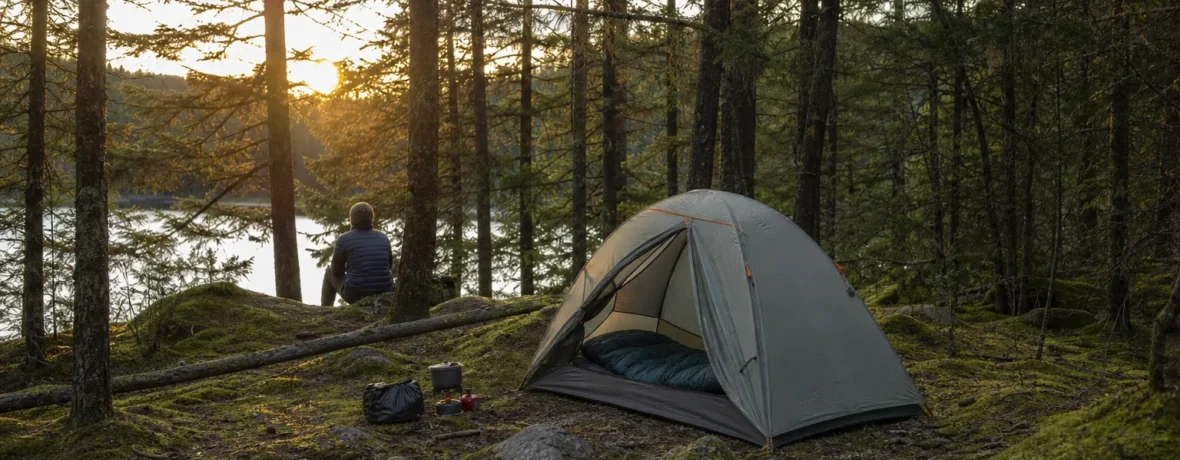
What is dispersed camping? It is camping outside a developed campground, usually on public land, without toilets, trash service, picnic tables, reservations, or marked sites. Yes, it is allowed in many U.S. national forests and BLM areas, but only where local rules, maps, fire restrictions, and posted closures permit it.
You get space, quiet, darker skies, and no campground loop. You also get zero hand-holding. No host. No spigot. No dumpster. If you want dispersed camping to stay legal and open, you need to pick the right land, camp lightly, and leave the place cleaner than you found it.
What does dispersed camping mean?
Dispersed camping means sleeping outside a designated campground.
In plain English, you are camping in an undeveloped spot rather than a numbered site with services. You might pitch a tent off a forest road, sleep in a vehicle on BLM land, or backpack to a legal backcountry zone. The key word is “undeveloped.” If there is a toilet, fee station, picnic table, fire grate, campground sign, and site number, that is not dispersed camping.
Dispersed camping is not the same as stealth camping on private land, sleeping in a city park, or pulling behind a closed gate. You still need permission from the land manager, and public land boundaries matter. A legal-looking dirt pullout can sit on private land, tribal land, a wildlife closure, a mining claim, or a road corridor where camping is banned.
What is dispersed camping compared with a campground?
Dispersed camping is more primitive than developed campground camping.
The trade is simple: fewer comforts, more freedom. You choose your spot, but you also carry the responsibility for water, waste, food storage, fire safety, and knowing whether you are actually allowed to be there.
| Feature | Dispersed camping | Developed campground |
|---|---|---|
| Sites | Unmarked or informal | Numbered or designated |
| Services | No toilets, water, trash, or tables | May have toilets, water, tables, fire rings, or hosts |
| Reservations | Usually none, but local permits may apply | Often first-come or reservable |
| Best for | Self-sufficient hikers, backpackers, and road-trippers | Families, new campers, and anyone wanting facilities |
Where is dispersed camping allowed in the United States?
Dispersed camping is commonly allowed on some BLM and National Forest lands, but not everywhere.
BLM says camping away from developed recreation facilities is dispersed camping, and most BLM lands allow it unless the area is posted closed or has specific restrictions; as of November 2026, BLM also says dispersed camping is generally limited to 14 days within a 28-day period, though limits vary by state and field office. Check the official BLM camping guidance before you go.
National Forest land often allows dispersed camping too, but each forest can set its own travel, fire, group-size, distance-from-water, seasonal, and stay-limit rules. Use the official U.S. Forest Service maps page to find forest maps and Motor Vehicle Use Maps, which show where motorized travel is legal. If you are driving to camp, that map matters as much as the campsite.
National parks are different. You should assume dispersed roadside camping is not allowed inside a national park unless the park’s own rules say otherwise. Many parks allow backcountry camping only with a designated itinerary or permit; start with the National Park Service page on backcountry camping permits and then read the specific park’s camping page.
Is dispersed camping legal on BLM land?
Yes, dispersed camping is legal on many BLM lands when no closure or local restriction applies.
That “when” is doing work. BLM land is not one giant free-for-all. Popular desert corridors, national monuments, wilderness study areas, archaeological sites, river corridors, trailheads, and restoration zones can have tighter rules. Signs on the ground beat what you heard online.
As of November 2026, BLM’s national camping page says most areas do not require permits or reservations for dispersed camping, but some areas may require permits for large groups or campfires. It also says vehicles must stay on designated roads and trails unless an area is specifically designated for off-road vehicle use.
Use the official BLM maps hub to confirm land status, then check the local field office page for restrictions. If the spot is near a famous trailhead, hot spring, canyon, arch, lake, or national park boundary, double-check. Crowded places get special rules first.
Is dispersed camping allowed in national forests?
Often yes, but the local ranger district sets the rules.
A national forest may allow dispersed camping along many forest roads, while another forest may restrict camping to designated corridors, signed pullouts, or certain distances from water and trailheads. Some forests use seasonal closures to protect wet roads, winter wildlife range, fire-damaged areas, or overused meadows.
If you are backpacking, read the wilderness or backcountry page for that district. If you are car camping, download the Motor Vehicle Use Map. A pretty two-track on a satellite map does not mean you can drive it. If the MVUM says a road is closed to motorized travel, park legally and walk, or pick another area.
How do you find a legal dispersed campsite?
Find the land manager first, then find the campsite.
Do not start with a pin from social media. Start with boundaries and rules. Then work down to the exact pullout, drainage, ridge, or backpacking zone.
- Choose the public land unit. Identify whether the area is BLM, National Forest, National Park, state land, tribal land, or private land.
- Read the local camping page. Look for dispersed camping rules, stay limits, permits, fire restrictions, food-storage orders, and seasonal closures.
- Check the map that has legal weight. For Forest Service roads, use the MVUM. For BLM, use official BLM maps and the field office’s recreation pages.
- Call the ranger district or field office when unsure. Ask one direct question: “Is dispersed camping allowed at this exact road or area this week?”
- Arrive with daylight left. You need time to read signs, avoid private driveways, avoid fragile ground, and turn around if the road is worse than expected.
- Use an existing disturbed site. Pick bare dirt, gravel, rock, or an already-used campsite instead of crushing grass, flowers, cryptobiotic soil, or wet meadow.
What rules should you follow when dispersed camping?
Follow the posted local rules first, then use Leave No Trace as your baseline.
Good dispersed camping is boring in the best way: small footprint, no drama, no mess. Your camp should not grow into a compound with trenches, hacked branches, stacked rock furniture, and trash bags hanging from trees.
- Camp on durable surfaces such as bare soil, gravel, sand, rock, or snow.
- Use existing sites instead of creating new scars.
- Keep camp away from water, trails, and other campers when local rules require distance.
- Pack out every piece of trash, including food scraps, foil, bottle caps, wipes, and micro-trash.
- Store food so wildlife cannot get it; in bear country, follow the local food-storage order.
- Use a stove when fire danger is high or fire rules are unclear.
- Never leave a campfire unattended, and drown it until it is cold to the touch.
- Do not cut live trees, build new fire rings, or move rocks into elaborate camp furniture.
For human waste, Leave No Trace guidance says to use toilets where available; if there are no facilities and packing out is not required, dig a cathole 6 to 8 inches [15 to 20 cm] deep at least 200 feet [61 m] from water, camp, and trails, then cover and disguise it. Pack out wipes and hygiene products. See the Leave No Trace waste guidance for the full method.
What should you pack for dispersed camping?
Pack as if no one is coming to help you.
That does not mean stuffing your vehicle with junk. It means carrying the right basics and having a backup plan if the road is washed out, the creek is dry, the fire ban is strict, or the site you wanted is closed.
- Paper map or downloaded offline map
- Enough water for drinking, cooking, washing, and emergencies
- Water filter or treatment if natural water may be used
- Headlamp plus spare power
- Stove and fuel
- Trash bags
- Trowel or approved waste bags
- Bear canister, bear-resistant cooler, or hanging kit where appropriate
- First-aid kit
- Warm layers and rain shell
- Traction boards, shovel, or tire repair kit for rough-road vehicle camping
What are the biggest dispersed camping mistakes?
The biggest mistake is assuming “public land” automatically means “camp anywhere.”
That assumption closes places. Land managers tighten rules when campsites spread, trash piles up, fire rings multiply, roads braid across meadows, and human waste collects near creeks. A legal site is not only about avoiding a ticket. It is about keeping the land from looking like a sacrifice zone.
Other classic mistakes: arriving after dark, depending on cell service, parking on vegetation, ignoring wind during campfire season, camping too close to water, and leaving gear to “hold” a spot. If you cannot pack it out, do not bring it in.
Related reading
- Dispersed Camping in Colorado: Best Areas and Rules
- Dispersed Camping Apps Compared
- How to Plan a Camping Trip
- How to Start Camping: A Beginner's Guide
FAQ
Can you dispersed camp anywhere in a national forest?
No. Many national forests allow dispersed camping, but each forest or ranger district can restrict where you camp. Check the local forest rules and the Motor Vehicle Use Map before driving to a site.
Do you need a permit for dispersed camping?
Sometimes. Many BLM and National Forest dispersed sites do not require a camping permit, but permits may be required in busy areas, wilderness zones, river corridors, national parks, or for campfires and large groups.
Is dispersed camping free?
Often, yes, but not always. Some public lands charge fees, require passes, or route campers into designated paid areas, so check the local land manager’s page before you go.
How long can you stay while dispersed camping?
It depends on the land manager. As of November 2026, BLM’s general guidance says dispersed camping is commonly limited to 14 days within a 28-day period, but local rules can differ.
Can you have a campfire while dispersed camping?
Only if fires are allowed at that place and time. Fire restrictions can change quickly with wind, drought, heat, and wildfire activity, so check current local restrictions before lighting anything.
Is dispersed camping safe?
It can be safe if you plan well and stay aware. Tell someone where you are going, carry enough water, know the weather, avoid sketchy roads, store food properly, and move along if a site feels wrong.