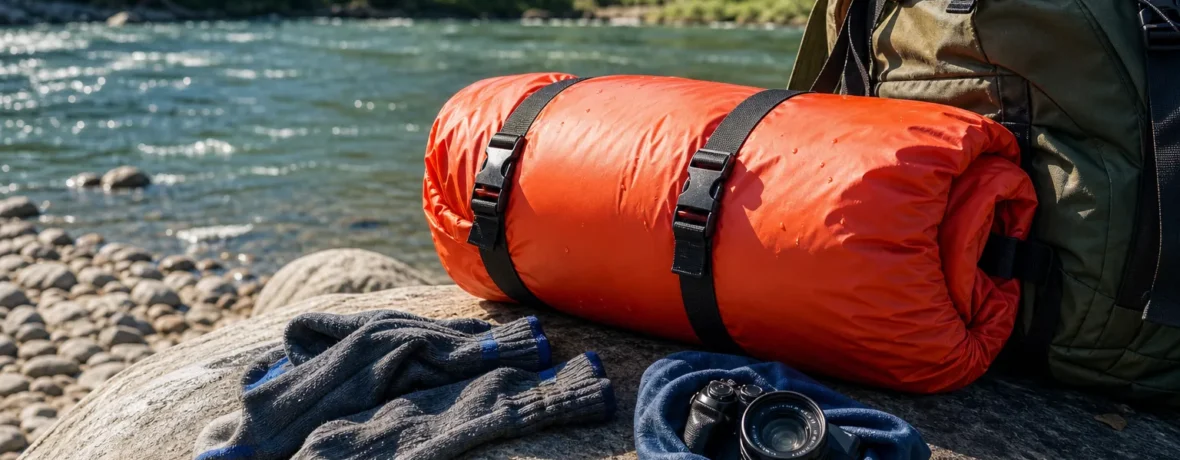
What is a dry bag? It’s a waterproof storage sack, usually with a roll-top closure, that keeps critical gear dry during rain, river crossings, and wet-pack days. Hikers need one when soaked gear could end the trip: sleeping insulation, warm layers, electronics, maps, medications, or food in soggy conditions.
What is a dry bag?
A dry bag is a waterproof gear bag made to block rain, splashes, and wet pack interiors. Most hiking dry bags are soft cylinders made from coated nylon, polyester, TPU, PVC, or laminated waterproof fabric, with sealed seams and a roll-top closure.
The roll top is the key. You press the air out, fold the stiff opening down at least three times, then buckle the ends together. Sea to Summit’s roll-top guidance also calls for three clean rolls before clipping the buckle, which is a good baseline for most trail use: Sea to Summit dry bag closure guidance.
Dry bags are not all built the same. A thin 1 oz [28 g] dry sack for spare socks is different from a burly 20-liter river bag with welded seams. Some are made for backpacking organization. Some are made for paddling. Some are closer to waterproof duffels.
Do hikers really need a dry bag?
Yes, hikers need a dry bag when the forecast, terrain, or gear stakes justify the weight. If you hike only short fair-weather trails, a zip-top freezer bag or pack liner may be enough. If you carry down insulation, electronics, paper maps, or medication, a dry bag earns its space fast.
A soaked puffy jacket is dead weight. A wet sleeping bag can turn a cold night dangerous. A damp battery bank may not charge. And once water gets inside your pack, gravity sends it straight to the gear you care about most.
Dry bags are most useful for:
- Rainy shoulder-season hikes
- Backpacking trips with overnight gear
- Routes with creek crossings
- Snowmelt, swampy trails, and wet brush
- Trips where your pack may sit on wet ground
- Protecting maps, electronics, first-aid supplies, and warm layers
For general rain prep, REI points out that many backpacks use waterproof fabric but do not have sealed seams, so water can still get inside; their rain-hiking advice includes pack liners and smaller waterproof bags for key gear: REI backpacking in the rain tips.
What size dry bag is best for hiking?
Most hikers should start with one 5-liter to 10-liter dry bag. That range handles the usual “must stay dry” items without eating too much pack space.
| Dry bag size | Best use | Typical hiking load |
|---|---|---|
| 1-3 L | Small essentials | Phone, wallet, keys, headlamp, repair kit |
| 5-8 L | Day hikes and clothing | Rain shell, gloves, beanie, socks, first-aid kit |
| 10-13 L | Backpacking layers | Puffy, sleep clothes, spare base layer |
| 20 L+ | Bulky insulation or paddling overlap | Sleeping bag, quilt, camp clothes |
For backpacking, many hikers use two or three smaller dry bags instead of one huge one. That keeps gear organized and lets you separate damp items from dry ones. A 3-liter bag for electronics, a 10-liter bag for insulation, and a 13-liter bag for clothing is a clean system.
One warning: bigger is not always better. A half-empty dry bag becomes a slippery balloon inside your pack. Choose the smallest size that fits the gear without crushing insulation flat.
Is a dry bag better than a pack cover?
A dry bag protects gear better inside the pack, while a pack cover protects the outside of the pack. They solve different problems.
Pack covers are fine in steady rain, but they can peel back in wind, snag on brush, and leave the shoulder straps and back panel exposed. Water can also run down your back and enter behind the cover. A dry bag sits inside the pack, so it keeps working after the outer fabric wets out.
The best setup for rough weather is layered:
- Pack liner: Protects the main compartment from widespread water intrusion.
- Dry bag: Protects mission-critical gear inside the liner.
- Pack cover: Reduces how much water the pack fabric absorbs.
If you want the lightest dependable system, use a trash compactor bag or dedicated pack liner, then put your sleeping bag, puffy, and electronics in dry bags. That gives you redundancy without turning your pack into a yard sale of sacks.
How waterproof is a dry bag?
A dry bag is waterproof against rain and splashes, but many roll-top models are not built for long submersion. That difference matters.
Roll-top dry bags seal by folding the opening over itself. Under rain, spray, and brief contact with water, that works well when closed correctly. Under sustained underwater pressure, water can creep through the rolled closure, especially if the bag is overfilled, under-rolled, twisted, or worn.
Some dry bags carry IP ratings. An IPX7-rated bag, for example, is designed around temporary immersion conditions, but the exact performance still depends on the closure, age, damage, and manufacturer instructions. Sea to Summit’s product FAQ says roll-top dry sacks can allow water through the closure and are not designed for intentional submersion of electronics: Sea to Summit dry bag FAQ.
Trail translation: trust a dry bag for rain. Do not blindly trust a basic roll-top dry bag as a phone safe during a swim, rafting flip, or full pack dunk. For electronics, use two layers: a small waterproof case or zip pouch inside a dry bag.
How do you use a dry bag correctly?
Close it cleanly, leave room for rolls, and protect it from sharp gear. Most dry bag failures come from rushed packing, not bad fabric.
- Load soft items first. Put clothing, insulation, or soft pouches against the sides.
- Keep sharp edges away from the fabric. Stove parts, stakes, utensils, and camera plates can abrade coatings.
- Stop below the closure strip. Leave enough empty fabric for three full rolls.
- Squeeze out extra air. This reduces bulk and helps the roll sit flat.
- Align the top edges. Wrinkles and offset corners create leak paths.
- Roll down three times. More rolls are fine if the bag still closes cleanly.
- Clip the buckle. The buckle holds the roll under tension; it is not a carry handle unless the brand says so.
- Pack it away from abrasion. Inside the pack is safer than strapped outside against rock and brush.
At home, test any new dry bag before trusting it with high-value gear. Put tissue paper inside, close it, spray it in the shower, then check for damp spots. Do not submerge a lightweight backpacking dry sack unless the maker says that model is built for immersion.
What should you put in a dry bag for hiking?
Put the gear you cannot afford to soak in a dry bag. Nice-to-dry gear can ride in normal stuff sacks; critical gear gets waterproof protection.
Dry bag checklist:
- Down sleeping bag or quilt
- Puffy jacket or insulated vest
- Sleep clothes and spare socks
- Phone, battery bank, cables, and satellite messenger
- Paper map, permit, notebook, and ID
- First-aid supplies and personal medication
- Fire starter, matches, and lighter
- Camera gear in a padded insert
- Food that turns useless when wet, such as drink mixes or dehydrated meals
Do not use one dry bag as a chaos sack for everything. If you stuff wet rain pants in with your dry sleeping clothes, the bag did its job and you defeated it. Separate wet, dry, clean, and scented items.
Can a dry bag be used as a bear bag?
A dry bag can hold food, but it is not a bear-resistant container. If local rules require a bear canister or approved food storage, a dry bag does not replace it.
A dry bag may work as the inner bag for food organization, odor mess control, or hanging where bear hangs are allowed. But fabric bags are chewable. Buckles break. Rodents can also make quick work of salty, food-scented gear.
Before backpacking in bear country, check the land manager’s current food-storage rules. The National Park Service tells visitors to check park-specific backcountry food requirements and use bear-resistant containers correctly where required: NPS bear food storage guidance.
What should you look for when buying a dry bag?
Buy for the trip type, not the shelf appeal. A shiny heavy river bag is overkill for many hikers, while an ultralight sack may be too fragile for canyons, packrafting, or daily outside-pack carry.
Look for these features:
- Sealed seams: Taped or welded seams keep water from sneaking through stitch holes.
- Roll-top closure: Simple, reliable, and easy to inspect.
- Right fabric weight: Ultralight for inside-pack use; heavier coated fabric for abrasion.
- Oval or rectangular base: Packs flatter than a round tube.
- Bright color: Easier to find in a dark pack or tent.
- White or light interior: Helps you spot tiny items.
- No mystery claims: “Waterproof” should come with clear construction details or a rating.
For most hikers, the sweet spot is a lightweight roll-top dry bag in the 5-liter to 13-liter range. If you paddle, canyoneer, or strap gear outside the pack, step up to thicker fabric and stronger hardware.
How do you care for a dry bag?
Rinse it, dry it, and store it open. Dirt, sand, sunscreen, fuel, and bug spray can shorten the life of waterproof coatings.
After a wet hike, turn the bag inside out if the design allows it, wipe out grit, and let it dry fully before storage. Check the closure strip for cracks. Look at the seams. Hold the fabric up to a light and inspect for pinholes. Small punctures can often be patched with gear repair tape made for coated fabrics.
Never store a dry bag tightly rolled for months. Long-term creases can weaken coatings, especially on ultralight sacks. Fold it loosely or hang it with the top open.
Related reading
- How to Choose a Sleeping Bag: Temperature Ratings, Fill and Shape
- How to Wash a Sleeping Bag at Home Without Damaging It
- How to Wash a Down Sleeping Bag and Restore the Loft
- How to Attach a Sleeping Bag to a Backpack
FAQ
Is a dry bag the same as a stuff sack?
No, a dry bag is not the same as a basic stuff sack. A stuff sack organizes gear; a dry bag adds waterproof fabric, sealed seams, and a water-blocking closure.
Can I put my sleeping bag in a dry bag?
Yes, a sleeping bag is one of the best things to put in a dry bag. Use a size that fits without extreme force, because over-compressing insulation can stress the bag and make closure harder.
Will a dry bag float?
Usually yes, if it has trapped air and is closed correctly. Do not rely on a hiking dry bag as safety flotation; it is gear protection, not a life-saving device.
Can I wash a dry bag?
Yes, hand-wash it with mild soap and water. Avoid machine washing, bleach, solvents, and high heat because they can damage waterproof coatings and seam seals.
How many dry bags do I need for backpacking?
Most backpackers need two or three dry bags. Use one small bag for electronics, one medium bag for clothing, and one larger bag or waterproof compression sack for sleeping insulation.
Are cheap dry bags good enough for hiking?
Sometimes, yes, if they have sealed seams, a clean roll-top closure, and pass a home spray test. For down insulation, expensive electronics, winter trips, or repeated rough use, buy from a reputable outdoor brand and inspect it often.