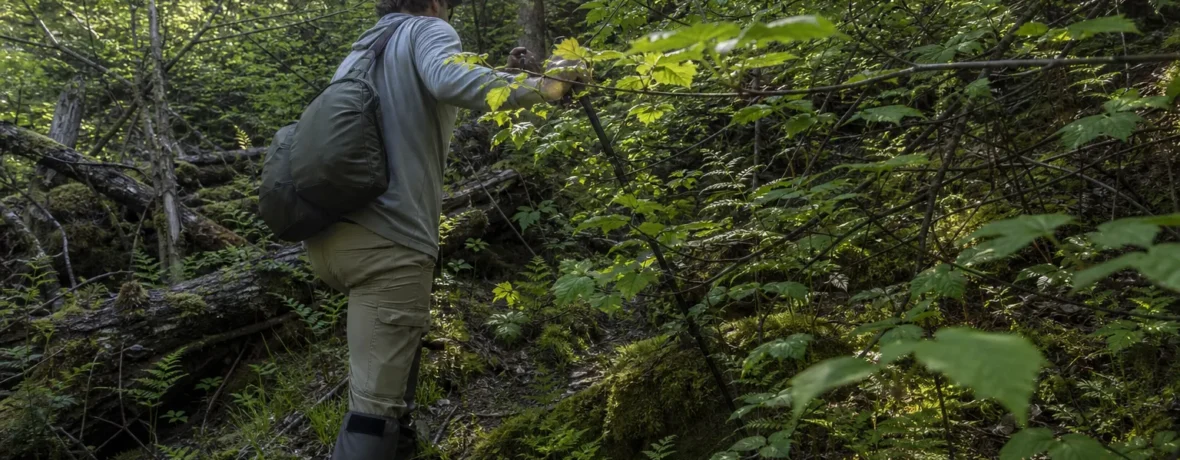
What is bushwhacking? Bushwhacking is off-trail hiking through undeveloped terrain where there is no maintained path to follow. You move by map, compass, GPS, terrain reading, and patience, often at 0.5 to 1 mph [0.8 to 1.6 km/h]. Yes, it is hiking, but only when it is legal, low-impact, and planned.
What is bushwhacking in hiking?
Bushwhacking is hiking without a trail.
That sounds simple. It is not. On a trail, the route has already been chosen for you. Somebody cut the tread, bridged the mud, moved blowdowns, and put the path where feet can pass without shredding the hillside. When you bushwhack, you take all of that responsibility back.
You choose the line. You read the slope. You decide whether that patch of spruce is passable or a green wall with needles. You figure out if the creek is a pleasant handrail or a trap that boxes you into steep banks. You move through brush, forest, talus, meadow, snow, desert wash, or open ridge without painted blazes telling you what to do next.
Here is the position: bushwhacking is not a casual shortcut. It is a separate backcountry skill. Treat it like one and it can open quiet basins, forgotten summits, and elegant routes between known trails. Treat it like a way to shave distance, and it becomes slow, destructive, and dangerous.
Is bushwhacking the same as off-trail hiking?
Usually, yes, but bushwhacking implies harder travel.
Off-trail hiking can mean strolling across open slickrock, walking a beach, or crossing a short meadow to reach a legal campsite. Bushwhacking has a rougher edge. The word suggests brush, branches, deadfall, wet leaves, route-finding, and the kind of progress that makes 2 miles [3.2 km] feel like a full afternoon.
| Term | What it usually means | Best mindset |
|---|---|---|
| Trail hiking | Following a maintained or established path | Stay on the tread and protect the corridor |
| Off-trail hiking | Traveling away from a formal trail | Move only where allowed and where impact is low |
| Bushwhacking | Off-trail travel through brush, forest, or complex terrain | Slow down, read terrain, and be ready to turn around |
The land does not care what word you use. Your feet still leave marks. Leave No Trace defines off-trail travel as any travel that does not use a designed trail, and it recommends choosing durable surfaces such as rock, sand, or gravel when you leave the path. Read their guidance on traveling and camping on durable surfaces before you decide that a faint line through fragile plants looks inviting.
Is bushwhacking legal?
Sometimes, and only the local land manager can tell you.
This is where hikers get sloppy. “Public land” does not automatically mean “walk anywhere.” National parks, national forests, wilderness areas, state parks, wildlife refuges, municipal preserves, tribal lands, and private timberlands can all set different access rules. Some places allow off-trail travel. Some restrict it to protect restoration zones, archaeological sites, nesting habitat, wetlands, private inholdings, or visitor safety.
Do not guess from a social media track. Check the official page for the specific unit you plan to visit. If you are in a national park, start with the park’s own website and current alerts. The National Park Service also reminds hikers that going off trail can damage plant and animal habitat in its hiking etiquette guidance.
One more hard line: cutting switchbacks is not bushwhacking. It is erosion with a backpack. A shortcut on a built trail concentrates damage, braids tread, and teaches the next person to do the same dumb thing. Stay on the trail unless you have a real reason, legal access, and the skills to travel cleanly.
How hard is bushwhacking?
Bushwhacking is usually much harder than the map makes it look.
A clean 3-mile [4.8 km] trail can be a relaxed morning. A 3-mile [4.8 km] bushwhack through mountain laurel, alder, blowdown, or steep second-growth forest can eat most of a day. The distance is not the problem. Friction is the problem.
Brush grabs your poles. Dead branches hide holes. Wet logs roll. Ridges split in the wrong direction. Your GPS arrow bounces around under tree cover. Your clothing snags. Your pace collapses. You stop more often, not because you are weak, but because route decisions come every few seconds.
That is the beauty of it, too. Good bushwhacking rewards attention. You start seeing old animal paths, open benches, contour breaks, dry creek crossings, and ridgelines that the map only hints at. The work is not just physical. It is mental.
What gear do you need for bushwhacking?
You need normal hiking gear, stronger navigation tools, and clothing that can take abuse.
The National Park Service lists navigation gear among the Ten Essentials in its Hike Smart safety guidance. For bushwhacking, do not treat that as decoration. A phone app is useful. A paper map and compass are not old-school theater; they are your backup when batteries die, screens crack, rain soaks everything, or tree cover makes your location fuzzy.
- Paper topographic map in a waterproof bag
- Compass you know how to use
- GPS device or offline map on your phone
- External battery and charging cable
- Long pants and long sleeves
- Eye protection or sunglasses for branch strikes
- Gloves for brush, rock, and deadfall
- Stiff-soled footwear with real traction
- Rain shell and insulation for slow travel
- Headlamp, even on a day hike
- First-aid kit, emergency shelter, and fire-starting supplies where fires are legal
- Whistle or satellite messenger for remote routes
Skip the ultralight romance if the terrain is mean. Delicate mesh shoes and bare shins are a bad match for thorn, scree, and sharp deadwood. You do not need armor. You do need clothing that lets you keep moving without bleeding from every twig.
How do you bushwhack safely?
Plan the route before you leave, then adjust constantly on the ground.
- Start with the map. Mark your trailhead, target, bailout points, water crossings, cliffs, private land boundaries, and the trail or road you can use to exit.
- Choose handrails. Favor ridges, creeks, shorelines, drainages, forest edges, and roads that help you stay oriented.
- Set a turnaround time. Use time, not ego. If the route is going too slowly, turn around while you still have daylight and energy.
- Take bearings. Do not wait until you feel lost. Confirm your direction at every major terrain change.
- Look behind you. The return route looks different. Turn around often and memorize landmarks.
- Move around obstacles early. If dense brush blocks the line, swing wide before you are trapped in it.
- Protect the land. Step on durable surfaces when possible, spread out in resilient terrain, and avoid creating a visible path.
- Quit before panic starts. Confusion is a signal, not a character flaw. Stop, eat, add a layer, check the map, and make a calm decision.
Do not follow a digital line like a mule. A downloaded route is not a command. If the line runs through a cliff band, swamp, restoration area, or private parcel, the line is wrong for you that day.
When should you not bushwhack?
Do not bushwhack when the risk or impact is higher than the reward.
That includes fragile desert crust, alpine tundra, wetlands, signed restoration areas, steep loose slopes, wildfire closures, hunting zones where visibility is poor, and any place where you cannot confirm access. It also includes days when you are already tired, short on daylight, low on water, or pretending that “it should go” is the same as “I have a safe plan.”
Weather matters more off trail. A thunderstorm on a maintained trail is one problem. A thunderstorm while tangled in brush above a swollen creek is a different animal. Check the forecast through an official source such as the National Weather Service, then make the conservative call.
The strongest hikers turn around all the time. That is not failure. That is judgment.
Is bushwhacking bad for the environment?
It can be, especially when many people repeat the same off-trail line.
One careful person crossing rock or snow may leave little sign. Ten people following the same faint shortcut through moss, meadow, cryptobiotic soil, or young vegetation can start a scar. Then the scar attracts more feet. Soon the “secret route” becomes an unofficial trail with none of the drainage, design, or maintenance that real trails need.
This is why the best bushwhackers are not the ones who smash straight through everything. They are the ones who leave no obvious evidence. They choose durable surfaces. They avoid wet soils when possible. They step over plants instead of grinding them down. They back out of sensitive terrain without needing a sign to tell them.
If your plan requires breaking branches, widening a gap, marking trees, stacking cairns, or trampling a meadow, your plan is bad.
So, should you try bushwhacking?
Yes, but start small and earn the freedom.
Pick a low-stakes route first: a short off-trail segment between two known trails, a gentle open ridge, or a legal cross-country approach where you can see your destination. Keep it under 1 mile [1.6 km] off trail the first time. Go with daylight to spare. Bring the right tools. Tell someone where you are going.
Bushwhacking deserves respect because it removes the guardrails. That is the whole point. You get more quiet, more problem-solving, more wildness, and more responsibility. The trade is fair only if you accept all of it.
So no, bushwhacking is not just “hiking where there is no trail.” It is route-finding with consequences. Done well, it is one of the most satisfying skills a hiker can build. Done poorly, it is a torn-up hillside and a search-and-rescue call waiting to happen.
Related reading
- Type 2 Fun: Why Hard Hikes Feel Good Later
- The Seven Summits Explained
- What Is Geocaching?
- What Is Hiking, Really? A Definition Worth Arguing About
FAQ
What does bushwhacking mean?
Bushwhacking means traveling off trail through undeveloped terrain, often through brush, forest, or rough ground. In hiking, it usually requires map reading, compass work, terrain awareness, and a slower pace than normal trail walking.
Is bushwhacking dangerous?
It can be dangerous if you are unprepared. The main risks are getting lost, moving too slowly, falling on hidden obstacles, crossing unsafe terrain, and underestimating how much daylight the route will take.
How fast can you hike while bushwhacking?
A common bushwhacking pace is 0.5 to 1 mph [0.8 to 1.6 km/h] in thick or complex terrain. Open forest, slickrock, snow, or tundra can be faster, but brush, blowdown, cliffs, and route-finding can slow you to a crawl.
Can you bushwhack in national parks?
Sometimes, but rules vary by park and by specific area. Check the official park website, current alerts, and backcountry rules before leaving a maintained trail.
What is the best beginner bushwhacking route?
The best beginner route is short, legal, visible on a topo map, and bounded by obvious handrails such as a road, trail, creek, lake, or ridge. Avoid cliffs, wetlands, dense brush, private land, and fragile vegetation until your skills are solid.