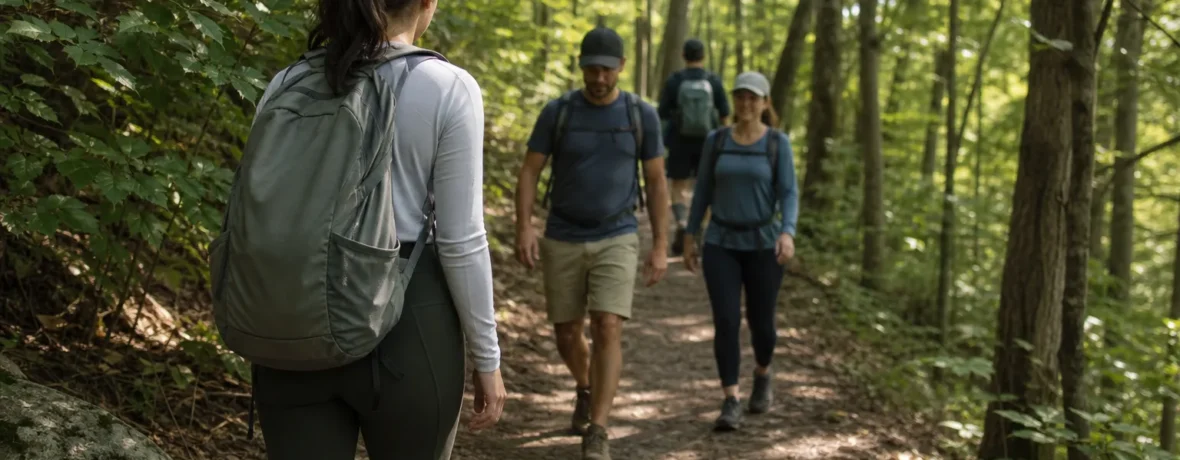
Hiking etiquette for groups means staying single file on narrow trail, yielding as one unit, keeping voices low enough for other hikers to pass in peace, taking breaks off the tread, packing out every scrap, and matching the day’s pace to the slowest steady hiker—not the fastest one.
What is hiking etiquette for groups?
It is the shared behavior that keeps your group safe, low-impact, and easy to pass.
A group changes the feel of a trail. Two hikers can usually slide by without drama. Eight hikers spread across switchbacks can block the path, drown out birds, crowd viewpoints, and make other people feel like they just walked into your private event. Good group etiquette fixes that before it starts.
The basics are simple: stay predictable, stay compact, and stay aware. The National Park Service hiking etiquette guidance stresses staying on the trail, yielding properly, and respecting other visitors. The Leave No Trace Seven Principles add the bigger frame: plan ahead, travel on durable surfaces, dispose of waste properly, leave what you find, minimize fire impacts, respect wildlife, and be considerate of others.
For a group, “be considerate” is not a soft idea. It is the whole game. Your crew should move like one courteous organism, not a loose parade of people shouting from bend to bend.
How should a hiking group plan before hitting the trail?
Plan for the slowest hiker and the least experienced person.
That does not mean the day has to be boring. It means the route, pace, start time, gear, and expectations should match the people actually showing up—not the fantasy version of the group.
Before you meet at the trailhead, agree on these details:
- Route: trail name, distance, elevation gain, expected terrain, and bailout options.
- Start time: the time boots move, not the time people start looking for parking.
- Turnaround time: a firm time to head back, summit or no summit.
- Group size: keep it manageable, and split into smaller pods if your crew is large.
- Bathroom plan: use facilities before starting, and know local waste rules.
- Dog plan: confirm whether dogs are allowed and who is handling them.
- Communication: decide how you will regroup if the trail branches or cell service drops.
If the hike is in a national park, national forest, state park, or wilderness area, check the official land manager page before you go. Rules for group size, permits, pets, seasonal closures, fires, and parking can change. If you cannot verify a rule from an official source, do not guess in the group chat. Send the link and make the plan from there.
Who sets the pace on a group hike?
The slowest steady hiker sets the sustainable pace.
Not the person with the lightest pack. Not the trail runner. Not the friend who says, “I’ll just meet you at the top.” A good group pace keeps people close enough to communicate without yelling and slow enough that nobody is quietly getting crushed.
Use this setup:
- Put a calm leader in front. This person watches turns, trail signs, hazards, and the pace.
- Put a reliable sweep in back. The sweep is the last person and makes sure nobody gets dropped.
- Regroup at every junction. Nobody turns until the whole group sees the direction.
- Use short, planned breaks. Frequent 2-minute pauses beat one exhausted 25-minute collapse.
- Check effort, not ego. If someone cannot speak in short sentences while walking, slow down.
Fast hikers can still have fun. Let them carry extra shared gear, scout a safe viewpoint only if the route is obvious, or take photos while others catch up. What they should not do is vanish. A group hike stops being a group hike when half the people do not know where the other half went.
How do groups yield on the trail?
Yield early, clearly, and as one group.
Trail yielding gets messy when every person improvises. One hiker steps left, another steps right, two keep walking, somebody says “you’re fine,” and now a horse, bike, runner, or uphill hiker has to thread a needle through your crew. Don’t make people solve your traffic jam.
General trail-sharing etiquette is that hikers yield to horses, downhill hikers yield to uphill hikers, and cyclists often yield to hikers and horses unless posted rules say otherwise. The U.S. Forest Service trail sharing guidance also emphasizes yielding to horses and communicating calmly around other users.
| Situation | What your group should do | Why it works |
|---|---|---|
| Uphill hikers approaching | Step aside together where the trail is durable and safe | Uphill hikers are working harder and may have less rhythm to spare |
| Horse or mule approaching | Stop, speak calmly, and follow the rider’s instructions | Stock animals can spook at sudden movement or silent figures |
| Trail runner coming from behind | Call “runner back,” move single file, and let them pass | Clear communication prevents shoulder bumps and surprise passes |
| Narrow ledge or drop-off | Wait at the wider spot before entering | The safest yield happens before the pinch point |
When your group yields, avoid stepping onto fragile plants, muddy edges, cryptobiotic soil, or steep loose slopes. If there is no safe place to step off, stop at the next durable wider spot and wave the other party through.
How loud is too loud on a group hike?
If strangers can hear your conversation for more than a few seconds, lower the volume.
Noise carries outdoors, especially across water, through canyons, and on still mornings. A big group does not need to whisper, but it should not turn the trail into a moving tailgate.
Good sound etiquette looks like this:
- Talk in normal voices, not parking-lot voices.
- Do not blast music from speakers.
- Pause loud jokes when passing other hikers.
- Use short calls, not long-distance shouting.
- Keep kids close enough that you do not have to yell instructions.
- Let viewpoints feel like viewpoints, not conference rooms.
Headphones are better than speakers, but keep one ear free or the volume low enough to hear bikes, runners, horses, thunder, falling rock, and your own group. The trail is shared space. Sound is part of that space.
What should a group do at breaks, viewpoints, and summits?
Move fully off the trail before stopping.
This is one of the fastest ways to look like you know what you are doing. Do not stop in the middle of the tread to adjust poles, open snacks, peel layers, or take a group photo. Step onto rock, gravel, sand, bare dirt, or another durable surface where you are not blocking movement.
At viewpoints, take your photos and then make room. The best rock, bench, or overlook does not belong to the first group that gets there. If your crew wants a long lunch, pick a durable spot away from the main photo pinch point.
Break etiquette checklist:
- Keep packs, poles, and trekking baskets out of the walkway.
- Do a quick trash check before leaving.
- Keep food secured so wildlife does not get a reward.
- Do not feed birds, squirrels, chipmunks, deer, or any other animal.
- Step away from water sources when washing hands or dealing with food scraps.
- Leave natural objects, antlers, flowers, rocks, and cultural items where they are.
One more thing: watch the “summit sprawl.” A dozen packs dumped across a small high point can block everyone else from arriving. Stack gear tight. Make space. Celebrate without taking over.
How do you handle dogs in a hiking group?
Bring dogs only when they are allowed, controlled, and suited for the trail.
A dog changes group dynamics fast. Some hikers love dogs. Some are afraid of them. Some are allergic. Some are managing reactive dogs of their own. Wildlife does not care how friendly your dog is.
The National Park Service guidance for hiking with pets says to keep pets on a leash where required, pack out pet waste, and check each park’s rules before you go. Many public lands have specific pet restrictions by trail, season, habitat, or land designation.
For group hikes, set dog rules before the trailhead:
- One handler per dog.
- No leash tangles across the trail.
- No letting dogs rush strangers, kids, horses, or other dogs.
- No “he’s friendly” as a substitute for control.
- Pack out every waste bag. Do not leave it for “later” unless you will retrieve it immediately on the return.
- Carry enough water for the dog without counting on creeks.
If one dog makes the group louder, slower, riskier, or less welcome, leave that dog home next time. That is not harsh. That is responsible.
What should you do when the group has different fitness levels?
Split into smaller groups with clear meeting points.
Mixed fitness is normal. The mistake is pretending everyone will naturally move together. They will not. A steep climb, heat, altitude, loose footing, heavy packs, or sore knees can spread a group out within minutes.
Use “pods” instead of one stretched-out line. A pod is a small cluster with similar pace and one person who knows the route. Each pod should have enough water, layers, navigation, light, and basic first aid to function if separated for a short time.
Set rules like these:
- No one hikes alone. If someone stops, at least one person waits.
- Every junction is a full stop. The front pod waits until the back pod arrives.
- Turnaround time beats destination. The clock decides when safety requires it.
- Concerns get said early. Hot spots, dizziness, nausea, knee pain, and fear are not “complaints.” They are information.
- The group adjusts without shaming. Nobody needs a speech about toughness on a recreational hike.
A clean split can make the day better for everyone. One group does the shorter loop. Another continues to the ridge. Both agree on where and when to meet afterward. No guilt. No rescue drama.
What is the right way to pass other hikers as a group?
Pass only when the whole move can happen smoothly and safely.
A single hiker can pass in three seconds. A group of nine cannot. If your group catches a slower party, do not breathe down their necks or stack up silently behind them. Have one person speak in a friendly, clear voice: “Hi there—could we pass when there’s a good spot?”
Then wait. Really wait. Let the other party choose a safe place. When they step aside, pass efficiently, say thanks, and keep moving until your whole group is clear. Do not stop immediately in front of them to adjust snacks or take photos.
If another group wants to pass you, make it easy. One person calls back, “Hikers behind,” and your crew moves single file to the same side when safe. Avoid the classic mistake where the first three people yield and the last four keep wandering down the center of the trail.
How can group leaders prevent bad trail behavior?
Set expectations before anyone takes the first step.
You do not need to act like a drill sergeant. You do need to say the quiet stuff out loud. Many etiquette problems happen because people assume everybody knows the same rules. They don’t.
Give a 60-second trailhead briefing:
- “We’ll stay single file on narrow sections.”
- “Uphill hikers get space.”
- “If we see horses, stop and listen to the rider.”
- “No speakers today.”
- “Take breaks off the trail.”
- “If you need to stop, tell the person behind you.”
- “We regroup at every junction.”
- “Pack out all trash, including peels, shells, and dog bags.”
That little speech saves you from correcting people all day. It also gives quieter hikers permission to speak up when something feels off.
What mistakes make hiking groups look rude?
The worst mistakes are blocking, shouting, littering, and acting surprised that other people exist.
Most rude group behavior is not evil. It is oblivious. Still, the result is the same for everyone else on the trail.
Avoid these common group sins:
- Walking three or four across. Save that for wide paths where passing remains easy.
- Stopping at blind corners. Someone can come around fast and collide with you.
- Taking over bridges. Cross, admire, photograph, then move along.
- Leaving snack trash. Tiny corners of wrappers count.
- Dropping fruit peels. Orange peels, banana peels, and pistachio shells do not belong beside the trail.
- Cutting switchbacks. It damages slopes and teaches everyone behind you to do the same.
- Ignoring posted signs. Closures, restoration areas, and private property boundaries are not suggestions.
- Forcing the summit. A group that cannot turn around is a liability.
If someone in your group slips, correct it casually and immediately. “Let’s move off the trail.” “Single file here.” “Grab that wrapper.” Short. Calm. Done.
How do you keep a large group low-impact?
Break large groups into smaller units and spread out only where the surface can handle it.
Large groups magnify everything: sound, erosion, wildlife disturbance, parking pressure, bathroom lines, and social impact. If your hike has more than a handful of people, think like an event organizer.
Carpool where practical. Arrive early enough that your group is not circling the lot and blocking traffic. Keep the pre-hike meetup away from road crossings, restroom doors, and trailhead signs other people need to read.
On trail, smaller pods reduce congestion. But do not create pods that trample parallel tracks beside the trail. On narrow paths, stay single file. In durable open areas, such as slickrock or gravel bars where travel is allowed, the group may spread out a bit to avoid creating one deep rut.
For restroom and waste issues, follow the local land manager’s rules. In many places, human waste disposal requirements vary by landscape, season, and agency. Desert canyons, alpine zones, river corridors, and heavily used trails may have stricter rules than forested areas. Check official sources before the trip and tell the group what to bring.
What should every group hiker carry?
Every hiker should carry enough personal gear to avoid becoming someone else’s emergency.
Shared gear is helpful, but it should not replace individual basics. If the group gets split, weather changes, or the hike runs long, each person needs enough to stay safe for the conditions.
- Water and a way to carry it securely
- Food plus an extra snack
- Rain shell or insulating layer suited to the forecast
- Sun protection: hat, sunglasses, sunscreen, or sun shirt
- Map, downloaded route, or navigation tool
- Headlamp or small flashlight
- Personal medications and allergy needs
- Small first aid items for blisters and minor scrapes
- Trash bag or zip-top bag for wrappers and waste
- Bathroom supplies that match local rules
The group leader should not be the only prepared person. That creates a fragile plan. A better plan is simple: everyone carries their own basics, and shared items are just backup.
Related reading
- Hiking Groups: How to Find Your People
- Hiking Etiquette: The Unwritten Rules of the Trail
- A Walk in the Woods: Bill Bryson's AT Story vs Reality
- Kids' Hiking Boots: How to Size and When to Buy
FAQ
Should a hiking group stay together the whole time?
Yes, unless you intentionally split into smaller groups with clear leaders, routes, and meeting points. Nobody should be left alone at the back or sent ahead alone without a plan.
Is it rude to play music while hiking with a group?
Yes, if other people can hear it. Use headphones at low volume instead, and keep enough awareness to hear trail users, wildlife, weather, and your group.
Who has the right of way: uphill or downhill hikers?
Uphill hikers usually get the right of way. If your group is descending, step aside together at a safe durable spot and let uphill hikers keep their rhythm.
How many people is too many for a group hike?
It depends on the trail, land manager rules, parking, terrain, and group skill. If your group cannot yield quickly, fit at breaks without blocking the trail, or communicate without shouting, it is too large for that setup.
What should you say when passing other hikers?
Say something short and friendly: “Hi, could we pass when there’s room?” After passing, say “thank you” and keep moving until your full group is clear.
Can beginners join a group hike?
Yes, if the route matches their fitness and the group agrees to support the beginner pace. Choose a shorter trail, explain etiquette before starting, and make it easy for new hikers to speak up early.