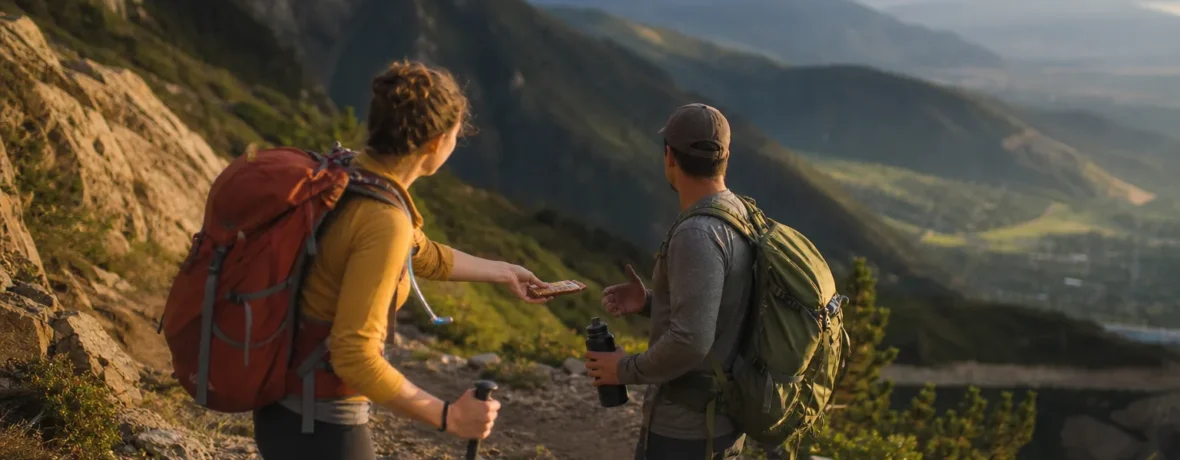
To hike with a slower partner, agree on the day’s goal before you start, let the slower hiker set the moving pace, regroup at every junction, and cap waits at 5-10 minutes. If the faster hiker needs more effort, add safe side trips, extra pack weight, or short out-and-backs.
Mixed-pace hiking can be sweet or miserable. The difference is rarely fitness alone. It is usually expectations. One person thinks the day is a workout. The other thinks the day is a shared walk with snacks, views, photos, and maybe a summit if the legs agree.
Say that out loud before boots hit dirt. A slow hiker who feels dragged will stop having fun. A fast hiker who feels trapped will get twitchy. You can fix both without turning the trail into a race or a couples’ therapy session with trekking poles.
How do you hike with a slower partner?
Let the slower hiker control the group’s moving pace, then build in short, predictable regroup stops.
This is the cleanest rule on trail: the group moves at the speed of the person who has the least spare energy. Not the person with the fanciest watch. Not the person who says, “We’re almost there,” when the map says otherwise. The person working hardest sets the baseline.
Use this simple plan:
- Pick the real goal. Is the goal the summit, a lake, 2 hours outside, or just time together? Choose before you start.
- Set a turnaround time. Decide the latest time you will turn back, even if the destination is still ahead.
- Put the slower hiker near the front. This prevents the accordion effect, where faster people surge ahead and the slower person burns energy catching up.
- Regroup at every trail junction. Nobody guesses which way the others went.
- Keep breaks intentional. Try 2-5 minutes for water and layers, or 10 minutes for food. Long surprise waits cool people down and can annoy both sides.
- Check the tone. “Want to slow down?” lands better than “Can you keep up?”
If the slower person is new to hiking, overloaded, recovering from poor sleep, hiking at altitude, or dealing with heat, the answer is not “push harder.” The answer is adjust the day. Cut miles. Drop elevation gain. Take the loop in the easier direction. Make the hike fit the humans you brought.
Should the slower hiker lead?
Yes, on most narrow trails the slower hiker should lead.
This one move solves half the problem. When the faster hiker leads, even with good intentions, the pace creeps up. The slower hiker falls 20 feet [6 m] behind, then 60 feet [18 m], then 200 feet [61 m]. Now they are hiking alone and wasting energy trying to close the gap.
When the slower hiker leads, the pace becomes smoother. The faster hiker can relax, look around, and stop micro-adjusting. The slower hiker no longer gets a constant visual reminder that they are “behind.”
There are exceptions. On steep descents, the steadier hiker may lead to choose a safe line. In bear country or on confusing terrain, the more experienced navigator may need to lead. If the trail is wide, two people can walk side by side and let conversation set the rhythm.
| Setup | Best for | Watch out for |
|---|---|---|
| Slower hiker leads | Most day hikes, climbs, and social hikes | Faster hiker hovering too close behind |
| Faster hiker leads, then waits | Short, obvious trails with no junctions | Long gaps, wrong turns, resentment |
| Experienced hiker leads | Navigation, rough terrain, poor weather | Pace drifting too fast |
| Side-by-side hiking | Wide paths, easy grades, conversation | Blocking other trail users |
How do you hike with someone faster than you?
Tell them what pace you can hold, ask for regroup points, and refuse to chase.
If you are the slower hiker, your job is not to apologize all day. Your job is to communicate early and hike steadily. A steady pace beats repeated surges. Surging to catch a faster hiker can spike your effort, wreck your breathing, and turn a normal climb into a grind.
Try language that is clear but not dramatic:
- “I can hold this pace for the climb. If I go faster, I’ll burn out.”
- “Please wait at junctions, not random spots where I can’t see you.”
- “If you want extra effort, take the viewpoint spur and meet me back here.”
- “I’m good to keep going, but I need 3 minutes for water.”
Use the talk test to check effort. The CDC’s guide to measuring physical activity intensity describes moderate effort as a level where you can talk but not sing, while vigorous effort makes talking harder. On a social hike, most people do better staying near that moderate zone except for short climbs.
Also, do not let pride choose your pack. If your faster partner is stronger and willing, they can carry a little more shared weight: water filter, stove, group shelter, or part of the food. That is not charity. That is group management.
What should the faster hiker do without being annoying?
The faster hiker should stop performing impatience.
No sighing. No jogging ahead and standing with arms crossed. No “You’re doing great” every 90 seconds in a tone usually reserved for toddlers. Encouragement is good. Condescension is poison.
Better moves:
- Start slower than you want. Give everyone 15-20 minutes to warm up before judging the pace.
- Offer choices, not pressure. Say, “Want to take the ridge spur or save it?” instead of “We should have time.”
- Use extra energy productively. Filter water, check the map, take photos, adjust layers, or scout the next safe rest spot.
- Do mini out-and-backs only when safe. Run or hike ahead to a visible landmark, then return. Never do this at junctions, in poor visibility, or where the group may need help.
- Carry more if it makes sense. Taking 2-5 lb [0.9-2.3 kg] from the slower hiker can change the whole day.
If you need a hard workout, say that before the hike and pick the right partner or route. A recovery-paced hike with someone you care about is not failed training. It is a different activity.
What is a good hiking pace for a group?
A good group hiking pace is the fastest pace the slowest hiker can hold while still eating, drinking, talking in short sentences, and staying coordinated.
Miles per hour can help with planning, but it can also lie to your face. A group may cruise on flat trail, then slow sharply on loose rock, heat, mud, snow, or steep grades. A 3-mile [4.8 km] hike with 1,500 feet [457 m] of gain can feel harder than a 6-mile [9.7 km] path with gentle rollers.
Instead of worshiping pace, track these signs:
- The slower hiker can answer a question without stopping every few words.
- Foot placement stays clean, not sloppy.
- Snack and water breaks happen before someone gets shaky or cranky.
- The group reaches junctions together or regroups within 5-10 minutes.
- Everyone still has energy for the descent, not just the summit photo.
Downhill counts. Many fast uphill hikers become slow downhill hikers because knees, balance, or loose tread change the game. Do not tease them. Today’s mountain goat can be tomorrow’s cautious stepper.
How do you plan a hike for different fitness levels?
Choose the route for the least experienced hiker, then add optional challenge for the stronger hiker.
The route should have bailouts, shade when possible, clear navigation, and a destination that still feels good if you turn around early. Out-and-back trails are easier to manage than committing loops. A loop can trap you into finishing the whole thing even when the group has already had enough.
Use this pre-hike checklist:
- Distance: Pick a route the slower hiker can finish without needing a heroic push.
- Elevation gain: Treat steep gain as the real difficulty, not just mileage.
- Terrain: Rock, sand, roots, snow, and mud slow people more than smooth dirt.
- Weather: Heat, wind, rain, and cold widen the pace gap.
- Daylight: Start early enough that a slower pace does not become a headlamp problem.
- Water: Know whether water sources exist and whether they are reliable before you count on them.
- Exit options: Favor trails where you can shorten the day without drama.
For the faster hiker, add optional work that does not punish the slower hiker: carry more shared gear, take a safe spur trail, do a short climb while the other person snacks, or schedule a separate workout later. Do not turn the shared hike into a stealth fitness test.
How do you stop resentment on mixed-pace hikes?
Name the mismatch before it becomes a mood.
Most resentment starts quietly. The faster hiker thinks, “We’re moving too slowly.” The slower hiker thinks, “They’re mad at me.” Nobody says anything. Then the snack break feels weird, the summit feels tense, and the car ride home has the emotional temperature of wet socks.
Use these rules:
- No disappearing. If you cannot see or hear each other, you need agreed regroup points.
- No fake “almost there.” If it is 1.4 miles [2.3 km] and 800 feet [244 m] of gain, say that.
- No surprise pace goals. If someone wants to average a certain speed, that belongs in the planning conversation.
- No shame breaks. People can stop to breathe, eat, pee, adjust socks, or stare at a bird. That is hiking.
- No summit-or-bust ego. Turning around is a normal trail skill.
One strong line helps: “We hike together, or we agree exactly when we are splitting and where we meet.” Anything else creates confusion.
Is it okay to split up on trail?
Sometimes, but only with a clear plan and low consequences.
Splitting up can work on a familiar, well-marked trail in good weather when both people have navigation, layers, water, food, and the skills to get back alone. It is a bad idea when the route has confusing junctions, river crossings, exposure, snow, extreme heat, limited daylight, or spotty communication.
If you split, agree on:
- The exact destination or turnaround point.
- The exact trail or route each person will use.
- A latest turnaround time.
- A latest meetup time.
- What to do if one person is not there.
- Who has the keys.
That last one matters more than people admit.
Do not leave the slower hiker without essentials because “it’s only a mile.” Each person should keep basic layers, light, water, food, and navigation. A phone map is helpful, but a drained battery turns helpful into decorative.
How do you handle breaks when one person is faster?
Make breaks frequent enough for the slower hiker and short enough that the faster hiker does not get cold or stiff.
The worst pattern is this: the faster hiker powers ahead, waits 15 minutes, gets chilled, then starts again the second the slower hiker arrives. The slower hiker never rests. The faster hiker only waits. Both lose.
Try this instead:
- Regroup at a landmark.
- Start the break when the last person arrives.
- Say the break length out loud: “Five minutes here.”
- Use breaks for tasks: drink, snack, layer, sunscreen, map check.
- Take one longer food break instead of endless random stops.
In cold weather, waiting gets serious fast. The faster hiker should add a layer before cooling down. The slower hiker should get a real rest before the group moves again. Fair is not everyone doing the same thing. Fair is everyone getting what they need to keep moving safely.
When to see a doctor
Get medical help right away for chest pain, fainting, confusion, severe shortness of breath, or heat illness symptoms that do not improve after stopping and cooling.
Hiking with different paces is usually a planning problem, not a medical problem. Still, pay attention when someone’s pace drops sharply for no clear reason. The Mayo Clinic’s exercise intensity guidance says pain, being short of breath, or being unable to work out as long as planned can mean the effort is above your current fitness level.
Heat changes the stakes. The NIH MedlinePlus heat illness page lists symptoms such as dizziness, nausea, confusion, and a rapid strong pulse among warning signs of heat illness. The Wilderness Medical Society heat illness guidance recommends minimizing dehydration and using oral fluids for mild to moderate heat illness when the person can drink safely.
Do not diagnose your partner on trail. Stop, cool down, get out of the sun or wind, and seek medical care if symptoms are severe, unusual, worsening, or not improving. If someone is confused, faints, has chest pain, or cannot walk normally, treat it as urgent.
What should you say before hiking with a slower or faster partner?
Say the awkward stuff early, while everyone is still clean, fed, and cheerful.
Here is a quick script you can steal:
- “What kind of day do we want: workout, scenery, summit, or relaxed time outside?”
- “Who wants to set the pace?”
- “Where will we regroup?”
- “What time do we turn around?”
- “Are we staying together the whole time?”
- “If one of us feels off, are we both okay changing the plan?”
That last question is the whole thing. Good hiking partners do not need identical fitness. They need compatible expectations. A fast hiker can be generous. A slow hiker can be steady. Both can be honest.
The best mixed-pace hikes feel like a shared project. You adjust. You laugh. You eat something salty. You get where you get, and everyone still likes each other at the trailhead.
Related reading
- A Walk in the Woods: Bill Bryson's AT Story vs Reality
- Kids' Hiking Boots: How to Size and When to Buy
- Mountain Porters: The People Who Carry Expeditions
- Teaching Leave No Trace to Kids
FAQ
How do I tell my hiking partner they are too slow?
Be direct without making it personal. Say, “I was hoping for a faster workout today; next time let’s pick a shorter route or agree on places where I can add extra distance.”
Is it rude to hike ahead of a slower partner?
It is rude if you have no plan, no regroup points, or leave them guessing. It is fine if you both agree on the route, timing, safety plan, and meetup spot.
Should couples hike at the same pace?
No, couples do not need the same natural pace. They need a shared system: slower hiker leads, faster hiker adds challenge safely, and both agree that the relationship matters more than the split time.
What if I am always the slowest hiker?
Own your pace and choose partners who respect it. Start with easier routes, carry less weight when possible, use steady effort, and avoid chasing people who turn every hike into a race.
Can a faster hiker get a workout with a slower partner?
Yes, if they add challenge without pressuring the group. Carry extra shared gear, take short safe out-and-backs, add a spur trail, or treat the day as low-intensity time outside.