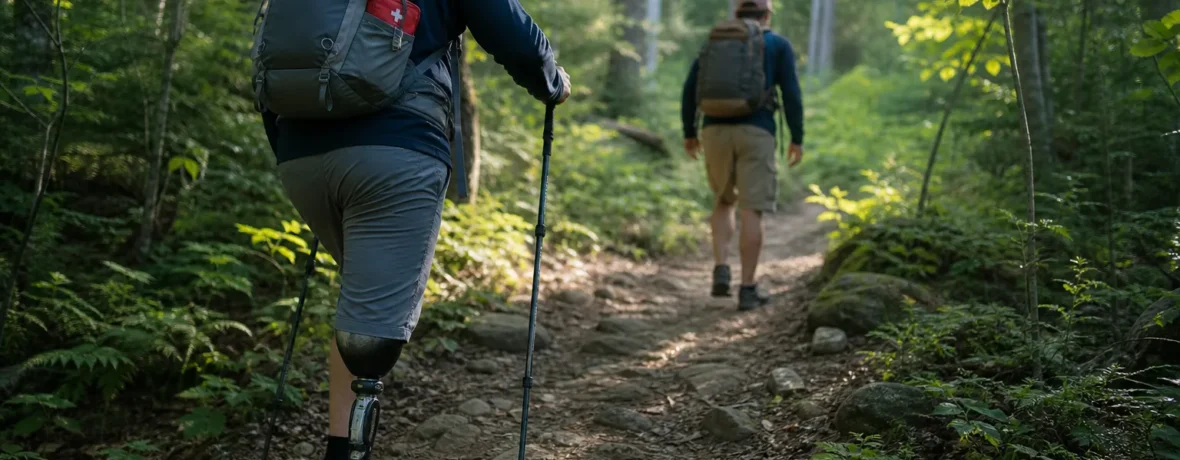
Hiking with a disability is possible on many U.S. trails when the route, surface, grade, distance, weather, transportation, bathrooms, and backup plan fit your body. U.S. citizens or residents with a medically determined permanent disability may qualify for a free lifetime federal Access Pass, with online order fees verified as of November 2026.
Can you go hiking with a disability?
Yes, you can go hiking with a disability if the trail and plan match your access needs.
That answer sounds simple because it is. The hard part is not proving you belong outside. The hard part is finding the right trail information before you burn energy getting there.
Disability covers a wide range of bodies and brains: mobility disabilities, limb differences, chronic illness, low vision, blindness, Deafness, hearing loss, neurodivergence, intellectual disabilities, pain conditions, balance issues, heart and lung conditions, and more. A trail that works beautifully for one person can be a poor fit for another. A paved 0.5-mile [0.8 km] loop with benches may be ideal for one hiker and too exposed, too noisy, too steep, or too far from a restroom for someone else.
Start with this mindset: you are not looking for the “easiest” trail. You are looking for the most honest match. Honest means the trail description tells you surface, grade, width, cross slope, parking, restroom access, shade, seating, cell coverage, and how far you must go before you can turn around safely.
The CDC physical activity guidance for adults with disabilities says some activity is better than none and recommends talking with a health care professional or physical activity specialist about the right type and amount of activity if you have a chronic condition or disability. That fits hiking well. You can scale a hike down to 10 minutes, choose a flat boardwalk, use a wheelchair, hike with a cane, take long breaks, or plan a picnic at the first viewpoint.
What makes a trail accessible?
An accessible trail gives you enough reliable information to decide if you can use it safely.
Do not stop at the word “accessible.” It can mean different things on different websites, signs, and apps. One park may use it for a paved lakeside path. Another may use it for a crushed-stone trail with short steep pitches, narrow turns, and seasonal washouts. Ask for details.
On federal outdoor sites, the U.S. Access Board’s outdoor developed area guidance says new trailhead information signs for newly built or altered pedestrian trails must include the trail or segment length, surface type, typical and minimum tread width, typical and maximum grade, and typical and maximum cross slope. The same U.S. Access Board outdoor developed areas guide describes technical standards for certain federal trails, including a minimum clear tread width of 36 inches [91 cm] where the standards apply, with passing spaces when narrower trails do not allow two mobility devices to pass.
That does not mean every trail in the country meets those numbers. Many old trails do not. Wilderness routes, backcountry paths, state parks, county trails, private preserves, and volunteer-built paths may follow different rules or have exceptions. Use the standards as a checklist for what to ask.
| Trail detail | Why it matters | What to ask before you go |
|---|---|---|
| Surface | Asphalt, boardwalk, packed gravel, sand, roots, snow, and mud all move differently under feet, wheels, crutches, and canes. | Is the surface firm and stable right now? |
| Grade | A short steep ramp can be harder than a long gentle path. | What is the maximum grade, and how long does it last? |
| Width | Mobility devices, service dogs, guides, and hiking partners need room to move and pass. | What is the narrowest point on the trail? |
| Facilities | Parking, restrooms, benches, shade, and water can decide the whole day. | Are accessible parking and restrooms open today? |
How do you choose an accessible hiking trail?
Choose the trail by barriers first, scenery second.
Pretty photos do not tell you enough. A waterfall shot may hide 30 stairs. A “family-friendly” loop may have loose gravel that catches small front casters. A “short” trail can still be too hot, too exposed, too loud, or too far from help.
Use this step-by-step filter before you commit:
- Define your non-negotiables. Examples: no stairs, firm surface, restroom within 300 feet [91 m] of the trailhead, shade every 0.25 mile [0.4 km], low crowd noise, no stream crossings, or a turnaround every 10 minutes.
- Check the official land manager page. Look for the park, forest, refuge, city, county, or preserve website. Social posts and trail apps help, but official pages are better for closures, permits, and facility status.
- Call the visitor center or ranger station. Ask specific questions. “Is it accessible?” is too broad. Try: “Is the boardwalk open from the accessible parking spaces to the overlook, and are there any steps?”
- Read recent condition reports. Storms, fire damage, snow, flooding, algae, heat, and construction can change an accessible route overnight.
- Plan the turnaround before the start. Pick a time or landmark where you will turn back even if the group wants to keep going.
- Save the offline map. Download it before you lose signal. Mark parking, restrooms, benches, shade, exits, and the nearest staffed building.
The best trail choice often feels almost too modest on paper. Good. A clean win beats a heroic sufferfest.
What passes are available for hikers with disabilities?
The main federal pass is the America the Beautiful Access Pass.
As of November 2026, the USGS Access Pass page describes the Access Pass as a free lifetime pass for U.S. citizens or residents who have been medically determined to have a permanent disability that severely limits one or more major life activities. The disability does not have to be rated 100%.
The pass covers entrance or standard amenity fees at more than 2,000 federal recreation sites managed by six federal agencies, including the National Park Service, U.S. Forest Service, Bureau of Land Management, U.S. Fish and Wildlife Service, Bureau of Reclamation, and U.S. Army Corps of Engineers. At many sites, the pass owner may also receive a discount on expanded amenity fees, such as camping, swimming, boat launching, or guided tours. Ask the specific site before you count on a discount.
Here is the straight version:
- The pass is for the pass holder. It is not transferable.
- It is lifetime. You do not renew it every year.
- It is not a parking placard. It does not replace state accessible parking permits.
- It does not erase every cost. Reservation fees, permits, concessions, cabins, group sites, and special activities may still cost money.
- You still need local permits where required. Examples may include timed-entry reservations, backcountry permits, shuttle tickets, or day-use reservations.
How do you get the America the Beautiful Access Pass?
You get it online through USGS or in person at participating federal recreation sites.
As of November 2026, USGS lists the Access Pass itself as free, with a $12.50 shipping and handling cost for a physical online order. The same official page says you must upload identification and documentation of permanent disability for an online order. USGS also says receipts, photos, or copies of the pass are not valid for use, so wait for the physical pass if that is the version you ordered.
Acceptable disability documentation listed by USGS includes examples such as a statement from a licensed physician, a document from a federal agency such as Veterans Affairs, Social Security Disability Insurance, or Supplemental Security Income, or a document from a state agency such as a vocational rehabilitation agency. For a physician statement, USGS says the statement must address that the individual has a permanent disability, that it severely limits one or more aspects of daily life, and the nature of those limitations.
Before you drive to get one in person, call the site. Not every entrance station, visitor center, or office issues passes every day. Staffing changes. Hours shift. Printers fail. Ask what documents they accept and whether the pass can be issued at that location on the date you plan to arrive.
Does the Access Pass cover national parks, forests, and other federal lands?
Yes, it covers many federal recreation sites, but not every outdoor cost.
The National Park Service accessibility page explains that the Access Pass provides benefits on federal lands managed by six agencies and includes free entrance to National Park Service sites that charge entrance fees. That is a big deal if you visit national parks, national forests, wildlife refuges, BLM lands, Corps lakes, or Bureau of Reclamation sites.
Still, read the fine print for the exact destination. A national park entrance fee is different from a campground reservation fee. A standard day-use fee is different from a guided cave tour. A federal pass may not cover a private shuttle, concession-run boat, special recreation permit, or state park entrance next door.
Use this quick pass check before booking:
- Who manages the land: federal, state, county, city, tribal, nonprofit, or private?
- Is the fee an entrance fee, standard amenity fee, reservation fee, permit fee, or concession fee?
- Does the pass holder need to be present?
- Do you need a separate timed-entry reservation?
- Does the site offer accessible campsites, shuttles, fishing piers, beach wheelchairs, loaner mobility devices, or sensory guides?
What should you pack for hiking with a disability?
Pack for the trail you are actually doing, not the trail description you wish were true.
Adaptive hiking gear can be simple: a cane tip that grips wet boardwalk, gloves for wheelchair pushing, a cooling towel, trekking poles, sunglasses, ear protection, a printed communication card, or a battery bank. It can also be specialized: an all-terrain wheelchair, adaptive crutches, a handcycle, a white cane, a GPS device with audio prompts, or a service dog setup.
Build your kit around your body’s patterns. Heat sensitivity? Shade, cooling, water, and early starts matter. Low vision? Contrast, lighting, guide technique, and audio maps matter. Chronic pain? Seating, pacing, medication storage, and a shorter exit matter. Deaf or hard of hearing? Visual alerts, written emergency info, and clear group signals matter.
A practical trail checklist:
- Offline map with parking, restrooms, benches, water, exits, and ranger stations marked
- Weather protection: sun hat, rain shell, warm layer, or cooling gear
- Water and snacks that are easy to open and eat
- Any personal medical supplies you already use, packed in a protected place
- Repair items for mobility devices, such as tire tools, spare tips, charger, straps, or tape
- Headlamp or small flashlight, even for daytime hikes
- Whistle, ID, emergency contacts, and written health information you want rescuers to know
- Service dog supplies if applicable: water bowl, waste bags, booties, food, and vaccination or access documentation where useful
- Comfort items for sensory regulation, communication, warmth, or pain management
How do you plan bathrooms, parking, and transportation?
Plan the unglamorous details first because they decide how the hike feels.
Accessible parking does not guarantee an accessible trailhead. You may still face a steep curb cut, gravel between the van space and restroom, a heavy bathroom door, or a shuttle that cannot carry your mobility device. Ask early.
If a park uses shuttles, find out if accessible vehicles run on the same schedule, where boarding happens, and whether you need to reserve space. If the trailhead parking fills before sunrise, ask about drop-off zones. If you use paratransit, rideshare, or a friend’s vehicle, confirm the exact pickup spot before you lose service.
Bathrooms deserve the same attention. Ask if they are flush toilets, vault toilets, portable toilets, or visitor center restrooms. Ask if they are open year-round. Ask about the route from parking to the restroom: paved, gravel, boardwalk, slope, distance, and lighting.
Then build a backup plan. A good backup is not failure. It is how you keep the day from turning sour. Pick a second trail, a shorter overlook, a picnic area, or a scenic drive stop that still gives you time outside if the first route is blocked, crowded, flooded, icy, smoky, or too hot.
When to see a doctor
See a doctor before hiking if your symptoms, condition, or medications could make exertion risky.
This is not about asking permission to be outdoors. It is about getting useful boundaries: effort level, heat limits, altitude concerns, hydration needs, warning signs, mobility-device fit, brace use, fall risk, rescue planning, and what to do if symptoms flare.
Talk with a health care professional or physical activity specialist if you have a new disability, a recent surgery or injury, chest pain, fainting, unexplained shortness of breath, seizures, severe dizziness, unstable blood sugar, a heart or lung condition, a condition affected by heat or cold, or a major change in pain, fatigue, balance, vision, or cognition. The CDC specifically recommends that adults with chronic conditions or disabilities consult a health care professional or physical activity specialist about appropriate types and amounts of physical activity.
Bring the trail details to the appointment. “Can I hike?” is too vague. Better: “Can I do a 1-mile [1.6 km] paved loop with 80 feet [24 m] of gain, benches every 0.2 mile [0.3 km], and temperatures around 75°F [24°C]?” That gives your clinician something real to work with.
How can hiking partners help without taking over?
Partners should ask, listen, and follow your lead.
Good support is specific. Bad support grabs, rushes, speaks over you, or turns your hike into a rescue drill. Before the trail, talk through pace, communication, physical assistance, rest breaks, service dog boundaries, photo preferences, privacy, and what to do if plans change.
Use clear agreements:
- Ask before touching a person, mobility device, pack, cane, or service dog.
- Let the disabled hiker set the pace unless there is an immediate safety issue.
- Share trail information plainly: grade, obstacles, sounds, crowds, weather, and distance.
- Do not minimize pain, fatigue, sensory overload, or access barriers.
- Keep group goals flexible. The hike is not ruined because the turnaround happens early.
If you are the hiker with a disability, you do not owe the group a full medical history. Share what helps the hike run well. That can be as simple as: “I need a 5-minute stop every 15 minutes,” “Do not pull my chair unless I ask,” “Tell me before steep descents,” or “If I go quiet, I need less talking, not more questions.”
Where can you find disability hiking resources?
Start with official land managers, then add community knowledge.
Official sites are best for fees, closures, pass rules, road access, construction, permits, and facility status. Community groups are often better for lived details: how rough the gravel feels, whether the “accessible” restroom door is heavy, which overlook has shade, or where crowds are loudest.
Useful places to look include:
- National park accessibility pages for specific parks
- National forest and BLM recreation pages
- State park accessibility pages
- City and county park departments
- Adaptive sports organizations
- Disability-led hiking groups and local Facebook groups
- Trail apps with recent photos, but only after checking official conditions
- Visitor centers, ranger stations, and accessible travel offices
When you find a good route, save the details for next time. Note the date, weather, surface, bathroom status, parking, barriers, rest spots, and what you would change. Your own trail notes become your best guidebook.
Related reading
- National Park Access Pass for People With Disabilities
- A Walk in the Woods: Bill Bryson's AT Story vs Reality
- Kids' Hiking Boots: How to Size and When to Buy
- Mountain Porters: The People Who Carry Expeditions
FAQ
Can disabled people get into national parks for free?
Yes, many can if they qualify for the America the Beautiful Access Pass. As of November 2026, the pass is available to U.S. citizens or residents with a medically determined permanent disability and covers entrance or standard amenity fees at many federal recreation sites.
Does the Access Pass work at state parks?
No, not usually. The Access Pass is a federal recreation pass, so state parks, county parks, city parks, tribal parks, and private preserves may have their own disability passes, discounts, or parking rules.
Are ADA hiking trails always wheelchair accessible?
No, the label alone is not enough. Check surface, grade, width, cross slope, obstacles, bathrooms, parking, and current conditions before you go.
What is the best distance for a first accessible hike?
The best first distance is short enough that you can finish with energy left. For many hikers, that may mean a 0.25- to 1-mile [0.4- to 1.6-km] route with a planned turnaround, but your ideal distance depends on your body, gear, weather, and support.
Can I hike with a service dog?
Yes, service dogs are generally allowed in many public outdoor areas where pets may be restricted, but rules can vary by land manager and situation. Check the official site before you go, especially for wildlife areas, shuttles, caves, beaches, or sensitive habitats.
What should I ask a ranger before hiking with a disability?
Ask for facts, not labels. Good questions include: “What is the narrowest trail width?”, “Are there steps or steep cross slopes?”, “Is the accessible restroom open?”, “Is the surface firm after rain?”, and “Where is the safest turnaround?”