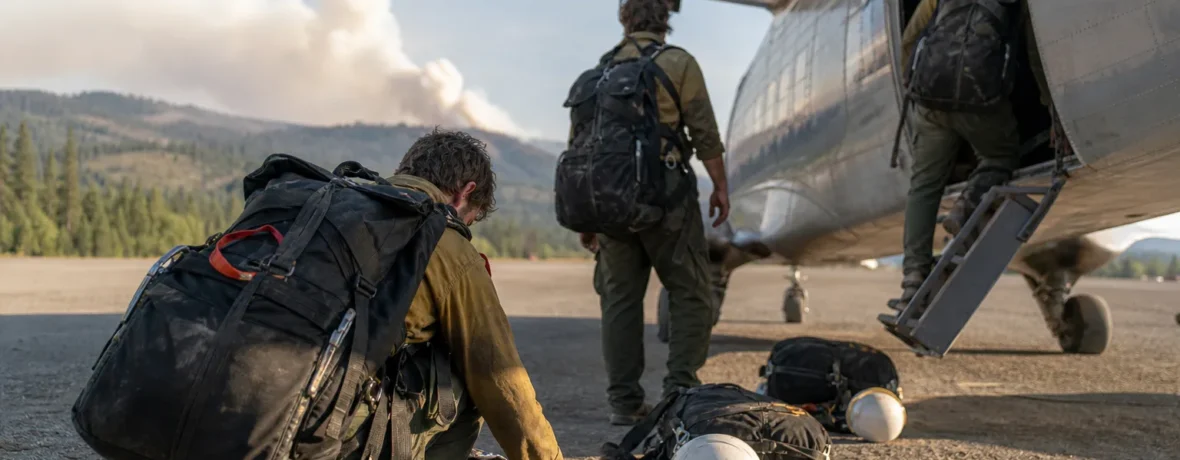
A smokejumper is an experienced wildland firefighter who parachutes from a fixed-wing aircraft into remote wildfire starts, often landing near fires before ground crews can hike or drive in. In the U.S., federal smokejumpers typically exit aircraft near 3,000 feet [914 m] above ground and carry firefighting gear, food, tools, and survival equipment.
What is a smokejumper in wildland firefighting?
A smokejumper is a fast-response firefighter for hard-to-reach wildfires. The job exists for one blunt reason: some fires start where roads don’t go.
Think lightning strike in steep timber. A smoke report comes in from a lookout, aircraft, satellite detection, or a member of the public. If the fire is small enough and remote enough, smokejumpers may be loaded into a plane and flown toward it. They jump, land, gather their gear, hike to the fire, and start building fireline before the fire gets legs.
The National Interagency Fire Center describes smokejumpers as wildland firefighters trained to reach remote fires by parachute, with rookie training in parachuting, aircraft safety, firefighting tactics, tree climbing, cargo delivery, chainsaw work, and more.
What does a smokejumper actually do after landing?
They fight the fire with hand tools, saws, water, dirt, and smart positioning. No magic. No superhero cape. Just hard, dirty work in a place where help may be hours away.
Once on the ground, smokejumpers move fast but not blindly. Fire behavior, wind, slope, fuels, escape routes, and safety zones all matter. A tiny fire in grass can turn mean when wind stacks up. A slow-looking fire in timber can throw embers uphill and trap careless crews.
- Exit the aircraft. Jumpers leave the plane one at a time after a spotter checks wind, terrain, hazards, and the jump spot.
- Land and clear the chute. They secure the parachute, check themselves and nearby jumpers, then move toward cargo.
- Collect tools and supplies. Cargo boxes may include chainsaws, hand tools, water, pumps, hose, food, radios, and overnight gear.
- Size up the fire. They read flame length, fuels, slope, weather, and where the fire is most likely to run.
- Build and hold fireline. They scrape, cut, dig, buck logs, remove fuels, and use water where they can.
- Mop up. They cool hot spots, stir ash, cut burning roots, and make sure the fire won’t wake up after they leave.
- Pack out. When the assignment ends, they may hike heavy loads to a road, trailhead, helicopter pickup, or another extraction point.
How do smokejumpers get to remote fires?
Smokejumpers fly in fixed-wing aircraft and parachute near the fire. According to NIFC’s smokejumper aircraft information, smokejumper aircraft deliver firefighters and cargo for initial attack and extended support, and common aircraft can carry eight to ten smokejumpers plus initial gear.
The plane does not drop them into flames. That makes good movie footage and bad tactics. The goal is to land in a safer opening close enough to reach the fire on foot. Meadows, ridges, old burns, gravel bars, and open timber can all become jump spots if the spotter approves them.
The cargo follows by parachute, too. That matters. A smokejumper without tools is just a person in the woods wearing a lot of padding.
Is a smokejumper the same as a hotshot?
No. Smokejumpers and hotshots are both elite wildland firefighters, but they reach fires in different ways and are used differently.
| Fire crew type | How they arrive | Typical role |
|---|---|---|
| Smokejumpers | Parachute from fixed-wing aircraft | Rapid initial attack on remote fires; short-term support on larger incidents |
| Hotshot crews | Vehicles, hiking, sometimes aircraft support | Large-fire handline construction, burnout operations, tough extended assignments |
| Helitack crews | Helicopter | Initial attack, bucket work, crew shuttle, remote access without parachuting |
| Engine crews | Wildland fire engines | Road-access fires, hose lays, structure protection, patrol, initial attack |
The National Park Service wildland fire jobs guide says smokejumpers are specialized, experienced firefighters who parachute into remote areas for initial attack, while helitack crews specialize in helicopter operations. Different tools. Different delivery. Same bigger mission.
How hard is smokejumper training?
Smokejumper training is brutally selective. You need fire experience first, then you need to prove you can run, pack, climb, think, and work when your body is cooked.
As of November 2026, the BLM Great Basin Smokejumpers recruitment page says smokejumper positions are not entry-level jobs, and previous parachute training is neither required nor an advantage. Fireline skill comes first.
That surprises plenty of hikers. Being brave enough to jump is not the main filter. Agencies can teach parachute procedures. They want people who already understand fire behavior, tools, crew discipline, radio traffic, long shifts, bad sleep, and the weird mental math of working in steep country with weather changing over your shoulder.
As of November 2026, BLM Great Basin lists these first-day rookie training physical standards:
- Run 1.5 miles [2.4 km] in 10:47 or less
- Complete 6 pull-ups
- Complete 30 push-ups
- Carry 110 pounds [50 kg] on level terrain in 65 minutes or less
Those are minimums, not a victory lap. The same BLM page lists higher target standards, including 10 pull-ups, 35 push-ups, and a 110-pound [50 kg] pack over 3 miles [4.8 km] in 55 minutes or less. That should tell you how serious the fitness culture is.
What gear does a smokejumper carry?
A smokejumper carries parachute gear, protective clothing, firefighting tools, survival supplies, and enough personal kit to work away from roads. The exact load changes by agency, aircraft, fire assignment, weather, and terrain.
During the jump, they wear padded protective clothing and a helmet. After landing, they switch from parachute mode into firefighter mode. The pack gets real heavy in a hurry.
- Parachute system and reserve
- Jump suit, helmet, gloves, and boots
- Fire shelter and standard wildland PPE
- Hand tools such as Pulaskis, shovels, and fusees when assigned
- Chainsaws and fuel, depending on the mission
- Radio, maps, compass or GPS tools
- Food, water, sleeping gear, and extra layers
- First-aid supplies and repair items
On the hiking side, this is where the job earns respect fast. A backpacking trip with 35 pounds [16 kg] feels honest. A smokejumper may jump with heavy protective gear, then later pack firefighting equipment out through blowdown, ash, alder, talus, or steep timber.
Where do smokejumpers work in the United States?
U.S. smokejumpers work mainly from federal bases in the West and Alaska. NIFC lists U.S. Forest Service bases in Missoula, Montana; Redmond, Oregon; Winthrop, Washington; Redding, California; McCall, Idaho; West Yellowstone, Montana; and Grangeville, Idaho, plus Bureau of Land Management bases for Great Basin and Alaska smokejumpers.
They are national resources, not backyard-only crews. A jumper based in Idaho may end up in Alaska, Oregon, Nevada, Montana, New Mexico, or another state when fire activity and dispatch priorities call for it. They can also support prescribed fire and hazardous fuels work when not chasing new starts.
How dangerous is smokejumping?
Smokejumping is dangerous, but the danger is managed through training, standards, equipment, and conservative decision-making. The risks come from two jobs stacked together: parachuting into rough country, then fighting wildfire.
Landing hazards include trees, rocks, deadfall, uneven ground, shifting wind, and tight openings. Fireline hazards include heat, smoke, rolling material, snags, chainsaws, dehydration, fatigue, lightning, and changing weather. Add isolation. Add heavy packs. Add the pressure of catching a fire while it is still small.
That is why the job is not built for thrill seekers. A good smokejumper is aggressive when it helps and cautious when it matters. The best ones know when to dig in, when to move, and when a fire is no longer worth the risk.
How do you become a smokejumper?
You become a smokejumper by first becoming a strong wildland firefighter. Start on an engine, hand crew, fuels crew, helitack crew, or hotshot crew, then build the fire experience and fitness to compete for a rookie smokejumper slot.
A clean path looks like this:
- Get seasonal wildland fire experience. Learn tools, hose lays, saw work, fire behavior, and crew life.
- Earn basic qualifications. Agencies look for firefighters who already know the fireline, not total beginners.
- Build mountain-grade fitness. Run, hike steep terrain, carry weight, do pull-ups, and train legs for downhill punishment.
- Apply through federal hiring channels. Most federal wildland fire jobs are posted through USAJOBS or agency-specific recruitment pages.
- Pass the medical and physical standards. Rookie candidates must show up fit on day one.
- Complete rookie training. You have to pass parachute, aircraft, firefighting, cargo, tree, and field-performance training before you are a qualified jumper.
If you are a hiker looking at this career from the outside, your trail fitness helps, but it is not enough by itself. Long climbs are useful. So is moving confidently off trail. But smokejumping adds chainsaws, radio discipline, fire weather, aviation procedures, and hard labor under command structure. It is mountain fitness with consequences.
Related reading
- A Walk in the Woods: Bill Bryson's AT Story vs Reality
- Kids' Hiking Boots: How to Size and When to Buy
- Mountain Porters: The People Who Carry Expeditions
- Teaching Leave No Trace to Kids
FAQ
Do smokejumpers jump directly into fire?
No. Smokejumpers aim to land in a safer opening near the fire, not in the flames. After landing, they gather tools and hike to the fireline.
Do you need skydiving experience to become a smokejumper?
No. As of November 2026, BLM Great Basin says previous parachute training is neither required nor advantageous. Firefighting experience and fitness matter more.
Are smokejumpers federal employees?
Usually, yes in the United States. Federal smokejumpers are hired by the U.S. Forest Service and the Bureau of Land Management, though they can respond to fires across different public lands.
How high do smokejumpers jump from?
NIFC says smokejumper aircraft fly near 3,000 feet [914 m] above ground for Bureau of Land Management and U.S. Forest Service smokejumpers using square parachutes. The exact operation depends on aircraft, terrain, wind, and agency procedures.
What is the main job of a smokejumper?
The main job is initial attack on remote wildfires. Smokejumpers try to reach small fires quickly, contain them early, and keep them from becoming large incidents.
Can women be smokejumpers?
Yes. Women can be smokejumpers if they meet the same hiring, experience, medical, training, and fitness standards. The job is demanding, but it is not limited by gender.