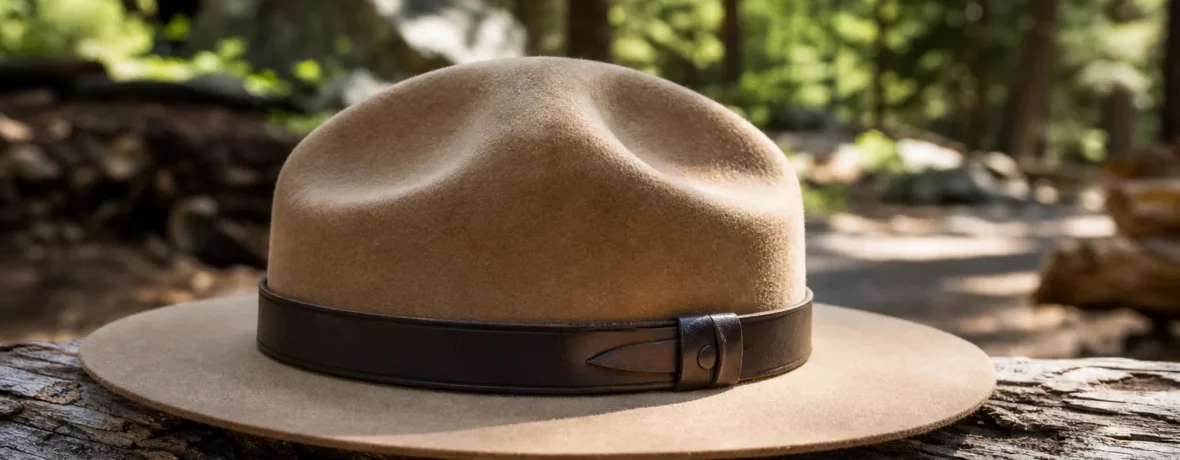
The park ranger hat is a stiff, wide-brimmed campaign hat, often called the “flat hat.” The National Park Service adopted a Stetson-style version with its first official uniform in 1920, and the look still signals ranger authority, public service, trail knowledge, and protection of America’s parks.
You know the shape before you know the name. Flat brim. High pinched crown. Brown band. Calm authority. The hat says, “I know where the trailhead is, and I also know why you shouldn’t pet the bison.”
What is the park ranger hat called?
It is usually called a flat hat, campaign hat, ranger hat, or Stetson-style hat.
Inside the National Park Service, “flat hat” is the plain-spoken nickname. The formal style is a campaign hat: a stiff, broad-brimmed felt or straw hat with a shaped crown. The NPS says the flat hat is probably the best-known part of the ranger uniform and traces the wide-brimmed style to hats worn by Buffalo Soldiers who protected Yosemite in the park’s early years. Read the NPS overview on the iconic flat hat and ranger uniform history.
That “lemon squeezer” crown is the giveaway. Four dents pinch the top into a peak, shedding water and giving the hat its crisp silhouette. It looks ceremonial now, but the bones are practical: shade your face, keep rain off your collar, hold shape in wind, and make a ranger easy to spot from across a visitor center lawn.
When did park rangers start wearing the flat hat?
The NPS made the Stetson-style flat hat part of its first official uniform in 1920.
The National Park Service was created in 1916, but its first official uniform came four years later. According to the NPS History Collection, the 1920 uniform included a Stetson hat with a stiff or cardboard brim in “belly” color, a reddish-buff shade tied to Belgian hare fur used in hat making. See the NPS History Collection note on the first official NPS uniform adopted in 1920.
Before that, rangers were not marching around in one perfectly standardized outfit. Early park protection came from soldiers, scouts, game wardens, forest rangers, and local employees who wore practical outdoor clothes. The flat hat survived because it solved problems. It shaded eyes at altitude, looked official, and stood up to rough field use better than a soft cap.
Why do park rangers wear flat hats?
Rangers wear flat hats because they provide shade, visibility, tradition, and instant identification.
On a hot overlook, that brim is useful. It throws shade over the face and neck. In rain, it moves water away from the eyes. In a crowd, it works like a beacon. If you need directions, first aid, a permit question answered, or a reminder to back away from wildlife, you scan for the hat.
The uniform also carries trust. As of November 2026, NPS Director’s Order #43 identifies the distinctive hat, gray-and-green colors, arrowhead patch, and Sequoia cones as visual markers that help identify NPS employees as stewards of special places. The same order describes winter dress with a felt flat hat and summer dress with a straw hat. You can read the official NPS Uniform Program policy.
| Hat type | What it does best | Where you see it |
|---|---|---|
| Felt flat hat | Holds shape, looks formal, works in cooler weather | Dress uniforms, ceremonies, public contact |
| Straw flat hat | Breathes better in heat | Summer uniforms and hot-weather posts |
| Boonie or soft sun hat | Packs easier and handles sweaty field work | Resource work, backcountry jobs, hot climates |
| Ball cap or beanie | Simple, practical, task-specific | Maintenance, winter work, informal field settings |
Is the ranger hat the same as Smokey Bear’s hat?
Smokey Bear wears a ranger-style campaign hat, but he is tied to the USDA Forest Service, not the National Park Service.
That mix-up is everywhere. People call the flat hat a “Smokey Bear hat,” and you’ll hear “Smokey the Bear,” too. Officially, the wildfire prevention icon is Smokey Bear. The Smokey Bear campaign began in 1944 through the USDA Forest Service, National Association of State Foresters, and the Ad Council; the first poster showed Smokey in the now-famous hat and blue jeans. The official Smokey Bear site gives the timeline in its Smokey Bear story.
So yes, the shape overlaps. No, Smokey is not an NPS ranger. He is the face of wildfire prevention. The hat does heavy cultural lifting for both: authority, outdoor competence, and a polite-but-firm message to act responsibly.
What are the parts of a park ranger flat hat?
The main parts are the brim, crown, hatband, chin strap, and insignia or ornamentation.
A real ranger flat hat is not just a cowboy hat with a stiff attitude. The parts work together.
- Brim: Wide, flat, and stiff for sun and rain protection.
- Crown: Tall and creased into the four-dent “lemon squeezer” shape.
- Hatband: A dark band around the crown that finishes the official look.
- Chin strap: Helps keep the hat on in wind, horseback work, or field conditions.
- Ornament: NPS versions may include details tied to official uniform standards, including Sequoia cone symbolism.
The hatband matters more than most visitors realize. The official NPS hatband was introduced in January 1930, and the NPS notes that an unofficial version was already being worn by some rangers and Director Horace M. Albright at least a year earlier. The NPS explains this in its article on NPS hatbands and shared uniform history.
How did the flat hat become a national park symbol?
It became a symbol because it stayed visible, consistent, and tied to public-facing rangers for more than a century.
Uniforms change. Boots change. Fabric changes. Job duties change even more. Rangers interpret geology, enforce laws, lead walks, fight fires, help lost hikers, protect cultural sites, rescue visitors, and answer the same bathroom question 200 times in one afternoon.
The flat hat held on because it tells you who to trust at a glance. It also photographs well. Put a ranger in the flat hat beside a giant Sequoia, a desert arch, or a snowy trailhead sign, and the message lands fast: this person belongs to the place and speaks for its care.
That is why the hat survives even when it is not always the most practical choice for every job. A ranger cutting trail, working a prescribed fire, or hauling gear in 95°F [35°C] heat may need a helmet, hard hat, fire gear, beanie, or soft sun hat instead. The flat hat remains the public symbol, not the only tool in the closet.
How do you wear or care for a campaign-style ranger hat?
Wear it level, keep the brim flat, and protect the crown from crushing.
If you own a civilian campaign hat for historical interpretation, costume use, or personal style, treat it like structured gear. It is not a floppy trail hat. Do this:
- Pick the right size. The hat should sit snugly above your ears without pinching your forehead.
- Keep the brim level. Tilting it too far back turns “ranger” into “lost at a parade.”
- Handle it by the brim. Repeatedly grabbing the crown can weaken the crease.
- Store it upside down or in a hat box. Resting it on the brim can warp the flat line.
- Brush felt gently. Use a soft hat brush, not trail grit, dish soap, or wishful thinking.
- Dry it slowly. If it gets wet, let it air-dry away from direct heat.
Can you buy a real park ranger hat?
You can buy a campaign-style hat, but official NPS uniform pieces are for authorized employees.
Plenty of hat makers sell civilian campaign hats inspired by ranger, scout, military, and state police styles. That is fine for collecting, theater, living history, or a sharp-looking sun hat. Just do not dress in a way that suggests you are an on-duty ranger if you are not one.
For hikers, a true flat hat is usually more romance than necessity. On trail, a crushable sun hat, baseball cap with neck cape, or wide-brimmed hiking hat packs better and handles sweat with less drama. The ranger flat hat is built for presence. Your trail hat is built for miles.
Related reading
- How to Become a Park Ranger: Education, Steps and Timeline
- What Does a Park Ranger Do? A Day in the Job
- How to Become a National Park Ranger (NPS)
- How Much Does a Park Ranger Make?
FAQ
Why is the park ranger hat flat?
The flat brim gives shade, sheds rain, and creates a clean official profile. The stiff shape also makes the ranger easy to recognize from a distance.
What is the ranger hat shape called?
The shape is commonly called a campaign hat with a Montana peak or “lemon squeezer” crown. Rangers often call the NPS version the flat hat.
Did Buffalo Soldiers influence the ranger hat?
Yes. The NPS says early wide, flat-brimmed ranger hats were inspired by Buffalo Soldiers who protected Yosemite Valley in the park’s early years.
Is Smokey Bear a national park ranger?
No. Smokey Bear is the wildfire prevention symbol associated with the USDA Forest Service and partner organizations. His hat resembles the ranger-style campaign hat, which is why people often connect him with park rangers.
Do all park rangers wear the flat hat every day?
No. Rangers wear different headgear depending on job, weather, location, and safety needs. The flat hat is the classic public symbol, but field work may call for helmets, ball caps, beanies, or soft sun hats.
What color is the NPS flat hat?
The traditional NPS flat hat is a tan or gray-brown shade, with felt and straw versions used for different seasons. The exact official uniform items are controlled through NPS uniform standards.