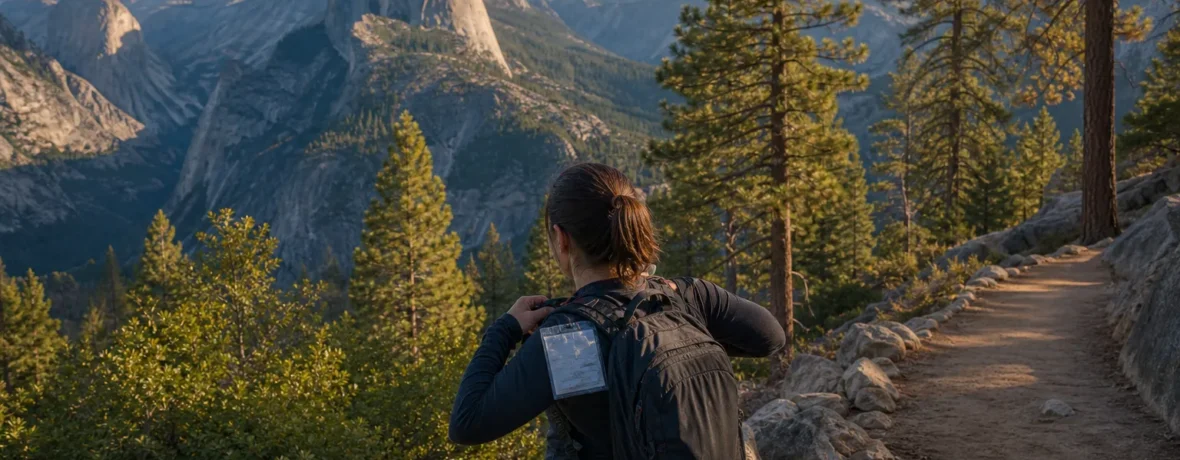
A Yosemite wilderness permit is required for every overnight stay in Yosemite Wilderness, year-round. As of November 2026, reserve online for late-April through mid-October trips; 60% of trailhead quota opens 24 weeks ahead, and 40% opens 7 days ahead. Day hikes do not need one, except Half Dome.
Do you need the wilderness permit Yosemite requires for your trip?
Yes, if you will sleep overnight in Yosemite Wilderness.
As of November 2026, the National Park Service says a wilderness permit is required year-round for backpacking, overnight climbing, or any other overnight stay in Yosemite Wilderness. You do not need a wilderness permit for ordinary day hikes, frontcountry campgrounds, lodging, or Yosemite Valley hotel stays. Half Dome is the big exception: when the cables are up, you need a Half Dome permit even for a day hike. Check the official Yosemite wilderness permits page before you plan dates or buy travel.
Think of the permit as your legal pass to start from one specific trailhead on one specific date with one specific group size. It is not a general Yosemite camping pass. It does not let you switch trailheads on a whim. It does not replace a campground reservation. It does not let you camp in Yosemite Valley.
How do you apply for a Yosemite wilderness permit?
You apply online through Recreation.gov for the main backpacking season.
As of November 2026, Yosemite wilderness permit reservations for entry dates beginning in late April through mid-October are handled online, and the reservation you make is tied to your entry trailhead and entry date. The official booking page is the Yosemite National Park Wilderness Permits page on Recreation.gov.
- Pick your entry trailhead. This is the trailhead where your overnight wilderness trip begins. The quota is attached to that trailhead, not just to the destination lake, peak, or pass.
- Choose your start date. Your permit is valid for the date printed on it. You must begin hiking on that entry date.
- Build a realistic itinerary. Yosemite Conservancy staff review applications for compliance with wilderness rules, so do not invent a heroic route that crosses half the park on day one.
- Create or log into your Recreation.gov account. Do this before the lottery or 7-day release window opens. The best trailheads go fast.
- Apply in the correct window. For popular summer trailheads, the 24-week lottery gives you the best shot.
- Watch your email and Recreation.gov account. If staff ask you to fix an itinerary problem, move fast.
- Accept and pay if awarded. A reservation is not the same as the physical permit you carry on trail.
- Pick up the permit in person. As of November 2026, Yosemite says wilderness permits are not issued by phone or email and cannot be printed at home.
When should you apply for a Yosemite wilderness permit?
Apply 24 weeks ahead if your route matters.
As of November 2026, 60% of each daily trailhead quota becomes available by lottery 24 weeks in advance. Any space not taken in that lottery becomes available first-come, first-served after the lottery period, and the remaining 40% of quota opens 7 days before the entry date. Yosemite posts the official calendar on its wilderness permit reservation window page.
| Permit window | When it opens, as of November 2026 | Best for | Watch out for |
|---|---|---|---|
| Weekly lottery | 24 weeks before the hiking start week | Half Dome-area trips, JMT starts, Cathedral Lakes, Sunrise Lakes, and other competitive trailheads | You can submit only one application per weekly lottery per group |
| Post-lottery first-come, first-served | After the lottery, for unfilled quota | Flexible routes and backup trailheads | Popular trailheads may already be gone |
| Week-ahead release | 7 days before entry, at 7 am Pacific time | Last-minute planners who can click fast | Reservations can be made only until sold out, up to 3 days before entry |
| Same-day in-person leftovers | Start date only, during wilderness center hours | Backup plans, not dream trips | Yosemite says few, if any, unused permits may be available |
If you are aiming for Little Yosemite Valley, Half Dome, the John Muir Trail, or a classic Tuolumne Meadows start, do not treat the 7-day release like a casual backup. Be logged in early, know your trailhead names, and have alternate dates ready.
How much does a Yosemite wilderness permit cost?
As of November 2026, the standard reservation cost is $10 plus $5 per person.
For lottery applications, Recreation.gov lists a $10 lottery fee; if you win, you pay an additional $5 per person when confirming the reservation. For reservations acquired after the lottery, the listed fee is $10 per permit plus $5 per person. Yosemite and Recreation.gov state that these fees are non-refundable and non-transferable, including cancellations, closures, fires, floods, or other emergencies. Use the official Recreation.gov permit page for current fee language before you pay.
Half Dome is separate. As of November 2026, eligible backpackers can add Half Dome permits at wilderness permit pickup for an additional $10 per person if their wilderness trip begins from a Half Dome-eligible trailhead. That fee is paid when you pick up the wilderness permit.
Are walk-up Yosemite wilderness permits still available?
Sometimes, but you should not count on them.
As of November 2026, Yosemite says that during the late-April through mid-October reservation season, unreserved permits may be available in person only on the start date of the trip, during wilderness center business hours. The park also says few, if any, unused permits may be available. No after-hours permits are issued.
Outside the main reservation season, Yosemite still requires wilderness permits. From late October to mid-April, the park says you can get a permit the day before or the day you intend to start at the issuing station nearest your trailhead, while trailhead quotas remain in effect. Winter is not “permit-free.” It is just a different system, with snow, closed roads, and fewer services.
How do you pick the right Yosemite trailhead?
Pick the trailhead where your overnight trip actually starts.
Yosemite’s quota system is built around entry trailheads. Your first step is not “I want to camp near a pretty lake.” Your first step is “Which legal trailhead gets me there, and does that trailhead match my first-night plan?”
For example, different Happy Isles permits mean different things. One may be for Little Yosemite Valley. Another may be for passing beyond Little Yosemite Valley. Donohue Pass-eligible John Muir Trail starts are their own category. If you choose the wrong one, your permit may not match your route.
- Start with the map. Use Yosemite’s trailhead map and trailhead descriptions before you apply.
- Match your first night. Some trailheads require a specific first-night camp area or require you to camp beyond a certain point.
- Build backups. Have several legal trailheads and date ranges ready before the lottery opens.
- Respect your pace. Yosemite terrain is steep, high, and exposed. A legal itinerary can still be a bad idea if it is too aggressive.
- Check seasonal access. Tioga Road and Glacier Point Road are seasonal roads. Snow and road closures can erase a trailhead plan.
What rules apply after you have a permit?
Your permit only works if you follow Yosemite’s wilderness rules.
As of November 2026, Yosemite’s official wilderness regulations say a permit is valid only for continuous wilderness travel. Exiting the wilderness generally invalidates the permit, with narrow exceptions such as crossing a road on foot as part of the same itinerary. Travel by vehicle or bus during the wilderness itinerary invalidates the permit.
The rules are strict because Yosemite is not a blank canvas. It is a heavily loved wilderness with bears, fragile alpine soil, crowded corridors, and a quota system built to keep the place from getting hammered.
- Group size: As of November 2026, maximum group size is 15 people, or 8 people for cross-country hiking more than 0.25 miles [0.4 km] off trail.
- Camping distance: As of November 2026, you must camp at least 4 trail miles [6.4 km] from Tuolumne Meadows, Yosemite Valley, Glacier Point, Hetch Hetchy, and Wawona, and at least 1 mile [1.6 km] from any road, unless a specific designated area applies.
- Food storage: As of November 2026, approved bear-resistant food canisters are required for food storage in all areas of Yosemite Wilderness. Hanging food, counterbalancing food, or guarding food overnight is not legal.
- Pets and wheels: As of November 2026, pets, wheeled vehicles, motorized equipment, and drones are prohibited in Yosemite Wilderness.
- Campfires: As of November 2026, campfires are prohibited above 9,600 feet [2,926 m] and in several named areas, including the top of Half Dome and the Upper and Lower Cathedral Lake basins.
- Bear spray: As of November 2026, Yosemite states that bear spray is not allowed in the park.
Do you need a Half Dome permit with a wilderness permit?
Yes, if you plan to go up the cables.
As of November 2026, a wilderness permit alone does not let you hike the Half Dome cables. Backpackers can request Half Dome access at permit pickup only if their wilderness permit begins from an eligible trailhead. Yosemite lists the eligible starts in its wilderness permit FAQ: Happy Isles to Little Yosemite Valley, Glacier Point to Little Yosemite Valley, Happy Isles past Little Yosemite Valley with Donohue Pass eligibility, Sunrise Lakes, Cathedral Lakes, Rafferty Creek to Vogelsang, and Mono Meadow.
If your wilderness permit starts somewhere else, you need to use the regular Half Dome day-hiker permit process. And if you are day hiking Half Dome with no overnight wilderness itinerary, a wilderness permit is the wrong permit.
What if you start outside Yosemite?
Get your permit from the agency that manages your starting trailhead.
As of November 2026, Yosemite honors wilderness permits from adjacent land agencies for continuous wilderness travel into the park, but only when the permit comes from the agency that manages the actual starting trailhead. If your trip starts outside Yosemite and later crosses into Yosemite, do not apply to Yosemite just because you will sleep inside the park later.
The reverse is also true. If you start in Yosemite and continue into adjacent wilderness, one Yosemite wilderness permit can cover that continuous trip. The John Muir Trail has extra rules: to exit Yosemite over Donohue Pass, your entry trailhead must be one of the Donohue Pass-eligible Yosemite starts.
What should you have ready before you apply?
Have your trip built before the permit window opens.
Do not wait until 6:58 am to learn trailhead names. Do the work first. Yosemite permits reward the prepared and punish the vague.
- Recreation.gov account login
- Entry trailhead, plus backups
- Entry date, plus backup dates
- Group size
- Trip leader and any alternate permit holders
- First-night camp plan
- Exit trailhead and exit date
- Bear canister plan
- Half Dome request, if your trailhead is eligible
- Transportation plan that does not break continuous wilderness travel rules
Also be honest about snow. A permit does not melt a pass. High Sierra routes can hold snow well into the hiking season, and seasonal roads can open late or close early. Before you lock in a route, check Yosemite’s current trail and wilderness conditions.
Related reading
- What Is a Wilderness Permit and When Do You Need One?
- Olympic National Park Wilderness Permits
- Angels Landing Permit Lottery Explained
- Is Yosemite Open? Roads, Passes and Closures
FAQ
Can you get a Yosemite wilderness permit the same day?
Yes, but only if space is available. As of November 2026, Yosemite says same-day in-person permits during the main season are limited to unreserved leftovers, available only during wilderness center hours, and few may be available.
Do you need a permit to day hike in Yosemite?
No, not for most day hikes. As of November 2026, Yosemite does not require a wilderness permit for ordinary day hikes, but Half Dome requires a separate Half Dome permit when the cables are up.
Can you print a Yosemite wilderness permit at home?
No. As of November 2026, Recreation.gov says Yosemite wilderness permits must be picked up in person at a Yosemite wilderness permit station and are not issued by phone, email, or home printing.
Can you change your Yosemite wilderness permit after booking?
Sometimes, if space is available. As of November 2026, Recreation.gov says itinerary changes may be made up to 3 days in advance or at permit pickup, but the trip leader cannot be changed.
Do you need a bear canister in Yosemite Wilderness?
Yes. As of November 2026, Yosemite requires allowed bear-resistant food canisters for food storage in all areas of Yosemite Wilderness, and hanging food is not legal.
Is a wilderness permit the same as a Yosemite campground reservation?
No. A wilderness permit covers overnight travel in undeveloped wilderness, not frontcountry campgrounds, lodging, or car camping. If you want to sleep in a developed campground, you need the campground reservation system instead.