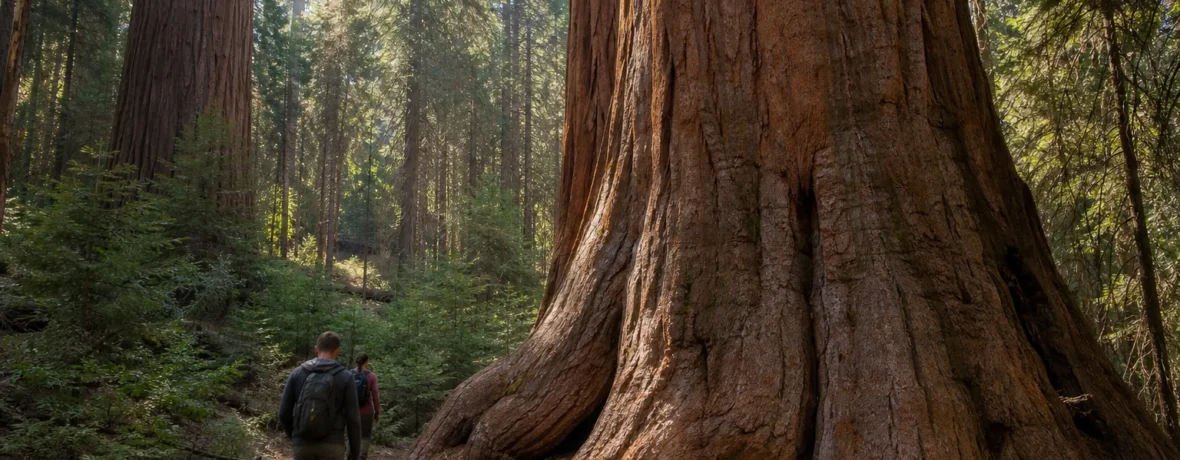
Hike 3 to 6 trails across Giant Forest, Lodgepole, and the Foothills. Start with General Sherman, Congress Trail, Big Trees Trail, Moro Rock, Crescent Meadow, Tokopah Falls, and Marble Falls if you have two full days.
What to do in Sequoia National Park if you only have one day?
Spend one day in Giant Forest and Lodgepole.
This is the cleanest, highest-reward plan. You get the biggest tree on earth, quiet Sequoia loops, a granite staircase with a Sierra view, and a river canyon walk if your legs still have gas. Keep the driving short. Parking gets tight, daylight disappears fast under the trees, and elevation at Giant Forest sits near 6,500 to 7,000 feet [1,981 to 2,134 m]. Move early.
- Start at General Sherman Tree. Walk the 1-mile [1.6 km] round trip before the main lot fills.
- Add Congress Trail. This paved Sequoia walk extends the Sherman visit into a real forest hike.
- Stop at Big Trees Trail. The loop around Round Meadow is short, scenic, and easy to pace.
- Climb Moro Rock. Go only in dry conditions. The stairs are exposed and slick when icy.
- Finish with Crescent Meadow or Tokopah Falls. Pick Crescent Meadow for sequoias and meadows, Tokopah Falls for granite walls and water.
Before you drive in, check the official Sequoia and Kings Canyon current conditions page. As of November 2026, the park warns that trail, road, fire, river, and seasonal access conditions can change quickly.
What are the best hikes in Sequoia National Park?
The best hikes in Sequoia National Park are General Sherman, Congress Trail, Big Trees Trail, Moro Rock, Crescent Meadow, Tokopah Falls, Marble Falls, and the Lakes Trail.
Pick by time, energy, and season. Sequoia is not one flat forest stroll. It jumps from hot foothills to snowy high country, with trailheads spread along winding mountain roads. The table below keeps the choices sharp.
| Trail | Distance | Best For | Effort |
|---|---|---|---|
| General Sherman Tree Trail | 1 mile [1.6 km] round trip | First-time visitors, biggest-tree moment | Easy to moderate at elevation |
| Congress Trail | 2 to 2.7 miles [3.2 to 4.3 km] | Classic Sequoia forest | Easy to moderate |
| Big Trees Trail | 0.75 to 1.1 miles [1.2 to 1.8 km] | Meadow views, accessible pacing | Easy |
| Moro Rock Trail | 0.4 miles [0.6 km] | Big views, sunrise or sunset | Short but steep |
| Crescent Meadow Loop | 1.8 miles [2.9 km] | Meadows, bears at a safe distance, Tharp’s Log | Easy |
| Tokopah Falls Trail | 3.4 to 3.8 miles [5.5 to 6.1 km] | River canyon, granite cliffs, early-summer waterfall | Moderate |
| Marble Falls Trail | 7.8 miles [12.6 km] round trip | Foothill workout, spring wildflowers | Moderate to hard |
| Lakes Trail to Heather, Emerald, or Pear Lake | Varies by lake | Alpine scenery, strong hikers | Hard |
The official NPS Giant Forest and Lodgepole trails guide lists the core Giant Forest hikes, including General Sherman, Congress Trail, Big Trees Trail, Moro Rock, and Tokopah Falls.
Is the General Sherman Tree hike worth it?
Yes, the General Sherman Tree hike is worth it if you go early or late.
This is the headline stop for a reason. General Sherman is the largest tree on earth by volume, and the walk down from the main parking area drops you into a grove that makes normal scale feel silly. The paved trail is short, but the return climb feels stronger than the mileage suggests because you are hiking at elevation.
Use the accessible parking area along Generals Highway if someone in your group needs the gentler accessible route. If you use the main lot, expect stairs, benches, crowds, and plenty of people stopping mid-trail for photos. Stay patient. Then keep walking. The best part is not snapping one picture at the sign; it is continuing onto Congress Trail after the crowd thins.
Which Sequoia trail is best for giant trees without the biggest crowds?
Congress Trail is the best big-tree hike once you step away from General Sherman.
The trail starts near the Sherman Tree and rolls past named giants, dense groves, and the kind of quiet that returns fast after the first few turns. It is paved, forested, and friendly to steady walkers. If you want a shorter and gentler option, Big Trees Trail around Round Meadow is the better pick.
For a less rushed feel, try this order:
- General Sherman before 9 a.m. for the famous tree.
- Congress Trail right after. Most visitors peel away early.
- Big Trees Trail near midday. It stays pleasant even when other lots feel busy.
- Crescent Meadow late afternoon. The light softens and the meadow edges glow.
Is Moro Rock hard to hike?
Moro Rock is short, steep, and exposed.
The trail climbs a granite dome by stairway, gaining roughly 300 feet [91 m] in a very short distance. That means your lungs work right away. The payoff is huge: the Great Western Divide, the western half of the park, and layers of Sierra ridgelines stacked into the distance.
Do not climb Moro Rock when snow or ice is on the stairs. Skip it during lightning, strong wind, or poor visibility. If heights bother you, treat the first few stair sections as your test. No shame in turning around. The mountain does not care.
What is the best waterfall hike in Sequoia National Park?
Tokopah Falls is the best waterfall hike for most visitors.
The trail starts near Lodgepole Campground and follows the Marble Fork of the Kaweah River into Tokopah Canyon. It is not a Sequoia walk. It is granite, water, boulders, and open canyon scenery. The waterfall is strongest in early summer when snowmelt is running; later in the season, the flow can shrink.
Stay away from slick rocks and fast water. As of November 2026, NPS river safety guidance for Sequoia and Kings Canyon warns that drowning is the primary cause of death in the parks, and that cold, swift water and unstable riverbanks create real hazards. Look. Photograph. Do not scramble into the current for a better angle.
What is the best hard day hike in Sequoia National Park?
The Lakes Trail is the best hard day hike for fit, prepared hikers.
Starting from Wolverton, the Lakes Trail heads toward Heather Lake, Emerald Lake, and Pear Lake. This is a different Sequoia: thinner air, granite basins, longer mileage, and conditions that can flip from pleasant to serious. As of November 2026, the park’s trail conditions page listed the Lakes Trail, Watchtower, Alta Peak, and other high-country routes under winter conditions.
If that sounds like too much, hike Marble Falls in the Foothills during cooler months. It climbs through chaparral to a cascade and gives you a solid workout without committing to the high alpine zone. Do not choose Marble Falls on a hot afternoon. The Foothills can bake.
When is the best time to hike in Sequoia National Park?
The best hiking window is late spring through fall, with trail choice changing by elevation.
May and June can bring waterfalls, wildflowers, and lingering snow up high. July and August open more high-country options, but heat builds hard in the Foothills and parking pressure rises in Giant Forest. September often brings steadier hiking weather, shorter days, and cooler mornings. Winter turns the park into a snow trip, not a casual trail checklist.
Match your hike to the season:
- Spring: Big Trees Trail, General Sherman, Congress Trail, Tokopah Falls, Marble Falls on cool days.
- Summer: Giant Forest loops early, Moro Rock in dry weather, Lakes Trail only if snow and storm conditions allow.
- Fall: Sequoia groves, Crescent Meadow before snow closes access, longer foothill hikes as temperatures drop.
- Winter: Snowshoeing, short grove walks, and low-elevation hikes only when roads and trails are open.
Do you need permits or reservations to hike in Sequoia National Park?
You do not need a wilderness permit for standard day hikes, but you do need one for overnight backcountry trips.
As of November 2026, Sequoia and Kings Canyon require wilderness permits for overnight wilderness travel, and the rules change between quota and non-quota seasons. During the non-quota season from September 27, 2026, through May 20, 2027, NPS says wilderness permits are free, self-issued, and not limited by daily entry quotas. Check the official NPS wilderness permits page before planning any backpacking route.
Entrance fees are separate from hiking permits. As of November 2026, the standard private vehicle entrance pass for Sequoia and Kings Canyon is $35, and the parks accept cashless payment at entrance stations. Non-U.S. residents age 16 and older pay a $100 nonresident fee in addition to the standard entrance fee unless admitted with an Annual or America the Beautiful Pass. Verify current prices on the official NPS entrance fees and passes page before you go.
Pets are not allowed on park trails. That includes short paved walks to famous trees. Leashed pets are limited to developed areas such as parking lots, picnic areas, campgrounds, and roads where permitted.
What should you pack for Sequoia National Park trails?
Pack for elevation swings, sun, cold shade, and sudden weather.
A warm morning in Three Rivers can turn into a chilly walk under the sequoias. A dry trailhead can lead to snow patches higher up. Carry more than a phone and a half-full bottle. Sequoia rewards simple preparation.
- Trail map or downloaded offline map
- Water and salty snacks
- Sun hat, sunglasses, and sunscreen
- Warm layer, even in summer
- Rain shell or wind shell
- Footwear with real traction
- Headlamp if hiking after midafternoon
- Small first-aid kit
- Trash bag for every wrapper and tissue
- Bear-aware food storage plan for your car and campsite
When to see a doctor
Get medical help fast for confusion, fainting, chest pain, severe shortness of breath, or heat illness symptoms that worsen.
Sequoia hiking can combine heat, altitude, exertion, and remote roads. Stop hiking if someone becomes disoriented, stops sweating in hot conditions, vomits repeatedly, has severe weakness, or cannot walk steadily. The CDC describes heat stroke as a medical emergency and advises immediate care for serious heat-related symptoms; review the CDC’s heat-related illness guidance before hot-weather hikes.
This guide cannot diagnose you. If symptoms feel scary, treat them as real. Turn around, cool down if heat is involved, descend if elevation seems to be making things worse, and contact emergency services when needed.
Related reading
- Is Sequoia National Park Open? Seasonal Closures
- How to Get to Dry Tortugas National Park
- What to Do in Zion National Park: Hikes by Difficulty
- Where to Stay in Yosemite for Hikers
FAQ
How many days do you need in Sequoia National Park?
You need two days for the best hiking sampler. One day covers General Sherman, Congress Trail, Big Trees Trail, and Moro Rock; a second day lets you add Crescent Meadow, Tokopah Falls, or Marble Falls without rushing.
What is the easiest trail in Sequoia National Park?
Big Trees Trail is one of the easiest high-value hikes. It circles Round Meadow on a short route with sequoias, interpretive signs, and a gentle pace.
Can you hike to the General Sherman Tree?
Yes, you can hike to the General Sherman Tree on a paved trail. The main route is short but includes a climb back to the parking area, so take breaks if the elevation hits you.
Are Sequoia National Park trails open in winter?
Some trails stay accessible in winter, but snow and ice change the trip. Roads, parking areas, and trailheads can close or require chains, so check current NPS conditions on the day you travel.
Can you hike in Sequoia National Park with a dog?
No, dogs are not allowed on park trails. Pets may be allowed in developed areas such as parking lots, picnic areas, campgrounds, and roads, but not on the hiking trails listed in this guide.
What should you not miss in Sequoia National Park?
Do not miss General Sherman Tree, Congress Trail, Moro Rock, and Crescent Meadow. Add Tokopah Falls if you want water and granite scenery, or Marble Falls if you want a tougher foothill hike in cooler weather.