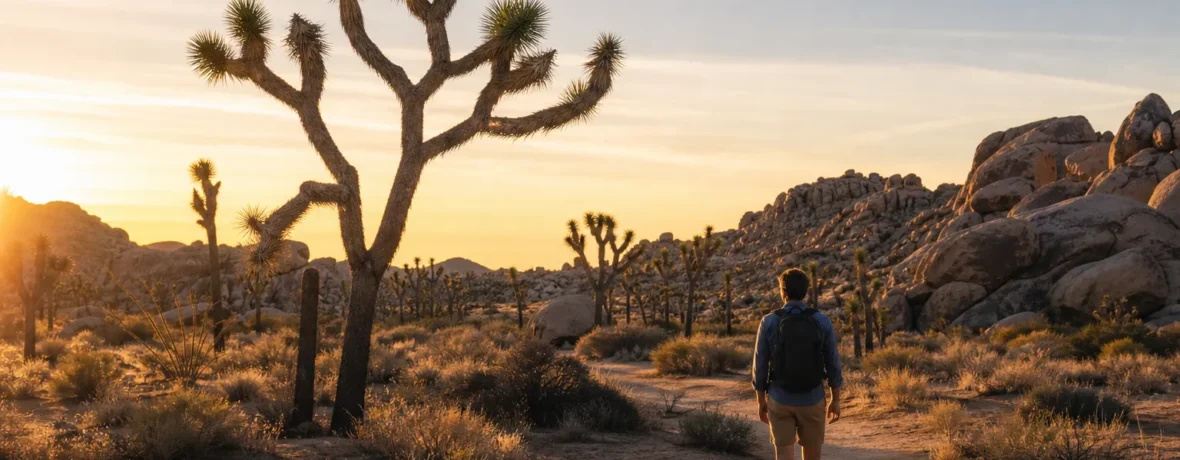
Start with 3 to 5 desert hikes, not a windshield-only tour. Pick Hidden Valley, Barker Dam, Ryan Mountain, Arch Rock, and Cholla Cactus Garden if you have one full day and mild weather. In summer, keep hikes short and start early.
What are the best hikes in Joshua Tree National Park?
The best Joshua Tree hikes are Hidden Valley, Barker Dam, Ryan Mountain, Arch Rock, Lost Horse Mine, Willow Hole, and Lost Palms Oasis.
Joshua Tree is not one single landscape. The west side gives you the boulder mazes, Joshua tree forests, and classic Mojave Desert scenery. The south and east side rolls into the lower, hotter Colorado Desert, with ocotillo, cholla, washes, and palm oases. That mix is the whole point.
Use the official Joshua Tree National Park hiking page for current trail details, and build your day around distance, heat, and how much sand you want under your feet.
| Hike | Distance | Best for | Difficulty |
|---|---|---|---|
| Hidden Valley | 1 mile [1.6 km] | First-time visitors, boulders, short loop | Easy |
| Barker Dam | 1.1 miles [1.8 km] | History, desert plants, possible wildlife | Easy |
| Ryan Mountain | 3 miles [4.8 km] | Big summit views | Strenuous |
| Arch Rock | 1.4 miles [2.3 km] | Rock formations, photos, short outing | Easy to moderate |
| Lost Horse Mine | 4 miles [6.4 km] | Mining history and open desert walking | Moderate |
What to do in Joshua Tree National Park if you only have one day?
With one day in Joshua Tree, hike early, connect the west-side classics, then finish near sunset at Keys View or Cholla Cactus Garden.
One day is enough to get the flavor, but not enough to roam without a plan. The park roads are scenic, yet trailhead parking can pinch your time on busy weekends. Start before the heat and crowds stack up.
- Enter early through the West Entrance or North Entrance. Aim for sunrise or soon after, especially from fall through spring when visitation is high.
- Hike Hidden Valley first. This 1-mile [1.6 km] loop gives you boulders, Joshua trees, and that enclosed “desert room” feeling right away.
- Add Barker Dam. The 1.1-mile [1.8 km] loop is short, varied, and close enough to pair with Hidden Valley without burning the whole morning.
- Choose your harder hike. If the weather is cool, Ryan Mountain is the clean, sweaty choice. If wind or heat is building, pick Lost Horse Mine or Arch Rock instead.
- Take a midday break. Eat, refill water before leaving developed areas, and stay out of the exposed sun during the hottest hours.
- Finish with a short walk. Cholla Cactus Garden is best in low-angle light. Keys View is a grand final stop if skies are clear.
As of November 2026, the standard private vehicle entrance pass is $30 and is valid for 7 days; the Joshua Tree annual pass is $55. Check the official Joshua Tree fees and passes page before you go, since fee rules can change.
Is Hidden Valley worth it in Joshua Tree?
Yes, Hidden Valley is worth it because it delivers the classic Joshua Tree look in a short, easy loop.
This is the hike to do when someone in your group says, “I want the real Joshua Tree.” You get stacked granite, sand underfoot, yucca, pinyon, juniper, and Joshua trees rising like odd desert sculptures. The trail is short, but it doesn’t feel like a throwaway walk.
Hidden Valley is also a smart first hike because it helps you calibrate the day. If this easy loop already feels hot, dry, and tiring, don’t force Ryan Mountain at noon. The desert is telling you something. Listen.
Is Barker Dam an easy hike?
Yes, Barker Dam is an easy 1.1-mile [1.8 km] loop, but it still needs desert common sense.
The route is short and mostly gentle, with a mix of sandy trail, rock, interpretive signs, and the historic dam area. After wet periods, you may see water. During dry spells, the basin can be empty. Either way, the hike works because the scenery changes fast for such a compact loop.
Go slowly near rock art and historic features. Don’t touch, scratch, climb on, or add anything to cultural sites. Desert damage lasts. A bad decision can outlive you.
Is Ryan Mountain hard?
Ryan Mountain is hard for its short distance because it gains 1,050 feet [320 m] in 1.5 miles [2.4 km] to the summit.
This is the no-nonsense fitness hike in the central park area. The trail climbs straight into bigger views, and there is little shade. On a cool morning, it’s one of the strongest hikes in the park. In hot weather, it can turn ugly fast.
Do Ryan Mountain when temperatures are mild, wind is reasonable, and you have more water than you think you need. Skip it in peak heat. The National Park Service advises summer visitors to avoid longer and strenuous trails, including Ryan Mountain, and to keep short hikes to early morning or evening on the official summer visiting guidance.
What are the best short hikes in Joshua Tree?
The best short hikes are Hidden Valley, Barker Dam, Arch Rock, Cap Rock, Cholla Cactus Garden, and the Bajada Nature Trail.
Short does not mean boring here. In Joshua Tree, a half-mile stroll can pass spiny gardens, cracked monzogranite, sandy washes, and plants that look designed by a cartoonist with a geology degree.
- Hidden Valley: Best all-around first hike, 1 mile [1.6 km].
- Barker Dam: Best short hike for history and variety, 1.1 miles [1.8 km].
- Arch Rock: Best quick rock-formation hike, 1.4 miles [2.3 km].
- Cap Rock: Best leg-stretcher near Park Boulevard, 0.4 miles [0.6 km].
- Cholla Cactus Garden: Best golden-hour stop, 0.25 miles [0.4 km].
- Bajada Nature Trail: Best easy walk in the Colorado Desert zone, 0.25 miles [0.4 km].
Watch your ankles and your camera stance around cholla. Those spines are not cute once they are in your sock.
What are the best longer hikes in Joshua Tree?
The best longer hikes are Lost Horse Mine, Willow Hole, Panorama Loop, Warren Peak, Boy Scout Trail, and Lost Palms Oasis.
Longer hikes in Joshua Tree are less forgiving than their mileage suggests. Sand slows you down. Shade is scarce. Trail junctions can feel subtle. Wind can erase your sense of comfort, and heat can erase your margin for mistakes.
Lost Horse Mine is a strong moderate pick because it combines a clear destination with open desert views. Willow Hole gives you Wonderland of Rocks scenery without a summit grind. Panorama Loop and Warren Peak are better when you want a quieter western park hike with elevation. Lost Palms Oasis is longer, hotter, and more remote-feeling, starting from the Cottonwood area in the south.
If you want a backpacking-style day but not an overnight, study the route beforehand and carry a paper map or downloaded map. Cell service is unreliable. Your phone can be a tool. It should not be your only plan.
Do you need permits for hiking in Joshua Tree?
You do not need an overnight backcountry permit for the day hikes listed here, but you do need a park entrance pass.
As of November 2026, overnight backcountry camping requires a permit, and the National Park Service lists the backpacking permit fee at $6 for groups of 1 to 12 people, with reservations available through Recreation.gov or the park permit office. Read the official Joshua Tree backpacking permit rules before planning any overnight route.
Day hiking is simpler. Pay the entrance fee, park only in legal spaces, stay on durable surfaces or established trail where signed, and give yourself enough daylight to get back without rushing.
What should you pack for Joshua Tree hikes?
Pack water, sun protection, salty snacks, layers, a map, a headlamp, and footwear that can handle sand and rock.
Joshua Tree punishes casual packing. The trailhead may feel friendly. Fifteen minutes later you can be sweating, squinting, and wondering why every rock reflects heat into your shins.
- Water: Carry more than you expect to drink. The NPS recommends at least 1 gallon [3.8 L] per person per day in hot conditions on its Joshua Tree safety guidance.
- Sun layers: Wide-brim hat, sunglasses, long sleeves, and sunscreen.
- Food: Salty snacks plus real calories, not just candy.
- Navigation: Paper map, downloaded offline map, and a backup battery.
- Light: Headlamp, even for “short” sunset walks.
- Footwear: Trail shoes or boots with grip; cactus spines and sharp rock are part of the deal.
- Small repair and first-aid kit: Include tweezers for cactus spines.
- Layers: Desert mornings and evenings can feel cold outside summer.
When is the best time to hike in Joshua Tree?
The best time to hike Joshua Tree is during the cooler months, especially fall, winter, and spring.
Summer hiking is possible only with restraint. Go very early or late, keep mileage short, and avoid exposed climbs. The National Park Service warns that desert temperatures can exceed 85°F [29°C] from April through September, with the hottest conditions in July and August. That may sound manageable if you’re used to humid summers, but the desert adds exposure, reflected heat, wind, and long gaps between water sources.
Winter can be excellent for longer hikes, but don’t pack like you’re going to a warm beach. Wind, cold mornings, and early darkness matter. Spring can bring wildflowers in good years, plus crowds. Fall is often the sweet spot: cooler air, strong light, and longer hiking windows than winter.
Can you hike Joshua Tree in summer?
Yes, you can hike Joshua Tree in summer, but you should keep it short, early, and conservative.
Summer is not the season for proving anything. Pick trails under 2 miles [3.2 km], start before the sun gains power, and be back at your vehicle while the day is still young. Save Ryan Mountain, Lost Palms Oasis, Boy Scout Trail, and other long routes for cooler weather.
Heat illness can build before you realize how much water you have lost. The CDC lists symptoms of heat exhaustion such as headache, nausea, dizziness, weakness, thirst, heavy sweating, and decreased urine output, and heat stroke symptoms can include confusion, altered mental status, and slurred speech. Use the CDC’s heat-related illness guidance as your baseline, not trailhead bravado.
When to see a doctor
Get medical help right away for confusion, fainting, worsening heat symptoms, repeated vomiting, or symptoms that do not improve after cooling and rest.
On trail, stop moving the moment heat illness signs appear. Get into shade, loosen extra clothing, sip water if the person is alert and able to drink, and cool the body with wet cloths or available water. Call 911 for severe symptoms, altered mental status, loss of consciousness, or any situation where the person cannot safely walk out.
After a desert hike, seek medical care if you have persistent dizziness, severe headache, chest pain, shortness of breath, confusion, very dark urine, or symptoms that return after you rest. Don’t diagnose yourself in a parking lot. Let a clinician sort it out.
What should you not do in Joshua Tree National Park?
Do not underestimate heat, climb on fragile cultural sites, feed wildlife, fly drones, bring pets on hiking trails, or rely on rideshare service for park travel.
As of November 2026, the National Park Service states that pets are not allowed on trails, drones are prohibited, vehicles and bicycles must stay on designated roads, and campfires are allowed only in designated fire rings in campgrounds. Check the official Joshua Tree basic information page for current rules before your trip.
Also: don’t chase wildlife for photos. Don’t cut switchbacks. Don’t park in vegetation because the lot is full. Don’t carve your name into rock. The desert looks tough, but the living crust, plants, and cultural resources are easy to wreck.
How do you plan the perfect Joshua Tree hiking day?
Plan your Joshua Tree hiking day around temperature first, trail difficulty second, and scenery third.
That order keeps you out of trouble. A beautiful hike at the wrong hour is still the wrong hike. A moderate route in January can become a bad idea in July. Your best day is the one that matches the forecast and your group’s real pace.
- Check park alerts and weather. Look for heat, wind, flash flood risk, road work, and trail closures.
- Pick one anchor hike. Choose Ryan Mountain, Lost Horse Mine, Willow Hole, or another main objective.
- Add two short walks. Hidden Valley plus Barker Dam is a strong pair; Arch Rock plus Cholla Cactus Garden works well farther east.
- Build in water stops. Do not assume every trailhead has drinking water.
- Set a turnaround time. If the heat rises or daylight drops, turn around. No drama.
- End with a view, not a rescue. Keys View, Cap Rock, or Cholla Cactus Garden can finish the day without adding a risky late hike.
Related reading
- How to Get to Dry Tortugas National Park
- What to Do in Zion National Park: Hikes by Difficulty
- Where to Stay in Yosemite for Hikers
- Where to Stay in Glacier National Park
FAQ
How many days do you need in Joshua Tree National Park?
One full day is enough for the main scenic drive and 3 to 5 short hikes. Two or three days is better if you want longer trails, sunrise and sunset stops, and time in both the Mojave and Colorado Desert sections.
What is the easiest hike in Joshua Tree?
Cap Rock, Cholla Cactus Garden, and Bajada Nature Trail are among the easiest short walks. Hidden Valley and Barker Dam are still easy for many hikers, but they are longer and have more uneven footing.
What is the hardest popular hike in Joshua Tree?
Ryan Mountain is one of the hardest popular short hikes because it climbs 1,050 feet [320 m] in 3 miles [4.8 km] round trip. Longer routes like Lost Palms Oasis, Panorama Loop, and Boy Scout Trail can be harder due to distance, exposure, sand, and heat.
Can beginners hike in Joshua Tree?
Yes, beginners can hike in Joshua Tree if they choose short trails and mild weather. Start with Hidden Valley, Barker Dam, Cap Rock, or Cholla Cactus Garden, and avoid midday heat.
Is Joshua Tree better at sunrise or sunset?
Joshua Tree is excellent at both, but sunrise is better for hiking because temperatures are cooler and parking is easier. Sunset is better for photography at places like Cholla Cactus Garden, Keys View, and Cap Rock.
Can you hike with a dog in Joshua Tree?
No, dogs are not allowed on hiking trails in Joshua Tree National Park as of November 2026. Pets can go only where park rules allow, so check current NPS pet guidance before bringing one.