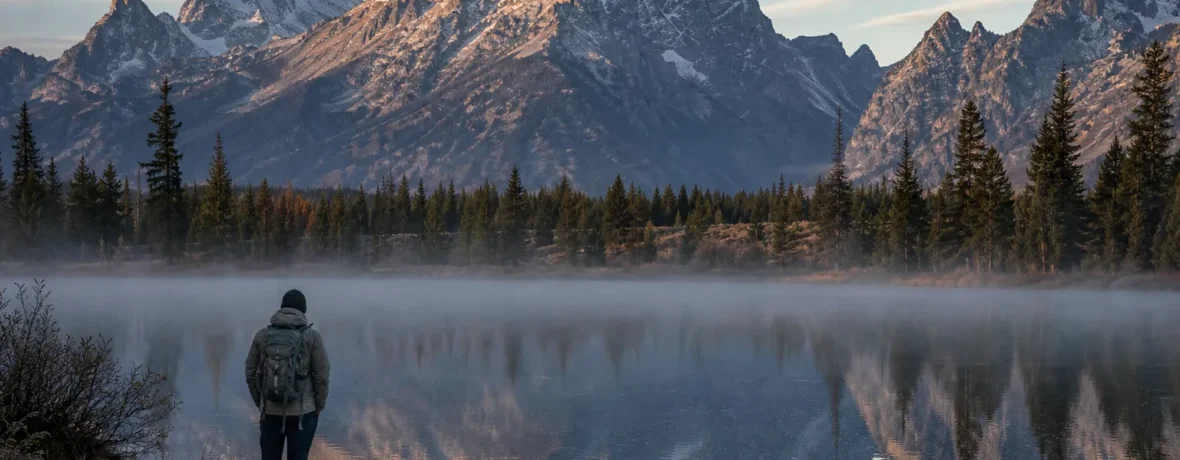
Start with 2 or 3 short hikes, drive Teton Park Road, watch wildlife at dawn or dusk, visit Jenny Lake, and save time for a Snake River or lake outing. You do not need timed entry, but camping, boating, and backcountry nights require planning.
What to do in Grand Teton National Park if you have one day?
Prioritize Jenny Lake, Teton Park Road, and one sunrise or sunset wildlife stop.
Grand Teton is compact compared with Yellowstone, but the views hit hard and the trailheads fill early. With one day, do not try to “see everything.” You will spend the whole day chasing parking spaces and roadside pullouts. Pick a clean route instead.
- Start before sunrise at Mormon Row or Schwabacher Landing. Both give you classic Teton skyline views without a hard hike. Bring a warm layer even in summer; the valley can feel cold before the sun clears the ridge.
- Drive Teton Park Road. Stop at Jenny Lake Overlook, String Lake, and pullouts that are actually open and safe. Do not stop in the road for wildlife.
- Hike at Jenny Lake. Go to Hidden Falls and Inspiration Point, or walk part of the lakeshore if crowds are thick. The National Park Service lists Inspiration Point as 5.7 miles [9.2 km] round trip from the Jenny Lake Trailhead, or 1.8 miles [2.9 km] round trip if you use the shuttle boat.
- Eat lunch away from the busiest trailhead. String Lake, Colter Bay, and Signal Mountain areas give you room to reset.
- End with wildlife viewing. Oxbow Bend, Willow Flats, and the Moose-Wilson Road area are popular for a reason, but you need distance, patience, and binoculars.
If you have energy left, add the Signal Mountain Summit Road for a broad valley view. If storms build, skip high viewpoints and water. Afternoon lightning in the Tetons is not background drama. It is a reason to get low.
What are the best hikes in Grand Teton National Park?
The best hikes are Taggart Lake, Jenny Lake, Inspiration Point, Cascade Canyon, Phelps Lake, and Hermitage Point.
Pick hikes by time, not ego. The Tetons rise fast from the valley, and a “moderate” trail can feel tougher if you came from sea level yesterday. The park’s hiking page warns that trails can be steep, high, rugged, and hit by sudden weather changes, so carry layers even when the trailhead feels warm; check the official Grand Teton hiking information before you choose a route.
| Hike | Best for | Plan on | Trail personality |
|---|---|---|---|
| Taggart Lake | First-time visitors | A half day | Lake views, Teton reflections, steady but manageable walking |
| Jenny Lake to Hidden Falls and Inspiration Point | Classic scenery | Half day, longer if you skip the boat | Busy, beautiful, and worth an early start |
| Cascade Canyon | Big mountain feel | Most of a day | Glacial canyon walls, wildlife habitat, deeper backcountry energy |
| Phelps Lake | Quieter forest and lake hiking | A half day | Aspens, boulders, lake views, and a calmer pace |
For an easy scenic start, walk near String Lake. The grade is friendly, the water is clear, and the Teton wall feels close enough to touch. For a bigger day, continue toward Leigh Lake or connect into longer trails if conditions and your legs agree.
Cascade Canyon is the “now we are really in it” hike. Many visitors use the Jenny Lake boat to shorten the approach, then climb past Hidden Falls and Inspiration Point into the canyon. Watch for moose, bears, and loose rock. Do not wear earbuds. You want to hear what is happening around you.
Do you need reservations or permits for Grand Teton National Park?
You do not need a timed-entry reservation, but you may need permits for camping, boating, or overnight backcountry travel.
As of November 2026, Grand Teton National Park does not use entrance reservations or timed entry, according to the park’s official permits and reservations page. You can enter without booking an arrival window. That does not mean you can roll in at 10 a.m. in July and expect easy parking at Jenny Lake. Get moving early.
As of November 2026, the standard entrance pass is $35 per private vehicle, $30 per motorcycle, or $20 per person entering by foot or bicycle, valid for 7 days. The park also states that it became cashless on May 1, 2026, for entrance fees and several permit payments; see the NPS entrance fee FAQ before you go.
Backcountry camping is different. As of November 2026, anyone sleeping overnight, camping, bivouacking, or carrying overnight equipment in the Grand Teton backcountry must have a backcountry camping permit. Recreation.gov lists a $20 nonrefundable permit fee plus a $7 per person nightly fee for Grand Teton backcountry permits. Check the official Recreation.gov backcountry permit page for current availability and rules.
- No timed entry: enter the park without an arrival reservation, as of November 2026.
- Campgrounds and lodging: reserve early; summer space goes fast.
- Backcountry nights: permit required.
- Boating and floating: park boat permit required for watercraft.
- Day hiking: no separate hiking permit for standard frontcountry trails.
Where can you see wildlife in Grand Teton National Park?
Go at dawn or dusk to Oxbow Bend, Willow Flats, Antelope Flats, Moose-Wilson Road, and quiet lake edges.
Grand Teton has grizzly bears, black bears, moose, elk, bison, pronghorn, wolves, coyotes, beavers, eagles, and more. The trick is not finding a crowd with cameras. The trick is watching wildlife without becoming the problem.
As of November 2026, the park requires visitors to stay at least 100 yards [91 m] from bears and wolves and 25 yards [23 m] from all other wildlife; the NPS wildlife viewing guidance is clear on those distances. That means no edging closer for a phone photo. Bring binoculars or a long lens.
- Oxbow Bend: sunrise reflections, birds, moose habitat, and possible bear activity.
- Willow Flats: elk, moose, and bears can move through the open-willow mix.
- Antelope Flats: pronghorn, bison, and huge sky views.
- Moose-Wilson Road: dense habitat, slow travel, and frequent wildlife slowdowns.
- Snake River overlooks: birds, river bends, and big landscape photos.
If a wildlife jam forms, keep your car fully off the road only where it is legal and safe. Follow ranger directions. Never feed wildlife, never put yourself between a mother and young, and never assume a moose is mellow because it is eating. Moose can move fast. Bison can move fast. Bears can move faster than your bad decision.
Can you kayak, float, or swim in Grand Teton National Park?
Yes, you can paddle, float, and swim in designated waters, but cold water and permits change the plan.
Grand Teton’s lakes are stunning from shore, and even better from a kayak or paddleboard when conditions are calm. As of November 2026, all watercraft in the park, including motorized craft, kayaks, canoes, stand-up paddleboards, and windsurfing boards, must have a valid Grand Teton boat permit. The NPS lists Grand Teton boat permit fees at $75 for motorized craft and $25 for non-motorized craft; check the official boating and floating page before launching.
Human-powered watercraft are allowed on several lakes, including Jackson, Jenny, Phelps, Taggart, Bradley, Leigh, and String lakes. Motorized boats are limited to Jackson and Jenny lakes, with horsepower limits on Jenny Lake. The Snake River is not a lazy tubing stream. It has braided channels, cold water, sweepers, logjams, and sections that demand real boat-handling skill.
Swimming is possible, but the water is cold. Start close to shore, wear sandals or water shoes, and treat wind like a schedule. Afternoon chop can turn a pleasant paddle into a grind back to the launch.
When is the best time to visit Grand Teton National Park?
September is the best all-around month for hiking, wildlife, cooler weather, and smaller crowds.
Every season works, but each one asks for a different plan. Summer gives you the easiest trail access and longest days. It also gives you packed trailheads, busy roads, afternoon thunderstorms, and smoke risk in some years. Fall sharpens the air and turns the cottonwoods gold. Winter strips the park down to snow, silence, and serious cold.
- May and June: snow lingers on higher trails, valley hikes open earlier, and weather swings hard.
- July and August: best access for big hikes, busiest parking, warm days, and common afternoon storms.
- September: cooler hiking, elk rut season, fewer families after school starts, and crisp mornings.
- October: quiet roads, cold nights, possible snow, and reduced services.
- November through April: winter travel, skiing, snowshoeing, closed seasonal roads, and avalanche awareness for mountain terrain.
As of November 2026, the Teton Park Road closes to vehicles from Taggart Lake Trailhead to Signal Mountain Lodge from November 1 through April 30, while the road corridor can be used for winter recreation when conditions allow. Check the official park roads page for current road status before you build a winter or shoulder-season trip.
What should you pack for hiking in Grand Teton?
Pack for sun, cold, wind, bears, and sudden storms on the same day.
The valley floor sits high, the mountains create their own weather, and shade can feel chilly even when the parking lot is hot. A small daypack beats a miserable walk back to the car.
- Bear spray, carried where you can grab it fast, not buried in your pack
- Map downloaded offline plus a paper map for longer hikes
- Rain shell and warm layer
- Sun hat, sunglasses, and sunscreen
- Water and salty snacks
- Headlamp, even for day hikes
- First-aid basics and blister care
- Extra socks if hiking near lakes, creeks, or snow patches
- Binoculars for wildlife viewing
- Trash bag so every wrapper leaves with you
Do not count on cell service. Download maps, save reservation details, and tell someone where you are going if you take a longer trail. Pets are not a trail companion here. As of November 2026, the park says pets are not permitted on hiking trails, pathways, beaches, in buildings, or swimming in park waters, with limited developed-area access under restraint; review the NPS pet rules if you travel with a dog.
When to see a doctor
See a doctor if symptoms are severe, worsening, or show up after a tick bite, cold exposure, or a high-elevation hike.
Grand Teton hiking can involve altitude, cold water, fast weather shifts, ticks, smoke, and long exertion. This is not a diagnosis guide. It is a nudge to take symptoms seriously when you are far from easy help.
Before a high-elevation trip, travelers with heart disease, lung disease, sleep apnea, sickle cell trait, or other underlying conditions should talk with a clinician familiar with altitude issues; the CDC Yellow Book altitude guidance covers those risk factors. If you have headache with dizziness, nausea, unusual fatigue, shortness of breath at rest, confusion, or symptoms that worsen as you climb, stop ascending and seek medical guidance.
If you suspect hypothermia, call emergency services. Mayo Clinic lists warning signs such as shivering that may stop, slurred speech, shallow breathing, weak pulse, clumsiness, drowsiness, confusion, and loss of consciousness in its hypothermia first-aid guidance. After a tick bite or time in brushy areas, see a healthcare provider if fever, headache, rash, muscle pain, nausea, or other illness develops; the CDC gives that advice in its Rocky Mountain spotted fever guidance.
Related reading
- How to Get to Dry Tortugas National Park
- What to Do in Zion National Park: Hikes by Difficulty
- Where to Stay in Yosemite for Hikers
- Where to Stay in Glacier National Park
FAQ
How many days do you need in Grand Teton National Park?
Two to three days is the sweet spot. With one day you can see Jenny Lake, drive Teton Park Road, and watch wildlife; with three days you can add longer hikes, paddling, and quieter corners.
Is Grand Teton better than Yellowstone for hiking?
Grand Teton is usually better for concentrated mountain hiking. Yellowstone has huge geothermal features and wildlife areas, but Grand Teton puts rugged trails, lakes, and alpine views closer together.
Can beginners hike in Grand Teton?
Yes, beginners have good options if they start early and choose valley trails. String Lake, Taggart Lake, lakeshore walks, and short overlooks are better first picks than steep canyon or alpine routes.
Do you need a car in Grand Teton National Park?
Yes, most visitors need a car to see the park efficiently. Trailheads, overlooks, lodges, and wildlife areas are spread out, and public transit is limited compared with major city parks.
What should you not miss in Grand Teton National Park?
Do not miss Jenny Lake, the Teton Park Road views, a sunrise or sunset wildlife stop, and at least one lake hike. If you have more time, add Cascade Canyon or a calm-water paddle on String, Leigh, or Jackson Lake.