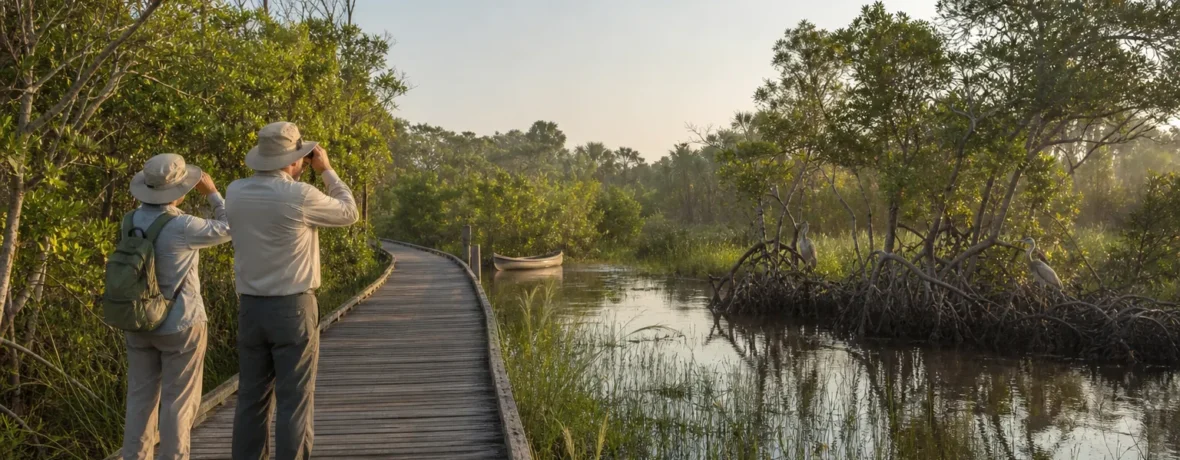
Start with Anhinga Trail, Shark Valley, and one water-based trip if you have a full day; add Flamingo, Gulf Coast, or wilderness paddling if you have two days. Go in the dry season for easier wildlife viewing, cooler hiking, and fewer mosquitoes.
What to do in Everglades National Park in one day?
Do one wildlife boardwalk, one big-view stop, and one slow water or tram experience. Everglades is not a peak-bagging park. You come here for sawgrass, birds, alligators, mangroves, and that flat horizon that makes the sky feel enormous.
If this is your first visit, use the Homestead entrance and work the Main Park Road toward Flamingo, or use the Shark Valley entrance if you are based in Miami and want the cleanest half-day plan. The park has three non-connected entrances, and the National Park Service says you need a car because distances are long and public transportation does not travel within the park; each entrance area and Flamingo are at least a 1-hour drive apart. Check the official Everglades directions and entrance information before you pick your route.
A strong first-time Everglades day
- Start early at Royal Palm. Walk Anhinga Trail first, before the midday heat and parking crunch build.
- Add Gumbo Limbo Trail. It is short, shaded, and a good contrast to the open marsh.
- Drive the Main Park Road. Stop at pineland, prairie, and overlook pullouts instead of rushing straight to Flamingo.
- Choose one longer activity. Pick Shark Valley tram or bike, a Flamingo boat tour, a canoe rental, or extra hiking.
- Be done with exposed walking before late afternoon storms in the wet season. Lightning is not a cute Everglades souvenir.
Which Everglades entrance should you choose?
Choose Homestead for classic hiking, Shark Valley for wildlife and biking, and Gulf Coast for boat access. The right entrance depends on where you sleep the night before and how much time you have.
The Homestead entrance gives you the most varied road-based day. You get Ernest F. Coe Visitor Center, Royal Palm, Anhinga Trail, Gumbo Limbo Trail, Pa-hay-okee Overlook, Mahogany Hammock, and the long run to Flamingo. This is the best pick if you want short hikes and a proper Everglades sampler.
Shark Valley sits off U.S. 41 west of Miami. It is simple: visitor center, 15-mile [24 km] paved loop, observation tower, wildlife, tram, bikes, and short trails. If you hate complicated logistics, Shark Valley is your friend.
Gulf Coast, at Everglades City, is water country. You go there for Ten Thousand Islands boat trips, paddling routes, and access to remote mangrove islands. It is less of a hiking stop and more of a “get on the water” stop.
| Entrance | Best for | Plan on | Skip if |
|---|---|---|---|
| Homestead / Main Park Road | Short hikes, boardwalks, Flamingo | Half day to full day | You only have 2 hours from Miami |
| Shark Valley | Wildlife, biking, tram, observation tower | 3 to 5 hours | You want coastal paddling |
| Gulf Coast / Everglades City | Boat tours, kayaking, Ten Thousand Islands | Half day to full day | You want easy boardwalk hikes |
What are the best short hikes in Everglades National Park?
The best short hikes are Anhinga Trail, Gumbo Limbo Trail, Pa-hay-okee Overlook, and Mahogany Hammock. They are short on mileage but big on Everglades character.
Start with the official Everglades hiking trails list, then match the trail to the habitat you want to see. This park changes fast from sawgrass marsh to hardwood hammock to pine rockland. That is the fun.
Anhinga Trail
Anhinga Trail is the first hike most visitors should do. The official distance is 0.8 miles [1.2 km] round trip, and the route winds through Taylor Slough and sawgrass marsh. Expect alligators, turtles, anhingas, herons, egrets, and other birds, especially in the dry season. Stay on the path. Give wildlife room. The animals are not props.
Gumbo Limbo Trail
Gumbo Limbo Trail is a 0.4-mile [0.6 km] paved loop through shaded tropical hardwood hammock. It feels completely different from Anhinga even though it starts from the same Royal Palm area. Walk it after Anhinga when the sun starts to bite.
Pa-hay-okee Overlook
Pa-hay-okee is the quick “River of Grass” view. The raised boardwalk leads to an overlook where the Everglades opens wide and low in every direction. It is the stop to make when someone in your group says, “So where is the actual Everglades?”
Mahogany Hammock
Mahogany Hammock gives you dense greenery, air plants, gumbo limbo, and a lush boardwalk feel. It is not a hard hike. It is a slow-looking hike. Take your time here and listen for movement in the leaves.
Is Shark Valley worth visiting?
Yes, Shark Valley is worth visiting if you want wildlife, an easy route, and big views without planning a complicated day. The 15-mile [24 km] paved Tram Road is open to walking, biking, and tram tours, with an observation tower near the halfway point.
Walking the full loop is possible, but biking or taking the tram is the better plan for most visitors. The route is flat and exposed. Shade is limited. The payoff is steady wildlife viewing: alligators, wading birds, turtles, and open sawgrass views.
If you bike, start early. Bring water. Do not crowd alligators sunning near the pavement. The NPS safety guidance for Everglades says to keep at least 15 feet [4.6 m] from alligators and crocodiles, and if an animal hisses, you are too close even if you are farther than that.
Should you take a boat tour, tram, or airboat ride?
Pick a boat tour for mangroves and open water, a tram for Shark Valley wildlife, and an authorized airboat ride if you specifically want that classic noisy skim across the marsh. They are different trips, not interchangeable ones.
A tram tour works well for families, non-hikers, hot afternoons, and anyone who wants interpretation without pedaling 15 miles [24 km]. A boat tour makes more sense at Flamingo or Gulf Coast, where roads end and water becomes the trail system. Airboat tours are offered by authorized businesses along U.S. 41 near Shark Valley, not from deep inside the park’s main wilderness areas.
If you care most about quiet, choose paddling over motors. A canoe or kayak puts you closer to the texture of the Everglades: mangrove roots, fish movement, bird calls, and the small sounds you miss from a deck or tram bench.
When is the best time to visit Everglades National Park?
The best time for most hikers is the dry season, from November through April. The National Park Service describes this season as cooler, less humid, less buggy, and better for wildlife concentration.
Dry season is also the busy season. Parking at Royal Palm and Shark Valley can fill on winter weekends, so arrive early and keep a backup stop in mind. The tradeoff is worth it: fewer mosquitoes, more ranger programs, and more comfortable walking.
Wet season runs May through November and brings heat, humidity, daily thunderstorms, and heavier insects. NPS wet-season guidance lists typical highs of 90°F [32°C], humidity over 90%, and heat index values over 100°F [38°C]. Wildlife can be harder to spot because rising water spreads animals across the landscape. If you visit then, move early, wear sun protection, and treat storms seriously.
How much does Everglades National Park cost?
As of November 2026, a standard Everglades entrance pass costs $20 to $35, depending on how you enter. The park is cashless, so bring a credit/debit card or buy a digital pass in advance.
According to the official Everglades fees page, as of November 2026 a private vehicle pass costs $35, a motorcycle pass costs $30, and an individual walking, biking, or paddling in without a vehicle pays $20. These standard passes are good for 7 consecutive days at all park entrances. Non-U.S. residents age 16 and older must pay an additional $100 per person unless admitted with an Annual or America the Beautiful Pass, as of November 2026.
Separate fees apply for camping, concession-run tours, rentals, and some reservations. If you plan to camp in the wilderness, do not wing it at the ramp.
Do you need permits or reservations?
You need a permit for overnight wilderness camping, but not for normal day hiking. Day visitors can usually walk boardwalks, stop at overlooks, bike Shark Valley, and visit visitor centers without a separate hiking permit.
For overnight backcountry trips, Everglades requires wilderness permits except for drive-in campgrounds or sleeping aboard boats. As of November 2026, the NPS says wilderness camping reservations are available through Recreation.gov on a rolling basis 3 months in advance, and the Recreation.gov confirmation serves as your permit. The official Everglades wilderness trip planner also lists a $21 administrative fee plus $2 per person per night use fee, as of November 2026.
Wilderness paddling is not casual sightseeing. The 99-mile [159 km] Wilderness Waterway connects Flamingo and Everglades City, and NPS recommends it for experienced paddlers only. Tides, wind, shallow water, confusing mangrove channels, and no freshwater in coastal wilderness areas make this a real trip, not a last-minute add-on.
What should you pack for Everglades hiking?
Pack for sun, bugs, water, and sudden weather. The trails may be short, but the climate can hit hard.
- At least 2 quarts [1.9 liters] of water per person for short frontcountry hiking; more for biking, paddling, or summer heat
- Wide-brim hat, sunglasses, and sunscreen
- Loose long-sleeve shirt and lightweight pants
- EPA-registered insect repellent
- Rain shell during wet season
- Binoculars for birds and distant wildlife
- Closed-toe walking shoes with grip
- Printed or saved map; cell service can be limited
- Snacks that handle heat
- Trash bag so every wrapper leaves with you
For mosquito protection, CDC recommends EPA-registered repellents, loose long sleeves and pants, and permethrin-treated clothing or gear when used as directed. See the CDC’s mosquito bite prevention guidance if you are especially sensitive to bites or traveling with kids.
Can you bring a dog to Everglades National Park?
You can bring a dog only in limited areas, not on hiking trails. Everglades is a rough park for pets because wildlife, heat, and trail restrictions stack up quickly.
As of November 2026, pets must be leashed at all times on a leash no longer than 6 feet [1.8 m]. They are allowed on public vehicle roads, roadside campground and picnic areas, maintained grounds near public facilities and residential areas, and private boats. They are not allowed on boardwalk, paved, or unpaved trails; unpaved roads; or the Shark Valley Tram Trail/Road.
If hiking is the plan, leave your dog in safe care outside the park. Do not leave a pet in a parked car. South Florida heat turns that into an emergency fast.
When to see a doctor
Get medical help right away for serious heat symptoms, worsening bite reactions, or symptoms that do not improve after cooling down and resting. Everglades heat and insects are manageable, but you should not try to tough out warning signs.
CDC heat guidance says heat stroke is a medical emergency; call 911 for confusion, altered mental status, slurred speech, loss of consciousness, seizures, or other severe heat symptoms. For heat exhaustion signs such as dizziness, weakness, heavy sweating, nausea, or headache, stop activity, cool down, and seek medical care if symptoms worsen or last longer than 1 hour. Do not diagnose yourself on the trail. End the day early and get help.
What are the biggest mistakes to avoid?
The biggest mistakes are underestimating distances, heat, bugs, and wildlife. Everglades looks flat and easy, then quietly wears you down.
- Trying to see every entrance in one day. The entrances are not connected by a scenic internal loop.
- Starting exposed trails at midday in summer. Heat index values can climb into dangerous territory.
- Standing too close to alligators. Use zoom, not your feet.
- Skipping bug protection. Mosquitoes can turn a good plan into a retreat.
- Assuming all airboat rides are inside the main park wilderness. Use authorized operators and know where your tour starts.
- Planning a wilderness paddle without tides, charts, and permits. Mangrove country is confusing even for competent paddlers.
Related reading
- How to Get to Dry Tortugas National Park
- What to Do in Zion National Park: Hikes by Difficulty
- Where to Stay in Yosemite for Hikers
- Where to Stay in Glacier National Park
FAQ
How many days do you need in Everglades National Park?
One full day is enough for Royal Palm, short hikes, and either Shark Valley or Flamingo. Two days is better if you want both Shark Valley and a boat or paddling trip without rushing.
What is the best thing to do in Everglades National Park?
For most first-time visitors, the best thing to do is walk Anhinga Trail early in the day. It is short, accessible, wildlife-rich, and gives you the classic sawgrass-marsh Everglades experience fast.
Can you see alligators in Everglades National Park?
Yes, you can often see alligators, especially along Anhinga Trail and Shark Valley. Keep at least 15 feet [4.6 m] away, never feed wildlife, and back up if an animal reacts to you.
Is Everglades National Park safe to hike?
Yes, Everglades is safe to hike if you stay on trails, manage heat, carry water, use insect protection, and give wildlife space. The main hazards are heat, storms, mosquitoes, slippery surfaces, and people getting too close to animals.
Can you visit Everglades National Park from Miami?
Yes, Shark Valley is the easiest Everglades area to visit from Miami. The Homestead entrance also works well from Miami if you want Royal Palm, Anhinga Trail, and the Main Park Road toward Flamingo.
What should you not miss in Everglades National Park?
Do not miss Anhinga Trail, Shark Valley, and at least one water-based experience if time allows. Add Pa-hay-okee Overlook for the big sawgrass view and Flamingo if you want the park to feel wilder and more coastal.