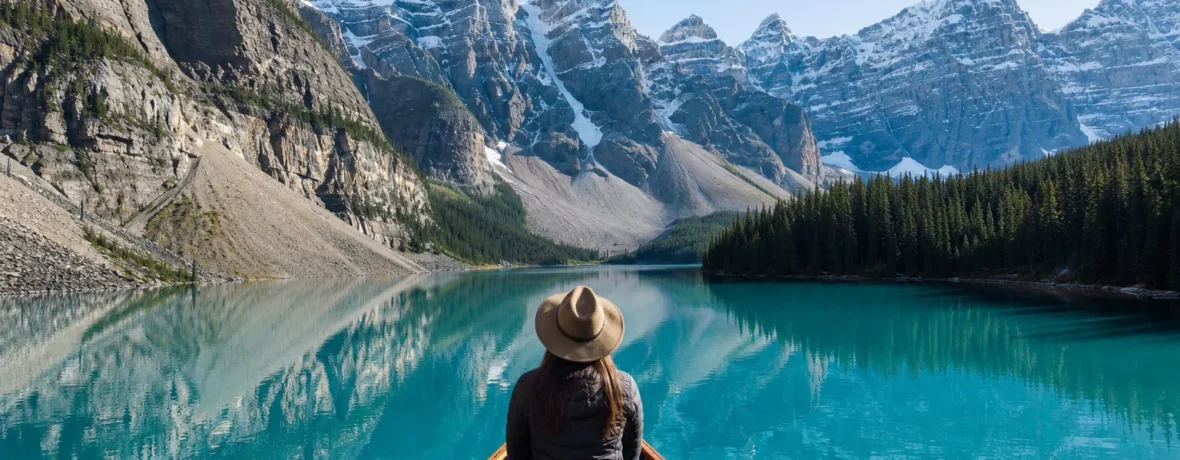
Build your trip around 6 core lake-and-hike areas: Lake Louise, Moraine Lake, Johnston Canyon, Banff town trails, Lake Minnewanka, and the Icefields Parkway. With 3 full days, you can see the icons, hike 2 serious trails, and still leave breathing room.
What to do in Banff National Park if you only have a few days?
Prioritize lakes early, hikes mid-morning, and town-based stops when parking gets messy.
Banff rewards people who plan. Not with spreadsheets. With sunrise light on turquoise water, quieter trail miles, and fewer hours circling full parking lots. If this is your first visit, keep the route simple: one Lake Louise/Moraine Lake day, one Banff town and canyon day, and one Icefields Parkway day.
Here is the clean 3-day structure:
- Day 1: Lake Louise and Moraine Lake. Use transit or a Parks Canada shuttle, then hike Lake Agnes, Plain of Six Glaciers, Larch Valley, or Sentinel Pass depending on your legs.
- Day 2: Johnston Canyon, Bow Valley Parkway, and Banff town trails. Pair a canyon walk with Tunnel Mountain, Sulphur Mountain, Vermilion Lakes, or the Bow River trail system.
- Day 3: Icefields Parkway lakes. Drive north for Bow Lake, Peyto Lake, Waterfowl Lakes, and one shorter hike such as Helen Lake or Cirque Lake if conditions fit.
As of November 2026, Parks Canada recommends planning Lake Louise and Moraine Lake access in advance, and Moraine Lake Road is closed to personal vehicles year-round. Check the official Parks Canada Lake Louise and Moraine Lake access page before locking your day.
What are the best hikes in Banff National Park for lake views?
The best lake-view hikes are Lake Agnes, Plain of Six Glaciers, Larch Valley, Sentinel Pass, Eiffel Lake, and Helen Lake.
Banff has plenty of roadside viewpoints, but the best days start when you leave the pavement. These hikes put you above the famous water instead of shoulder-to-shoulder beside it.
| Hike | Distance | Best for | Effort |
|---|---|---|---|
| Lake Agnes | 2.4 mi [3.9 km] one way | Classic Lake Louise overlook and tea house | Moderate climb |
| Plain of Six Glaciers | 3.6 mi [5.8 km] one way | Glacier views beyond Lake Louise | Moderate to hard |
| Larch Valley | 2.8 mi [4.5 km] one way | Moraine Lake, Ten Peaks, fall color | Steady climb |
| Sentinel Pass | 3.5 mi [5.6 km] one way | High alpine pass above Larch Valley | Hard |
Lake Agnes is the first-timer’s sweet spot. You climb through forest from Lake Louise, pass Mirror Lake, then reach a smaller alpine lake tucked under cliffs. Keep going to Little Beehive or Big Beehive if you want a higher angle over the blue curve of Lake Louise.
Plain of Six Glaciers feels bigger and wilder. The trail follows Lake Louise’s shoreline, then climbs into open terrain with rock, ice, and long views into the glacier basin. If your legs are strong, Parks Canada lists a 8.9 mi [14.3 km] loop linking Lake Agnes and Plain of Six Glaciers via the Highline Trail on its Banff hiking trails page.
From Moraine Lake, Larch Valley is the marquee hike. It starts with switchbacks, then opens into one of the most photographed alpine basins in the Rockies. Add Sentinel Pass only if the weather is stable, the trail is clear, and your group is ready for steeper, rockier terrain.
Can you visit Lake Louise and Moraine Lake in one day?
Yes, you can visit both in one day if you use the shuttle or transit system and keep your hiking plan realistic.
Trying to drive it like an ordinary sightseeing loop is where trips go sideways. As of November 2026, personal vehicles can go to Lake Louise only, while Moraine Lake access is by Parks Canada shuttle, Roam Public Transit, licensed commercial operators, bicycle, or approved lodge access. During the shuttle season, paid parking applies at Lake Louise Lakeshore, and the lot can fill by sunrise.
A strong one-day plan looks like this:
- Early shuttle window: Start with Moraine Lake if you want the Rockpile viewpoint before the busiest part of the day.
- Midday connector: Move to Lake Louise and pick one hike, not three.
- Best moderate hike: Lake Agnes.
- Best longer hike: Plain of Six Glaciers.
- Best no-big-hike finish: Walk the Lake Louise shoreline, then return by shuttle.
Do not stack Larch Valley, Sentinel Pass, Lake Agnes, and Plain of Six Glaciers into one day unless you are a fast, fit hiker with an early start and stable conditions. The terrain is too good to rush.
What lakes should you see in Banff National Park?
See Lake Louise and Moraine Lake first, then add Peyto Lake, Bow Lake, Lake Minnewanka, and Vermilion Lakes.
Each lake has a different job. Lake Louise is the grand stage. Moraine Lake is the postcard. Peyto Lake is the high viewpoint. Bow Lake is a calmer Icefields Parkway stop. Lake Minnewanka gives you space, big water, boat tours, and shoreline hiking. Vermilion Lakes are for sunset, wildlife viewing from a distance, and easy wandering close to town.
Lake Louise
Lake Louise is the classic Banff scene: pale turquoise water, steep peaks, and trails leaving straight from the shore. Go early or use transit. If the lakeshore feels crowded, walk 15 minutes along the shoreline trail and the noise thins fast.
Moraine Lake
Moraine Lake sits in the Valley of the Ten Peaks, and the Rockpile viewpoint gives the famous elevated view. The easiest add-on is the lakeshore trail. The bigger move is Larch Valley, especially during golden larch season when the alpine trees turn bright yellow.
Peyto Lake
Peyto Lake is a short viewpoint stop on the Icefields Parkway, not a long hike for most visitors. It is still one of the sharpest views in the park: a bright blue lake shaped by glacial silt below a broad overlook.
Bow Lake
Bow Lake is made for slow travel. Stop here when driving the Icefields Parkway and give yourself time to look across the water toward the glacier-fed headwall. If you hike beyond the lakeshore, check current trail conditions first.
Lake Minnewanka
Lake Minnewanka is close to Banff town but feels larger and windier than the smaller alpine lakes. It works well when Lake Louise plans fall apart, when you want an easier day, or when you need a scenic place that does not require a major climb.
What is the best easy hike in Banff National Park?
Johnston Canyon is the best easy hike for most visitors, while Tunnel Mountain is the best short summit near town.
Johnston Canyon gives you catwalks, waterfalls, cliffs, and a clear route. It is popular for a reason. Go early, go late, or expect company. In shoulder season and winter, ice can turn the trail into a slip-and-slide, so traction belongs in your pack when temperatures drop.
Tunnel Mountain is short, direct, and satisfying. You start near town, climb steady switchbacks, and finish with views over Banff, the Bow Valley, and surrounding peaks. It is the hike to choose when you arrive in the afternoon and still want a summit before dinner.
Other easier picks:
- Bow River Trail: Gentle walking close to town.
- Vermilion Lakes Road: Flat, scenic, strong at sunset.
- Lake Louise Lakeshore: Big payoff with minimal climbing.
- Marsh Loop near Cave and Basin: Good for a low-key nature walk.
What is the best hard hike in Banff National Park?
Sentinel Pass is the best hard hike for classic Banff alpine scenery, while Fairview Mountain is the stronger choice for a steep summit above Lake Louise.
Sentinel Pass starts from Moraine Lake and climbs through Larch Valley to a high saddle between two dramatic valleys. Parks Canada lists it at 3.5 mi [5.6 km] one way with 2,461 ft [750 m] of elevation gain. The reward is huge, but the trail can hold snow, and the upper section is exposed to weather.
Fairview Mountain starts near Lake Louise and climbs 3.1 mi [5 km] one way with 3,248 ft [990 m] of gain. That is not a casual stroll. It is a steep workout with a summit view down to Lake Louise and across to Mount Temple.
If you want something hard but not as committing as a summit, look at Rockbound Lake. Parks Canada lists it at 5.3 mi [8.5 km] one way with 2,510 ft [765 m] of gain. The trail climbs through forest toward Tower Lake and Rockbound Lake behind Castle Mountain.
Do you need permits, passes, or reservations for Banff hikes?
Yes, you need a national park entry pass to stop in Banff National Park, and you need reservations for some shuttles and all overnight backcountry trips.
As of November 2026, Parks Canada lists regular fees and service charges through its official Banff fees page. Youth admission is free at Parks Canada places, but camping, backcountry overnight use, reservation fees, guided programs, firewood, hot springs, and other services can still cost extra.
For day hikes, you usually do not need a hiking permit. You do need to obey closures, seasonal restrictions, parking rules, and wildlife-area requirements. For overnight trips, Parks Canada says a backcountry permit is mandatory, advance reservations are required for backcountry camping, and random camping is allowed only in designated areas with a specific permit. Check the official Banff backcountry camping page if you plan to sleep beyond a frontcountry campground.
When is the best time to hike in Banff National Park?
Late June through September is the most reliable hiking window, with July and August bringing the warmest high-country access and the largest crowds.
Banff is mountain country. Snow can linger high on trails into summer, and fresh snow can return early in fall. Lake Louise and Moraine Lake typically hit peak chaos in July, August, and larch season. If you want quieter trails with strong hiking odds, look at late June, early July, or the first half of September.
Season-by-season, think like this:
- May: Lower trails open first. Lakes can still look icy. High trails may be snowy.
- June: Waterfalls run strong, but alpine routes can still be mixed.
- July and August: Best high-trail access, biggest crowds, long daylight.
- September: Cooler air, larch color, busy Moraine Lake trails.
- October: Shoulder season. Some services wind down, and snow risk rises.
- November through April: Winter travel. Avalanche terrain, ice, and short days change the game.
Before any hike, check the official Banff trail conditions report. As of November 2026, Parks Canada posts current trail ratings, warnings, closures, and condition notes there.
What should you pack for hiking in Banff?
Pack for cold wind, hot sun, sudden rain, wildlife country, and limited cell service.
A blue-sky morning in Banff can still turn sharp above treeline. Bring real layers, not wishful thinking. Cotton hoodies and fashion sneakers get old fast when the trail turns muddy, windy, or icy.
- Broken-in hiking shoes or boots with grip
- Rain shell and warm insulating layer
- Hat, gloves, and sunglasses
- Water and snacks for the full hike
- Map downloaded offline
- Headlamp, even for day hikes
- First-aid kit and blister care
- Bear spray carried where you can grab it fast
- Sun protection
- Traction devices in icy shoulder-season conditions
- Trash bag for every wrapper and scrap
Banff is bear habitat. Parks Canada recommends hiking in a tight group of 4 or more in bear country, carrying bear spray, making noise, staying on official trails, and storing food properly. Read the official Parks Canada bear safety guidance before you hike.
How do you avoid crowds in Banff National Park?
Start early, use transit, choose one major destination per day, and keep backup hikes ready.
You will not have Lake Louise to yourself at midday in July. That is not defeat. That is Banff. The trick is to stop fighting the obvious and build your day around it.
- Book transport first. For Lake Louise and Moraine Lake, solve access before picking lunch spots.
- Hike past the photo line. Many visitors stop at the first viewpoint. Walk 1 mile [1.6 km], and the mood changes.
- Use town trails for flexible windows. Tunnel Mountain, Bow River, and Vermilion Lakes work well when bigger plans jam up.
- Drive the Icefields Parkway with patience. Stop early at Peyto Lake or Bow Lake, then move beyond the busiest viewpoints.
- Carry a Plan B and Plan C. If parking, weather, or a closure blocks the first choice, pivot fast.
The best Banff day is not always the most famous one. Sometimes it is the trail you take because the first lot was full.
Related reading
- How to Get to Dry Tortugas National Park
- What to Do in Zion National Park: Hikes by Difficulty
- Where to Stay in Yosemite for Hikers
- Where to Stay in Glacier National Park
FAQ
How many days do you need in Banff National Park?
Three full days is the minimum for a strong hiking-and-lakes trip. With 5 days, you can add more Icefields Parkway stops, a harder alpine hike, and a recovery day near Banff town.
Can beginners hike in Banff National Park?
Yes, beginners can hike in Banff if they choose short, marked trails and turn around before fatigue becomes a problem. Start with Johnston Canyon, Tunnel Mountain, Lake Louise Lakeshore, Bow River Trail, or Vermilion Lakes.
Is Moraine Lake better than Lake Louise?
Moraine Lake has the stronger single viewpoint, while Lake Louise has better trail variety directly from the shore. If you can see both, do both; if you must pick one and want a classic hike, choose Lake Louise.
Do you need a car in Banff National Park?
No, you do not need a car for the main sights if you use shuttles and Roam Public Transit. A car helps for Icefields Parkway stops, early starts outside shuttle routes, and flexible backup plans.
Are Banff hikes safe with bears?
Banff hikes can be safe when you follow bear-country habits. Carry bear spray, know how to use it, hike in a group when possible, make noise, keep food sealed, and give every wild animal far more space than you think it needs.
What is the most scenic hike in Banff National Park?
For many hikers, Sentinel Pass is the most scenic trail because it combines Moraine Lake, Larch Valley, the Ten Peaks, and a high alpine pass. For a Lake Louise-based hike, Plain of Six Glaciers delivers the biggest mountain-and-ice scenery.