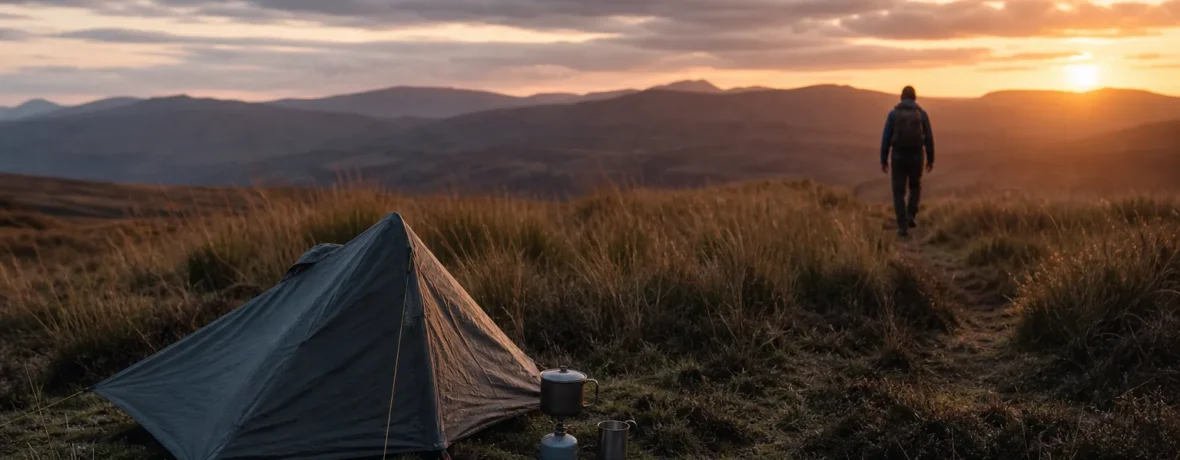
What is wild camping? It is sleeping outside a developed campground, usually in a small tent, bivy, hammock, or under a tarp, with no toilets, trash cans, picnic tables, or water taps. It is legal only where land rules allow it: often on USFS or BLM land, rarely by default on private land.
What is wild camping in simple terms?
Wild camping means camping away from a built campground.
Think of it as the stripped-down version of backpacking overnight. You hike in, choose a low-impact spot, sleep, pack up, and leave with every wrapper, tent stake, and orange peel you brought. No campground host. No numbered pad. No fire grate unless one already exists and fires are allowed.
In the United States, you’ll often hear “dispersed camping” instead of wild camping. The meaning is close, but land agencies use “dispersed camping” for camping outside developed recreation facilities. The Bureau of Land Management says most BLM lands allow dispersed camping unless an area is posted closed or has specific restrictions, as of November 2026, according to the BLM camping guidance.
Wild camping is not the same as stealth camping in a city park, sleeping in a trailhead parking lot, or pulling off a highway wherever you feel tired. Those can bring fines, towing, or a very awkward knock on the window at 2 a.m.
Where is wild camping legal in the United States?
Wild camping is often legal on some federal public lands, but not everywhere.
Your best bets are National Forest land managed by the US Forest Service and public lands managed by the BLM. Even there, rules change by forest, district, road, season, fire danger, wildlife closure, and restoration area. One valley may be open. The next drainage may be closed to camping to protect water, habitat, or a heavily used trail corridor.
| Land type | Can you usually wild camp? | What to check first |
|---|---|---|
| National Forests | Often, where dispersed camping is allowed | Forest orders, motor vehicle maps, fire restrictions, wilderness permits |
| BLM public lands | Often, unless posted closed or restricted | Local field office rules, stay limits, seasonal closures |
| National Parks | Only with park-specific permission or permit | Backcountry permit, assigned sites or zones, food storage rules |
| State parks, city parks, private land | Usually no without permission or a designated site | Park rules, landowner permission, local ordinances |
On National Forest land, dispersed camping is commonly allowed outside developed campgrounds, but the exact limits are local. A Forest Service dispersed camping flyer for Gila National Forest states that dispersed camping means camping anywhere in the National Forest outside a developed campground, with no services such as trash removal, water, tables, or fire pits, and lists a 14-day limit in any 30-day period for that forest, as of November 2026, in this USFS dispersed camping guide.
National Parks are tighter. Do not assume you can wander off trail and pitch a tent. Many parks require a backcountry or wilderness permit and may assign specific campsites, zones, or travel corridors. The National Park Service states that backcountry permits help prevent overcrowding and protect resources, as of November 2026, in its backcountry camping permit guidance.
Is wild camping legal on BLM and National Forest land?
Yes, often, but only if the local office has not restricted that area.
This is the sweet spot for many hikers in the western US. BLM desert country, high-elevation National Forest roads, and trail-accessed wilderness areas can all offer legal, quiet nights without a developed campground. Still, “public land” is not a magic phrase. Public land can include mining claims, grazing allotments, archaeological sites, closed restoration zones, wilderness study areas, and fire closures.
As of November 2026, BLM says dispersed camping is generally limited to 14 days within any 28-day period, though limits vary by state and field office. That same BLM guidance says rules vary locally, so you should comply with posted signs and verify details with the local BLM office.
For National Forests, don’t rely on a single national rule. One forest may allow roadside dispersed camping only within a set distance of open roads. Another may require you to camp in signed dispersed sites. A California forest may require a campfire permit for stoves or fires. A dry forest may ban wood and charcoal fires outside developed campgrounds.
How do you know if a wild camping spot is allowed?
You confirm the land manager, then read the local rules before you go.
Do this before you drive three hours into patchy cell service. The legal part is a map problem first, then a rule problem.
- Identify the land owner or manager: USFS, BLM, NPS, state, county, city, tribe, or private.
- Open the official land manager page, not a forum thread from five years ago.
- Look for “dispersed camping,” “backcountry camping,” “wilderness permit,” or “camping restrictions.”
- Check current fire restrictions and seasonal road closures.
- Check whether overnight parking is legal at your trailhead.
- Call the ranger district or field office if the map and rules do not match what you see on the ground.
A good rule of thumb: if you cannot explain why your campsite is legal, pick a different spot or use a designated campground. “Nobody stopped me last time” is not a plan.
Can you wild camp in national parks?
Sometimes, but only under that park’s backcountry system.
National Parks protect busy, fragile places. The rules are not there to kill your sense of freedom; they keep alpine meadows from becoming dust bowls and keep popular lakeshores from turning into tent cities.
Some parks use designated backcountry campsites. Some use zones. Some require bear canisters. Some ban camping above certain elevations, near roads, near water, or in sensitive basins. Permits can be limited and may be handled through Recreation.gov or the park’s own process.
If your route crosses a National Park boundary, treat that boundary like a rule change. A legal campsite on National Forest land can become illegal 100 yards [91 m] later inside the park.
Can you wild camp on private land?
No, not without permission.
Private land is private even if it looks wild, unfenced, or unused. In many hiking areas, public and private parcels form a checkerboard. A meadow beside a National Forest road may be a ranch inholding. A riverbank may be private even though the trail nearby is public.
Ask first. Get a clear yes. If the landowner says no fires, no dogs, or leave by sunrise, that is the deal. Better yet, avoid the guesswork and camp on land where the rules are published.
Is wild camping legal in Scotland, England, and Wales?
Scotland is broadly more permissive; England and Wales are much more limited.
In Scotland, responsible lightweight camping is included under outdoor access rights on most land, as long as you follow the Scottish Outdoor Access Code. The official code says access rights include responsible lightweight camping in tents, in small numbers, for two or three nights in one place, as of November 2026, in the Scottish Outdoor Access Code guidance.
England and Wales are different. Wild camping is generally not a right on open country without landowner permission, with Dartmoor as the famous special case. Dartmoor National Park says backpack camping is permitted on some commons shown on its official camping map, with one or two nights maximum, no vehicle camping, no large tents, no large groups, no fires, and all rubbish taken home, as of November 2026, in the Dartmoor camping map guidance.
What should you pack for wild camping?
Pack like nobody is coming to clean up after you.
Your kit should be light enough to carry and complete enough to handle weather, darkness, water treatment, and waste. For a one-night trip, keep it simple.
- Low-profile tent, tarp, hammock, or bivy suited to the area
- Sleeping bag or quilt rated for the expected low
- Sleeping pad with enough insulation for the season
- Headlamp plus spare power
- Water filter, purifier, or chemical treatment
- Map, compass, and downloaded offline map
- Trowel and waste bags where catholes are allowed
- Bear canister or approved food storage where required
- Stove instead of a campfire
- Trash bag for every bit of waste
- Warm layer, rain shell, hat, and gloves
- First-aid kit and emergency communication plan
How do you wild camp without damaging the place?
Choose durable ground, stay small, and leave fast.
Leave No Trace recommends camping at least 200 feet [61 m] from lakes and streams and choosing durable surfaces such as established campsites, rock, gravel, dry grass, or snow, according to its Travel and Camp on Durable Surfaces guidance. Local rules may require a different distance, so follow the stricter rule.
Use this quick campsite test:
- Can you camp here legally?
- Are you out of sight from trails, roads, and homes where possible?
- Are you away from water, fragile plants, and wildlife travel routes?
- Can your tent sit without digging, trenching, or moving rocks?
- Can you cook without building a fire?
- Can you leave in the morning with no visible sign you slept there?
Skip loud music, bright lanterns, chopped branches, soap in streams, and campfires in questionable conditions. Wild camping works only when the next hiker cannot tell you were there.
Related reading
- How to Plan a Camping Trip
- How to Start Camping: A Beginner's Guide
- Dispersed Camping in Colorado: Best Areas and Rules
- Camping Checklist: What to Bring
FAQ
What is the difference between wild camping and dispersed camping?
Wild camping is the common outdoor term; dispersed camping is the land-agency term used in much of the United States. Both usually mean camping outside a developed campground with no services.
Is wild camping free?
Often, yes, on BLM or National Forest land where dispersed camping is allowed. It may still require a permit, pass, reservation, or overnight parking authorization in certain areas.
Can you have a campfire while wild camping?
Only if fires are legal at that place on that date. Fire bans, drought rules, elevation limits, wilderness rules, and local forest orders can all prohibit campfires, so a stove is the safer default.
How far should you camp from water?
Use 200 feet [61 m] as a strong default unless local rules require another distance. This protects water quality, streamside vegetation, and wildlife access to lakes and creeks.
Can you wild camp anywhere if you arrive late and leave early?
No. Arriving late does not make an illegal campsite legal. Set up late and leave early only after you have confirmed that overnight camping is allowed there.
What is the safest beginner wild camping plan?
Start with one night on land where dispersed camping is clearly allowed. Pick a mild-weather forecast, hike a short distance from the trailhead, use a stove, carry all your water or a treatment method, and leave the site cleaner than you found it.