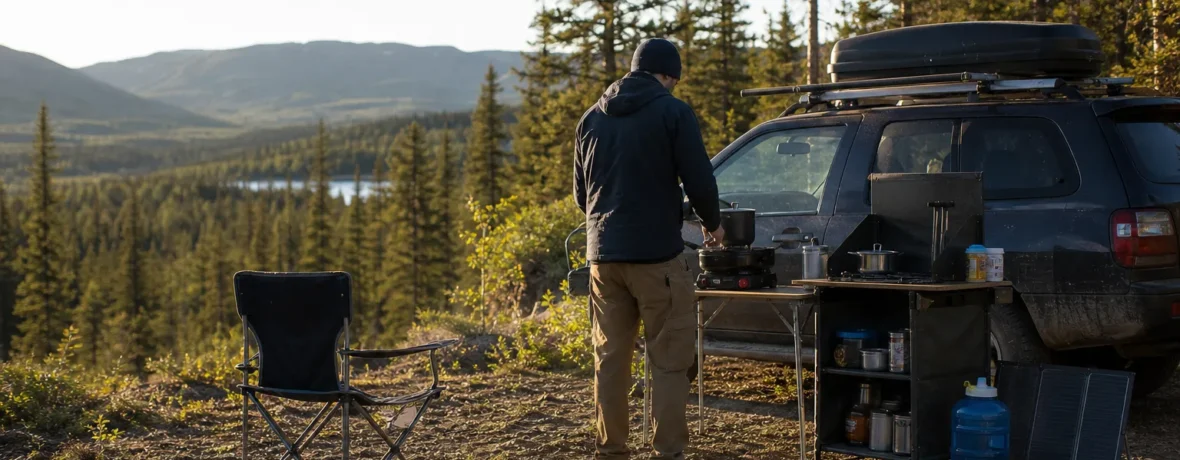
What is dry camping? It is camping without electrical, water, or sewer hookups. You bring your own power, carry your own water, manage your own toilet waste, and leave with everything you brought in. Yes, it can be comfortable, but only if you plan for 24 to 72 hours of self-sufficiency.
What is dry camping in plain English?
Dry camping means your campsite gives you a place to park or pitch, not services.
No shore power. No water spigot. No sewer connection. Sometimes no picnic table, no toilet, no trash can, and no cell signal either. You might be in a van, truck camper, RV, rooftop tent, or plain old ground tent. The label changes, but the deal stays the same: you are responsible for water, power, waste, food storage, and cleanup.
Here is the position: dry camping is one of the best ways to camp if you want quieter nights, better trail access, and more room to breathe. But it is not “camping for free” in the lazy sense. It is camping with more responsibility. If you cannot carry out your trash, manage human waste, control noise, and follow land rules, you are not dry camping. You are just making a mess somewhere pretty.
Is dry camping the same as boondocking?
Mostly, yes, but people use the words a little differently.
“Dry camping” describes the lack of hookups. “Boondocking” usually means dry camping away from developed campgrounds, often on public land. You can dry camp inside a campground if the site has no hookups. You can boondock along a desert road, in a national forest pullout, or on Bureau of Land Management land where camping is allowed.
| Term | What it usually means | Typical setting |
|---|---|---|
| Dry camping | No water, sewer, or electrical hookups | Campgrounds, trailheads, public land |
| Boondocking | Dry camping away from developed sites | BLM land, national forests, remote roads |
| Dispersed camping | Camping outside a developed campground | National forests and some BLM areas |
Where can you dry camp legally?
You can dry camp legally only where the land manager allows it.
That sounds obvious until you roll into a scenic pullout at sunset and see tire tracks, fire rings, and no signs. Tire tracks are not permission. A rock fire ring is not permission. A pretty view is not permission.
On many BLM lands, dispersed camping is allowed unless an area is posted closed or has local restrictions; as of November 2026, the BLM says dispersed camping is generally limited to 14 days within a 28-day period, though local rules vary by field office. Check the official BLM camping guidance before you count on a spot.
National forests often allow dispersed camping, but each forest can set its own road, fire, stay-limit, and seasonal restrictions. National parks are usually stricter. The National Park Service tells campers to check park-specific rules, permits, food storage, potable water, and campsite requirements before setting up; start with the NPS guide to finding and setting up a campsite.
Private land is different: you need permission. Parking lots are different too: store policies, city ordinances, security rules, and overnight parking bans can all apply. Ask first. A quiet “yes” beats a 2 a.m. knock on the window.
What do you need for dry camping?
You need enough water, power, food storage, toilet plan, and judgment to stay self-contained.
Start lean. The point is not to haul a rolling apartment into the woods. The point is to meet your actual needs without leaning on a campground pedestal.
- Water: Carry drinking, cooking, dishwashing, and handwashing water in sturdy containers.
- Power: Use a charged power bank, portable battery, solar panel, or vehicle system sized to your devices.
- Light: Pack a headlamp, lantern, and spare batteries or a charging plan.
- Toilet setup: Use campground toilets when present, a portable toilet where required, or a legal cathole method where allowed.
- Trash system: Bring tough bags and a sealed bin so food wrappers do not blow around camp.
- Food storage: Use a bear canister, bear box, hard-sided vehicle, or approved storage method where required.
- Navigation: Download maps before you lose signal and carry a paper backup in remote country.
- Fire plan: Bring a stove. Do not depend on a campfire, especially during dry or windy conditions.
How much water do you need for dry camping?
Plan on at least 1 gallon [3.8 liters] per person per day for basic drinking and cooking, then add more for heat, dogs, dishwashing, and dusty travel.
That number is a floor, not a trophy. In hot desert weather, during long hikes, or at high elevation, your water use can climb fast. If you are camping with a dog, bring dedicated water for the dog. If your meals need boiling water, count that too. If your route has no reliable refill, do not pretend a blue line on the map is water.
If you collect from a lake, stream, or spring, treat it. The CDC says untreated water can contain bacteria, viruses, and parasites even when it looks clear, and recommends boiling or using other proven treatment methods when you are not sure the water is safe. For specific methods, see the CDC’s water treatment guidance for hiking, camping, and traveling.
How do you dry camp without being that camper?
You keep your footprint small, quiet, legal, and temporary.
The best dry campers are almost boring. They do not build new fire rings. They do not trench around tents. They do not run a generator all night in a canyon where sound ricochets like a thrown pan. They show up, camp cleanly, and leave the site looking unused.
- Choose a legal, durable site. Use existing impacted areas when allowed. Avoid crushing vegetation for a better view.
- Park without blocking roads. Leave room for emergency vehicles, ranch access, trail users, and other campers.
- Set up before dark. You make worse decisions when tired, hungry, and swinging a headlamp at every shadow.
- Store food correctly. Bears, rodents, ravens, and raccoons learn fast. Do not train them with your snacks.
- Manage gray water and toilet waste legally. Rules change by place. When in doubt, pack it out.
- Kill the noise. Voices, doors, dogs, music, and generators carry farther than you think.
- Leave early if conditions turn ugly. Mud, flash flood risk, smoke, wind, and heat are not character tests.
Can you use a generator while dry camping?
Sometimes, but a generator should be the backup plan, not the soundtrack.
Many dry camping areas restrict generator hours, and some ban them. Even where generators are legal, they can wreck the whole reason people came out: quiet. If you need one for medical equipment or a specific power need, follow the local rule and place it safely.
Carbon monoxide is the non-negotiable hazard. The CDC says carbon monoxide is odorless and colorless, and portable generators can produce it. Run generators outdoors and away from doors, windows, vents, tents, campers, and neighboring rigs; see the CDC’s carbon monoxide poisoning basics for safety guidance.
When to see a doctor
Get medical help fast if someone may have carbon monoxide exposure, severe dehydration, confusion, chest pain, fainting, or symptoms that worsen after drinking questionable water.
Dry camping does not need to be scary, but remoteness raises the stakes. If multiple people in a tent, van, or RV develop headache, dizziness, weakness, nausea, vomiting, chest pain, or confusion, leave the area for fresh air and seek urgent care because those can be carbon monoxide symptoms. For dehydration concerns, Mayo Clinic advises medical treatment right away for severe dehydration; review its dehydration symptoms and causes page for general warning signs.
Is dry camping worth it?
Yes, if you want more freedom and accept the work that comes with it.
Dry camping gives you options. You can sleep closer to a trailhead, skip crowded RV parks, watch the stars without a bathhouse light buzzing over your picnic table, and learn exactly how much water and power you really use. That last part humbles people fast.
But dry camping is not automatically better than a developed campground. If you are new, tired, traveling with kids, camping in extreme heat, or trying to figure out a new rig, hookups can be a smart choice. Comfort is not a moral failure. Neither is paying for a site with a toilet.
The smart approach is simple: earn your way outward. Try one night at a no-hookup campground. Then try a legal dispersed site near town. Then go farther when your system works. Dry camping rewards preparation, not bravado.
Related reading
- Best Camping Stoves
- What Is a Dry Bag and Do Hikers Need One?
- How to Plan a Camping Trip
- How to Start Camping: A Beginner's Guide
FAQ
What is the main difference between dry camping and regular camping?
Dry camping means you have no electrical, water, or sewer hookups. Regular campground camping may include some or all of those services, plus toilets, trash cans, picnic tables, or potable water.
Can you dry camp in a tent?
Yes, tent campers can dry camp. You still need the same basics: water, food storage, lighting, waste plan, weather protection, and a legal campsite.
How long can you dry camp?
You can dry camp as long as your water, food, power, toilet capacity, weather window, and land rules allow. On many public lands, stay limits apply, so check the managing agency before settling in.
Do you need solar for dry camping?
No, solar is useful but not mandatory. For short trips, a charged power bank or portable battery may cover lights, phones, and small electronics.
Is dry camping safe?
Dry camping is safe when you choose legal sites, carry enough water, store food correctly, monitor weather, and avoid carbon monoxide risks. It becomes risky when you guess on water, ignore closures, camp in washes, or use fuel-burning gear in enclosed spaces.
Is dry camping free?
Sometimes, but not always. Some dispersed areas have no nightly fee, while other no-hookup sites require reservations, permits, entrance fees, or passes, so verify the specific location before you go.