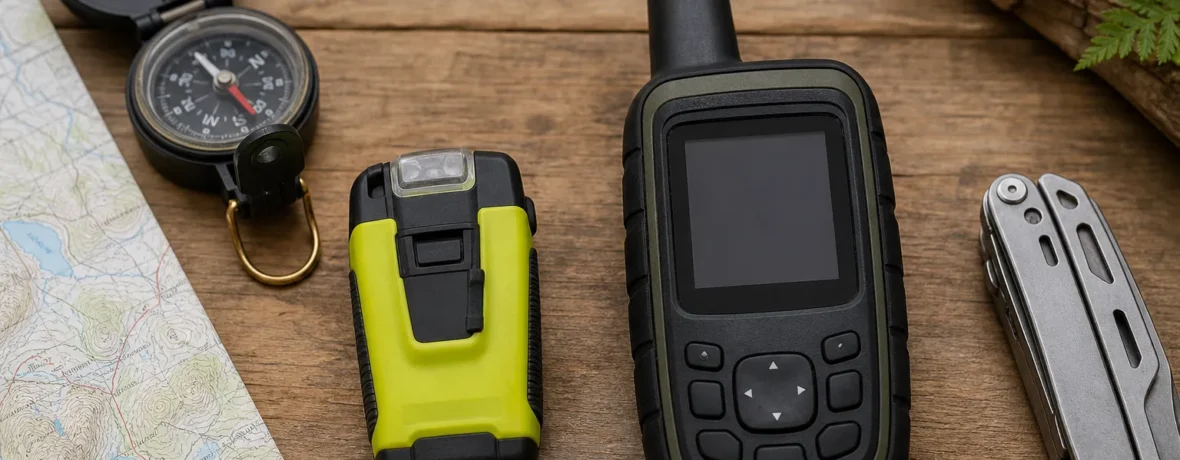
What is a personal locator beacon? It’s a handheld 406 MHz emergency transmitter you carry for life-threatening trouble, not casual texting. In the U.S., you register it with NOAA, press one SOS button, and it sends a distress alert through the Cospas-Sarsat system so rescuers can start looking for you.
What is a personal locator beacon?
A personal locator beacon is a last-resort SOS device for remote places.
NOAA describes a personal locator beacon as a portable emergency beacon carried by an individual and activated manually. Once triggered, it transmits a 406 MHz distress signal to the Cospas-Sarsat satellite system; many models also include GPS/GNSS coordinates in the alert, and 406 beacon designs include a low-power homing signal for rescuers once they are nearby. NOAA states that PLBs have a minimum operational battery life of 24 hours once activated, and GPS-equipped models can improve location accuracy to the 100-meter level [328 ft], depending on conditions and device capability. See NOAA’s official 406 MHz emergency beacon guidance.
A beacon is not a phone. It is not a check-in gadget. It does not send “running late” texts. Think of it as a red handle behind glass: break only when the problem is real.
How does a PLB work?
A PLB works by sending your emergency signal to satellites, then to search-and-rescue authorities.
Here is the simple version:
- You deploy the antenna and press the SOS button according to the device instructions.
- The beacon transmits a 406 MHz distress signal with its unique beacon ID.
- If the beacon has GPS/GNSS and a valid position, that location can be included in the digital message.
- The Cospas-Sarsat system routes the alert to mission control and rescue coordination channels.
- Rescuers use the alert, your NOAA registration record, your emergency contacts, your trip plan, and the beacon’s homing signal to narrow the search.
As of November 2026, NOAA says U.S.-coded 406 MHz beacons must be registered with NOAA, registration is free, and beacon owners must update the record if contact information or ownership changes. NOAA also says registration is valid for two years and must be renewed every two years. Use NOAA’s official beacon registration page before your first trip.
What is the difference between a personal locator beacon and a satellite messenger?
A personal locator beacon is built for emergency alerting; a satellite messenger is built for communication.
That one sentence should guide most buying decisions. A beacon is blunt and strong. A satellite messenger is more flexible, but it depends on a service plan, device battery, message delivery, and the company’s emergency workflow.
| Feature | Personal locator beacon | Satellite messenger |
|---|---|---|
| Main job | Emergency SOS only | SOS plus two-way or preset messaging, depending on model |
| Ongoing subscription | No NOAA subscription for registration | Usually needs an active service plan for satellite features |
| Communication | No normal texting; limited or no feedback depending on model | Can often send check-ins, texts, tracking points, and updates |
| Best fit | Solo hikers, off-trail travel, cold trips, water trips, deep backcountry backup | Trips where you want routine contact, itinerary updates, and interactive SOS |
For one current example, as of November 2026, Garmin says inReach devices require an active satellite subscription plan for Iridium network access, including SOS, live tracking, and messaging. Check the device maker’s own service rules before you toss a messenger in your pack; plan terms change. See Garmin’s inReach subscription support page.
Do you need a personal locator beacon in national parks?
You do not need one for every paved overlook, but you should strongly consider one for remote hikes where cell service can vanish.
The National Park Service says not to rely on your cell phone in parks because coverage may be missing, and it specifically suggests considering a personal locator beacon if you may need to call for help. As of November 2026, that NPS safety advice is current on its Hike Smart guidance.
A beacon does not replace the boring stuff that keeps you out of trouble:
- Leave a trip plan with a real person who will call if you miss your return time.
- Carry paper maps or downloaded maps, plus the skill to use them.
- Pack insulation, rain protection, light, water treatment, food, and a first-aid kit.
- Know the park’s permit, camping, food-storage, and fire rules before you go.
- Turn around while you still have daylight, legs, and judgment.
When should you activate an SOS?
Activate SOS when someone faces grave danger and self-rescue is not realistic.
Good reasons can include a serious fall, uncontrolled bleeding, a life-threatening allergic reaction, being lost in dangerous weather, being trapped by terrain, or a party member who cannot walk out and cannot be kept safe overnight. Weak reasons include sore feet, a late dinner reservation, a ride that did not show, or regret.
NOAA’s guidance for 406 MHz beacons says they should never be activated unless you are in grave and imminent danger. False alerts waste rescue time, pull teams into risk, and can delay help for someone else. Test the device only with the manufacturer’s self-test process, not by firing a live SOS.
How do you register and pack a personal locator beacon?
Register it first, then pack it where you can reach it with one hand.
- Record the beacon’s 15-character HEX ID before the trip.
- Register a U.S.-coded beacon with NOAA and add emergency contacts who will answer the phone.
- Add route details in the registration notes when the form allows it.
- Renew the registration every two years and update it whenever your phone number, address, contacts, or ownership changes.
- Run the self-test at home using the manual’s instructions.
- Carry the beacon on your body, shoulder strap, or hip belt—not buried at the bottom of a pack.
- Keep the antenna area clear when you activate it, and give it the widest sky view you can safely reach.
Cold eats batteries. So does carelessness. Keep electronics dry, protect the SOS button from accidental pressure, and know the activation sequence before your hands are numb.
When to see a doctor
Get medical help fast if an injury or exposure problem could threaten life, limb, or clear thinking.
This article cannot diagnose you. Use the device, call 911, or seek medical care when symptoms are severe, worsening, or paired with confusion, fainting, trouble breathing, chest pain, major bleeding, suspected fracture, head injury, heat illness, or hypothermia. Mayo Clinic describes hypothermia as a medical emergency; learn the warning signs before cold-weather trips using Mayo Clinic’s hypothermia guide.
Which should you carry?
Carry the tool that matches your risk and your habits.
Choose a personal locator beacon if you want a tough, emergency-only device with no texting plan and a direct 406 MHz distress role. Choose a satellite messenger if you want two-way communication, routine check-ins, weather updates, tracking, and the ability to explain the emergency while help is being coordinated.
Many hikers carry a satellite messenger because family wants updates. Some carry a beacon because they want the simplest possible SOS backup. For higher-risk trips—solo winter travel, packrafting, bushwhacking, desert crossings, or routes far from trailheads—carrying both can make sense if you know how each works.
The best device is the one you register, charge or maintain, test correctly, and carry where you can reach it after a fall.
Related reading
- America the Beautiful Pass: Price, Coverage and Where to Buy
- Machu Picchu Tickets: Circuits and Entry Rules
- How Many National Parks Are There in the US?
- What Is a Red Flag Warning and What It Means for Hikers
FAQ
Is a personal locator beacon better than a satellite messenger?
A personal locator beacon is better for pure emergency alerting, while a satellite messenger is better for communication. If you want check-ins and two-way texts, choose a messenger; if you want a no-subscription emergency beacon, choose a PLB.
Does a PLB work without cell service?
Yes. A PLB does not use cell towers; it sends a 406 MHz distress signal to the Cospas-Sarsat satellite system. You still need sky exposure, correct activation, and a registered beacon.
Do I have to register a personal locator beacon?
Yes, in the U.S., a U.S.-coded 406 MHz beacon must be registered with NOAA, as of November 2026. Registration is free, and NOAA says you must update it when your information changes.
Can I use a personal locator beacon for texting?
No. A traditional PLB is for emergency distress alerting, not normal messaging. If you want texts, tracking, or “I’m OK” check-ins, look at a satellite messenger.
Will a personal locator beacon guarantee rescue?
No device guarantees rescue. A beacon can start the alert process and improve your odds, but weather, terrain, daylight, aircraft availability, and rescuer safety can all slow response.