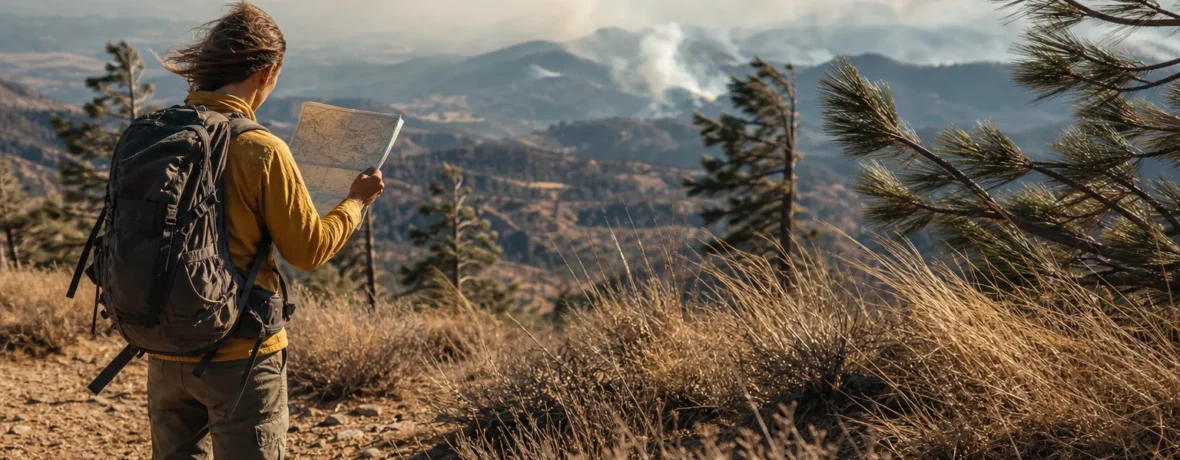
What is a red flag warning? It is a National Weather Service alert that dry fuels and weather conditions can support extreme fire danger, often within 24 to 48 hours or already happening. Local triggers vary, but they commonly involve strong wind, very low humidity, and vegetation dry enough to burn fast.
What is a red flag warning?
A Red Flag Warning means wildfire conditions are lined up and ready to run.
The National Weather Service issues Red Flag Warnings for specific fire weather zones when forecasters have high confidence that local red flag criteria will be met, or when those conditions are already happening. Those criteria are not identical everywhere. They are set locally with fire managers and land-management partners, according to the National Weather Service fire weather directive.
That local piece matters for hikers. In one region, red flag conditions may mean frequent wind gusts of 25 mph [40 km/h] or stronger plus relative humidity of 15% or lower for several hours. In another, the humidity threshold may be 30%, or the warning may hinge on lightning, drought, dry grass, or a cold front that shifts wind direction fast. The National Weather Service Denver/Boulder office, for example, lists frequent gusts of 25 mph [40 km/h] or greater with relative humidity of 15% or less as one set of criteria for its area.
Plain English: fire can start easily, spread quickly, and become hard to control. Your little stove spark, dragging chain, cigarette butt, or illegal campfire is not little in that weather.
Does a Red Flag Warning mean trails are closed?
No, not automatically.
A Red Flag Warning is a weather alert, not a universal closure order. Trails, campgrounds, roads, and backcountry zones may stay open, or land managers may restrict access based on local risk. The National Park Service tells visitors to check public land management agencies for fire restrictions or area closures before going, and to check current park alerts, as of November 2026, on its wildland fire safety page.
That means your job is simple but non-negotiable: check the forecast, then check the land manager. A weather app alone is not enough. The trail may be inside a national forest, national park, BLM district, state park, county open space, tribal land, or a patchwork of several agencies. Each can set its own rules.
| Alert or rule | Who issues it | What it means for you |
|---|---|---|
| Red Flag Warning | National Weather Service | Weather and fuels can support rapid fire spread. Change your plan and check restrictions. |
| Fire Weather Watch | National Weather Service | Red flag conditions are possible soon. Start making a safer backup plan. |
| Fire restrictions | Land manager | Specific activities may be banned, such as campfires, charcoal, smoking, or certain tools. |
| Closure | Land manager | Do not enter the closed trail, road, campground, or area. |
Can you hike during a Red Flag Warning?
Yes, if the area is open and your plan does not add fire risk.
That “if” is doing real work. A Red Flag Warning is a bad day for exposed ridges, dry grasslands, long dead-end canyons, and trails with one road in and one road out. It is also a bad day to depend on a campfire, cook in wind without control, park in tall grass, or push deep into country where evacuation would be slow.
If you still go, make the trip smaller and cleaner. Choose a short route with multiple exits. Start early. Avoid high-wind afternoons. Skip remote trailheads reached by rough roads where help may be delayed. Do not hike into smoke or toward a visible column. If you smell smoke and the wind is rising, turn around before the decision gets made for you.
What should hikers do when a Red Flag Warning is issued?
Scale down, remove ignition sources, and keep your exit easy.
- Check the exact warning area. Use the National Weather Service forecast for the trailhead and nearby high points, not just the nearest town.
- Check the land manager’s current alerts. Look for fire restrictions, campground rules, road closures, and area closures.
- Call the local office if the rule is unclear. Ask about campfires, backpacking stoves, dispersed camping, and trail access.
- Drop the campfire from the plan. The National Park Service says that during high fire danger, visitors should consider alternatives such as a propane camp stove, as of November 2026.
- Park on bare dirt or pavement. Hot vehicle parts and dry grass are a lousy mix.
- Keep the route short. Pick trails with fast exits, cell coverage where possible, and no long commitment past a choke point.
- Leave if conditions worsen. New smoke, ash, strong wind, sirens, aircraft, or changing closures are reasons to end the hike now.
Are campfires allowed during a Red Flag Warning?
Sometimes no, sometimes only in specific developed sites, and sometimes the answer depends on the agency.
Never assume a fire ring makes a campfire legal. Fire rings stay in place year-round; restrictions change. The National Park Service tells visitors to contact the park when they arrive or shortly before visiting to learn whether a burn ban or weather-related rule is in effect, as of November 2026, on its campfires guidance page.
Some agencies write Red Flag Warning language directly into their restrictions. For example, as of November 2026, BLM California fire restrictions list “No campfires or recreational target shooting during any Red Flag Warning or Fire Weather Watch” for multiple California Desert District field offices. That is not a national rule for every acre of public land. It is a verified example of why you need the local order.
Your safest hiking habit: treat a Red Flag Warning as a no-campfire day unless the managing agency clearly says otherwise. For backpackers, that means meals that need no flame or a stove that is specifically allowed under current restrictions.
What causes a Red Flag Warning?
Dry fuel plus fire-starting weather causes a Red Flag Warning.
“Fuel” means the burnable stuff around you: grass, brush, pine needles, leaves, deadfall, and timber. Fine fuels such as grass and needles can dry quickly. Add wind and low humidity, and a spark can become a moving fire before anyone has time to react.
Common red flag ingredients include:
- Strong wind: Wind feeds oxygen to flames and pushes embers ahead of the fire.
- Low relative humidity: Dry air pulls moisture from vegetation.
- Dry fuels: Cured grass, leaf litter, brush, and dead wood ignite more easily.
- Lightning: Dry thunderstorms can start fires without meaningful rain.
- Wind shifts: A front can change fire direction fast and trap people on the wrong side.
The exact numbers change by forecast office because forests, deserts, grasslands, elevations, and seasonal fuel conditions are different across the U.S. That is why a warning in New Mexico, Minnesota, and New Jersey will not always be built from the same thresholds.
What should you pack during fire weather?
Pack for a fast change of plans.
A Red Flag Warning is not the day to shave your kit to bragging-weight. You want information, visibility, water, and options.
- Paper map or downloaded offline map
- Headlamp, even for a day hike
- Extra water: carry more than your normal fair-weather amount
- Food that does not require cooking
- Power bank for your phone
- Bandana or buff for blowing dust and ash
- Car keys and wallet kept on your body, not buried in a pack pocket
- Emergency contact who knows your trailhead and turnaround time
- No fireworks, no charcoal, no wood fire supplies, no “just in case” lighter games
What is the difference between a Fire Weather Watch and a Red Flag Warning?
A watch means conditions may develop; a warning means confidence is higher or conditions are happening.
A Fire Weather Watch gives you time to pivot. A Red Flag Warning means the pivot is now. If your overnight trip depends on exposed camping, a campfire, a long shuttle, or a remote road, treat the watch as your early off-ramp rather than waiting for the warning.
For hikers, the practical difference is planning speed. During a watch, line up Plan B. During a warning, use Plan B.
How do you check Red Flag Warnings before a hike?
Check the weather zone and the land manager.
Use this quick routine before any hike in dry, windy weather:
- Search the trailhead location on weather.gov.
- Read active alerts, not just the daily high temperature.
- Click the alert text and confirm the start and end time.
- Check the park, forest, BLM district, or state park page for current restrictions.
- Look for local smoke, fire, and road updates if any wildfire is nearby.
- Recheck the morning of the hike. Red Flag Warnings can be issued, extended, or canceled as conditions change.
Do not outsource this to social media comments. Use the official forecast and the official land manager. Then make the conservative call.
Related reading
- America the Beautiful Pass: Price, Coverage and Where to Buy
- Machu Picchu Tickets: Circuits and Entry Rules
- How Many National Parks Are There in the US?
- National Park Pass Changes for 2026
FAQ
Is a Red Flag Warning the same as a fire ban?
No. A Red Flag Warning is a National Weather Service weather alert, while a fire ban or fire restriction is issued by the land manager or local authority. They often overlap, but you need to check both.
Can I use a backpacking stove during a Red Flag Warning?
Maybe. Some restrictions allow certain gas stoves with shut-off valves, while others may be stricter. Check the current order for the exact park, forest, or district before you count on cooking.
Should I cancel my hike because of a Red Flag Warning?
Cancel or change it if the route is remote, windy, smoky, hard to evacuate, or under any closure. If you still hike, choose a short open trail with quick exits and no flame-dependent plan.
How long does a Red Flag Warning last?
It lasts for the time window listed in the official alert. That may be part of a day, a full day, or longer if dangerous fire weather continues. Recheck the alert before you leave and again if you have service.
What should I do if I see smoke while hiking?
Leave the area and report it when you can do so safely. Do not hike toward smoke to investigate, and do not assume someone else has called it in.
Are Red Flag Warnings only a western U.S. problem?
No. Red Flag Warnings can be issued anywhere local fuels and weather support dangerous fire behavior. Grasslands, pine barrens, hardwood forests after leaf drop, and drought-stressed areas can all burn fast under the right conditions.