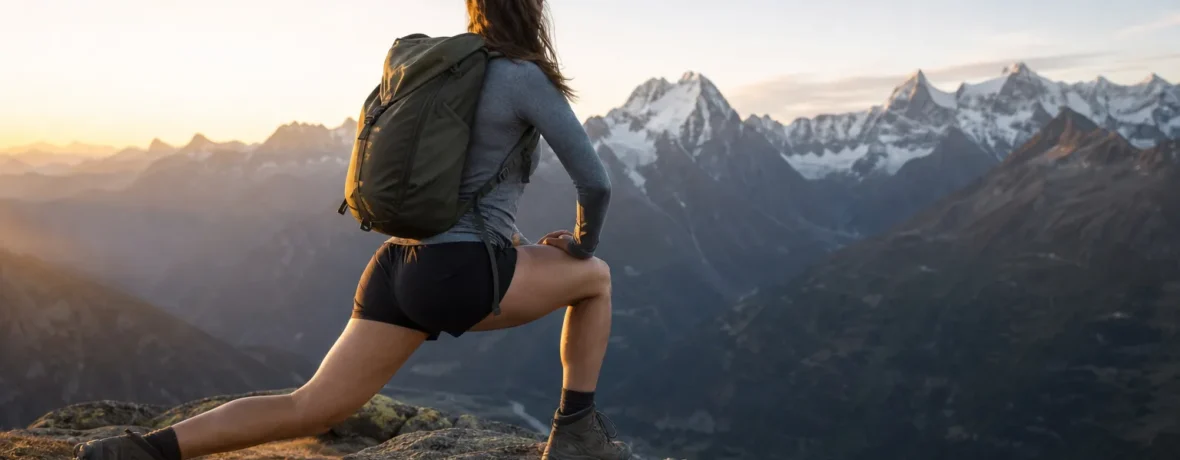
What are lunges good for? Lunges build single-leg strength in your quads, glutes, hamstrings, calves, hips, and core. For hikers, yes, they help—if you use good form and progress slowly—because hiking is thousands of uneven single-leg steps, often with 10 to 35 pounds [4.5 to 15.9 kg] on your back.
A lunge is not a gym trick. It is trail training in plain clothes. Every climb asks one leg to push while the other catches up. Every descent asks one leg to brake while your knee, hip, and ankle work together. A good lunge trains that pattern without needing a stair machine, a squat rack, or a mountain outside your door.
What are lunges good for?
Lunges are good for building trail-useful leg strength, balance, hip control, and downhill braking power.
That “one leg at a time” part is the point. Hiking rarely lets both legs push evenly like a clean gym squat. You step onto rocks, roots, ledges, wet slabs, and eroded dirt. One foot lands higher. One foot lands lower. One side has to stabilize while the other side moves.
Lunges train that split stance. They ask your front leg to produce force, your back leg to assist, and your trunk to stay quiet instead of wobbling around. That matters when you are tired, carrying a pack, and trying not to bang your toes into the front of your boots on mile 9.
Strength training also belongs in a hiker’s weekly plan. The CDC recommends adults do muscle-strengthening activity at least 2 days per week, and lunges fit that bucket when they challenge your legs, hips, and core.
What muscles do lunges work for hiking?
Lunges work your quads, glutes, hamstrings, calves, hip stabilizers, and core.
Here is what that means on trail:
- Quads: Help you step up, climb stairs, and control knee bend on descents.
- Glutes: Drive your hips forward on climbs and help keep your knees from collapsing inward.
- Hamstrings: Assist the glutes and help control your leg as it swings and lands.
- Calves: Help with push-off, especially on steep grades and rocky steps.
- Hip stabilizers: Keep your pelvis from dropping side to side when one foot is on the ground.
- Core: Helps your torso stay stacked when the trail tilts, twists, or fights back.
The Mayo Clinic describes the lunge as a body-resistance exercise that works the leg muscles and emphasizes a neutral back position. That neutral torso matters for hikers because bending, twisting, and collapsing under a pack wastes energy fast.
Do lunges help with uphill hiking?
Yes, lunges help uphill hiking by training the same hip-and-knee drive used in step-ups and steep climbs.
On a climb, your front leg has to push your body upward. Add a loaded pack and that step gets heavier. A forward lunge teaches your front leg to accept weight, bend under control, then push the floor away. That looks a whole lot like climbing onto a water bar, stone step, or steep trail bench.
For uphill carryover, keep the rep smooth. Do not bounce. Do not shove off the back foot like you are escaping a starting block. Think “front leg does the work.” If you feel it mostly in the back leg, shorten the step and reset.
Do lunges help with downhill hiking?
Yes, lunges can help downhill hiking because they train controlled lowering.
Downhill hiking is not just “walking down.” It is repeated braking. Your quads have to slow your body as your knee bends. Your glutes and hips help keep the knee tracking cleanly. Your calves and ankles deal with changing ground angles. If those tissues are not ready, descents can feel like someone replaced your legs with wet rope.
Reverse lunges are often the friendlier choice for downhill training. You step back, lower under control, then return to standing. That lets many hikers practice the braking part without the sharper forward impact of a walking lunge.
Are lunges better than squats for hikers?
No, lunges are not always better than squats; they train a different job.
Squats build two-leg strength. Lunges build split-stance strength. Hikers can use both, but lunges usually feel more specific to rough trail because each leg works independently.
| Exercise | Best hiking carryover | Use it when |
|---|---|---|
| Squat | General leg strength and pack-carrying base | You want a stable, simple lower-body strength move |
| Forward lunge | Climbing steps, uneven trail, stride control | Your knees tolerate forward stepping well |
| Reverse lunge | Downhill control and single-leg strength | You want a lower-impact lunge variation |
| Step-up | Steep climbs, stairs, ledges, big rock steps | You have a sturdy box, bench, or step |
How do you do a lunge with good form?
A good lunge is slow, stacked, and controlled.
Use this setup before you add dumbbells, a pack, or high reps:
- Stand tall with feet hip-width apart.
- Step one foot forward far enough that both knees can bend without your front heel lifting.
- Lower until both knees are bent, stopping before pain or loss of control.
- Keep your front knee tracking in the same direction as your toes.
- Keep your ribs over your hips, not folded over your front thigh.
- Push through the whole front foot to return to standing.
- Switch sides and repeat with the same control.
Start with body weight. The Mayo Clinic notes that correct form and technique matter when starting strength training. For hikers, clean reps beat ugly reps every time. A sloppy lunge teaches sloppy trail movement.
How many lunges should hikers do?
Most hikers can start with 2 sets of 6 to 8 reps per side, 2 days per week.
That is enough to learn the pattern without turning your legs into toast. After 2 to 3 weeks, if your knees and hips feel good, build toward 3 sets of 8 to 12 reps per side. Rest 60 to 90 seconds between sets. Keep at least 1 day between hard lunge sessions.
A simple hiker-friendly progression looks like this:
- Week 1: Split squat, hands on a wall or trekking poles for balance.
- Week 2: Bodyweight reverse lunge.
- Week 3: Bodyweight forward lunge.
- Week 4: Add a light daypack or hold 5 to 10 pound [2.3 to 4.5 kg] dumbbells.
- Week 5 and beyond: Add reps first, then weight, then harder variations.
Do not chase soreness. Mild muscle fatigue is fine. Sharp pain, joint pain, swelling, or limping is not a training badge.
Which lunge variations are best for hikers?
The best lunge variation is the one you can do with control and no joint pain.
Use these based on what you need most:
- Reverse lunge: Best first choice for many hikers. Lower impact and easier to control.
- Forward lunge: Good for step acceptance and uphill drive.
- Walking lunge: Good for rhythm and endurance, but only after your form is solid.
- Split squat: Great beginner option because your feet stay planted.
- Loaded lunge: Useful when you are ready to train with a pack or dumbbells.
- Lateral lunge: Helps with side-to-side control for uneven trails and off-camber footing.
If you only pick one, pick the reverse lunge. It gives you strength, control, and balance with less drama.
Are lunges bad for your knees?
No, lunges are not automatically bad for your knees.
Bad form, too much volume, too much weight, or pushing through pain can make lunges a problem. So can doing hard lunges when your knees are already irritated from a big descent, a long road walk, or a sudden jump in mileage.
Use these knee-friendly checks:
- Your front heel stays down.
- Your knee tracks toward your second or third toe.
- You can control the lowering phase.
- You feel muscle effort more than joint pressure.
- You stop the set before your form falls apart.
If forward lunges bother your knees, switch to reverse lunges or split squats. Shorten the range of motion. Hold a wall. Slow down. Pain is information, not an invitation to prove something.
When to see a doctor
See a doctor if pain is sharp, worsening, swollen, or changes how you walk.
Do not use lunges to test a questionable injury. Get medical care after a major injury, if you cannot bear weight, if the joint looks deformed, or if swelling is significant. The Mayo Clinic’s knee pain guidance recommends medical evaluation for severe symptoms and persistent knee pain.
If you have a heart condition, recent surgery, a balance disorder, osteoporosis concerns, or a history of major knee, hip, ankle, or back injury, ask a qualified clinician or physical therapist how to modify strength training. No article can diagnose your pain from across the internet.
How should hikers add lunges to a training plan?
Add lunges after a warm-up and before long cardio, not after your legs are fried.
Try this twice per week:
- 5 minutes brisk walking or easy cycling
- 2 sets of 8 reverse lunges per side
- 2 sets of 8 step-ups per side
- 2 sets of 10 calf raises
- 30 to 45 seconds of side plank per side
Keep the session short. You are training for hiking, not trying to win a basement leg-day trophy. The best strength plan is the one you repeat long enough for your body to adapt.
Related reading
- Is Jump Rope Good Cardio?
- Is the StairMaster Good Cardio for Hiking Fitness?
- Is Rowing Good Cardio?
- What Is a Good Walking Pace?
FAQ
Are lunges good for backpacking?
Yes, lunges are good for backpacking because they train single-leg strength under control. Add load slowly by wearing a light pack only after bodyweight reps feel steady.
Should hikers do lunges every day?
No, most hikers should not do hard lunges every day. Two strength sessions per week is a better starting point, with recovery days between them.
Why do my knees hurt during lunges?
Knee pain during lunges can come from form, too much range, too much load, fatigue, or an existing issue. Stop painful reps, switch to an easier variation, and see a clinician if pain persists or affects walking.
Are reverse lunges or forward lunges better?
Reverse lunges are usually better for beginners and knee-sensitive hikers. Forward lunges are useful later because they train stepping and weight acceptance more aggressively.
Can lunges replace hiking?
No, lunges cannot replace hiking. They build strength that supports hiking, but you still need trail time, walking volume, pack practice, and downhill exposure.
Do lunges build endurance?
Yes, lunges can build local muscular endurance when done for moderate reps with clean form. For hiking endurance, pair them with regular walking, climbing, and longer time on feet.