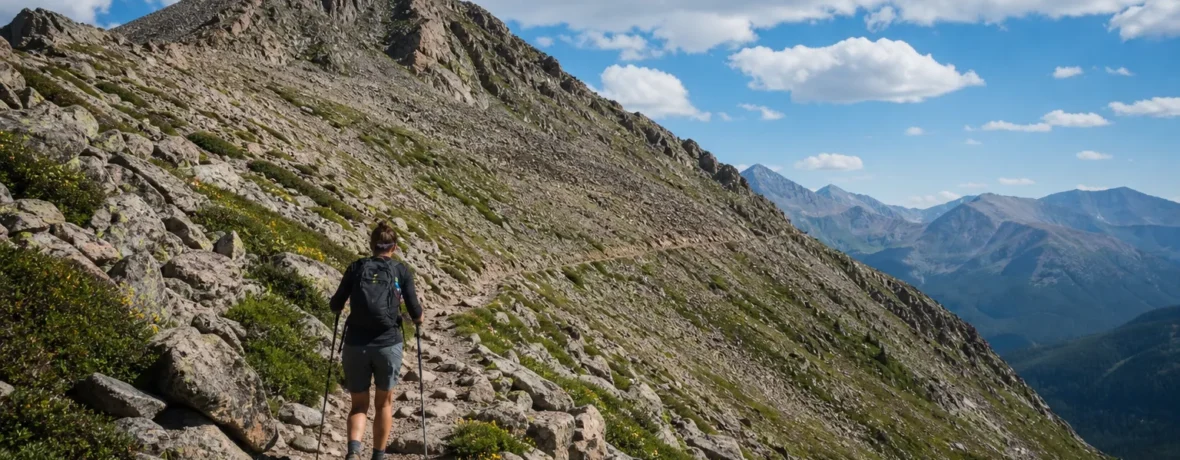
How to train for a 14er: give yourself 8 to 12 weeks, hike or walk uphill 3 days per week, strength train 2 days per week, and build to one long hike with 3,000 to 4,000 feet [914 to 1,219 m] of gain before summit day.
How hard is hiking a 14er?
A 14er is hard because altitude, vertical gain, weather, and time on your feet stack up fast.
A “14er” is a mountain with a summit above 14,000 feet [4,267 m]. Colorado alone has more than 50 peaks above that mark, according to NOAA’s National Geodetic Survey discussion of Colorado summit elevations. That number sounds tidy. The hiking is not.
Most first 14er attempts ask you to climb for several hours, breathe thinner air, manage a cold dawn start, descend on tired legs, and still make good decisions when the summit is close. The route might be a clear trail. It might also include loose rock, snow patches, talus, or hands-on scrambling.
Fitness helps. So does humility. If your normal hike is 4 miles [6.4 km] with 700 feet [213 m] of gain, don’t expect your body to love a 10-mile [16 km] day with 3,500 feet [1,067 m] of gain at altitude. Train for the actual job.
How long does it take to train for a 14er?
Most hikers should train for 8 to 12 weeks before a first 14er.
If you already hike weekly and can climb 2,000 feet [610 m] without feeling wrecked the next day, 6 to 8 focused weeks may be enough. If you are starting from casual walks, give yourself 12 weeks. If you are coming back from injury, illness, or a long layoff, get medical clearance and stretch the timeline.
Your goal is not to become a runner or a gym rat. Your goal is to arrive at the trailhead with legs that can climb, lungs that can work for hours, feet that tolerate shoes and socks, and a head that does not panic when the trail tilts upward.
A simple readiness target: before your 14er, complete one training hike of 8 to 12 miles [13 to 19 km] with 3,000 to 4,000 feet [914 to 1,219 m] of gain while carrying the pack you plan to use. You do not need to sprint it. You need to finish steady, eat along the way, and descend under control.
What is the best 8-week plan for how to train for a 14er?
The best plan mixes uphill cardio, leg strength, pack practice, and one longer mountain hike each week.
Here is a practical 8-week structure. Move days around to fit your life, but keep the rhythm: hard day, easier day, hard day, recovery. Do not stack every tough workout into one heroic weekend. That is how knees, shins, and motivation go sideways.
| Week | Long hike goal | Midweek focus | Strength focus |
|---|---|---|---|
| 1 | 4 to 5 miles [6.4 to 8 km], 1,000 feet [305 m] gain | 2 brisk walks or stair sessions | Bodyweight squats, step-ups, planks |
| 2 | 5 to 6 miles [8 to 9.7 km], 1,500 feet [457 m] gain | Hill repeats, easy walk | Add lunges and calf raises |
| 3 | 6 to 7 miles [9.7 to 11.3 km], 2,000 feet [610 m] gain | Stairs with light pack | Add loaded step-ups |
| 4 | Recovery hike: 4 to 5 miles [6.4 to 8 km] | Easy aerobic work | Light strength, mobility |
| 5 | 7 to 9 miles [11.3 to 14.5 km], 2,500 feet [762 m] gain | Long hill climb or treadmill incline | Heavier step-ups, single-leg work |
| 6 | 8 to 10 miles [13 to 16 km], 3,000 feet [914 m] gain | Stairs with summit pack | Core, glutes, calves |
| 7 | 9 to 12 miles [14.5 to 19 km], 3,000 to 4,000 feet [914 to 1,219 m] gain | Short hard uphill effort | Moderate strength only |
| 8 | Taper, then summit attempt | Short walks, gentle hills | Light mobility, no heavy lifting |
Use this as a guide, not a dare. If your joints are sore in a sharp or worsening way, back off. If you are tired but moving well, keep going. Training should make you more durable, not more beaten up.
What cardio should you do for a 14er?
Train your engine with uphill walking, hiking, stairs, cycling, or running at a sustainable effort.
The most specific cardio for a 14er is hiking uphill. Simple. If you have hills, use them. If you live somewhere flat, use stairs, a treadmill incline, a stair machine, parking garages, or a loaded pack walk on rolling terrain.
Use the talk test from the CDC’s physical activity intensity guidance: at moderate intensity, you can talk but not sing; at vigorous intensity, you can only say a few words before breathing hard. Most 14er training should live in the moderate zone. Add short vigorous uphill efforts once or twice per week after your base feels solid.
A good weekly cardio mix looks like this:
- One long hike or long uphill walk: 90 minutes to 5 hours, depending on training week.
- One uphill workout: 30 to 60 minutes on stairs, hills, or incline treadmill.
- One easy aerobic session: 30 to 60 minutes of walking, cycling, jogging, or swimming.
- Optional short hike or walk: keep it relaxed and conversational.
Don’t chase speed early. Chase time on feet. Your summit pace will likely feel slower than your sea-level hiking pace, and that is fine. The mountain does not care how fast your app says you walk on sidewalks.
What strength exercises help most for a 14er?
The best strength exercises for a 14er train your quads, glutes, calves, hamstrings, hips, and core.
Climbing is only half the bill. Descending beats up legs that skipped strength work. Your quads act like brakes. Your calves work every step. Your hips keep your knees from wobbling inward. Your core helps you carry a pack without folding forward.
Do strength training 2 days per week. Keep it simple and clean. The NIH’s MedlinePlus exercise guidance includes both aerobic activity and strengthening activity as part of adult fitness, and that combination fits 14er prep well.
-
Step-ups: Use a bench, box, or sturdy step. Start low. Drive through the whole foot. Build to 3 sets of 8 to 12 reps per leg.
-
Split squats or reverse lunges: Train single-leg control for uneven trails. Keep the front knee tracking over the toes.
-
Squats: Bodyweight, goblet, or loaded. Control the lowering phase. No bouncing.
-
Calf raises: Use both straight-knee and bent-knee versions. Your calves and Achilles will thank you on long climbs.
-
Hip hinges: Romanian deadlifts or good mornings strengthen hamstrings and glutes for climbing and balance.
-
Planks and side planks: A steady trunk makes pack carrying easier and descents less sloppy.
Start with bodyweight if you are new. Add a pack or dumbbells only when your form stays quiet and controlled. Soreness is normal. Joint pain is feedback. Listen early.
How do you train for altitude before a 14er?
You train for altitude by arriving fit, ascending gradually when possible, sleeping lower when you can, and respecting symptoms.
You cannot fully fake 14,000 feet [4,267 m] at sea level. Strong legs help, but altitude is its own animal. The air pressure drops as you climb, and your body has to work harder to get oxygen. That is why a hiker who feels sharp at 6,000 feet [1,829 m] can feel clumsy and slow above treeline.
The CDC Yellow Book guidance on high-altitude travel says acute mountain sickness symptoms often begin 2 to 12 hours after arrival at high altitude or after moving higher. Headache, nausea, unusual fatigue, dizziness, and poor sleep can all be warning signs.
For bigger trips, the Wilderness Medical Society altitude illness guidelines recommend, for travel above 9,842 feet [3,000 m], limiting sleeping elevation gain to 1,640 feet [500 m] per day and adding a rest day every 3 to 4 days when the schedule allows. A single-day 14er often does not allow that perfect pattern, but the principle still helps: spend time at moderate altitude before summit day if you can.
Good altitude tactics:
- Arrive 1 to 2 days early if you live near sea level.
- Sleep at a moderate elevation rather than driving straight from low elevation to the trailhead at midnight.
- Do an easy acclimatization hike before your summit attempt.
- Start slower than you think you need to.
- Do not climb higher if altitude symptoms are getting worse.
- Turn around if coordination, confusion, severe shortness of breath, or chest symptoms appear.
No summit is worth gambling with altitude illness. The mountain will still be there after you go down.
How much should your pack weigh for a 14er?
Your pack should be heavy enough to carry safety gear, food, water, and layers, but light enough that you can move well for hours.
For training, start with 5 to 10 pounds [2.3 to 4.5 kg]. Build toward the weight you will actually carry on summit day. Many day-hiking packs for 14ers land in the 10 to 20 pound [4.5 to 9.1 kg] range once water, insulation, rain gear, food, navigation, and emergency items are inside.
Do not make the classic mistake: train with nothing, then hike the mountain with a loaded pack. Your shoulders, hips, feet, and lower back need rehearsal. Add weight gradually, especially on descents.
A basic 14er training pack can include:
- Water bottles or a hydration reservoir
- Snacks you will actually eat while breathing hard
- Rain shell and warm layer
- Hat, gloves, and sun protection
- Headlamp
- Map or GPS, plus a backup plan
- Small first-aid and blister kit
- Emergency blanket or bivy
What should you eat and drink while training for a 14er?
Practice eating and drinking during training so summit day does not become a stomach experiment.
Your long hikes are rehearsals. Use them to test breakfast, snacks, caffeine, electrolytes, water bottles, and timing. Food that sounds great in your kitchen may turn into a brick at 13,000 feet [3,962 m]. Find that out before the big day.
For long hikes, many hikers do better with small, regular bites than with one huge lunch. Aim for easy carbs plus some salt and protein: tortillas, bars, pretzels, nut butter, dried fruit, jerky, cheese, gummy candy, or whatever sits well for you. Fancy does not matter. Edible matters.
Hydration is similar. Drink steadily, not desperately. Clear urine all day is not a badge of honor, and neither is rationing water until your mouth feels like dust. In training, track what you drink in different temperatures so you know your own pattern.
How should you pace yourself on summit day?
Start slower than feels necessary, then hold a pace you can repeat for hours.
A 14er is not won in the first mile. Many hikers burn matches in the dark, pass everyone before sunrise, then sit on a rock at 13,200 feet [4,023 m] wondering why their legs have filed a complaint. Don’t be that hiker.
Use these pacing rules:
- Start at a pace where you can breathe through your nose part of the time.
- Take short steps on steep terrain.
- Pause briefly without turning every break into a picnic.
- Eat before you feel empty.
- Put on layers before you are chilled.
- Turn around at your planned time, even if the summit looks close.
Descending needs focus too. Most slips happen when people relax after the summit. Keep your poles handy if you use them. Tighten loose laces. Watch gravel over hard dirt, wet rock, snow edges, and tired foot placements.
What are the biggest training mistakes before a 14er?
The biggest mistakes are training too little, training too hard too late, ignoring descents, and underestimating altitude.
You can avoid most trouble with plain common sense. Build early. Recover often. Practice the boring stuff. Then show up rested.
- Only doing flat runs: Running helps your engine, but climbing uses different muscles and movement patterns.
- Skipping downhill training: Descents load your quads and knees. Train controlled downhill walking before the mountain.
- Adding pack weight too fast: Your tissues need time to adapt. Increase weight gradually.
- Buying new shoes right before the hike: Break footwear in during training, not on summit day.
- Ignoring weather timing: Many high peaks build storms later in the day. Plan an early start and a firm turnaround.
- Treating symptoms like weakness: Altitude symptoms are information, not a character flaw.
When to see a doctor
See a doctor before training if you have heart, lung, blood, neurologic, or significant chronic medical conditions, or if exercise causes concerning symptoms.
Talk with a clinician who understands exertion and altitude if you have chest pain, fainting, unexplained shortness of breath, irregular heartbeat symptoms, severe headaches with exertion, recent surgery, pregnancy concerns, poorly controlled asthma, sleep apnea, or a history of altitude illness. The CDC also advises people with heart or lung disease to talk with a doctor familiar with high-altitude medicine before high-elevation travel.
During training or on the mountain, stop and seek medical help for chest pressure, trouble breathing at rest, confusion, loss of coordination, severe weakness, fainting, or symptoms that worsen despite rest and descent. Do not self-diagnose altitude illness or push higher to “see if it clears.” Go down and get help.
Related reading
- How to Train for a Long-Distance Hike
- How to Train for High-Altitude Hiking at Sea Level
- How to Train for Backpacking With a Loaded Pack
- How to Train for Kilimanjaro
FAQ
Can a beginner hike a 14er?
Yes, a beginner can hike a 14er if they choose an appropriate route, train for 8 to 12 weeks, start early, and turn around when conditions or symptoms demand it. Pick a non-technical route for your first one and avoid making your first big mountain day your hardest hike ever.
Do you need to run to train for a 14er?
No, you do not need to run to train for a 14er. Uphill hiking, stairs, incline treadmill walking, cycling, and strength work can prepare you well if you build enough time on feet and vertical gain.
How much elevation gain should I train for?
Train up to 3,000 to 4,000 feet [914 to 1,219 m] of gain in a single long hike before summit day. If your chosen 14er has more gain than that, build closer to the route’s actual demands.
How many days a week should I train?
Train 4 to 5 days per week for most 14er plans. That usually means 3 cardio or hiking days, 2 strength days, and at least 1 full rest day.
What if I live at sea level?
You can still train for a 14er from sea level, but you should arrive early if possible and keep your summit pace conservative. Fitness helps you tolerate the work, but it does not guarantee altitude acclimatization.
When should I taper before a 14er?
Taper during the final 5 to 7 days before your summit attempt. Keep moving with short walks and light mobility, but skip heavy leg workouts and long hard hikes so you start rested.