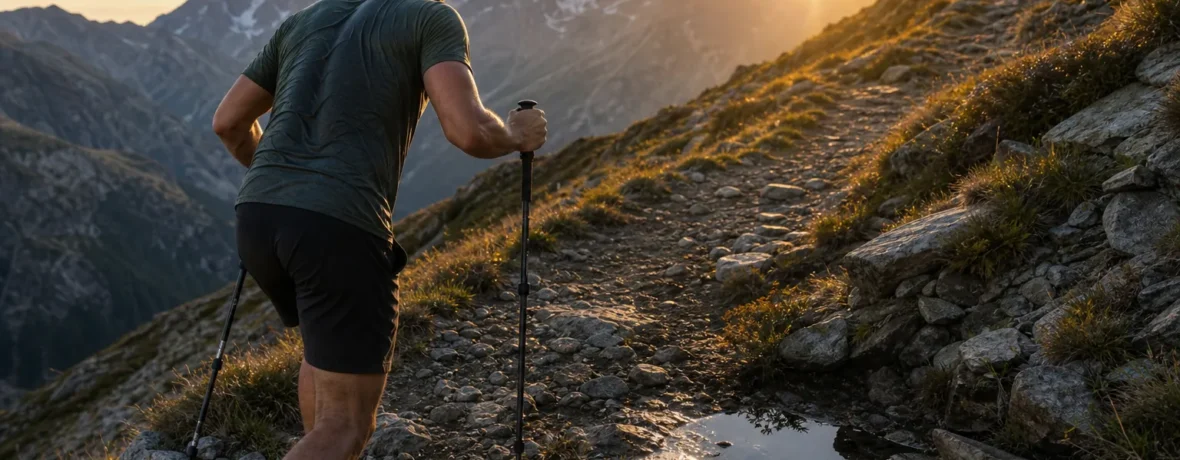
To improve vo2 max for mountain hiking, train 3–5 days per week with one hard hill-interval session, two easy aerobic sessions, one loaded hike, and 2 strength workouts. Give it 8–12 weeks. You should climb longer, recover faster, and feel steadier above 8,000 ft [2,438 m].
VO2 max is your body’s ceiling for using oxygen during hard effort. On steep trails, that ceiling matters. A higher VO2 max will not make a 4,000 ft [1,219 m] climb feel flat, and it will not protect you from altitude sickness by itself. But it gives you more headroom when the grade kicks up, your pack bites into your shoulders, and the air gets thin.
This guide keeps the gym-science talk on a short leash. You need a plan that works for trail legs, not a lab coat. You need hills, easy miles, hard breathing, strong hips, and enough recovery that the work actually sticks.
What is VO2 max, and why does it matter for mountain hiking?
VO2 max is the maximum amount of oxygen your body can use during intense exercise.
For hikers, think of it as the size of your aerobic engine. The bigger the engine, the less desperate you feel when the trail points straight at the ridge. Your heart pumps blood, your lungs bring in oxygen, and your working muscles use that oxygen to keep you moving uphill.
Mountain hiking is not just “cardio.” It is cardio under load. You are moving your body weight plus a pack, often on uneven ground, often with long climbs that last 30 minutes to several hours. That means your VO2 max, muscular endurance, balance, and pacing all stack together.
Researchers use VO2 max as a key marker of cardiorespiratory fitness, and high-intensity interval training has been shown to improve VO2 max in adults in controlled trials and reviews, including this PubMed-indexed meta-analysis on HIIT and VO2 max.
How do you know your VO2 max needs work?
Your VO2 max likely needs work if steep climbs spike your breathing early and you cannot recover while still walking.
You do not need a lab test to spot the signs. A lab test is the most accurate option, but trail feedback is plenty useful for training.
- You slow to a crawl on moderate grades while your legs still feel strong.
- You need frequent full stops on climbs under 1,000 ft [305 m].
- Your breathing stays ragged after the trail flattens.
- You avoid routes with long sustained climbs because they feel crushing.
- Your hiking pace collapses when you add a 15–25 lb [7–11 kg] pack.
A watch estimate can help you track trends, but do not worship the number. Wrist-based VO2 max estimates can be thrown off by terrain, heat, fatigue, altitude, and poor heart-rate readings. Use the trend over several weeks, not one reading after a bad night of sleep.
How to improve VO2 max for mountain hiking?
The best way is to combine easy aerobic volume with one hard interval workout per week.
Most hikers go wrong in one of two ways. They either hike hard every time and never recover, or they walk easy forever and never give the heart a reason to adapt. You need both ends: relaxed aerobic work and short doses of hard climbing.
- Build your base first. Spend 2–4 weeks doing easy hikes, brisk walks, bike rides, or stair sessions where you can speak in full sentences.
- Add one VO2 max interval session weekly. Use hills, stairs, treadmill incline, or a bike. Hard means you can say only a few words.
- Keep two easy aerobic sessions. These teach your body to use oxygen efficiently without beating up your joints.
- Do one loaded hike. Start with 10–15 lb [4.5–7 kg], then add weight slowly if your knees, feet, and back tolerate it.
- Strength train twice per week. Strong legs let your aerobic system show up on rough terrain.
- Take recovery seriously. VO2 max improves after training, not during the ugliest minute of an interval.
A simple weekly rhythm works better than a heroic one. Try this:
| Day | Workout | Purpose |
|---|---|---|
| Monday | Rest or easy walk | Recovery |
| Tuesday | Hill intervals | VO2 max stimulus |
| Wednesday | Strength training | Leg and core durability |
| Thursday | Easy aerobic session | Base fitness |
| Friday | Rest or mobility | Fresh legs |
| Saturday | Loaded hike | Trail-specific endurance |
| Sunday | Easy aerobic session or strength | Volume or support work |
What are the best VO2 max workouts for hikers?
The best workouts are uphill intervals lasting 2–5 minutes with full control on the recovery.
You want hard breathing, not sloppy suffering. Pick terrain where you can climb steadily without tripping over rocks or dodging traffic. A dirt road, smooth trail, long staircase, treadmill, or bike all work.
Workout 1: 4 x 4-minute hill repeats
This is the classic. Warm up for 10–15 minutes. Climb hard for 4 minutes, then walk easy downhill or on flat ground for 3 minutes. Repeat 4 times. Cool down for 10 minutes.
Your effort should land near vigorous intensity. The CDC describes vigorous effort as activity where you cannot say more than a few words without pausing for breath; see the CDC guide to measuring physical activity intensity.
Workout 2: 6 x 2-minute steep climbs
Warm up well. Climb hard for 2 minutes, recover for 2 minutes, and repeat 6 times. This is useful when your local hill is short or your legs are not ready for longer intervals.
Workout 3: Treadmill incline intervals
Set the treadmill to 8–15% incline. After warming up, hike hard for 3 minutes, easy for 2 minutes, and repeat 5 times. Avoid holding the rails unless you are using them lightly for balance; gripping them changes the workout.
Workout 4: Pack-on stair intervals
Use a light pack, not expedition weight. Climb for 90 seconds, descend carefully, and repeat 6–8 rounds. Keep the descent controlled. Your knees do not care that your lungs wanted a bigger workout.
How hard should VO2 max intervals feel?
They should feel hard enough that talking is broken, but controlled enough that you can finish every repeat.
On a 1–10 effort scale, aim for 8–9 during the work interval. Not 10. A true all-out effort turns the session into survival practice and usually wrecks the next few days.
If you use heart rate, your pulse may lag behind the first minute of each interval. That is normal. Do not sprint the start just because your watch has not caught up. Mayo Clinic explains several ways to judge effort, including breathing, sweating, muscle fatigue, and heart rate, in its guide to measuring exercise intensity.
- Too easy: You can chat through the final minute.
- Right: You want the interval to end, but your form stays clean.
- Too hard: You fade badly, stagger, wheeze, or cannot complete the next repeat.
How often should hikers train VO2 max?
Most hikers should do one VO2 max workout per week.
That is enough for steady progress and low enough to keep your knees, calves, and motivation intact. Fit hikers training for a big objective can add a second hard session for 3–4 weeks, but only if sleep, soreness, and easy-day pace stay normal.
Hard intervals stack stress fast. Uphill work loads your calves, Achilles tendons, hip flexors, and lungs. Downhill recovery adds eccentric pounding. If you are also strength training and hiking on weekends, one sharp session is plenty.
Use this simple progression:
- Weeks 1–2: 4 x 2-minute hard climbs.
- Weeks 3–4: 5 x 2-minute hard climbs.
- Weeks 5–6: 4 x 3-minute hard climbs.
- Weeks 7–8: 4 x 4-minute hard climbs.
- Week 9: Cut volume by 30–50% and let your body absorb the work.
Does zone 2 training improve VO2 max?
Yes, zone 2 training can improve VO2 max, especially if you are newer to aerobic training.
Zone 2 is the steady, conversational work that builds your aerobic base. For hiking, this is gold. You spend most mountain days below your redline, so you need a big low-intensity engine. Easy aerobic work improves your ability to keep moving for hours, recover between climbs, and handle back-to-back trail days.
Use the talk test. You should be able to speak in full sentences, but singing should feel annoying. If every “easy” hike turns into a chase, you are stealing energy from the hard workout that actually targets VO2 max.
Good zone 2 options for hikers:
- 60–120 minute easy hike on rolling terrain
- 45–75 minute brisk walk
- 45–60 minute bike ride
- 30–45 minute incline treadmill walk
- Easy snowshoe or ski tour in winter
Can strength training improve VO2 max for hiking?
Strength training does not directly raise VO2 max like intervals do, but it helps you use your fitness on steep trails.
Weak legs turn every climb into a strength test before your aerobic system gets a fair shot. Strong glutes, quads, calves, hamstrings, and trunk muscles make your stride more stable and efficient under load.
Train strength 2 days per week. Keep the sessions short enough that they support hiking instead of burying it.
- Step-ups: 3 sets of 8–10 per leg
- Split squats: 3 sets of 6–8 per leg
- Romanian deadlifts: 3 sets of 8
- Calf raises: 3 sets of 12–15
- Side planks: 2–3 holds per side
- Farmer carries: 3 carries of 30–60 seconds
Do not chase soreness. Soreness is not a badge; it is a bill. You still need to climb stairs, descend trails, and train again later in the week.
How do altitude and thin air change VO2 max?
Altitude reduces the oxygen available to your body, so your sea-level fitness will feel smaller up high.
This is why a hiker can feel strong at 2,000 ft [610 m] and strangely flat at 10,000 ft [3,048 m]. A higher VO2 max gives you a better starting point, but it does not cancel altitude. You still need smart pacing, hydration, food, sun protection, and time to acclimatize.
The CDC Yellow Book high-altitude guidance, citing Wilderness Medical Society recommendations, advises gradual ascent patterns for high-altitude travel, including limiting sleeping-altitude gains once above 9,800 ft [3,000 m] and adding acclimatization nights during larger gains; read the CDC Yellow Book section on high-altitude travel and altitude illness.
For training, do not wait until you reach the mountains to find your lungs. Build fitness at home, then respect the first high day. Start slower than pride wants. Eat before you feel bonked. If symptoms feel wrong, stop ascending and seek medical help when needed.
What should you eat and drink when training VO2 max?
Eat enough carbohydrates and protein to support hard training and recovery.
VO2 max intervals burn hot. If you start underfed, the workout becomes a grind instead of a clean aerobic stimulus. You do not need fancy sports products for most sessions, but you do need fuel.
- Before hard intervals: Eat a carb-rich snack 30–90 minutes before training if your last meal was more than 3 hours earlier.
- During sessions under 60 minutes: Water is usually enough unless heat is high or you started low on fuel.
- After training: Eat a meal with protein, carbs, and fluids within a few hours.
- For long loaded hikes: Pack easy calories you will actually eat while breathing hard.
Caffeine, gels, powders, and electrolyte mixes can help some hikers, but they do not replace fitness. Test anything new during training, not at mile 6 of a climb in hot sun.
How long does it take to improve VO2 max?
Most hikers need 8–12 weeks of consistent training to feel a clear difference.
You may notice early wins in 2–3 weeks: smoother breathing, faster recovery, less dread when the trail rises. Bigger changes take longer because your heart, blood vessels, muscles, tendons, and habits all adapt on their own clocks.
Track practical trail markers:
- Time to climb a familiar hill
- Number of stops on a known route
- Heart rate at the same pace and grade
- How quickly breathing settles after a climb
- How your legs feel the next morning
Retest every 4 weeks, not every other day. Pick one route or treadmill workout and repeat it under similar conditions. Same pack weight. Similar temperature. Similar sleep if you can manage it.
What mistakes stop VO2 max from improving?
The biggest mistake is doing every workout at the same medium-hard pace.
Medium-hard feels productive. It gives you sweat, fatigue, and a smug little glow. But too much of it leaves you too tired for real intensity and too stressed for real recovery.
- Skipping easy days: Easy training builds the base that supports harder work.
- Starting intervals too fast: Even pacing beats a dramatic first minute.
- Adding pack weight too quickly: Your lungs may adapt faster than your joints.
- Ignoring descents: Downhill damage can ruin the next workout.
- Training sick or exhausted: One skipped session is better than three bad weeks.
- Changing everything at once: Add intensity, volume, or load one at a time.
When to see a doctor
See a doctor before hard VO2 max training if you have heart, lung, metabolic, or major joint concerns.
Also get medical guidance if exercise causes chest pain, fainting, unusual shortness of breath, irregular heartbeat sensations, severe dizziness, or symptoms that feel out of proportion to the effort. Do not self-diagnose trail symptoms as “just being out of shape.”
If you are heading to high altitude and have a history of altitude illness, heart disease, lung disease, pregnancy, sleep apnea, or another significant medical condition, talk with a clinician before the trip. For wilderness-specific altitude guidance, the Wilderness Medical Society altitude illness guideline update is a useful medical reference to discuss with a qualified professional.
Related reading
- What Is VO2 Max and Why It Matters for Hikers
- How to Improve Balance for Rocky Trails
- How to Improve Cardio Endurance for Hiking
- How Many Steps in a Mile (Walking vs Hiking)?
FAQ
What is the fastest way to improve VO2 max for hiking?
The fastest practical way is one weekly session of hard hill intervals plus 2–3 easy aerobic workouts. Keep the hard repeats between 2 and 5 minutes, and give yourself at least 48 hours before the next brutal effort.
Can hiking alone improve VO2 max?
Yes, hiking can improve VO2 max if the climbs are hard enough and you hike consistently. If your routes are mostly flat or easy, add hill repeats, stairs, or treadmill incline work.
Should I train VO2 max with a backpack?
Sometimes, but not always. Use no pack or a light pack for your hardest intervals, then use a moderate pack for separate loaded hikes so your joints are not hammered every session.
Is running better than hiking for VO2 max?
Running can be very effective, but it is not automatically better for hikers. Uphill hiking intervals are more specific, lower impact than many runs, and easier to match to mountain terrain.
How do I improve VO2 max if I live somewhere flat?
Use stairs, stadium steps, treadmill incline, cycling intervals, rowing, or brisk weighted walking. The key is sustained hard breathing for repeated intervals, not the mountain view.
Will a higher VO2 max prevent altitude sickness?
No, a higher VO2 max does not prevent altitude sickness. Fitness helps you hike stronger, but altitude illness risk still depends on elevation, ascent rate, acclimatization, personal history, and how your body responds on that trip.