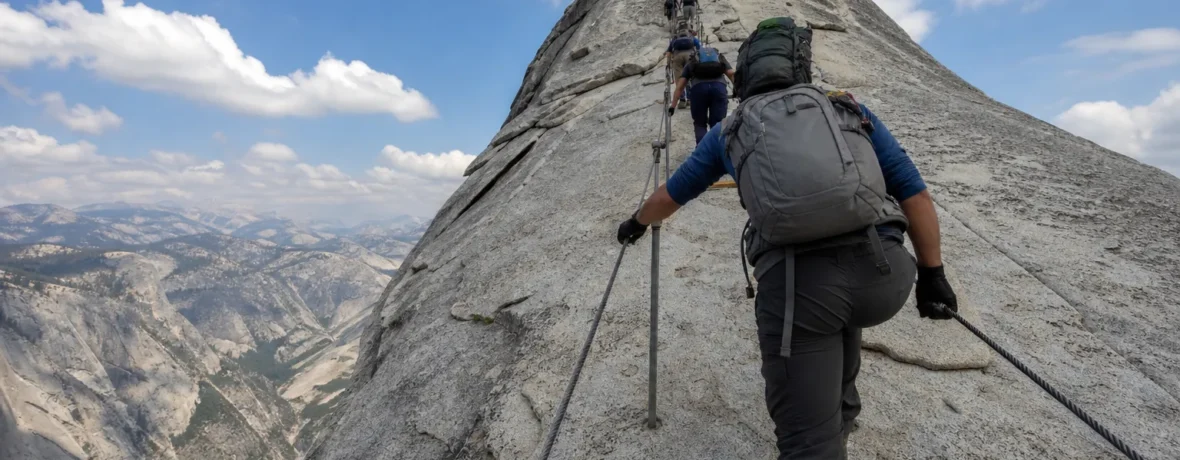
How long is Half Dome hike? The standard Half Dome day hike is 14 to 16 miles [22.5 to 25.7 km] round trip with 4,800 feet [1,463 m] of elevation gain. Most hikers take 10 to 12 hours, and some take longer, depending on route, fitness, crowds, weather, and time spent on the cables.
How long is Half Dome hike from Yosemite Valley?
The Half Dome hike is 14 to 16 miles [22.5 to 25.7 km] round trip from Yosemite Valley.
Most hikers start at Happy Isles, then climb past Vernal Fall, Nevada Fall, Little Yosemite Valley, the subdome, and the cables before reaching the summit. The National Park Service lists the hike as 14 to 16 miles with 4,800 feet [1,463 m] of gain, and Yosemite’s trail information lists the John Muir Trail option at 16.2 miles [26.1 km] round trip with 4,830 feet [1,472 m] of gain. As of November 2026, those are the official planning numbers to use. NPS Half Dome day hike guide (nps.gov)
The mileage changes because you can use different combinations of the Mist Trail and John Muir Trail. The Mist Trail is shorter and steeper. The John Muir Trail is longer, more gradual, and often easier on tired knees during the descent.
| Route choice | Round-trip distance | Best use |
|---|---|---|
| Mist Trail both ways | 14 miles [22.5 km] | Shortest route, steep stairs, waterfall spray in season |
| John Muir Trail both ways | 16.2 miles [26.1 km] | Longer, steadier grade, less direct |
| Mist Trail up, John Muir Trail down | 15 miles [24.1 km] | Strong all-around choice for many day hikers |
How long does it take to hike Half Dome?
Most hikers take 10 to 12 hours to hike Half Dome and return to Yosemite Valley.
That time is not just walking time. It includes water stops, food breaks, waiting at the cables, slower travel on steep granite, and the mental tax of descending after a huge climb. A fast, well-conditioned hiker may finish sooner. A group that starts late, pauses often, or hits a cable backup can take longer.
Use a hard turnaround time. NPS gives an example of turning around if you have not reached the summit by 3:30 pm, and it recommends leaving around sunrise or earlier. Every hiker should carry a real headlamp or flashlight with extra batteries; a phone light is not a plan. As of November 2026, NPS still warns that hikers commonly struggle down after dark without adequate light. (nps.gov)
A realistic pacing plan looks like this:
- Happy Isles to top of Nevada Fall: steady climbing, stone steps, spray, and big crowds in peak season.
- Nevada Fall to Little Yosemite Valley: a calmer stretch where you should eat and reset.
- Little Yosemite Valley to subdome: forest, then more exposed climbing as the day gets warmer.
- Subdome and cables: slow, steep, exposed, and weather-dependent.
- Return to the Valley: long, pounding, and where tired mistakes happen.
How do you get Half Dome permits?
You get Half Dome day-hike permits through a lottery on Recreation.gov.
A permit is required to ascend the subdome steps or the Half Dome cables when the cables are up. As of November 2026, day-hike permits are handled by lottery only: a preseason lottery in March and smaller daily lotteries two days before hiking dates during the cable season. Day-use permits are not issued at Yosemite offices. NPS Half Dome permit rules (nps.gov)
As of November 2026, NPS lists 225 day-hiker permits per day during the preseason lottery, with applications accepted March 1 through March 31 Eastern time. Daily lottery applications are accepted two days before the hiking date, from midnight to 4 pm Pacific time. If you want to backpack and camp in Little Yosemite Valley or elsewhere, do not use the day-hike lottery; request Half Dome access with your wilderness permit instead. (nps.gov)
Fees can change, so always check before applying. As of November 2026, the official permit fee structure is a nonrefundable $10 application fee per lottery application plus a $10 per-person recreation fee if you receive a permit. The per-person recreation fee is refundable if you cancel by the stated deadline or if the cables are not up for your permit date. Recreation.gov Half Dome permits (nps.gov)
When are the Half Dome cables up?
The Half Dome cables are normally up from late May through mid-October, but the exact dates depend on conditions.
NPS says the cables usually go up the Friday before Memorial Day and come down the day after the second Monday in October. Snow, ice, storms, trail work, and crew availability can shift those dates. As of November 2026, Yosemite’s current conditions page lists the Half Dome cables as down for the season. Yosemite current conditions (nps.gov)
Do not treat “cables down” as a dare. The posts and wooden planks are removed, the cable route becomes much more dangerous, and NPS strongly discourages attempting the route when the cables are down. Wet granite is the other big red flag. NPS says the leading cause of fatal falls from the cable route is being on the cables when the rock or cables are wet. (nps.gov)
How to hike Half Dome from Happy Isles?
Start early at Happy Isles, climb to Nevada Fall, continue through Little Yosemite Valley, ascend the subdome, use the cables only in safe conditions, then descend with daylight to spare.
- Start before or near sunrise. The shuttle does not help with very early starts, so plan your walk from parking or lodging to Happy Isles.
- Climb past Vernal Fall and Nevada Fall. The Mist Trail is shorter and steeper; the John Muir Trail is longer and more gradual.
- Refill or treat water correctly. NPS says the only treated water on the trail is seasonal at the Vernal Fall Footbridge. River water must be treated.
- Eat before you feel empty. This is a long-output day. Use salty snacks, real calories, and steady hydration.
- Check the sky before subdome. If storm clouds are building, turn around. Half Dome is not a place to argue with lightning.
- Use the cables patiently. Stay inside the cables, keep three points of contact when possible, and let faster hikers pass only when it is safe.
- Leave nothing at the base. Pack out gloves, wrappers, wipes, and toilet paper.
- Descend while you still have focus. The way down is long. Save legs, water, and daylight for it.
What should you pack for Half Dome?
Pack for a full mountain day, not a casual Yosemite stroll.
NPS recommends carrying enough water, food, rain gear, a map, compass, headlamp, extra batteries, layers, grippy footwear, and gloves for the cables. As of November 2026, NPS suggests a minimum of 1 gallon [4 liters] of water per person for hiking to the top of Half Dome. (nps.gov)
- Printed or offline map, plus navigation skills
- Headlamp with extra batteries
- 1 gallon [4 liters] of water capacity per person, plus treatment if using natural sources
- Salty snacks and enough calories for 10 to 12 hours of movement
- Broken-in hiking shoes or boots with strong traction
- Grippy gloves for the cables, packed out afterward
- Rain shell and insulating layer
- Sun hat, sunglasses, and sunscreen
- Small first-aid kit and blister care
- Permit confirmation and photo ID for the permit holder or alternate
- Trash bag for every wrapper, glove, and scrap
How hard is the Half Dome hike?
Half Dome is very strenuous.
The numbers tell part of the story: 14 to 16 miles [22.5 to 25.7 km], 4,800 feet [1,463 m] of climbing, a summit over 8,800 feet [2,682 m], and a final cable ascent up steep granite. The rest is harder to measure. You need legs for the climb, balance for slick stone, patience for crowds, and enough judgment to turn around when weather, time, or your body says no.
If you are not already comfortable with long hikes that gain several thousand feet, build up before you go. Good preparation hikes should include steep climbs, long descents, stairs or rock steps, and a pack similar to what you will carry in Yosemite. Gym fitness helps. Trail fitness matters more.
When to see a doctor
Get medical help fast for severe heat illness, serious altitude symptoms, chest pain, fainting, confusion, or trouble breathing.
Half Dome combines heat, altitude, exertion, dehydration risk, and a long exit. The CDC lists heat stroke symptoms such as confusion, slurred speech, loss of consciousness, seizures, and very high body temperature, and says to call 911 for suspected heat stroke. Heat exhaustion signs can include headache, nausea, dizziness, weakness, thirst, heavy sweating, and decreased urine output. CDC heat-related illness guidance (cdc.gov)
Altitude can also hit hikers who come from lower elevations and move hard above 8,000 feet [2,438 m]. The Wilderness Medical Society states that travel above 2,500 meters [8,202 feet] by unacclimatized people can be associated with acute altitude illness. Descend and seek care if symptoms worsen, coordination changes, breathing becomes difficult, or the person seems confused. Wilderness Medical Society altitude illness guidelines (journals.sagepub.com)
What is the best time of year to hike Half Dome?
The best time is when the cables are up, the forecast is dry, and you can start early with stable weather.
Many hikers aim for June through September because daylight is longer and the cables are typically up. Early season can mean water on the Mist Trail, lingering snow, and cold mornings. Mid-summer can bring heat, crowds, and afternoon thunderstorms. Fall can bring cooler hiking, shorter days, and a tighter margin before dark.
Weekdays are usually a better target than weekends if your schedule is flexible. NPS says permit success tends to be higher on weekdays, especially beginning at the end of August, though that can shift year to year. As always, the winning date is not just the date you get in the lottery. It is the date with safe weather.
Related reading
- How to Train for Half Dome
- Half Dome Permit Lottery: Dates and Odds
- How Long Is the Appalachian Trail? Miles, States and Time
- How to Plan a Camping Trip
FAQ
Do you need a permit to hike Half Dome?
Yes, you need a permit to ascend the subdome or Half Dome cables when the cables are up. Day hikers use the Recreation.gov lottery, while backpackers request Half Dome access with an eligible wilderness permit.
Can beginners hike Half Dome?
Most beginners should not make Half Dome their first big hike. You should be comfortable hiking 14 to 16 miles [22.5 to 25.7 km] with 4,800 feet [1,463 m] of gain before trying it.
Are the Half Dome cables dangerous?
Yes, the cables can be dangerous, especially when the granite or cables are wet. Do not go up in storms, wet conditions, or when the cables are down.
Can you hike Half Dome in one day?
Yes, many hikers do Half Dome as a day hike from Yosemite Valley. Plan for 10 to 12 hours, start early, and carry a headlamp even if you expect to finish before dark.
Is Half Dome harder than Angels Landing?
Yes, Half Dome is generally longer and more physically demanding than Angels Landing. Angels Landing has major exposure, but Half Dome adds far more mileage, elevation gain, and time on trail.
What time should you start the Half Dome hike?
Start around sunrise or earlier. An early start gives you cooler climbing, more daylight for the descent, and a better chance of being off the summit before afternoon storm risk builds.