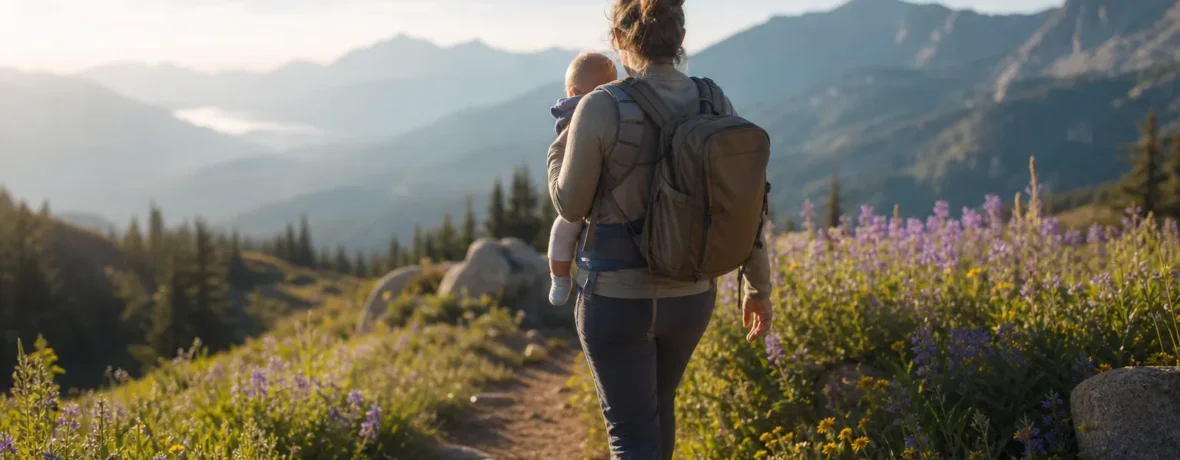
Yes, hiking with a baby can be safe when your baby is healthy, dressed for the weather, carried in an age-appropriate carrier, and checked often. Start with 1 to 2 miles [1.6 to 3.2 km], stay close to the car, avoid extreme heat or cold, and turn around at the first sign of trouble.
Babies change the trail math. A mellow loop becomes a logistics puzzle. A 10-minute snack break becomes a feed, diaper, layer swap, and “why is one sock missing?” moment. That’s fine. The goal is not crushing miles. The goal is getting outside without gambling with your baby’s comfort or your own balance.
What age is safe for hiking with a baby?
There is no single magic age.
The safer question is: can your baby breathe freely, stay warm or cool, feed normally, and ride in a carrier that fits their body today? A healthy newborn may handle a short, flat walk in a properly fitted soft carrier if your pediatrician has no concerns and the adult carrying them is steady and rested. A long, hot, remote hike is a different animal.
For the early months, keep outings short and boring in the best way: smooth trail, shade, cell service, easy exit, no exposure, no creek crossings, no steep scrambles. Babies younger than 4 months need extra caution in slings and carriers because airway position matters. The American Academy of Pediatrics warns that some carriers can curl a baby into a C-shape and raise the risk of breathing problems; keep the face visible, chin off chest, and nose and mouth clear.
Framed backpack carriers usually come later. Your baby should have strong head and neck control and enough trunk strength to sit upright with support. Always follow the carrier maker’s age and weight limits, and check buckles, straps, stitching, and recalls before using the product. The U.S. Consumer Product Safety Commission gives practical carrier checks in its soft infant and toddler carrier safety tips.
What baby carrier is best for hiking?
The best carrier is the one that fits your baby, fits you, and matches the trail.
For newborns and younger infants, a soft structured carrier or wrap-style carrier keeps the baby close to your chest where you can see their face and monitor breathing. For older babies with strong head and torso control, a framed backpack carrier can carry weight better and add storage, but it raises your center of gravity. That matters on loose rock, roots, wet leaves, and stairs.
| Carrier type | Best for | Trail cautions |
|---|---|---|
| Soft structured carrier | Short hikes, newborns to infants when used within the product limits | Baby can overheat against your body; airway must stay visible and open |
| Wrap or sling | Very short walks, calm terrain, close contact | Requires careful fit; loose fabric can block the face |
| Framed backpack carrier | Older babies with head and trunk control, longer easy trails | Heavier load, higher fall risk, harder to duck under branches |
| All-terrain stroller | Wide gravel paths, rail trails, paved park loops | Not for narrow, steep, rocky, muddy, or rooty trails |
Try the carrier at home before the trail. Load it with the diaper kit, water, and the layers you plan to carry. Walk stairs. Bend at your knees. Practice taking it off without setting it on a slope. If anything feels sketchy in the living room, it will feel worse one mile [1.6 km] from the trailhead.
How do you plan the first hike with a baby?
Pick the easiest hike that still feels like a hike.
Your first outing is a systems check. You are testing feeding, diaper changes, carrier fit, layering, timing, and your own patience. Save the big views for later.
- Choose a short route. Start with 1 to 2 miles [1.6 to 3.2 km] on gentle terrain. A loop is nice, but an out-and-back makes it easier to turn around fast.
- Check the weather twice. Look at temperature, wind, precipitation, and heat index. A breezy 55°F [13°C] ridge feels different from a sheltered 55°F [13°C] forest.
- Start after a feed and diaper change. You want the first 20 minutes to be calm, not a trailhead emergency.
- Keep the car close. Choose a trail where you can be back at the vehicle quickly if the baby melts down, spits up, gets cold, or needs a full reset.
- Set a turnaround rule. Turn around for persistent crying, poor feeding, unusual sleepiness, weather shifts, carrier rubbing, or adult fatigue.
- Build in one real stop. Pick a safe, flat spot off the trail for feeding, changing, and checking fingers, toes, neck, and diaper area.
A good baby hike often feels slow. That is not failure. That is the pace that lets you notice the small stuff before it becomes big stuff.
How do you keep a baby safe in a hiking carrier?
Check position before you move and every time you stop.
Babies cannot tell you when a strap is pressing, a sock has bunched, or their chin has dropped. You have to inspect. Use a simple rhythm: face, airway, hips, hands, feet, temperature.
- Face visible: You should be able to see your baby’s nose and mouth without moving fabric.
- Chin up: Keep the chin off the chest so the airway stays open.
- Close enough to kiss: In front carriers, baby should sit high on your chest, not low on your stomach.
- Supported body: Head, neck, back, and hips need support appropriate to the baby’s age and strength.
- No loose straps near the face: Tuck or secure dangling webbing.
- Feet and hands checked: Look for cold fingers, hot skin, tight cuffs, and missing socks.
- No sleeping slump: If baby falls asleep, stop and confirm the head has not tipped forward or sideways into fabric.
Your own footing is part of baby safety. Skip trekking poles if you cannot use them smoothly while carrying. Step around blowdowns instead of climbing over them. Do not cross fast water with a baby carrier. Wet rocks and a top-heavy pack are a bad bargain.
What should a baby wear hiking?
Dress the baby in thin, adjustable layers.
Your baby is not hiking under their own power. They are riding, which means they may be colder than you in wind and warmer than you inside a carrier. Touch the back of the neck or upper chest to judge temperature; hands and feet often feel cooler and can fool you.
- Base layer: Soft, breathable fabric; avoid bulky seams under carrier straps.
- Sun layer: Lightweight long sleeves, pants, and a brimmed hat for exposed trails.
- Cool-weather layer: Fleece or wool layer that fits without bunching in the carrier.
- Rain and wind protection: A carrier cover or adult rain jacket setup that does not block airflow.
- Feet: Socks that stay on, plus booties in cold weather.
For sun, shade beats sunscreen for young infants. The CDC says infants younger than 6 months should have very limited direct sunlight and can be protected with shade and covering clothing rather than sunscreen; see its sun exposure guidance for travelers. For babies 6 months and older, sunscreen can help on exposed skin, but clothing, shade, and timing still do the heavy lifting.
How hot is too hot to hike with a baby?
If you are questioning the heat, shorten the hike or skip it.
Babies overheat faster than adults because they depend on caregivers to manage shade, fluids, clothing, and pace. Heat also builds inside carriers, especially soft front carriers where your body heat and the baby’s body heat stack together.
Choose shaded trails, start early, and avoid the hottest part of the day. Watch for flushed skin, unusual fussiness, limpness, fast breathing, fewer wet diapers, or feeding refusal. The CDC advises seeking medical care immediately if a child has symptoms of heat-related illness; its infants and children heat guidance is a smart pre-summer read.
Cold deserves the same respect. A baby sitting still in a carrier can chill quickly in wind, rain, and snow. Keep cotton out of the cold-weather kit, add insulation before the baby gets cold, and turn around if you cannot keep the baby dry.
Can you hike at altitude with a baby?
Yes, but gain elevation slowly and watch behavior closely.
Altitude is tricky with babies because early symptoms can look like ordinary baby behavior: fussiness, poor sleep, poor feeding, or unusual tiredness. The CDC says children are as susceptible to altitude illness as adults, and young children who cannot talk may show nonspecific symptoms such as appetite loss, irritability, unexplained fussiness, and changes in sleep or activity patterns. Read the CDC’s traveling safely with infants and children guidance before high-country trips.
Do not make your baby’s first mountain day a big jump from low elevation to a hard hike. Sleep lower if you can. Keep the first day mellow. If symptoms appear after ascent, stop going higher. If symptoms worsen, descend and seek medical help.
What should you pack for hiking with a baby?
Pack for the hike you planned and the delay you did not plan.
Baby gear expands fast, so focus on the items that solve real trail problems: food, diapers, temperature, sun, mess, and exit.
- Diapers, wipes, and a sealable bag for packed-out waste
- Changing pad or small foam sit pad
- Extra baby layer, extra socks, and a warm hat or sun hat
- Feeding supplies needed for your baby
- Burp cloth or small towel
- Hand sanitizer
- Baby-safe sun protection: shade, clothing, hat, and sunscreen when age-appropriate
- Adult water and snacks; the carrier makes you work harder
- Small first-aid kit
- Navigation, charged phone, keys, and a headlamp even for short hikes
Put the diaper kit near the top. Put one layer where you can grab it without unpacking the whole bag. Keep snacks for the adults easy to reach. Hungry parents make sloppy decisions.
When to see a doctor
Get medical help fast if your baby looks or acts seriously unwell.
Call your pediatrician before hiking if your baby was premature, has heart or lung disease, has feeding or growth concerns, recently had a fever, or has any condition that affects breathing, temperature control, or hydration. For urgent symptoms on or after a hike, do not wait it out on the trail.
- Breathing trouble, blue lips, or repeated pauses in breathing
- Hard to wake, unusually floppy, confused-looking, or not responding normally
- Signs of dehydration, such as no wet diaper for 8 hours, very dry mouth, or no tears when crying
- Repeated vomiting or refusal to feed
- Fever in a baby younger than 12 weeks
- Symptoms after heat exposure that do not improve quickly in a cool place
- Unexplained worsening fussiness, poor feeding, or unusual sleepiness after going to higher elevation
Mayo Clinic’s guide on when to seek medical attention for a sick baby is a useful reference to keep bookmarked, but trail judgment is simple: if your gut says the baby is not right, turn around and get care.
Related reading
- A Walk in the Woods: Bill Bryson's AT Story vs Reality
- Kids' Hiking Boots: How to Size and When to Buy
- Mountain Porters: The People Who Carry Expeditions
- Teaching Leave No Trace to Kids
FAQ
Can you take a newborn hiking?
Yes, on a short, easy walk if the baby is healthy and your pediatrician has no concerns. Use a properly fitted soft carrier, keep the face visible, avoid temperature extremes, and stay close to the trailhead.
When can a baby ride in a backpack hiking carrier?
A baby should have strong head and neck control and enough trunk strength to sit upright with support before using a framed backpack carrier. Follow the carrier’s manual for exact age, weight, and fit limits.
How long should a first baby hike be?
Plan 1 to 2 miles [1.6 to 3.2 km] for the first hike. That gives you enough time to test the carrier, feeding, diapers, and layers without committing to a long exit.
Is it safe for a baby to sleep in a hiking carrier?
Short naps happen, but you need to check position often. Make sure the chin is not pressed to the chest, the face is uncovered, and the baby is not slumped into fabric or the side of the carrier.
What is the biggest safety mistake parents make?
Doing too much too soon is the big one. Long mileage, heat, steep terrain, and an untested carrier can stack small problems into a hard turnaround.
Do babies need shoes for hiking?
Non-walking babies do not need trail shoes. They need warm or breathable foot coverage that stays on and does not squeeze their toes or ankles inside the carrier.