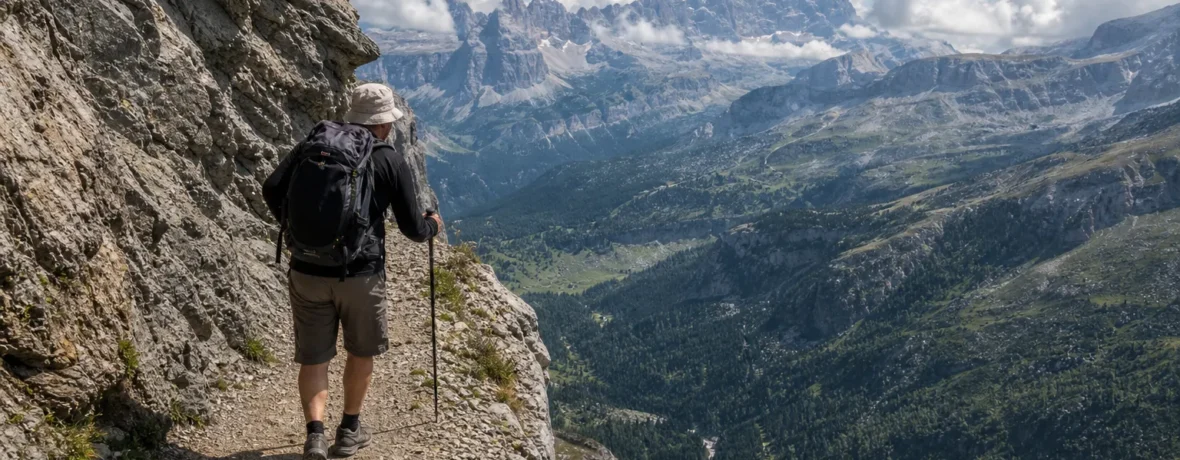
Yes, you can hike with a fear of heights if you choose trails with wide tread, low exposure, and turnarounds before committing terrain. Start with routes under 5 miles [8 km], avoid cliff-edge scrambles, and turn back the first time fear makes your feet freeze or your judgment shrink.
Here is the blunt position: you do not beat a fear of heights by pretending you are not afraid. You beat it, if that is even the right word, by respecting the fear, training your response, and refusing to let summit fever make decisions for you.
The mountain does not care that you want the view. The ledge does not care that the guidebook called the route “moderate.” If your brain reads exposure as danger, that is information. Not a character flaw. Not weakness. Information.
But information is not a life sentence. You can hike big country, climb to overlooks, cross bridges, and enjoy high places without bullying yourself into panic. The trick is to stop treating fear as something to crush and start treating it as something to manage.
Can you hike if you have a fear of heights?
Yes, you can hike with a fear of heights if you pick terrain that keeps fear below panic.
That means your route choice matters more than your fitness watch, your boots, or the inspirational quote you saved last night. A strong hiker can still shut down on a narrow shelf trail. A slow hiker can move safely all day on broad ridgelines and forested climbs.
Fear of heights often overlaps with specific phobias, and the National Institute of Mental Health describes exposure therapy as a treatment that focuses on facing avoided fears in a structured way. That does not mean you should self-prescribe a cliff traverse this weekend. It means gradual, controlled exposure has a logic behind it, while “just send it” does not. Read more from the National Institute of Mental Health on phobias.
Good hiking decisions start before your boots hit dirt. Study photos. Read recent trail reports. Look for words that hint at exposure: ledges, knife-edge, airy, no-fall zone, scramble, cables, fixed ropes, steep drop-offs. Those words are not automatic dealbreakers, but they are yellow lights.
What does fear of heights feel like on a trail?
It can feel like your body hits the brakes before your mind agrees.
Some hikers feel dizziness. Some feel shaky legs, tunnel vision, nausea, a racing heart, or the sudden urge to sit down and cling to rock that is not actually helping. Others become oddly quiet because all their bandwidth is going into staying upright.
Mayo Clinic lists symptoms of specific phobias that can include intense fear, anxiety, panic, and physical reactions when facing the feared object or situation. On trail, that can look like a hiker who was chatting 10 minutes ago and now cannot step across a harmless-looking slab. See Mayo Clinic’s overview of specific phobia symptoms and causes.
Do not mock that person. Do not rush them. And if that person is you, do not start bargaining with your pride. A fear response narrows your choices. Narrow choices are dangerous in exposed terrain.
How do you choose trails when heights scare you?
Choose trails by exposure first, mileage second, and elevation gain third.
This is where many hikers get it wrong. They see “only 3 miles [5 km]” and assume the route is easy. Maybe it is. Or maybe those 3 miles [5 km] include a steep drop-off, a slick slab, and one spot where you need both hands. Distance is not exposure.
| Trail feature | Usually better for height anxiety | Usually harder for height anxiety |
|---|---|---|
| Tread width | Wide path, room for two hikers | Narrow shelf trail |
| Drop-off | Forested slope or gradual hillside | Open cliff edge or loose talus above exposure |
| Movement | Walking with trekking poles | Scrambling, downclimbing, ladders, cables |
| Commitment | Frequent turnarounds | One-way ridge, bottleneck, or exposed traverse |
Pick hikes with options. An out-and-back trail is often friendlier than a loop because you can turn around without solving a new descent. Avoid routes where the crux comes late, when your legs are tired and daylight is sliding away.
How can you train for hiking with a fear of heights?
Train in small steps, not heroic leaps.
The best plan is boring on purpose. Boring builds trust. Your nervous system needs proof that you can feel discomfort and still make calm choices.
- Start on safe elevation. Walk hills, staircases, boardwalks, and overlooks with railings. Stay long enough for the first fear spike to ease.
- Add mild exposure. Choose a broad ridge, a bridge, or a viewpoint with plenty of room away from the edge.
- Practice stopping. Pause, breathe slowly, relax your hands, and look at the trail instead of the drop.
- Practice turning around. Make retreat a normal skill, not a shame event.
- Repeat the same trail. Familiar ground lets your brain compare fear with reality.
- Increase one variable at a time. Add distance, elevation, or exposure. Not all three.
Mayo Clinic describes exposure therapy as a common treatment approach for specific phobias, but clinical treatment is not the same as daring yourself on a mountain. If your fear is severe, work with a licensed mental health professional rather than using a hiking trail as your therapist. Mayo Clinic explains treatment options for specific phobias and exposure therapy.
What should you do when fear hits on an exposed trail?
Stop moving before fear makes you sloppy.
The worst move is to rush. Rushing turns a manageable fear response into bad foot placement, dropped poles, and poor communication. Stop somewhere stable. Put both feet down. Face into the hillside if that helps. Let faster hikers pass when it is safe.
- Keep your eyes on the next 6 feet [2 m] of trail, not the whole drop.
- Lower your center of gravity if you feel wobbly.
- Use three points of contact on rock: two feet and one hand, or two hands and one foot.
- Ask your hiking partner for clear, simple cues.
- Do not let anyone pull, shove, tease, or crowd you.
- Turn around if you cannot regain steady movement.
This is not about being dramatic. It is about staying alive and keeping the group from stacking poor choices on top of one person’s panic.
Do trekking poles help with fear of heights?
Yes, trekking poles can help on moderate trails, but they are not a cure for exposure.
Poles add rhythm and stability. They give your hands something useful to do. On steep dirt, gravel, and uneven forest trails, they can make you feel more grounded.
But poles can become clumsy on scrambles, ladders, cables, and tight ledges. If you need your hands on rock, stow the poles. If a pole tip bounces toward the edge and steals your focus, shorten the poles or pack them away.
Also check the simple stuff. Shoes with worn tread, an overloaded pack, loose laces, and fogged sunglasses can all magnify fear. You want fewer problems, not more.
Should you hike alone if you are afraid of heights?
Usually, no: hike with a calm partner until you know your limits.
The right partner matters. You want someone patient, steady, and willing to turn around without making a courtroom speech about it. You do not want the friend who says, “Come on, don’t be a baby,” while standing on a cliff edge eating trail mix.
Before the hike, say the quiet part out loud:
- “I may turn around at exposed sections.”
- “Do not pressure me past my comfort zone.”
- “If I freeze, give me space and short instructions.”
- “The summit is optional.”
That last line should be carved into every trailhead sign. The summit is optional. Coming home is not.
When should you turn back on a hike because of heights?
Turn back when fear changes your movement, judgment, or ability to communicate.
Not when you feel nervous. Nervous is workable. Turn back when you freeze, stumble repeatedly, stop processing directions, or feel trapped by the idea of continuing. Turn back when the descent looks harder than the climb. Turn back when weather, crowds, darkness, wet rock, snow, or wind raises the stakes.
There is no prize for crossing your personal red line. There is only a more complicated rescue if things go badly.
The Centers for Disease Control and Prevention recommends practical fall-prevention basics such as reviewing medicines, checking vision, and improving strength and balance for older adults. Trail falls have different causes than home falls, but the larger point carries over: balance, vision, footwear, and physical condition matter. See the CDC’s fall prevention guidance.
When to see a doctor
See a doctor or licensed mental health professional if fear of heights causes panic, avoidance, or unsafe behavior.
You do not need a diagnosis to make better trail choices. But if heights trigger intense physical symptoms, keep you from ordinary activities, or make you feel out of control, get help. A clinician can screen for anxiety conditions, discuss therapy options, and rule out other causes of dizziness or faintness.
Get medical advice before harder hikes if you have fainting episodes, unexplained dizziness, chest pain, shortness of breath, or a history of falls. Those symptoms deserve more than trailhead optimism.
What is the best mindset for fear of heights hiking?
The best mindset is firm humility.
Humility says, “This terrain has consequences.” Firmness says, “I still get to hike.” Put those together and you become the kind of hiker who makes durable progress.
The bad mindset is shame. Shame tells you to hide fear until it erupts. Shame tells you to keep going because people are watching. Shame tells you that turning around ruins the day.
Wrong. Turning around can save the day. Choosing a lower overlook can save the day. Repeating a tame trail until your confidence catches up can save the day.
Fear of heights does not disqualify you from hiking. It does disqualify you from lazy planning. Fair trade.
Related reading
- Type 2 Fun: Why Hard Hikes Feel Good Later
- The Seven Summits Explained
- What Is Geocaching?
- What Is Hiking, Really? A Definition Worth Arguing About
FAQ
Is fear of heights the same as vertigo?
No, fear of heights and vertigo are not the same thing. Fear of heights is a fear response to exposure, while vertigo usually means a sensation of spinning or movement and may have medical causes.
Can you get over a fear of heights by hiking more?
Sometimes, but only if the exposure is gradual and controlled. Repeated panic on scary trails can reinforce fear instead of reducing it.
What trails should I avoid if I have a fear of heights?
Avoid narrow ledges, exposed scrambles, knife-edge ridges, cable routes, ladders, and steep trails with loose footing above drop-offs. Also avoid committing loops where the hardest exposed section comes after the halfway point.
Should I use headphones to distract myself from heights?
No, skip headphones on exposed terrain. You need full awareness of wind, rockfall, other hikers, and instructions from your partner.
What should my hiking partner do if I freeze?
They should stay calm, give you space, and offer short directions. They should not grab you, mock you, rush you, or stand in a place that forces you to look over the edge.
Is turning around because of fear a failure?
No, turning around is a valid safety decision. The trail will still be there, and your confidence grows faster when you trust yourself to stop before panic takes over.