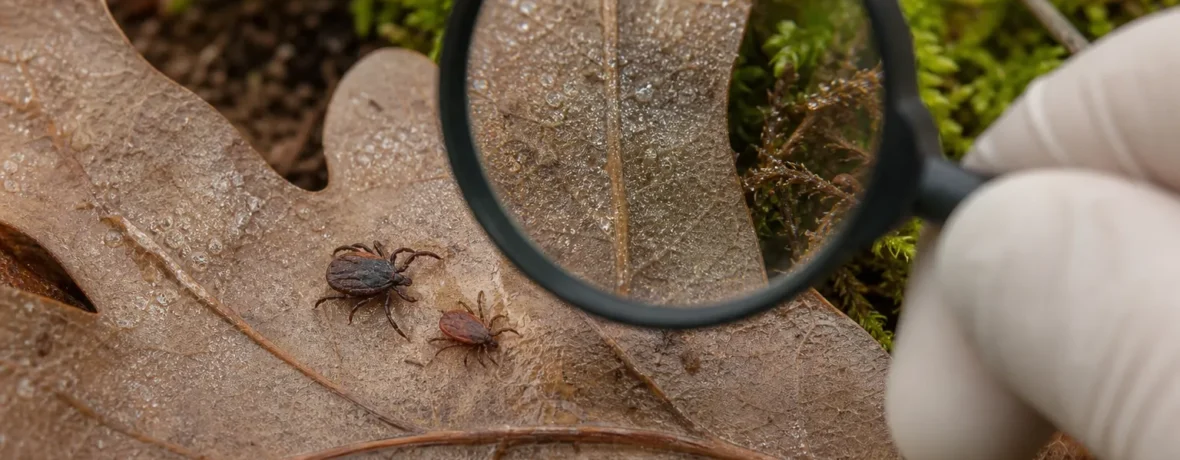
The fastest way to tell a deer tick from a dog tick is size and markings: deer ticks are smaller, with black legs and a reddish-brown body; American dog ticks are larger, with gray-white patterned shields. Deer ticks can spread Lyme disease. American dog ticks do not spread Lyme, but can spread Rocky Mountain spotted fever and tularemia.
Deer tick vs dog tick: what is the quickest way to tell?
Look at size first, then the back pattern.
A deer tick, also called a blacklegged tick, is the small, dark-legged tick hikers worry over in Lyme country. A dog tick, usually meaning the American dog tick in the U.S., is chunkier and easier to spot, with pale gray or cream markings on its shield. If the tick looks like a tiny black-legged speck with a reddish rear, think deer tick. If it looks like a larger brown tick with a decorative pale shield, think dog tick.
Here is the trail-side comparison:
| Feature | Deer tick / blacklegged tick | American dog tick |
|---|---|---|
| Scientific name | Ixodes scapularis in the East; Ixodes pacificus on the Pacific Coast | Dermacentor variabilis; western form often listed as D. similis |
| Fast visual clue | Black legs, dark shield, reddish-brown body on adult females | Brown body with whitish or gray patterned shield |
| Unfed adult size | Adult female 2.5 mm; nymph 1.0 mm, similar to a poppy seed | Unfed adult commonly 3/16 in [5 mm] |
| Main health concern | Lyme disease and several other tickborne infections | Rocky Mountain spotted fever and tularemia |
The catch: engorged ticks are harder to identify. A fed female can swell, fade, stretch, and lose the clean outline you would use for ID. When in doubt, take clear photos from the top and underside, save the tick in a sealed bag or container, and show it to a clinician or local extension office if symptoms appear.
What does a deer tick look like?
A deer tick is small, dark-legged, and often reddish-brown behind the shield.
The tick most people call a deer tick is the blacklegged tick. In the eastern U.S., that is Ixodes scapularis. On the Pacific Coast, the Lyme-carrying cousin is the western blacklegged tick, Ixodes pacificus. Both are tiny enough to fool you during a quick sock check.
Adult female blacklegged ticks have black legs, a dark shield near the head, and a reddish-orange to brown rear body when unfed. Adult males look darker overall and do not swell like females. Nymphs are the sneaky stage: the NIH MedlinePlus Magazine lists blacklegged tick nymphs at 1.0 mm and adult females at 2.5 mm. That means a nymph can look like a moving poppy seed.
Use these deer tick clues:
- Black legs: the name “blacklegged tick” is a real field clue.
- Small size: nymphs can be 1.0 mm; adult females are still smaller than many dog ticks.
- Reddish rear on adult females: the back half may look rusty, red-brown, or orange-brown.
- No pale ornate shield: deer ticks do not have the gray-white patterned shield you see on American dog ticks.
- Longer-looking mouthparts: from above, the front end can look more stretched than a dog tick’s blunt front.
Do not bank on color alone after feeding. An engorged deer tick can look gray, tan, olive, or pale brown. Size changes too. That is why a clear photo before disposal can help.
What does a dog tick look like?
An American dog tick is larger and has pale patterned markings on its back.
“Dog tick” can mean different things, but hikers in the U.S. usually mean the American dog tick. This is the classic wood tick: brown, tough-looking, and far easier to see than a deer tick nymph. The Illinois Department of Public Health describes unfed American dog tick adults as reddish-brown and 3/16 in [5 mm] long, with females reaching 1/2 in [13 mm] after feeding.
Female American dog ticks have a brown body with a large pale shield behind the head. Male dog ticks can look even more decorated, with pale lines or mottling across much of the back. That ornamented look is a major difference from a deer tick.
Use these dog tick clues:
- Bigger body: adults are usually easier to spot crawling on pants, socks, dogs, and pack straps.
- Pale shield: females have a gray-white or cream shield near the head.
- Mottled male back: males can look patterned across the whole back.
- Brown legs: dog ticks lack the obvious black-legged look of deer ticks.
- Blunter outline: the body often looks wider and sturdier than a deer tick.
One more wrinkle: the brown dog tick is a different species. It can live indoors and is tied closely to dogs. This article focuses on American dog ticks because that is the dog tick most hikers run into on brushy trails, old fields, trailheads, and campsites.
Do deer ticks and dog ticks carry the same diseases?
No, they carry different disease risks.
Deer ticks are the main Lyme disease concern in the U.S. The CDC says Lyme disease bacteria are spread through bites from infected blacklegged ticks, also called deer ticks, and that Lyme is most common in the Northeast, mid-Atlantic, and upper Midwest, with some cases on the Pacific Coast. The CDC also lists blacklegged ticks as vectors for anaplasmosis, babesiosis, hard tick relapsing fever, ehrlichiosis, and Powassan virus disease in parts of their range.
American dog ticks are not the Lyme tick. The CDC lists American dog ticks as transmitting tularemia and Rocky Mountain spotted fever. That still deserves respect. Rocky Mountain spotted fever can be serious, and the name is misleading because cases are not limited to the Rocky Mountains.
| Tick | Diseases CDC associates with it | Trail takeaway |
|---|---|---|
| Blacklegged / deer tick | Lyme disease, anaplasmosis, babesiosis, hard tick relapsing fever, ehrlichiosis, Powassan virus disease | Take tiny nymphs seriously, especially in Lyme regions. |
| Western blacklegged tick | Lyme disease, anaplasmosis, hard tick relapsing fever | West Coast hikers still need tick checks, especially in coastal and foothill habitat. |
| American dog tick | Rocky Mountain spotted fever, tularemia | Bigger does not mean harmless; remove it promptly. |
Not every tick is infected. A bite is not a diagnosis. Still, ID matters because it helps your clinician judge which illnesses fit your location, season, symptoms, and exposure.
Where do deer ticks and dog ticks live?
Deer ticks favor wooded, brushy, leafy places; dog ticks often show up in grassy, brushy, and edge habitat.
The CDC says blacklegged ticks are widely distributed across the eastern U.S., while western blacklegged ticks occur along the Pacific Coast, particularly in northern California. American dog ticks are widely distributed east of the Rocky Mountains and also occur in limited areas to the west, with a western relative now recognized by scientists. You can check the CDC’s current range maps on its Where Ticks Live page.
On a hike, the highest-risk spots are not dramatic. They are the places you barely notice:
- Leaf litter beside the trail
- Brush rubbing your shins
- Overgrown trail edges
- Tall grass at a viewpoint or campsite
- Old fields, meadow borders, and fence lines
- Dog rest spots near parking lots and trailheads
Ticks do not fly or jump. They climb vegetation, hold out their front legs, and grab onto passing animals or people. That is why your ankles, cuffs, calves, and waistline are prime inspection zones after hiking through brush.
Can you identify a tick after it bites?
Usually, yes, but a fed tick is harder to ID.
When a tick feeds, its body expands. The tidy field marks stretch. The colors shift. A deer tick that looked dark and reddish can become pale and bean-shaped. A dog tick can swell into a grayish oval. If the tick has already been removed, crushed, dried out, or partly damaged, identification gets messy fast.
Do this instead of guessing from memory:
- Take photos before disposal. Shoot the top, underside, and a size reference such as a ruler or coin.
- Save the tick if you can. Put it in a sealed bag or small container. Do not crush it with your fingers.
- Write down the date and place. Include the trail, county, state, and likely attachment window.
- Check the bite site and your body. Finding one tick can mean you picked up more than one.
- Use a local expert if needed. County extension offices, state health departments, and some university tick labs can help with ID.
A phone photo is often enough for a healthcare professional to decide whether the bite fits a deer tick exposure, dog tick exposure, or something else. Mayo Clinic recommends securing the tick or taking a photo because it can help your provider identify the tick and judge disease risk.
What should you do after a tick bite on trail?
Remove the tick right away.
The CDC’s tick bite guidance is refreshingly simple: do not wait for a healthcare provider to remove the tick. The longer an infected tick remains attached, the more opportunity some pathogens have to pass into the skin.
- Use clean, fine-tipped tweezers. Grab the tick as close to the skin as possible. Aim for the mouthparts, not the swollen body.
- Pull straight out. Use steady, even pressure. Do not twist, jerk, burn, smother, or paint the tick with nail polish.
- Clean the area. Wash the bite and your hands with soap and water, rubbing alcohol, or hand sanitizer.
- Save or photograph the tick. A sealed container, tape, or a clear photo can help later.
- Do a full tick check. Look behind knees, along sock lines, around the waist, in armpits, behind ears, at the hairline, and in the groin area.
- Monitor for symptoms. Watch for rash, fever, headache, muscle aches, joint pain, fatigue, or a bite site that worsens.
Skip the folk remedies. Heat, petroleum jelly, essential oils, and nail polish waste time and can make removal messier. Tweezers win.
How do you prevent tick bites while hiking?
Block ticks before they reach skin.
The best tick plan is boring and effective: clothing barriers, repellent, quick checks, and a shower after the hike. The CDC recommends avoiding grassy, brushy, and wooded tick habitat when possible; using EPA-registered repellents; and wearing long sleeves, pants, or clothing and gear treated with 0.5% permethrin.
Use this hiking checklist:
- Treat clothing and gear: use 0.5% permethrin on pants, socks, gaiters, shoes, and packs, or buy pre-treated clothing.
- Use repellent on exposed skin: choose an EPA-registered product with an active ingredient such as DEET, picaridin, IR3535, oil of lemon eucalyptus, PMD, or 2-undecanone.
- Dress for inspection: light-colored pants make crawling ticks easier to see.
- Tuck pants into socks: it looks goofy. It works.
- Stay centered on trail: avoid brushing through grass and shrubs when you have a choice.
- Check during breaks: scan socks, calves, waistband, sleeves, and pack straps.
- Do a post-hike body check: use a mirror or partner check for hard-to-see areas.
- Handle your dog too: use vet-recommended tick prevention and check ears, collar line, toes, tail base, and armpits.
Throwing clothes in a hot dryer after a hike can help kill ticks on clothing. Showering also gives you a clean chance to find ticks before they stay attached for long.
When to see a doctor
See a doctor if you develop symptoms after a tick bite.
The CDC says to see a doctor if you develop a rash or fever within several days to weeks after removing a tick. Mayo Clinic also advises contacting a healthcare professional if you cannot fully remove the tick, the rash gets bigger, you develop flu-like symptoms, the bite site looks infected, or you think you were bitten by a deer tick.
Get urgent help right away for severe symptoms such as trouble breathing, paralysis, heart palpitations, or a severe headache. Do not try to self-diagnose Lyme disease, Rocky Mountain spotted fever, or any other tickborne illness from a photo or a rash description. Bring the tick or photo, your hiking location, and the date you found it.
Tell the clinician:
- Where you hiked, including state and county if known
- When you found the tick
- Whether it was attached or crawling
- How long it may have been attached
- What it looked like before removal
- Any rash, fever, headache, fatigue, muscle aches, or joint pain
Fast details beat vague worry. A good timeline helps your provider decide what fits and what does not.
Related reading
- Tick Bites on Dogs After a Hike: What to Look For
- What Does a Tick Bite Look Like? Photos and Warning Signs
- How to Remove a Tick the Right Way
- When to Worry About a Tick Bite
FAQ
Is a deer tick smaller than a dog tick?
Yes. Deer ticks are usually smaller, especially in the nymph stage. A blacklegged tick nymph can be 1.0 mm, while an unfed adult American dog tick is commonly 3/16 in [5 mm].
Can a dog tick give you Lyme disease?
No, the American dog tick is not the Lyme disease tick. In the U.S., Lyme disease is spread by infected blacklegged ticks and western blacklegged ticks, not American dog ticks.
Which is worse, a deer tick or a dog tick?
Neither is “safe.” Deer ticks are the bigger Lyme concern, while American dog ticks can spread Rocky Mountain spotted fever and tularemia. The right move is the same: remove any attached tick promptly and watch for symptoms.
How soon should you remove a tick?
Immediately. The CDC says to remove an attached tick as soon as you find it and not wait for a healthcare provider to do it. Use fine-tipped tweezers and pull straight out with steady pressure.
What if the tick head stays in?
Try to remove visible mouthparts with clean tweezers if they come out easily. If they do not, leave them alone and let the skin heal; seek medical care if the site worsens, oozes, becomes increasingly painful, or you develop systemic symptoms.
Should you save the tick after removing it?
Yes, if you can do it safely. Place it in a sealed container or bag, or take sharp photos with a size reference. The tick or photo can help a healthcare professional judge what species bit you and what risks fit your location.