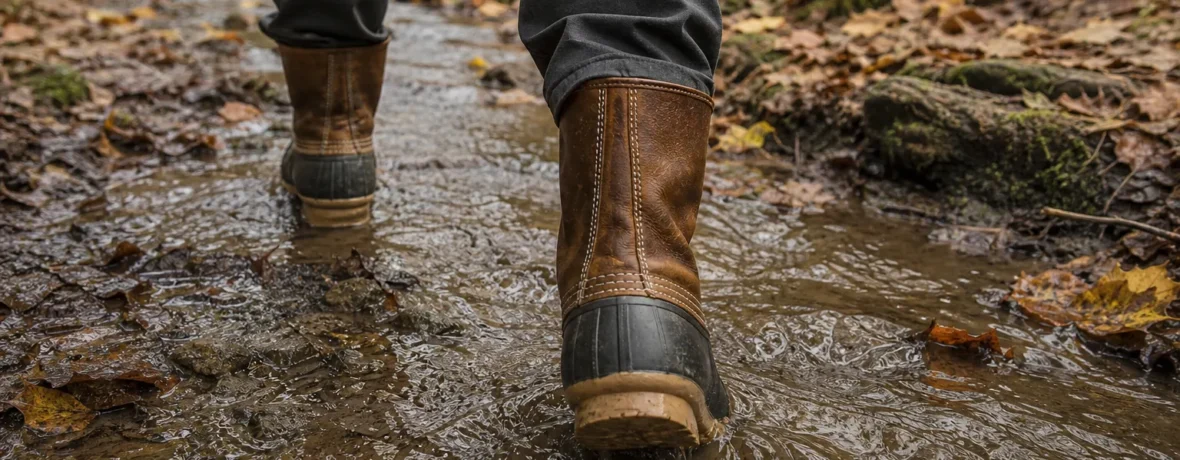
Are duck boots good for hiking? Yes, but only for short, easy, wet trails under 3 miles [4.8 km] with mild grades and packed dirt. For rocky, steep, hot, icy, or all-day hikes, choose hiking shoes or boots with deeper lugs, better heel hold, and trail-specific support.
Are duck boots good for hiking on real trails?
Usually, no.
Duck boots were built for wet errands, muddy yards, slushy sidewalks, boat decks, and camp chores. The classic design gives you a rubber lower, a leather or textile upper, and a roomy fit that feels forgiving around town. That combo is useful when the ground is wet and flat. It is less useful when the trail tilts, twists, or turns into loose rock.
The main issue is control. Hiking footwear needs to hold your heel, flex where your foot flexes, bite into dirt, and protect your foot from sharp ground. REI’s hiking footwear guide points to trail features such as lugged outsoles and uppers built for terrain and support, while the National Park Service recommends planning ahead and wearing footwear suited to the hike in its Hike Smart safety guidance.
Duck boots can work for a mellow nature path after rain. They are a poor pick for switchbacks, talus, roots, long descents, scrambling, backpacking, and warm-weather miles.
What are duck boots actually good for?
Duck boots are best for wet, low-output use.
Think puddles, damp grass, shoulder-season chores, cold parking lots, and short walks where waterproofing matters more than traction. The rubber foot section sheds water well, and many models have a tall enough collar to keep splash and mud off your socks.
They shine in these situations:
- Walking the dog on wet pavement
- Car camping in rain or mud
- Standing around a cold campsite
- Short walks on packed dirt or gravel
- Yard work, boat launches, and muddy trailheads
They struggle once your foot starts working hard. Rubber traps heat. Roomy uppers can let your heel slide. Many duck boot soles are flatter and less aggressive than hiking soles. That means less bite on wet roots, slick clay, loose gravel, and angled rock.
Can you hike in duck boots if the trail is wet or muddy?
Yes, if the trail is short, easy, and not slippery.
Wet does not automatically mean duck boots are the right call. A flat, muddy path around a lake is one thing. A wet trail with roots and rock steps is another. Waterproof rubber helps keep puddle water out, but traction keeps you upright.
Use this quick filter before you wear them:
- Check distance. Keep it under 3 miles [4.8 km] if you already know the boots fit well.
- Check elevation. Skip them for sustained climbs or descents.
- Check tread. If the sole looks smooth or shallow, do not trust it on slick ground.
- Check heel movement. Walk uphill and downhill at home. If your heel lifts, the trail will make it worse.
- Check temperature. Warm rain plus rubber boots equals sweaty feet fast.
For mud plus hills, a hiking boot or trail shoe with deeper lugs is the safer choice. The American Academy of Orthopaedic Surgeons notes that hiking shoes should have good tread to help keep the foot planted on uneven surfaces in its athletic shoe guidance.
Are duck boots waterproof enough for hiking?
They can be waterproof at the rubber lower, but not always at the whole boot.
This surprises people. The rubber shell is the easy part. Water usually sneaks in higher up: through stitching, the tongue, the shaft opening, or where the upper meets the lower. Some duck boots are fully waterproof. Some are water-resistant. Some are warm and dry for slush but disappointing in steady rain.
Even if the boot keeps water out, it can keep sweat in. That matters. Wet socks from sweat can rub just as badly as wet socks from rain. On a long hike, breathability is not a luxury. It is comfort, skin care, and blister prevention.
If you plan to hike in steady rain, look for trail footwear with a waterproof membrane, a gusseted tongue, a secure heel cup, and an outsole made for dirt. If you are crossing streams, no low or mid boot is magic once water pours over the top.
Do duck boots have enough traction for hiking?
Most duck boots do not have enough traction for rough hiking.
Look at the outsole. Many duck boots use siped, wavy, or modest tread patterns designed for wet pavement, snow crust, or general muck. Hiking footwear uses lugs: raised teeth that dig into soil, gravel, and soft trail surfaces. REI describes lugs as traction-giving bumps or teeth on the outsole in its hiking boot selection guide.
| Feature | Duck boots | Hiking boots or shoes |
|---|---|---|
| Best surface | Wet pavement, grass, packed dirt | Dirt, rock, roots, gravel, mud |
| Traction | Often shallow or street-focused | Deeper lugs for trail grip |
| Fit | Roomy, casual, sometimes loose | More secure heel and midfoot hold |
| Breathability | Low around rubber lower | Varies, often better in non-waterproof models |
Are duck boots comfortable for long hikes?
Not for most feet.
Comfort in the store is not the same as comfort after 5 miles [8 km]. Duck boots often feel plush and easy because they are roomy. On trail, that room can turn into sliding. Sliding turns into hot spots. Hot spots turn into blisters.
Long hikes ask more from footwear:
- A heel cup that limits lift
- Enough forefoot flex for walking
- Enough torsional stiffness for uneven ground
- A midsole that softens repeated impact
- A toe box that allows swelling without smashing toes
- A sole that grips during braking on descents
Duck boots may miss several of those marks. The rubber lower can crease against your toes. The upper may not lock your ankle or heel. The sole may feel clunky on dry rock and thin under sharp gravel.
Can duck boots cause blisters on hikes?
Yes, especially if they fit loose or trap sweat.
Blisters usually come from friction, moisture, pressure, or some ugly mix of all three. Duck boots can create that mix because they are often wide, warm, and less breathable than trail shoes. If your heel moves with every step, your skin pays the bill.
Reduce blister risk before you leave the house:
- Wear hiking socks, not cotton gym socks.
- Test the boots on a 30-minute walk before any trail use.
- Stop early if you feel rubbing. Do not “walk through it.”
- Carry blister bandages or tape.
- Trim toenails before downhill walking.
- Dry your feet and change socks if they get soaked.
Mayo Clinic’s blister first aid guidance recommends protecting blisters and seeking medical care if signs of infection appear.
When should you wear duck boots instead of hiking boots?
Wear duck boots when the hike is barely a hike.
That is not an insult. Some of the best outdoor days are low-key: a damp campground loop, a walk to a fishing spot, a muddy half-mile [0.8 km] to a picnic table, or a stroll through wet fields. Duck boots are fine there.
A good rule: if you would feel comfortable doing the route in sturdy casual shoes, duck boots may work. If you would pack water, layers, a map, snacks, or trekking poles, wear real hiking footwear.
Choose duck boots for:
- Cold rain around town
- Wet grass and mud near camp
- Flat nature trails
- Short walks with no time pressure
Choose hiking boots or trail shoes for:
- Rocky trails
- Steep descents
- Backpacking
- Hot weather
- Snowy or icy routes
- Any hike where a slip would be serious
How should duck boots fit if you plan to hike in them?
They should fit snug in the heel and roomy, not sloppy, in the toes.
Do not buy duck boots loose because you want space for thick socks. That can backfire on trail. Your toes need room, but your heel should not pump up and down. Your midfoot should feel held when laced.
Try this fit check:
- Put on the socks you would wear outside.
- Lace the boots firmly, especially over the instep.
- Walk up and down stairs for 5 minutes.
- Press your toes forward on a downhill step. They should not slam the front.
- Watch for heel lift. A little movement is normal; repeated rubbing is not.
- Wear them indoors for 30 minutes before committing to trail use.
If the boot feels vague underfoot or your heel floats, save it for errands. Your feet will thank you.
When to see a doctor
Get medical help if a foot problem looks infected, becomes severe, or does not improve.
Do not try to diagnose trail foot pain from a gear article. If you have spreading redness, warmth, swelling, pus, red streaks, fever, numbness, worsening pain, or a blister that is not healing, contact a health professional. Mayo Clinic also advises medical care for blisters that look infected.
Be extra cautious if you have diabetes, poor circulation, reduced sensation, immune system problems, or a history of slow-healing wounds. In those cases, foot issues can become serious faster.
So, should you buy duck boots for hiking?
No, not if hiking is the main job.
Buy duck boots for wet daily life and camp comfort. Buy hiking shoes or hiking boots for hiking. That sounds obvious, but plenty of people try to make one boot do everything and end up with sore feet, sketchy grip, or a long, damp walk back to the car.
If you already own duck boots, use them selectively. Flat trail? Short distance? Cool weather? Good fit? Fine. Bigger terrain? Grab trail footwear with real lugs, better support, and a secure fit.
The straight answer: duck boots are outdoor-friendly, but they are not trail-first footwear.
Related reading
- Are Hiking Boots Good for Snow? Insulation, Traction and Limits
- Are Columbia Hiking Boots Good? Durability and Value Review
- Are Combat Boots Good for Hiking?
- How to Clean Hiking Boots Without Ruining Leather or Membranes
FAQ
Are duck boots good for hiking in snow?
Only for short, packed-snow walks on gentle ground. For icy trails, steep grades, or deep snow, you need winter hiking boots and traction devices suited to the route.
Are duck boots good for hiking in summer?
No, they are usually too hot. The rubber lower traps heat and moisture, which can make sweaty feet and blisters more likely on warm hikes.
Can I wear L.L.Bean-style duck boots on trails?
Yes, on easy, short, wet trails with low consequences. For rocky, steep, or long routes, use trail shoes or hiking boots with better grip and heel hold.
Are duck boots better than rain boots for hiking?
Sometimes, but only slightly. Duck boots usually lace more securely than tall rain boots, but neither is a strong choice for rough or long hikes.
What should I wear instead of duck boots for hiking?
Wear hiking shoes, trail runners, or hiking boots based on terrain and load. Pick deeper lugs for mud, more support for backpacking, and breathable models for hot, dry trails.