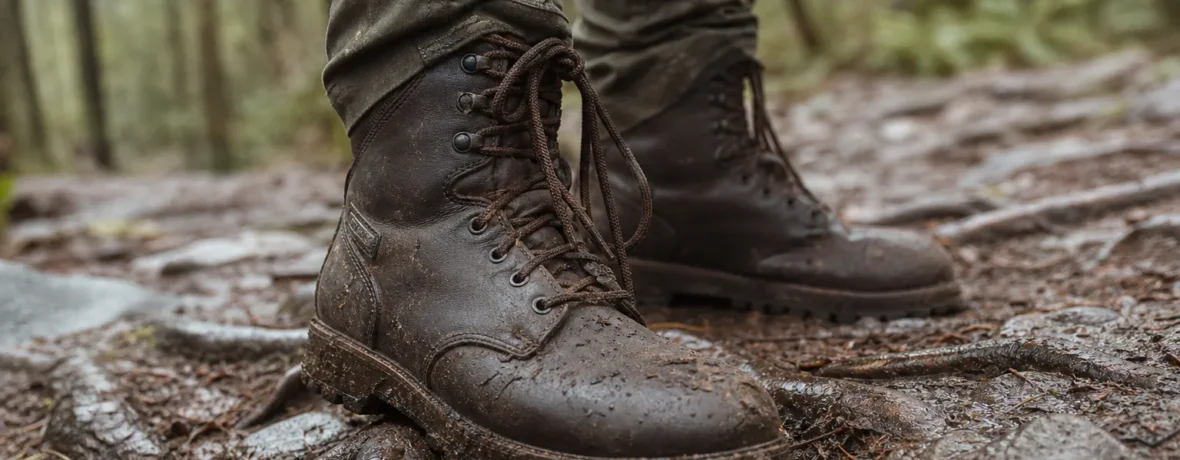
Are combat boots good for hiking? Yes, for short hikes, rough ground, yard-to-trail use, and carrying heavier loads. No, not usually for fast day hikes or long backpacking trips. Most combat boots give you 8-10 inches [20-25 cm] of ankle coverage, but they can feel stiff, hot, and heavy past 5-8 miles [8-13 km].
Are combat boots good for hiking on real trails?
Sometimes, but they are not the best default trail shoe.
Combat boots are built for protection, uniform standards, durability, and load carriage. Hiking boots are built for repeated uphill and downhill walking over dirt, rock, roots, mud, and scree. Those goals overlap, but they are not the same.
A modern combat boot can work well when the trail is rocky, brushy, wet, sandy, or filled with ankle-scraping junk. The tall cuff keeps debris out and shields your ankles from cuts. The tougher upper can shrug off abuse that would chew up a light trail runner.
But there is a trade. You move every ounce on your feet thousands of times per mile. A stiff, heavy boot can make a moderate hike feel longer. On steep descents, a boot that does not flex naturally can also encourage heel slip, toe bang, and hot spots.
Are military boots good for hiking compared with hiking boots?
Military boots are good for some hiking, but purpose-built hiking boots usually walk better.
Here is the straight comparison:
| Feature | Combat boots | Hiking boots |
|---|---|---|
| Ankle height | Usually tall, often 8-10 inches [20-25 cm] | Low, mid, or high depending on model |
| Flex | Often stiffer through the upper and sole | Designed for walking stride and trail flex |
| Best use | Brush, mud, work, load carry, rugged terrain | Day hikes, backpacking, steep climbs, long miles |
| Main downside | Heat, weight, break-in, slower drying | Less ankle coverage and abrasion protection |
The U.S. Army’s DA PAM 670-1 describes Army combat boots as 8-10 inches [20-25 cm] high, coyote-colored, flesh-side-out cattlehide leather with a plain toe and rubber or polyether polyurethane outsole materials. That tells you what the boot is built around: durability, uniform compliance, and field use, not necessarily low weight or trail comfort. See the Department of the Army DA PAM 670-1 boot description.
When do combat boots make sense for hiking?
Combat boots make sense when protection matters more than speed.
Choose them for:
- Short hikes under 5 miles [8 km] where comfort is already proven.
- Brushy routes where thorns, sticks, and sharp grass hit your ankles.
- Muddy trails where a taller boot helps keep grime out.
- Cold shoulder-season walks when ventilation matters less.
- Heavy pack days where a stiff platform feels stable.
- Work hikes, trail maintenance, hunting approaches, or training walks.
They can also be useful if you already own a broken-in pair and your feet like them. That last part matters. A familiar boot that fits well beats a brand-new “better” boot that shreds your heels on mile 2.
When are combat boots a bad choice for hiking?
Combat boots are a bad choice when the hike is long, hot, fast, or steep.
Skip them for:
- Long day hikes over 8 miles [13 km] unless you have already tested them.
- Hot desert hikes where trapped heat can cook your feet.
- Fast, high-mileage hiking where foot weight slows you down.
- Wet trips if the boots hold water and dry slowly.
- Steep descents if your toes hit the front of the boot.
- Trips where blisters would be more than annoying, such as remote backpacking.
Hot feet swell. Swollen feet rub. Rubbing makes blisters. The American Academy of Dermatology says friction is a common cause of blisters and recommends reducing rubbing and protecting irritated skin; their guide on how to prevent and treat blisters is a useful reference before you gamble on stiff boots.
How should combat boots fit for hiking?
They should fit snug in the heel, roomy in the toes, and secure through the midfoot.
Your toes need space because feet slide forward on descents. Stand in the boots, kick your heel gently back into the heel cup, lace them, then walk downhill or down stairs. If your toes hit the front, the boot is wrong for hiking. Not “needs breaking in.” Wrong.
Use this fit checklist before taking them on trail:
- Your heel lifts less than 1/4 inch [6 mm] while walking.
- Your toes do not touch the front on a downhill step.
- The widest part of your foot is not pinched.
- The tongue does not fold into a pressure ridge.
- The collar does not bite your ankle bone.
- You can wear your hiking socks without cutting off circulation.
How do you break in combat boots for hiking?
Break them in gradually before the trail.
- Wear them indoors for 30-60 minutes with your hiking socks.
- Walk 1 mile [1.6 km] on pavement and check for hot spots.
- Adjust lacing: tighter at the ankle for heel hold, looser over the forefoot for swelling.
- Walk 2-3 miles [3-5 km] with a light pack.
- Try uneven ground before committing to a real hike.
- Stop using them for hiking if the same hot spot appears twice.
Do not soak leather boots, bake them, or try to “toughen your feet” through pain. That is how you earn a limp. Break-in should make the boot flex more naturally, not force your foot to tolerate bad fit.
Are combat boots waterproof enough for hiking?
Some are water-resistant, but not all are waterproof.
Leather and nylon combat boots can handle damp grass, puddle splashes, and sloppy dirt if treated well. But once water comes over the collar, it is inside. And if the boot has a waterproof membrane, it may keep outside water out while also trapping sweat in warm weather.
For wet trails, drying speed matters as much as waterproofing. A boot that stays wet overnight can give you soft skin, more friction, and a higher blister risk the next day. If you hike in rain often, a hiking boot or trail shoe with a known waterproof or quick-drying design is usually easier to manage.
Do combat boots give better ankle support?
They give better ankle coverage, but not always better ankle support.
A tall cuff protects skin from scrapes and can remind your ankle not to roll too far. That is useful. But ankle injuries are also affected by fit, fatigue, load, terrain, balance, and outsole grip. A tall boot with a sloppy heel can still let your foot move around inside it.
If you have ankle pain, swelling, or a recent sprain, do not treat a combat boot as medical equipment. Mayo Clinic recommends contacting a healthcare professional if you have ankle pain and swelling and think you may have a sprain; see their page on sprained ankle symptoms and care.
What socks work best with combat boots for hiking?
Use hiking socks, not thin cotton gym socks.
Merino wool or synthetic hiking socks manage moisture better and cushion the high-rub zones: heel, ball of foot, toes, and shin. Cotton holds sweat and dries slowly, which is bad news inside a tall boot.
For stiff combat boots, try:
- Midweight hiking socks for general trail use.
- Thin liner socks if you often get heel blisters.
- Taller crew or over-the-calf socks to protect your shins from the boot cuff.
- Fresh socks for the return hike if your feet sweat heavily.
When to see a doctor
See a doctor when foot or ankle pain changes how you walk, gets worse, or shows signs of infection.
Blisters are usually minor, but spreading redness, warmth, pus, increasing pain, or swelling can signal infection. Mayo Clinic’s blister first aid guidance says to call a doctor for signs such as increasing pain, pus, warm skin, or expanding skin color changes.
For ankle trouble, get medical help if you have significant swelling, cannot bear weight, feel instability, or pain continues after rest. Do not diagnose yourself on the trail. Get out safely, reduce load if you can, and have the injury checked.
So, should you hike in combat boots?
Use combat boots for hiking only if they fit well, are already broken in, and match the trail.
If you are doing a short, rough, brushy hike, they can be a solid choice. If you are chasing miles, climbing all day, or hiking in heat, a hiking boot or trail runner will usually feel better and reduce foot fatigue.
The best answer is not “combat boots are good” or “combat boots are bad.” The best answer is: match the boot to the job. Your feet will tell you fast. Listen early, before a hot spot becomes a trip-ending blister.
Related reading
- Are Hiking Boots Good for Snow? Insulation, Traction and Limits
- Are Columbia Hiking Boots Good? Durability and Value Review
- Are Duck Boots Good for Hiking?
- How to Clean Hiking Boots Without Ruining Leather or Membranes
FAQ
Can you wear combat boots for backpacking?
Yes, but only if they are broken in and comfortable under pack weight. For multi-day trips, test them on at least one loaded training hike before trusting them far from the trailhead.
Are combat boots better than hiking boots for ankle support?
Not always. Combat boots usually provide more ankle coverage, but real support depends on fit, heel hold, stiffness, traction, and your own ankle strength.
Are jungle boots good for hiking?
Jungle boots can be good for hot, wet, muddy routes because many drain better than padded leather boots. They are not ideal for cold weather, sharp rock, or long descents if the sole lacks cushioning.
Do combat boots cause blisters?
They can if they are stiff, too loose in the heel, too tight in the forefoot, or worn with poor socks. Blisters come from friction, heat, and moisture, so fit and sock choice matter more than the label on the boot.
Should combat boots feel tight at first?
No. They can feel firm, but they should not pinch, numb your toes, or crush the sides of your feet. Leather may soften with use, but a bad size rarely turns into a good hiking boot.
What is the best alternative to combat boots for hiking?
For most hikers, a mid-height hiking boot is the closest alternative. It gives some ankle coverage with better trail flex, lighter materials, and outsole patterns made for hiking miles.