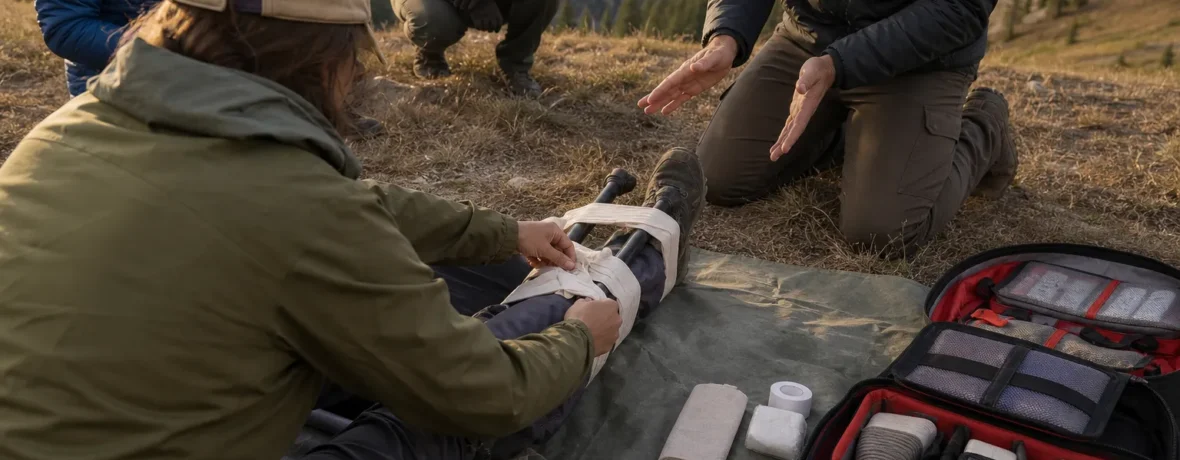
A wilderness first responder is a trained non-licensed rescuer who gives first aid in remote places when professional help may be hours or days away. WFR training typically runs 70-80 hours, includes hands-on scenarios, and fits guides, SAR volunteers, outdoor educators, and serious backcountry hikers.
What does a wilderness first responder do?
A WFR stabilizes problems, makes evacuation decisions, and keeps care going until higher medical help takes over.
Think less “bandage and move on” and more “manage the scene when the trailhead is 6 miles [10 km] away, weather is turning, and someone can’t walk.” A WFR is trained to slow down, size up hazards, check the patient, treat urgent problems, document changes, and decide if the group can continue, self-evacuate, or call for rescue.
The job is practical. You learn to work with what is in a pack: trekking poles, foam pads, extra layers, rain gear, water bottles, and a satellite messenger. You also learn what not to do. A WFR certificate does not make you a doctor, nurse, paramedic, or EMT. The Wilderness Medical Society describes WFR-type certificates as first aid-level training, not a license to practice medicine.
Is WFR the same as wilderness first aid?
No, WFR is longer, deeper, and aimed at leaders who may manage an incident for hours.
Wilderness First Aid, often called WFA, is the shorter course. It suits day hikers, scout leaders, paddlers, hunters, and campers who want solid backcountry first aid without a week-plus commitment. The American Red Cross lists its Wilderness and Remote First Aid course as 16 hours with a 2-year certification, as of November 2026.
WFR sits a level up. As of November 2026, NOLS describes its WFR course as a 9- to 10-day program that usually lasts 70-80 hours. That extra time matters because you practice patient assessment again and again under pressure.
| Course | Typical fit | Training style |
|---|---|---|
| Basic first aid | Everyday cuts, burns, choking, CPR/AED basics | Urban setting, fast EMS access |
| Wilderness First Aid | Recreational hikers and group members | Short course with outdoor-focused problems |
| WFR | Guides, trip leaders, SAR volunteers, serious backcountry travelers | Longer course with repeated scenarios and evacuation decisions |
How do you get WFR certification?
You take an approved course, pass the required skills and written work, and keep the credential current.
Most students choose a recognized wilderness medicine school, college outdoor program, guide service host, or SAR-affiliated course. Expect long days. Expect mud, fake blood, splints, shouting, awkward role-play, and instructors who keep asking, “What is your plan now?” That is the point. Reading about a broken ankle is easy. Managing a shivering patient on a steep trail while your group gets cold is different.
Here is the usual path:
- Pick the right provider. Look for a course accepted by your employer, volunteer team, school, guide service, or permit holder.
- Check prerequisites. Many courses require or include CPR training. Some expect full participation in outdoor scenarios.
- Block the time. Full WFR courses commonly take 70-80 hours. Hybrid formats may move lectures online but still need in-person skills.
- Practice the patient assessment system. This is the backbone: scene safety, consent, life threats, head-to-toe exam, vitals, history, and ongoing care.
- Pass the evaluations. Providers commonly use written tests, practical scenarios, or both.
- Track your expiration date. As of November 2026, SOLO says its WFR certification is valid for 3 years. Other providers may use different renewal periods.
Who needs a WFR course?
You need WFR if other people rely on your backcountry decisions and help may not arrive fast.
For casual front-country hikes with cell service and short walks to the road, WFA may be enough. For remote trips, youth programs, guiding, field research, trail crews, outdoor education, ski patrol, climbing instruction, packrafting, hunting camps, and search and rescue, WFR is often the baseline expectation.
You should strongly consider WFR if you:
- Lead groups more than 1 hour from definitive medical care.
- Plan trips where weather, terrain, river crossings, snow, or heat could trap the group.
- Carry a satellite communicator because cell service is unreliable.
- Make go/no-go calls for kids, clients, students, or volunteers.
- Travel with people who have known medical issues and need a stronger emergency plan.
- Want a realistic view of what your first aid kit can and cannot do.
What skills do you learn in a WFR course?
You learn a system for handling injury, illness, environment, communication, and evacuation.
The biggest skill is not a fancy splint. It is clear thinking. WFR training teaches you to stop the scene from getting worse, find life threats first, and keep reassessing instead of guessing. That matters when the patient looks fine for 10 minutes, then gets pale, confused, or weak.
Common topics include:
- Scene safety and group management
- Patient assessment and documentation
- Bleeding control and wound care basics
- Shock recognition and prevention
- Fractures, sprains, dislocations, and improvised splints
- Head, spine, chest, and belly injuries
- Heat illness, hypothermia, frostbite, dehydration, and lightning risk
- Allergic reactions, asthma, diabetes-related emergencies, seizures, and chest pain
- Evacuation urgency and communication with rescuers
Good courses also teach humility. You learn that a small ankle roll can become a serious problem if the group is wet, cold, late, and 4 miles [6.4 km] from the car. You learn that “walk it off” is not a treatment plan.
What can a WFR not do?
A WFR cannot diagnose, prescribe, replace EMS, or work outside the training and local rules that apply.
This is where many hikers get sideways. WFR training gives you a framework, not superpowers. You may be trained to assist with certain patient-carried medications depending on your course, protocol, and local rules, but that is not the same as prescribing. You may practice spine assessment, but that does not mean you can clear every spine injury with confidence. You may learn evacuation guidelines, but rescue decisions also depend on terrain, weather, daylight, communications, and available help.
Your best tools are simple: calm voice, warm layers, clean water, gloves, notes, time, and a plan. If a situation feels bigger than your training, it is bigger than your training. Call for help early when communication is possible.
When to see a doctor
Get medical help right away for life threats, worsening symptoms, or any problem you cannot safely manage in the field.
Call 911 or activate emergency communication for trouble breathing, chest pain, severe bleeding, loss of consciousness, severe allergic reaction, major trauma, suspected spine injury, confusion after a head injury, or any patient who is getting worse. For cold exposure, the CDC warns that hypothermia can become dangerous when the body loses heat faster than it can produce it. For heat emergencies, the CDC lists heat stroke with mental status changes as a medical emergency.
Snakebite is another no-messing-around problem. Mayo Clinic advises treating an unknown snakebite as potentially dangerous and seeking medical care right away; for a venomous snakebite, call 911 or your local emergency number.
After a trip, see a clinician if pain, swelling, redness, numbness, fever, wound drainage, dizziness, breathing trouble, or unusual fatigue shows up or gets worse. Do not use a WFR course to talk yourself out of care.
Is WFR worth it for hikers?
Yes, if you hike remote routes, lead others, or want better judgment when plans break.
The value is not just medical trivia. It changes how you pack, how you pace, how you screen partners, and how you turn around. You start seeing risk earlier: the wet cotton hoodie, the loose rock above the lunch spot, the hiker who stopped eating, the thunderhead building behind the ridge.
For solo hikers, WFR will not splint your own ankle by magic. But it can sharpen prevention and self-rescue planning. For group hikers, it gives you a shared language. Instead of five people arguing over panic ideas, one person can start a patient assessment while another gets insulation under the patient, another checks coordinates, and another prepares a message for rescue.
Related reading
- Tenzing Norgay and Edmund Hillary: The First Everest Summit
- Junko Tabei: The First Woman to Climb Everest
- How to Become a Wilderness Ranger
- From First Walk to Lifelong Hobby: How Hiking Sticks With People
FAQ
How long does a WFR course take?
A full WFR course usually takes 70-80 hours. Many traditional courses run 9-10 days, while hybrid formats may combine online coursework with several full in-person field days.
Do you need WFR to be a hiking guide?
Often, yes, but it depends on the employer, permit, and trip type. Many outdoor programs and guide services prefer or require WFR because guides may manage emergencies far from rapid EMS access.
Can a WFR give medications?
Not as a prescriber. Some courses teach how to assist with certain patient-carried medications under specific guidelines, but your legal role depends on training, protocols, state rules, and the situation.
Is WFR harder than Wilderness First Aid?
Yes, WFR is a bigger commitment. It has more scenarios, more assessment practice, more decision-making, and more responsibility than a shorter wilderness first aid class.
Does WFR replace CPR training?
No, WFR does not automatically replace CPR training for every job or organization. Some WFR courses include CPR, but you should check the course listing and any employer requirement before enrolling.
What should I take before WFR?
You can take WFR as a first wilderness medicine course if you are ready for the time and intensity. If you want a gentler start, take Wilderness First Aid first, then move up when you begin leading harder or more remote trips.