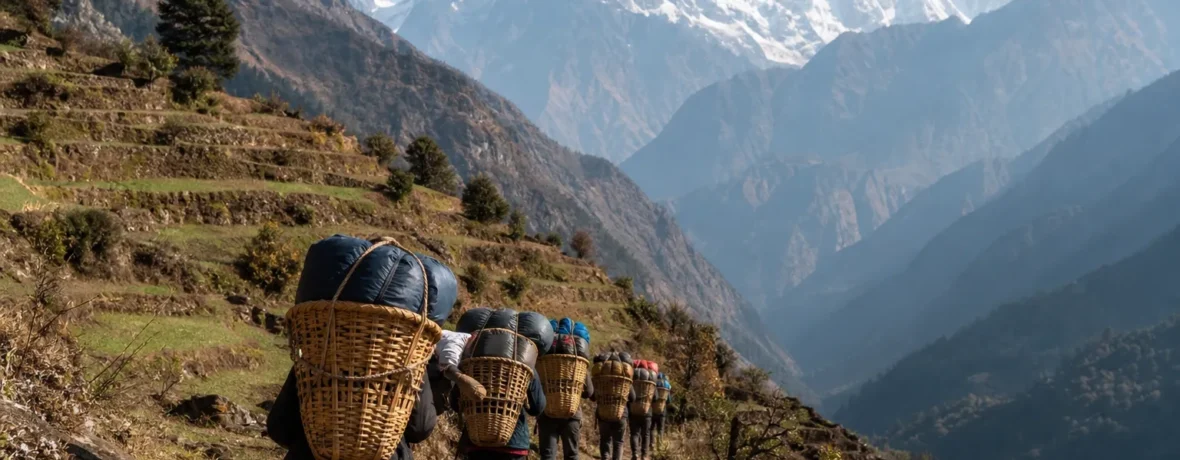
What is a porter? A mountain porter is a paid expedition worker who carries shared gear, food, tents, fuel, and sometimes a client’s duffel between camps or lodges. Porters do not replace your own fitness, but they make supported treks possible by moving heavy loads through steep, remote, high-altitude terrain.
What is a porter on a mountain expedition?
A porter is the muscle and logistics backbone of a supported trek.
On big mountains and long treks, the trail is only part of the job. Someone has to move tents, kitchen gear, food, toilet systems, fuel, medical kits, tables, chairs, and duffels from one camp to the next. That “someone” is usually a team of porters.
Porters work on routes where roads stop and wheels stop being useful. Think Kilimanjaro, Mount Kenya, the Andes, the Himalayas, and remote approaches where mules, helicopters, or vehicles are either banned, unavailable, too expensive, or impractical.
A porter may carry gear in a backpack, basket, duffel, head strap system, or load frame, depending on the region. In Nepal, you may see loads carried with a tumpline across the forehead. On Kilimanjaro, loads are commonly balanced on the head, shoulders, or back. The technique changes. The work stays hard.
What does a porter actually carry?
Porters carry the gear that keeps the expedition moving.
Your daypack should still hold your water, rain shell, warm layer, snacks, sunscreen, camera, and personal essentials. The porter-carried load is usually the stuff you do not need until camp: sleeping bag, spare layers, toiletries, and expedition equipment assigned by the operator.
| Role | Usually carries | Usually responsible for |
|---|---|---|
| Porter | Client duffels, food, tents, fuel, camp gear | Moving loads safely between camps or lodges |
| Guide | Navigation, safety gear, permits, group plan | Route decisions, pacing, safety, client management |
| Cook or camp crew | Kitchen gear and food systems | Meals, hot drinks, camp kitchen, hygiene |
On some trips, job titles blur. A “porter-guide” may carry a smaller load and also help with route finding. A “summit porter” may assist climbers on a summit push. A “toilet porter” may carry and maintain a portable toilet system. These jobs deserve respect, not jokes.
How much weight can a porter carry?
The safe and legal load depends on the country, route, altitude, and operator.
On Kilimanjaro, Tanzania National Parks regulations state that a porter is allowed to carry a maximum weight of 44 lb [20 kg] during mountain climbing, as of November 2026; see the official TANAPA park rules and regulations. Older mountain regulations also describe porter loads in the 40–55 lb [18–25 kg] range, which is why you may still see different numbers online. Use the stricter 44 lb [20 kg] figure when you pack.
The Tanzania Association of Porters also describes monitoring compliance with the 44 lb [20 kg] maximum load on Kilimanjaro, as of November 2026. That number is not an invitation to pack to the edge. Your duffel is only one part of what must move up the mountain; tents, food, fuel, and crew equipment have to move too.
In Nepal, porter loads vary more by agency and region. Many ethical trekking companies set their own limits, often lower for high passes, winter routes, or climbing trips. Ask before you book. If the answer sounds vague, keep looking.
How is a porter different from a guide or Sherpa?
A porter carries expedition loads; a guide leads the route and manages safety.
A guide is usually responsible for decisions: pacing, route timing, acclimatization, weather calls, permit checks, emergency response, and client supervision. A porter’s main job is transport. Both jobs require mountain skill. They are just different jobs.
“Sherpa” is often misused. Sherpa is an ethnic group from the Himalayan region, not a synonym for porter. Some Sherpa people work as porters, guides, cooks, lodge owners, high-altitude workers, doctors, pilots, and business owners. Use the job title when you mean the job.
Clean language matters. It reminds you that the person carrying the load is not part of the scenery. They are a worker with a name, family, wage, risk, skill, and rights.
How much to tip Kilimanjaro porters?
Tip through the operator’s transparent crew system, and confirm the crew size before summit day.
For how much to tip Kilimanjaro porters, the cleanest answer is this: ask your operator for its written tipping guideline before you pay your deposit, then compare it with porter-welfare guidance. The Kilimanjaro Responsible Trekking Organization/KPAP tipping guidance recommends knowing the exact number of guides, cooks, and porters supporting your climb and using a transparent procedure, as of November 2026.
Why not just hand cash to the loudest person at the gate? Because expedition crews are layered. The lead guide, assistant guides, cook, waiter, toilet crew, summit assistants, and porters may all be part of the system. A good operator will show you:
- the full crew list by name and role;
- the recommended tip split for each role;
- how tips are recorded;
- when tips are distributed;
- whether each worker confirms receipt.
Budget tips before you fly. If you arrive broke, the porters pay for that mistake. If you want to give extra because the crew was exceptional, do it through a system that still protects the lower-paid workers from being skipped.
How do you choose an ethical trekking company?
Choose the company that can prove how it treats porters.
Pretty summit photos tell you nothing about labor standards. Ask blunt questions. Good operators answer without getting defensive.
- Ask for the porter load limit. On Kilimanjaro, confirm the 44 lb [20 kg] maximum and ask how loads are weighed.
- Ask who checks compliance. Park gates, porter associations, and internal staff may all play a role.
- Ask about wages. Tips should add to fair pay, not replace wages.
- Ask about meals. Crew should eat real meals, not client leftovers.
- Ask about sleeping arrangements. Porters need shelter suitable for wind, cold, rain, and altitude.
- Ask about gear. Boots, gloves, rain protection, warm layers, and sleeping systems matter.
- Ask about insurance and evacuation. If a porter gets sick or injured, there must be a plan.
- Ask for the tipping procedure in writing. Verbal promises disappear fast after descent.
On Kilimanjaro, KPAP’s partner program uses monitoring to encourage fair treatment, load limits, transparent tipping, proper shelter, and meals; you can review the Kilimanjaro Porter Assistance Project program overview. Membership is not the only possible signal of a decent operator, but refusing to discuss porter welfare is a bright red flag.
What should you pack when a porter carries your duffel?
Pack lighter than the limit and keep daily essentials with you.
A porter is not a moving van. Keep your duffel tight, weatherproof, and honest. If the operator says 33 lb [15 kg] for your personal duffel, that means 33 lb [15 kg], not 39 lb [18 kg] plus “just this one extra bag.”
- Use one soft duffel, not loose shopping bags.
- Line the duffel with a trash compactor bag or dry bag.
- Label the bag with your name and group.
- Keep passport, medications, cash, rain shell, insulation, water, and snacks in your own daypack.
- Do not strap wet boots, extra water, or souvenirs onto the porter load at the last minute.
- Weigh your packed duffel at home before the trip.
A lighter duffel helps everyone: the porter, the guide, the operator, and you. It also makes camp logistics smoother when rain, altitude, fatigue, and short daylight start squeezing the day.
How should you treat porters on the trail?
Treat porters like skilled coworkers, not background labor.
Learn names. Say hello. Step aside when a loaded porter is moving faster than you, which they often will be. Do not block narrow trail sections for photos while a worker is standing under 40 lb [18 kg] of gear.
Small habits make a difference:
- Keep your duffel packed on time each morning.
- Do not ask a porter to carry items outside the agreed load.
- Thank the cook and camp crew, not only the guide.
- Report unsafe treatment if you see it.
- Tip through a transparent system.
- Leave unwanted gear only if it is clean, useful, and welcomed.
Do not turn generosity into a dumping ground. Broken sunglasses, worn-out socks, and trashed boots are not gifts. Good gear can help; garbage creates another problem.
When to see a doctor
See a doctor before high-altitude travel if you have heart, lung, blood, sleep, or major chronic health conditions.
High-altitude trips can stress everyone: clients, guides, and porters. The CDC Yellow Book on high-altitude travel advises travelers with underlying medical conditions to consult a physician familiar with altitude medicine before the trip, as of November 2026.
On the mountain, tell your guide immediately if you or anyone in the group develops worsening headache, confusion, loss of coordination, breathlessness at rest, chest tightness, persistent vomiting, or symptoms that get worse despite rest. The CDC says descent is mandatory when altitude symptoms worsen despite treatment or rest at the same elevation. Do not diagnose yourself on the trail. Get help early.
Related reading
- A Walk in the Woods: Bill Bryson's AT Story vs Reality
- Kids' Hiking Boots: How to Size and When to Buy
- Teaching Leave No Trace to Kids
- How to Become a Park Ranger: Education, Steps and Timeline
FAQ
Do porters carry your whole backpack?
No, not usually. Porters typically carry your duffel or assigned expedition load, while you carry a daypack with water, layers, snacks, and essentials.
Is hiring a porter cheating?
No. Hiring a porter is part of how many supported treks operate, especially where camping gear and food must move daily. You still have to hike the route under your own power unless your trip has a separate assisted-travel arrangement.
Should I give my porter gifts instead of money?
No, not instead of wages or tips. Useful gear can be appreciated if it is clean and wanted, but cash through a transparent tipping system is usually more practical.
Can I hire one extra porter for more luggage?
Often yes, depending on the route and operator. Ask before the trip, pay the proper porter fee, and include that worker in the tipping plan.
What is the biggest red flag with a trekking company?
Vague answers about porter pay, load limits, food, shelter, and tips are the biggest red flag. A responsible operator can explain the system clearly before you book.
Do porters get altitude sickness too?
Yes. Porters are strong and acclimatized compared with many visitors, but they are still human and can get sick or injured at altitude. A good expedition plan protects the crew as well as the clients.