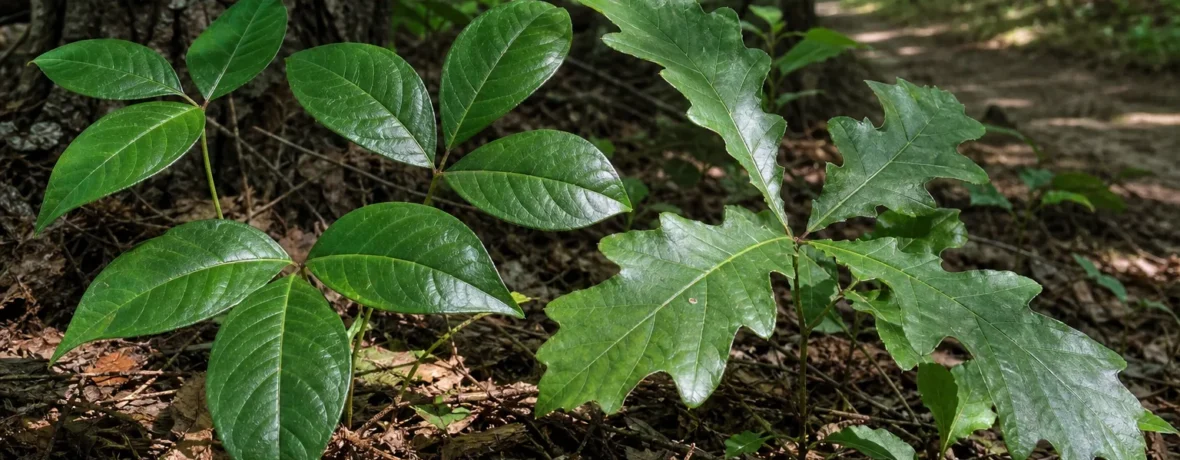
Poison oak vs poison ivy comes down to shape, range, and growth habit: poison ivy often grows as a vine or low shrub with 3 leaflets, while poison oak is usually a shrub or climbing vine with oak-like 3-leaflet clusters. Poison sumac is different: 7–13 leaflets and wetland habitat.
What is the difference between poison oak vs poison ivy?
The short answer: poison ivy is usually the trail-edge vine; poison oak is the oak-leaf lookalike shrub or vine.
Both plants contain urushiol, the oily resin that triggers the classic itchy, blistering rash in people who are sensitive to it. That means the rash can feel the same even when the plant looks different. Your skin does not care whether the oil came from ivy or oak. It just reacts.
The useful difference for you on trail is visual. Poison ivy often has a longer-stalked middle leaflet, side leaflets with shorter stalks, and can climb trees with hairy-looking aerial roots. Poison oak commonly has rounded, lobed leaflets that resemble small oak leaves. Pacific poison oak is common in the West, especially California and the Pacific Coast, while poison ivy is widespread across much of the United States. The CDC/NIOSH guide to poisonous plants backs the old “leaves of three” warning for poison ivy and poison oak, with one catch: plant shape varies by species, place, and season.
So use the rhyme, but do not worship it. Leaves can be glossy or dull. Edges can be smooth, toothed, or lobed. Spring leaves may be reddish. Fall leaves may turn red, orange, or yellow. Winter vines can still carry urushiol even when the leaves are gone.
| Plant | Fast ID | Where you’ll usually meet it | Trail warning |
|---|---|---|---|
| Poison ivy | 3 leaflets, often with a longer-stalked middle leaflet; vine or shrub | Woods, trail edges, fence lines, disturbed ground | Hairy climbing vines on trees can still cause rash |
| Poison oak | 3 leaflets, often rounded or lobed like oak leaves; shrub or vine | Dry slopes, chaparral, oak woodland, coastal areas | Easy to brush with shins and calves on narrow trail |
| Poison sumac | 7–13 leaflets in pairs, often with one leaflet at the tip | Swamps, bogs, wet woods, soggy shorelines | Less common for hikers, but nastier when you hit it |
How do you identify poison ivy on the trail?
Look for 3 leaflets, alternate growth, and a middle leaflet that usually has a longer little stem.
Poison ivy is sneaky because it changes costume. It can sprawl at ankle height, stand as a small shrub, or climb a trunk like it owns the forest. On trees, mature poison ivy vines may look rough, shaggy, or hairy. Do not grab them for balance. That is a bad trade.
Common poison ivy clues:
- One leaf made of 3 leaflets, not 3 separate leaves.
- Middle leaflet often sticks out on a longer stalk.
- Side leaflets may look like little mittens, with one deeper notch.
- Leaves may be shiny in spring and duller later.
- Clusters of whitish berries may appear later in the season.
- Vines can climb trees, posts, and rocks.
Do not use shine alone. Plenty of safe plants shine after rain. Do not use red leaves alone either. Lots of plants turn red. The better trail habit is pattern recognition: 3 leaflets, alternate placement, vine or low shrub, and a plant sitting exactly where your bare calf wants to swing.
Poison ivy can also be confused with Virginia creeper, boxelder seedlings, young blackberry, and fragrant sumac. Virginia creeper usually has 5 leaflets. Boxelder has opposite leaves along the stem. Blackberry often has thorns. When in doubt, leave space. A half step around a plant beats two weeks of scratching.
How do you identify poison oak?
Poison oak usually has 3 leaflets with rounded, lobed edges that resemble small oak leaves.
Pacific poison oak is a big one for hikers in the West. It can grow as a dense shrub in sun or climb as a vine in shade. The leaves may be green, red, or bronze depending on season and exposure. In dry country, it can blend right into chaparral and brushy trail edges. That is where shorts become a poor decision.
The National Park Service describes Pacific poison oak leaves as typically arranged in 3 leaflets and measuring roughly 1–6 inches [2.5–15 cm] long, with lobed edges that give the oak-like look. See the NPS Pacific poison oak guide for a clear field description.
Eastern poison oak also exists, but it tends to be more shrub-like and less common than poison ivy across much of its range. The name causes confusion because hikers use “poison oak” for almost any 3-leaflet rash plant. That is not great botany, but it is understandable when your legs are on fire.
Use these clues:
- 3 leaflets per leaf.
- Rounded lobes, often like a miniature white oak leaf.
- Shrubby patches along sunny, dry trail edges.
- Vining growth in some shaded or coastal areas.
- Color shifts from reddish new growth to green, then red or orange in fall.
How do you identify poison sumac?
Poison sumac has 7–13 leaflets and usually grows in wet places, not dry upland trail dust.
This is the one that breaks the “leaves of three” rule. Poison sumac is a shrub or small tree with paired leaflets and one leaflet at the tip. The stems can look reddish. The leaves are generally smooth-edged, not toothed like many harmless sumacs.
Habitat is your biggest clue. Poison sumac likes wet feet. Think swamps, bog edges, wet woods, and soggy shorelines. If you are hiking a dry ridge in Utah, poison sumac is not your likely enemy. If you are pushing through a wetland edge in the eastern United States, pay attention.
Harmless sumacs often grow in dry fields and roadsides and may have upright red fruit clusters. Poison sumac has pale, drooping fruit clusters. Still, do not play plant detective with your fingertips. Use your eyes. Use distance. If you need to push through unknown wetland brush, wear long pants and wash up after.
Do poison oak, poison ivy, and poison sumac rashes look different?
No, not reliably: the rash is caused by the same type of oil, so the skin reaction can look similar.
The rash is allergic contact dermatitis from urushiol. According to NIH MedlinePlus on poison ivy, oak, and sumac, the oily sap is found in roots, stems, leaves, and fruit. If it gets on your skin, it can cause a blistering rash.
Typical signs include:
- Redness where the oil touched skin.
- Intense itching.
- Swelling.
- Blisters, sometimes in streaks or patches.
- Oozing or crusting as blisters heal.
The streaky look comes from the way your skin brushed the plant or contaminated gear. It does not mean the rash is spreading from blister fluid. Once urushiol is washed off, the fluid from blisters usually does not spread the rash to other people or other parts of your body, according to MedlinePlus Medical Encyclopedia.
New spots may still appear later. That can happen because different skin areas absorbed different amounts of urushiol, or because oil remained on boots, trekking poles, dog fur, gloves, or clothing. The plant got a second shot at you. Rude, but common.
How long does a poison ivy or poison oak rash last?
Most rashes clear on their own in 2–3 weeks, but severe reactions can last longer and need medical care.
The first itch may show up within hours, or it may take several days. The timing depends on how sensitive you are, how much urushiol hit your skin, and whether you have reacted before. The FDA’s poisonous plant guidance says symptoms can emerge from a few hours to several days after exposure.
Mild cases can be annoying but manageable at home. Bad cases can wreck sleep, swell your face, or cover enough skin that you need a clinician. Mayo Clinic says poison ivy rash usually goes away on its own in 2–3 weeks and lists self-care options such as cool compresses, calamine, and oatmeal baths; see Mayo Clinic’s poison ivy treatment page.
Do not scratch until you bleed. That is how a miserable rash can become an infected one. Trim nails short, cover hot spots with breathable clothing, and keep the area clean.
What should you do right after touching poison ivy, oak, or sumac?
Wash your skin and gear as soon as you can, because urushiol is an oil and it clings.
Speed helps. So does technique. You are trying to remove oil, not perform a spa ritual. Lukewarm water, soap, and friction are your friends. A dedicated poison plant wash can help, but plain soap used well beats fancy products used late and lazily.
- Step away from the plant. Do not keep walking through the patch while deciding if it “counts.”
- Rinse exposed skin. Use running water if you have it. On trail, use clean carried water if you can spare it.
- Wash with soap. Clean between fingers, under watch bands, around sock lines, and behind knees.
- Rinse thoroughly. Do not leave oily soap residue sitting on skin.
- Bag contaminated clothes. Keep them away from clean layers and sleeping gear.
- Clean tools and gear. Trekking poles, boot uppers, gaiters, knife handles, and dog leashes can all hold oil.
- Shower when you get home. Wash hair, skin folds, and any area that could have touched clothing while changing.
Avoid hot water at first. Hot water can make itching feel worse once the reaction starts, and it may encourage more rubbing and scratching. Also, do not burn the plants. Smoke from burning poison ivy, oak, or sumac can carry irritating compounds and may affect the eyes, nose, throat, or lungs, according to CDC/NIOSH.
Can poison ivy spread from person to person?
No, the rash itself is not contagious, but leftover urushiol oil can transfer from skin, clothing, pets, and gear.
This is where hikers get fooled. Your buddy’s blister fluid is not the issue. The oil is the issue. If your dog plows through poison oak and then naps across your bare legs, congratulations, your dog just became a fuzzy delivery system.
Urushiol can ride on:
- Dog fur and collars.
- Boot laces and tongues.
- Trail pants, gaiters, and socks.
- Trekking pole grips.
- Backpack hip belts.
- Gloves used for clearing brush.
- Camp chairs and car seats touched by contaminated clothing.
Wash pets with care and gloves if they may have run through the plant. Launder clothes separately with regular detergent. Wipe hard gear with soap and water or the cleaner recommended by the gear maker. The goal is simple: break the oil chain before it reaches skin again.
How can hikers prevent poison oak and poison ivy rash?
Cover skin, learn the plants, stay on trail, and wash exposed skin after brushy miles.
Prevention is not glamorous. It is pants. It is socks that sit higher than ankle bones. It is not grabbing random vines while scrambling up a muddy bank. It is looking down before stepping off trail for a snack break.
Use this pre-hike checklist when you are heading into poison plant country:
- Wear long pants in brush, even if shorts sound better.
- Use gaiters when trails are narrow or overgrown.
- Keep dogs leashed in dense poison oak or ivy areas.
- Teach kids “leaves of three” and “wetland sumac has many leaflets.”
- Do not sit in brush without checking the plants around you.
- Carry a small soap or poison plant wipe on long day hikes.
- Wash hands before eating, touching your face, or using the bathroom.
- Change clothes before crawling into a tent or sleeping bag after heavy exposure.
Barrier skin products exist, but they are not armor. They work only when used correctly and reapplied as directed on the label. Clothing and avoidance still do the heavy lifting.
When to see a doctor
Get medical help if the rash is severe, widespread, on sensitive areas, or tied to breathing trouble after smoke exposure.
This article cannot diagnose you. A clinician can look at the rash, ask about exposure, and decide whether you need prescription treatment or evaluation for infection. Mayo Clinic notes that widespread rash, many blisters, or bacterial infection may require medical care.
Contact a doctor or urgent care if you have:
- Rash on your face, eyes, mouth, or genitals.
- Severe swelling.
- A rash covering a large area of your body.
- Blisters that are widespread or worsening.
- Signs of infection, such as increasing pain, warmth, pus, or fever.
- Itching that keeps you from sleeping despite basic care.
- A rash that is not improving after several days or keeps spreading from new oil exposure.
Seek emergency help right away if you have trouble breathing, throat swelling, or severe symptoms after inhaling smoke from burning poison ivy, oak, or sumac. Do not wait that one out at camp.
Related reading
- What Does Poison Ivy Look Like? Leaves of Three and Lookalikes
- How Long Does Poison Ivy Last?
- Is Poison Ivy Contagious?
- What Does a Poison Ivy Rash Look Like?
FAQ
Is poison oak worse than poison ivy?
Not automatically. Both can cause the same type of urushiol rash, and severity depends on your sensitivity, the amount of oil, and how quickly you wash it off.
What kills poison ivy rash fastest?
There is no instant cure once the allergic reaction starts. Washing early can reduce exposure, while cool compresses, calamine, oatmeal baths, and clinician-directed treatment can help manage symptoms.
Does hand sanitizer remove urushiol?
Soap and water are the better choice. Hand sanitizer may not reliably remove the oily resin, and it is not a substitute for washing contaminated skin, clothes, and gear.
Can you get poison ivy in winter?
Yes. Leafless vines and stems can still contain urushiol, so winter poison ivy can still trigger a rash if you touch it.
Does poison sumac have 3 leaves?
No. Poison sumac usually has 7–13 leaflets, which is why “leaves of three” does not apply to it.
Can my dog get poison ivy and give it to me?
Your dog’s fur can carry urushiol oil to your skin, bedding, or car seat. Dogs may not show the same rash you do, so wash the dog carefully if it ran through suspect plants.