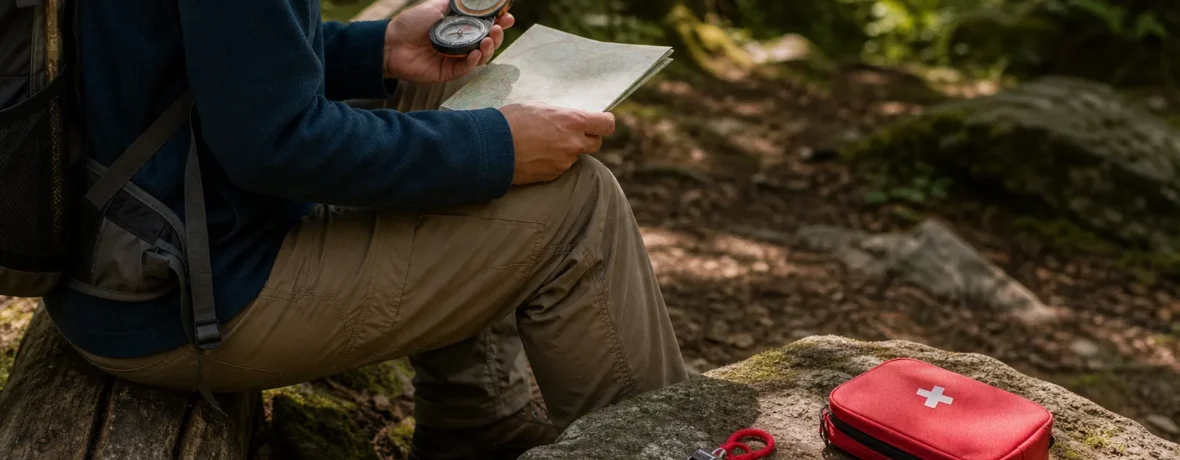
Stop moving, breathe, call 911 if you have signal, and use STOP: Stop, Think, Observe, Plan. Stay put unless you face immediate danger. Signal every few minutes with three whistle blasts, bright gear, or a phone light.
What is the first thing to do if you get lost in the woods?
Stop walking immediately.
That sounds too simple, which is why people ignore it. They push another 10 minutes. Then another. They follow a faint path, cross a drainage, climb a ridge, and turn a small problem into a search area measured in miles.
Your first job is to quit making the map bigger. Sit down if you can do it safely. Drink water. Put on a layer before you get chilled. Tell yourself out loud: “I am stopped. I am safe enough right now. I am going to make one decision at a time.”
The National Park Service outdoor emergency plan tells lost hikers to stop, breathe, assess the situation, and stay put unless there is an immediate threat. That advice is boring on purpose. Boring keeps you alive.
- Stop. Do not wander. Mark your spot with a bandana, trekking pole, or bright item.
- Think. Ask: When did the trail last feel certain? What direction was the sun? Did you cross water, a road, a junction, or a ridge?
- Observe. Check your body, daylight, weather, phone battery, map, compass, water, clothing, and hazards nearby.
- Plan. Choose the safest next move: call for help, stay put, return only if the route is obvious, or build a visible waiting spot.
If you are with kids, a tired hiker, or an injured person, the answer is even clearer: stop and hold the group together. Splitting up feels productive. It usually creates more problems.
How does the STOP method work when you are lost?
The STOP method turns panic into a short checklist.
Here is what each letter means in practical trail language.
| STOP step | What you do | What you avoid |
|---|---|---|
| Stop | Freeze in place, breathe, sit if safe, prevent more distance from your last known point. | Running downhill, chasing sounds, or following animal trails. |
| Think | Rebuild the last hour in your head: turns, landmarks, trail signs, creek crossings, photos. | Making fast choices because you feel embarrassed. |
| Observe | Check weather, daylight, injuries, water, insulation, terrain, phone signal, and map tools. | Ignoring cold, thirst, blisters, steep ground, or incoming storms. |
| Plan | Pick one safe plan and stick with it long enough to help rescuers or your group find you. | Changing direction every few minutes. |
The hard part is not remembering the letters. The hard part is swallowing your pride. Nobody likes admitting they are turned around. Do it anyway. The woods do not care how experienced you are, how expensive your boots are, or how many summits you have tagged.
If you have a map and compass and can identify your exact position, you may be able to backtrack carefully. Exact means exact. “I think the trail is probably over there” is not exact.
If your location is uncertain, stay where you are or move a very short distance to a safer, more visible spot: an open area, a ridge clearing away from cliffs, a dry bench above a creek, or a place where you can make shelter without trampling around in circles.
Should you stay put or try to walk out?
Stay put unless you can clearly identify a safe route or you are in immediate danger.
Immediate danger means fire, flash flooding, falling rocks, a rising river, lightning exposure, extreme cold without shelter, or another threat that will likely hurt you if you remain there. In that case, move only as far as needed to get safer, then stop again.
Most lost hikers make things worse by “just checking” one more direction. A slope pulls you downhill. A creek feels like it must lead somewhere. A game trail looks human-made for the first 200 yards [183 m], then vanishes into brush. Now you are scratched, tired, wet, and farther from the place where someone might start looking.
Before you move, run this quick test:
- Can you point to your current location on a map with confidence?
- Do you know where the trail, road, trailhead, or camp is from that point?
- Do you have enough daylight to reach it without rushing?
- Can the weakest person in your group make the walk safely?
- Will moving take you away from the route you told someone you planned to hike?
If you cannot answer yes to all five, staying put is usually the better call.
When you do move, leave signs. Build a clear arrow from sticks. Write the time and direction on paper and pin it under a rock. Use only materials you already have or loose natural debris. Do not carve trees or damage signs. Keep the distance short and deliberate.
How do you call for help if you have cell service?
Call 911 as soon as you know you are lost and cannot self-rescue safely.
You do not need to wait until dark. You do not need to be bleeding. You do not need to prove you are tough. Call while your battery still has power and your thinking is still sharp.
Tell the dispatcher:
- Your name and phone number.
- Your trailhead, route, park, forest, or nearest town.
- Your GPS coordinates if your phone can show them.
- How many people are with you.
- Any injuries, medical conditions, or signs of cold or heat illness.
- Your clothing colors, tent color, pack color, and any bright gear.
- How much daylight, water, food, and warm clothing you have.
After the call, conserve the phone. Switch to low power mode. Dim the screen. Close apps. Keep the phone warm in an inside pocket in cold weather. If service is weak, try texting 911 only where that service is available; a text may go through when a call will not. Send one message with your location and situation, then wait rather than draining the battery with repeated attempts.
If you carry a satellite messenger or personal locator beacon, use it when you are lost, injured, benighted, or facing conditions you cannot manage safely. Once activated, stay in the area if you can. Rescuers need a stable target, not a moving one.
How do you signal rescuers in the woods?
Use sound, light, color, and contrast.
Your voice is a poor tool. It burns energy, gets hoarse fast, and does not carry as well as a sharp whistle. The Texas Parks and Wildlife Department’s lost-person guidance lists three evenly spaced whistle blasts, horn blasts, shots, or fires as distress signals. A whistle belongs in your pocket, not buried in your pack.
Try this signal pattern:
- Blow three whistle blasts.
- Wait and listen.
- Repeat every few minutes.
- At night, flash a headlamp or phone light in sets of three.
- In daylight, place bright clothing, a reflective blanket, or a pack cover in an open spot.
If you hear aircraft, move into the open only if you can do so safely. Wave both arms slowly. Lay out bright gear in a large X. A signal mirror can flash sunlight across long distances, and it never needs batteries.
Fire can help with warmth and visibility, but do not start one if local fire risk is high, if fires are banned, if wind could spread it, or if you cannot control it. A rescue that turns into a wildfire is not a rescue plan.
How do you survive in the woods overnight?
Stay warm, dry, visible, and in one place.
Night feels bigger than it is. Your brain starts inventing noises. The temperature drops. Every mistake seems permanent. Slow down and build a small camp before darkness forces your hand.
Work in this order:
- Pick a safe site. Avoid creek beds, dead trees, cliff edges, avalanche paths, and exposed ridges in lightning.
- Add insulation. Put on dry layers. Sit on a pack, foam pad, leaves, or spare clothing instead of bare ground.
- Block wind and rain. Use a rain shell, poncho, emergency bivy, space blanket, tarp, or natural windbreak.
- Make yourself visible. Keep bright items out. Put a headlamp where it can be seen. Mark the spot.
- Manage water. Sip, do not chug. Treat natural water if you have a filter, purifier, tablets, or a stove.
- Ration effort, not food. Eat enough to keep your mood and energy steady, but do not burn calories wandering.
Think small. You are not building a cabin. You are trying to reduce heat loss and stay findable until morning or rescue.
Cold ground will steal warmth fast. Even a thin barrier helps. Put your pack under your hips and torso. Stuff spare socks or gloves inside your jacket if you are chilled. Keep rain gear on the outside, insulating layers underneath, and wet clothing away from your skin when you have dry replacements.
Food matters less than warmth and water during one unexpected night out. Do not eat unknown berries, mushrooms, roots, or leaves. Hunger is uncomfortable. Poisoning yourself is worse.
What gear helps most if you get lost hiking?
The best gear is the gear you carry on every hike.
A two-mile [3.2 km] loop can turn into a night out if you take a wrong spur, lose the trail under snow, help an injured friend, or miss a junction near sunset. Tiny emergency items earn their space.
The National Park Service Ten Essentials include navigation, sun protection, extra clothing, lighting, first aid, fire, repair tools, extra food, water, and emergency shelter. For lost-hiker safety, build your day pack around those systems.
- Navigation: paper map, compass, downloaded offline map, and a battery bank.
- Signaling: whistle, signal mirror, bright bandana, headlamp, spare batteries.
- Shelter: emergency bivy, space blanket, poncho, or small tarp.
- Warmth: rain shell, insulating layer, hat, gloves, dry socks.
- Water: bottle or reservoir plus a treatment method.
- Food: salty snacks, bars, nuts, or other high-energy food you will actually eat.
- Fire: lighter, waterproof matches, and fire starter where fires are legal and safe.
- First aid: blister care, bandages, wrap, personal medications, and any emergency items specific to your health.
- Repair: knife or multitool, tape, cord, and a way to patch torn gear.
Keep the whistle, phone, and light reachable. If they are deep in your pack when you fall, get separated, or drop the pack during a scramble, they might as well be at home.
What mistakes make being lost more dangerous?
The big mistakes are moving too much, waiting too long to call, and letting panic drive.
Here are the ones that bite hikers again and again:
- Following water downhill blindly. Creeks can lead to waterfalls, brush, cliffs, private land, or miles of rough travel.
- Trusting a dying phone. GPS is useful until the battery fails, the screen breaks, or the map was never downloaded.
- Leaving the planned route. Searchers often start with your itinerary. If you wander far from it, you become harder to find.
- Getting wet late in the day. A creek crossing or rainstorm can turn a cool evening into a cold emergency.
- Yelling nonstop. Use a whistle or light pattern instead. Save your throat and energy.
- Ignoring embarrassment. Shame makes people walk when they should call. Rescue teams would rather reach you early.
Also watch for “summit logic” in reverse. On the way up, people think, “I’m almost there.” When lost, they think, “The trail must be just ahead.” Maybe it is. Maybe it is three drainages away. Make choices from evidence, not hope.
How can you avoid getting lost before the hike starts?
Plan your route, tell someone, and carry backup navigation.
Prevention is less exciting than survival skills. Good. Excitement is overrated when the sun is dropping and you cannot find the trail.
Before you leave:
- Study the route, junctions, trail names, bail-out points, and water crossings.
- Download offline maps before you lose service.
- Carry a paper map for unfamiliar or remote terrain.
- Tell a reliable person your trailhead, route, group size, vehicle description, and return time.
- Set a check-in deadline and explain who to call if you miss it.
- Check weather and daylight.
- Turn around early if the route stops matching the map.
At junctions, pause and look backward. The return view often looks completely different. Take a photo of trail signs, odd trees, creek crossings, and confusing splits. Those photos can help you backtrack or explain your location to rescuers.
Do not rely on cairns unless you know the area and the route. Rock piles can be old, unofficial, wrong, or built by people who were also confused.
When to see a doctor
Get medical help right away for signs of hypothermia, heat illness, severe dehydration, injury, or confusion.
This guide is not a diagnosis tool. Woods problems can become medical problems fast, especially when you are wet, cold, overheated, alone, or delayed overnight.
Seek emergency help if you or someone in your group has shivering that worsens or stops, confusion, slurred speech, fumbling hands, drowsiness, or memory trouble. The CDC lists these as signs of hypothermia and says to seek immediate medical attention. Hypothermia can happen even at mild temperatures around 50°F [10°C] when rain, sweat, or cold water chill the body.
Get urgent care for dehydration signs such as extreme thirst, dizziness, confusion, very dark urine, rapid heartbeat, or inability to keep fluids down. The Mayo Clinic dehydration guidance says severe dehydration needs medical treatment right away.
Also seek care after rescue if you had a fall, head hit, chest pain, trouble breathing, possible broken bone, deep cut, animal bite, tick bite with later symptoms, or numb skin after cold exposure. Adrenaline can hide injuries until you are warm, fed, and safe.
Related reading
- How to Avoid Getting Lost While Hiking
- How to Get to Dry Tortugas National Park
- How to Get to Channel Islands National Park
- How to Get to Isle Royale National Park
FAQ
What is the STOP acronym for getting lost?
STOP means Stop, Think, Observe, and Plan. It gives you a simple order of operations when fear is pushing you to move too fast.
Is it better to go uphill or downhill when lost?
Neither is automatically better. Go only where you have a clear safety reason, such as reaching a nearby open area for signaling or moving away from flooding, fire, or cliffs.
How long can you survive lost in the woods?
Survival time depends on temperature, weather, water, injuries, clothing, and decisions. For a typical unexpected night out, staying dry, warm, hydrated, and visible matters more than finding food.
Should you follow a creek if you are lost?
No, not unless you know exactly where it leads and can travel safely beside it. Creeks can drop into steep ravines, waterfalls, slick rock, dense brush, or dangerous crossings.
What should kids do if they get separated on a hike?
Kids should stop, stay in one place, blow a whistle, and make themselves visible. Teach them before the hike that they are not in trouble for getting lost and that staying put helps adults find them.
Can rescuers find your phone if it dies?
Do not count on it. A working phone can help with calls, texts, coordinates, and location sharing, but once it dies you lose those tools, so conserve battery early and carry backup navigation.