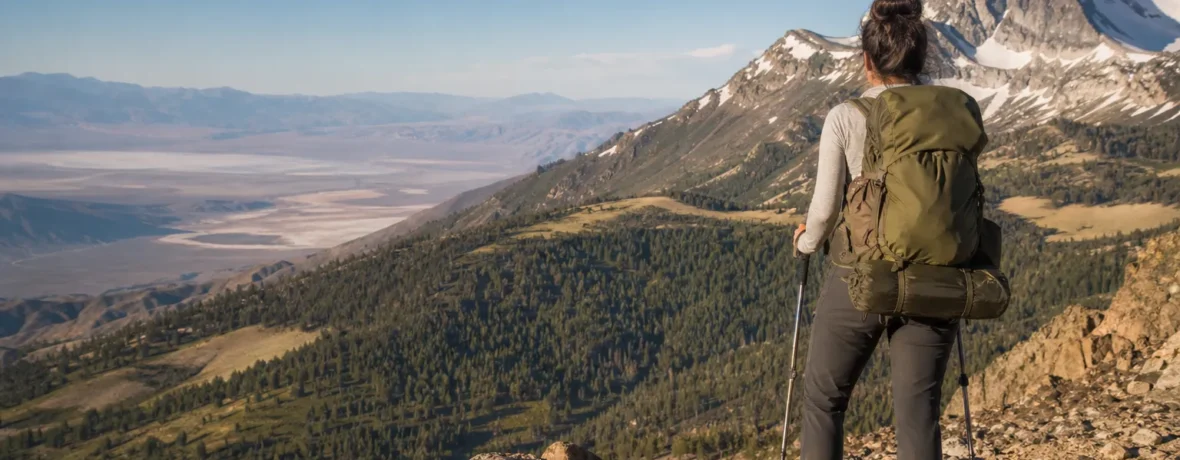
Most hikers can cover 5 to 12 miles [8 to 19 km] in a day. Fit, prepared hikers often reach 12 to 20 miles [19 to 32 km]. On steep, rough, hot, snowy, or high-altitude trails, daily mileage can drop to 3 to 8 miles [5 to 13 km]. That is the real answer to how far can you hike in a day.
How far can you hike in a day?
A realistic day hike for most people is 5 to 12 miles [8 to 19 km].
That range assumes you are carrying a day pack, starting in the morning, hiking on a marked trail, and taking normal breaks for water, snacks, photos, layers, and map checks. If you are new to hiking, 5 miles [8 km] can feel like a full day. If you hike often and move well on uneven ground, 12 miles [19 km] can feel steady instead of punishing.
Distance alone tells only half the story. A flat 10-mile [16 km] rail trail and a 10-mile [16 km] mountain route with 3,000 feet [914 m] of climbing are not the same hike. Your legs know the difference.
| Terrain | Realistic daily mileage | Typical moving pace | Why it changes fast |
|---|---|---|---|
| Flat, smooth trail | 8-18 miles [13-29 km] | 2-3 mph [3.2-4.8 km/h] | Few obstacles, easier footing |
| Rolling hills | 6-14 miles [10-23 km] | 1.8-2.5 mph [2.9-4 km/h] | Repeated climbs drain energy |
| Steep mountain trail | 4-10 miles [6-16 km] | 1-2 mph [1.6-3.2 km/h] | Elevation gain, switchbacks, descents |
| Loose rock, snow, mud, or off-trail | 2-8 miles [3-13 km] | 0.5-1.5 mph [0.8-2.4 km/h] | Slow footing and higher risk |
How many miles can you hike in a day as a beginner?
Most beginners should plan on 3 to 7 miles [5 to 11 km] for a first full day hike.
Pick the lower end if the trail is steep, rocky, exposed to sun, or far from help. Pick the higher end if the trail is smooth, close to town, and you already walk several miles during a normal week. Your first goal is not a heroic number. Your first goal is to finish with good knees, enough daylight, and enough energy to drive home safely.
A smart beginner hike has a simple route, clear trail signs, modest elevation gain, and an easy bailout point. Avoid stacking every challenge at once. Long distance plus heat plus big climb plus new boots is how a fun plan turns into a slow limp.
How much does elevation gain affect hiking mileage?
Elevation gain can cut your daily mileage by 25 to 50 percent.
A useful planning shortcut: add 30 minutes for every 1,000 feet [305 m] of climbing, then add more time if the trail is rough or the group is mixed. Downhill is not free, either. Long descents pound your quads, knees, toes, and balance. On loose dirt or talus, downhill can be slower than climbing.
For a moderate hiker, 8 miles [13 km] with 500 feet [152 m] of gain may be a relaxed outing. Eight miles [13 km] with 3,500 feet [1,067 m] of gain is a mountain day. Same mileage. Different animal.
What hiking pace should you use to plan your day?
Use 2 mph [3.2 km/h] as a starting pace, then adjust for terrain, elevation, weather, and pack weight.
Fast hikers on easy ground may move at 3 mph [4.8 km/h]. Many groups average 1.5 to 2 mph [2.4 to 3.2 km/h] once breaks are included. On steep, rocky, snowy, or high-altitude trails, 1 mph [1.6 km/h] can be honest progress.
The National Park Service recommends tracking time and distance, setting a turnaround time, and letting the slowest hiker set the pace on group hikes in its Hike Smart guidance.
How do you calculate a realistic hiking day?
Build your plan from time, not ego.
- Check total distance. Count the full out-and-back or loop, not just the distance to the viewpoint.
- Add elevation gain. Treat every 1,000 feet [305 m] of climb as a real time cost.
- Estimate moving pace. Start with 2 mph [3.2 km/h] on moderate trail, 1 mph [1.6 km/h] on hard mountain terrain.
- Add break time. Plan 10 minutes per hour for water, snacks, layers, photos, and map checks.
- Set a turnaround time. If you are not where you planned to be by that time, turn around. No debate.
- Keep a daylight buffer. Aim to finish with at least 60 minutes of daylight, even if you carry a headlamp.
Example: a 10-mile [16 km] hike with 2,000 feet [610 m] of gain on a rocky mountain trail may take 6 to 8 hours for many hikers once breaks are included. That is not slow. That is normal mountain math.
What factors reduce how far you can hike in a day?
The biggest mileage killers are heat, steep climbing, rough footing, pack weight, and poor pacing.
- Heat: Hot weather raises effort and increases the need for rest. Learn the signs of heat illness from the CDC heat-related illness guide.
- Altitude: Above 8,000 feet [2,438 m], many hikers move slower and breathe harder. MedlinePlus explains symptoms and warning signs in its acute mountain sickness overview.
- Pack weight: A heavy backpack changes your stride, balance, and downhill comfort.
- Trail surface: Roots, loose rock, mud, sand, snow, and stream crossings all slow you down.
- Navigation: Confusing junctions and off-trail sections eat time.
- Group size: A group moves at the speed of its slowest hiker, plus extra time for breaks and regrouping.
How far can fit hikers and backpackers go in one day?
Fit hikers can often cover 15 to 25 miles [24 to 40 km] in a long day on friendly terrain.
That does not mean everyone should chase those numbers. Big-mile days require durable feet, practiced fueling, efficient breaks, good navigation, and a pack that does not fight you all day. Backpackers carrying overnight gear usually move slower than day hikers, even when they are strong.
On maintained trail, an experienced backpacker may plan 10 to 18 miles [16 to 29 km] per day. In high mountains, desert heat, wet brush, or snow travel, that plan may shrink to 5 to 10 miles [8 to 16 km]. Mileage is not a badge. It is a tool.
What should you pack for a longer day hike?
Pack for the hike taking longer than planned.
- Map, downloaded offline map, and a backup navigation method
- Headlamp with charged batteries
- Extra water and a way to filter or treat more
- Salty snacks and quick calories
- Rain shell, warm layer, and sun protection
- First-aid kit with blister care
- Emergency shelter or bivy
- Whistle, lighter, and repair tape
- Tick protection in brushy or wooded areas; the CDC recommends preventing tick bites, walking near the center of trails, and checking for ticks after being outdoors in its tick prevention guidance
When to see a doctor
Seek medical help right away for confusion, fainting, severe shortness of breath, chest pain, severe headache, repeated vomiting, seizure, loss of consciousness, or symptoms that worsen instead of improving.
Heat stroke is a medical emergency; the CDC lists confusion, slurred speech, loss of consciousness, and hot skin among danger signs. If heat illness is suspected, stop hiking, cool the person, and get emergency help.
Do not try to self-diagnose altitude illness, dehydration, or low blood sodium on the trail. Symptoms can overlap. Mayo Clinic lists confusion, seizures, lost consciousness, nausea, vomiting, headache, cramping, and weakness as possible warning signs of hyponatremia, which needs medical evaluation.
Related reading
- Las Vegas to Zion: Distance, Drive and Day-Trip Plan
- Glacier to Yellowstone Road Trip: Distance and Route
- Seattle to Olympic National Park: Routes and Ferries
- How Far Is 10,000 Steps in Miles and on Trails?
FAQ
Can you hike 20 miles [32 km] in a day?
Yes, but 20 miles [32 km] is a long day for most hikers. It is realistic on smoother trails for fit hikers who start early, manage food and water well, and keep breaks efficient.
Is 10 miles [16 km] a hard hike?
Ten miles [16 km] can be moderate or hard depending on elevation gain and trail surface. A flat 10 miles [16 km] is very different from a rocky mountain 10 miles [16 km] with thousands of feet of climbing.
How long does a 5-mile [8 km] hike take?
A 5-mile [8 km] hike usually takes 2 to 3 hours on easy to moderate terrain. Add time for steep climbs, rough footing, heat, photos, and longer rest stops.
How many miles should I hike per day on a backpacking trip?
Many backpackers plan 8 to 15 miles [13 to 24 km] per day on maintained trails. Choose the lower end if you are new, carrying a heavy pack, hiking at altitude, or planning big elevation gain.
What is a good hiking distance for kids?
A good starting distance for kids is 1 to 4 miles [1.6 to 6 km], depending on age, terrain, weather, and motivation. Shorter hikes with snacks, water breaks, and something fun to reach usually beat forced mileage.