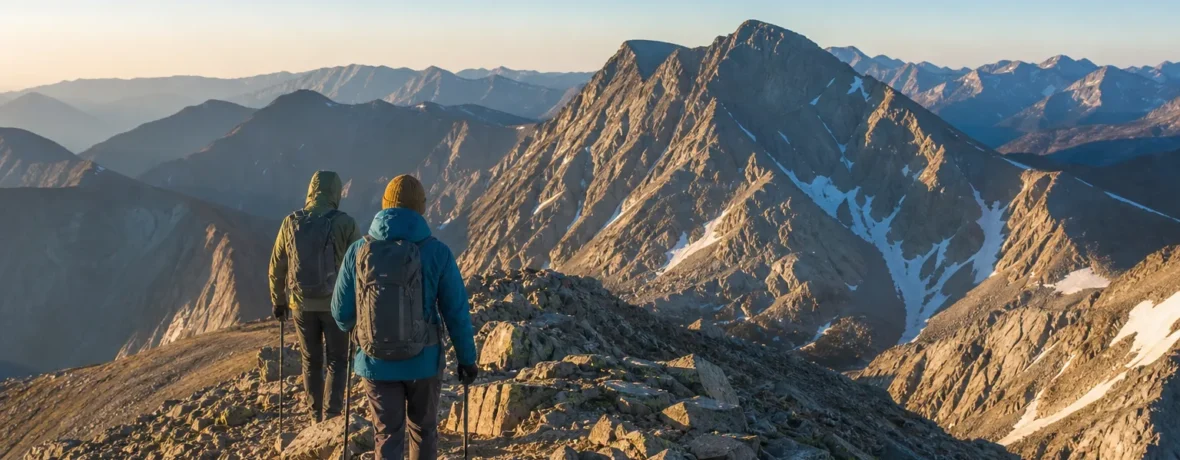
A 14er hike is a climb to the summit of a mountain at least 14,000 feet [4,267 meters] above sea level. In Colorado, that usually means a steep, high-altitude day hike with thin air, fast-changing weather, and serious exposure. You can do one safely if you choose the right route, start early, and turn around when conditions say so.
What is a 14er hike?
A 14er hike is a hike to the top of a 14,000-foot mountain.
That sounds simple. It is not always simple on the ground. A Colorado fourteener can be a walk-up on a maintained trail, a loose scree grind, a hands-and-feet scramble, or a technical climb that needs a rope. The number alone tells you the summit is high. It does not tell you the route is easy.
Colorado has 58 named peaks over 14,000 feet [4,267 meters] by the commonly used count, according to the Colorado Fourteeners Initiative. Some lists count fewer “ranked” summits because mountaineers often use 300 feet [91 meters] of topographic prominence to decide what counts as an independent peak.
Why are Colorado’s fourteeners such a big deal?
They pack big-mountain terrain into reachable day-hike objectives.
Colorado has more 14ers than any other state in the Lower 48, and many trailheads sit within a few hours of Denver, Colorado Springs, Buena Vista, Leadville, Aspen, or Telluride. That access is part of the appeal. You can leave a trailhead in the dark, stand on a summit above 14,000 feet before lunch, and be back in town for dinner.
But popularity can fool you. A busy trail is still a mountain trail. The summit is still cold, windy, and exposed. Thunderstorms still build fast. The air still has less oxygen than you are used to at lower elevations.
How hard is a 14er hike?
A 14er hike is hard because of elevation, gain, distance, terrain, and weather.
Some first-timer routes are non-technical trails. Others cross loose rock, steep gullies, snowfields, or knife-edge ridges. Do not choose by summit fame alone. Choose by the route.
| Factor | What it means for you | Why it matters |
|---|---|---|
| Elevation | You climb above 14,000 feet [4,267 meters] | Thin air makes every step feel harder |
| Elevation gain | Many routes climb thousands of vertical feet | Your legs and lungs work the whole day |
| Route class | Class 1 is easiest; Class 5 is technical climbing | Scrambling and exposure change the risk fast |
| Weather | Wind, hail, lightning, and snow can hit above treeline | There may be nowhere safe to hide |
The Yosemite Decimal System is the common route-rating language. For hikers, Class 1 means a clear trail. Class 2 may involve rough trail, talus, or route-finding. Class 3 means you use your hands for scrambling. Class 4 is steeper, more exposed scrambling where a fall can be serious. Class 5 is roped technical climbing.
What should you know before hiking your first 14er?
Pick a beginner-friendly route and treat it like a serious mountain day.
Your first 14er should not be the one with the wildest photos. It should be the one with the clearest route, stable forecast, reasonable distance, and an easy bail-out if your body or the sky says no.
- Choose the route, not just the peak. One mountain can have an easier hiking route and a dangerous climbing route.
- Check current trailhead access. Dirt roads, seasonal gates, private land issues, and parking rules change. Use the current land manager page when planning.
- Read recent condition reports. Snow, ice, mud, downed trees, and rockfall can change the hike even in summer.
- Start before sunrise. On many summer days, you want to be descending before afternoon storms build.
- Set a turnaround time. The summit is optional. Getting down is not.
- Stay on durable surfaces. Alpine tundra is fragile. Cut switchbacks and you damage the place you came to enjoy.
What do you need to pack for a 14er?
You need gear for cold, sun, storms, injury, and a slower-than-planned descent.
A bluebird morning can turn ugly at 13,000 feet [3,962 meters]. Pack for the mountain you might get, not the trailhead weather you like.
- Backpack with enough room for layers
- Rain shell or waterproof jacket
- Warm layer, hat, and gloves
- Sun hoodie or long sleeves, sunglasses, sunscreen, and lip balm
- Headlamp with fresh batteries
- Map, compass, GPS app, or downloaded route
- First-aid kit and blister care
- Plenty of water and a way to treat more
- Salty snacks and easy calories
- Trekking poles if your knees like help on descents
- Emergency blanket or lightweight bivy
- Traction, ice axe, or helmet when conditions and route call for them
The National Park Service’s Ten Essentials is a solid baseline for backcountry day hikes. For 14ers, add altitude awareness, storm timing, and route-specific gear.
Can beginners hike a 14er?
Yes, beginners can hike a 14er if they are fit, prepared, acclimated, and choose an easier route in good conditions.
Beginner does not mean unprepared. Before your first 14er, you should be comfortable hiking for several hours, climbing sustained uphill grades, descending on tired legs, and making decisions without cell service. A shorter local trail does not fully prepare you for altitude, but it does build the engine.
Spend time at higher elevation before summit day if you can. Sleep in a mountain town the night before. Do an easier acclimatization hike. Drink regularly, eat early, and do not sprint out of the trailhead because three people passed you in the dark.
What are the main risks on a 14er?
The main risks are altitude illness, lightning, falls, getting off-route, and underestimating the descent.
Altitude illness can affect hikers who ascend quickly to high elevations. The CDC guidance on high-altitude travel says people with altitude illness should not continue higher until symptoms are gone. Headache, nausea, dizziness, unusual fatigue, and poor coordination are warning signs to take seriously.
Lightning is another big one. Above treeline, you may be the tallest object around. Watch the forecast, watch the sky, and move down early if clouds build vertically or you hear thunder.
Route-finding mistakes also stack up fast. A wrong gully can turn a hike into a scramble. A loose shortcut can knock rocks onto people below. Keep checking your route before you are forced to fix a mistake on exposed terrain.
When to see a doctor
See a doctor before hiking a 14er if you have heart, lung, blood, or major medical concerns, or if you have had altitude illness before.
Do not use a mountain day to test a health problem. Talk with a clinician before the trip if you are pregnant, have a chronic condition, take medications that affect breathing or hydration, or have had severe symptoms at altitude. The CDC Yellow Book on altitude illness gives medical guidance for high-elevation travel.
During or after a hike, get urgent medical help for confusion, trouble walking straight, shortness of breath at rest, chest pain, blue lips, coughing up frothy fluid, fainting, or symptoms that worsen instead of improve after descending. Do not diagnose yourself on the trail. Descend, get help, and let medical professionals handle the rest.
How do you plan a safe 14er day?
Plan backward from the weather, your pace, and your turnaround time.
A clean plan beats summit fever. Here is a simple structure that works:
- Pick the exact route. Know the trailhead, mileage, elevation gain, class rating, and escape options.
- Check three forecasts. Look at the town, the mountain zone, and the summit or point forecast when available.
- Set a start time. Many hikers start in the dark during summer to avoid afternoon storms.
- Set a turnaround time. If you are not on or near the summit by then, head down.
- Tell someone your plan. Include trailhead, route, party size, vehicle, and expected return time.
- Reassess all day. Wind, clouds, pace, nausea, snow, and loose rock are data. Use them.
Before you go, review stewardship advice from the Colorado Fourteeners Initiative education resources. These peaks get heavy use, and your choices matter: stay on trail, pack out trash, respect closures and private property, and give wildlife room.
Related reading
- How to Train for a 14er
- How Long Is the Appalachian Trail? Miles, States and Time
- How to Plan a Camping Trip
- Where Does the Appalachian Trail Start and End?
FAQ
What does 14er mean?
A 14er is a mountain with a summit at least 14,000 feet [4,267 meters] above sea level. In Colorado, “fourteener” and “14er” mean the same thing.
How many 14ers are in Colorado?
Colorado has 58 named 14ers by the commonly used list. Some mountaineering lists count 53 ranked 14ers because they require at least 300 feet [91 meters] of prominence.
How long does a 14er hike take?
A 14er hike often takes most of a day. Your time depends on mileage, elevation gain, altitude, trail condition, weather, group pace, and how long you spend above treeline.
Do you need climbing gear for a 14er?
Not for every 14er. Many standard routes are hikes in dry summer conditions, but harder routes may require a helmet, traction, ice axe, rope, or technical climbing skills.
What is the best first 14er?
The best first 14er is an easier Class 1 or Class 2 route with current safe conditions and a stable forecast. Do not pick only by popularity; pick by route difficulty, trailhead access, and your fitness.
Can you get altitude sickness on a 14er?
Yes, you can get altitude sickness on a 14er. If you develop concerning symptoms, stop ascending, descend if symptoms worsen, and seek medical help for severe or unusual symptoms.