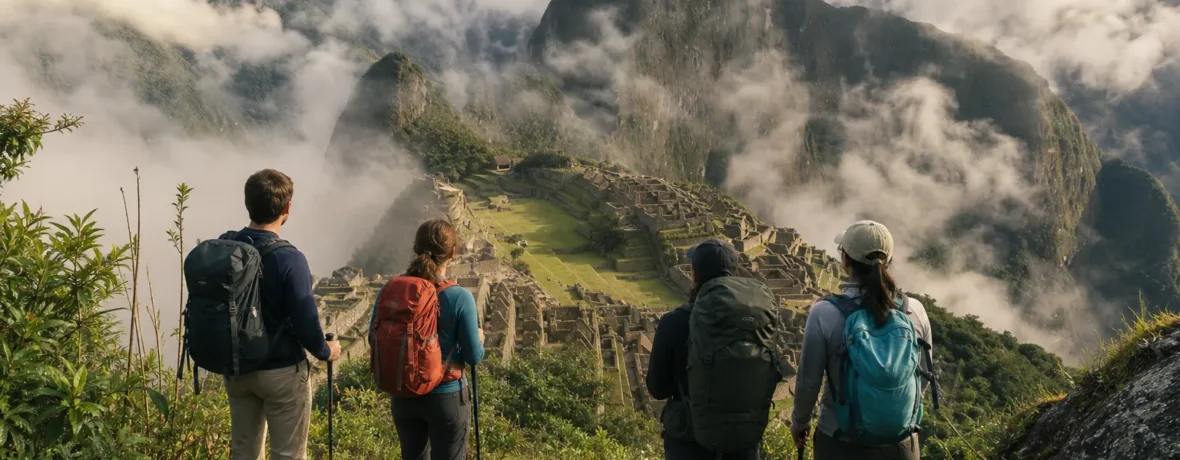
It depends on your route: the Classic Inca Trail takes 4 days over 26 miles [42 km], the Short Inca Trail takes 1–2 days, and alternative treks usually take 4–8 days before you reach Machu Picchu by train, bus, or foot.
How long is the hike to Machu Picchu on the Inca Trail?
The Classic Inca Trail is a 4-day, 26-mile [42 km] trek to Machu Picchu.
This is the route most hikers picture: stone steps, cloud forest, high passes, Inca ruins, tent camps, and a final approach through Intipunku, the Sun Gate. It starts near Km 82, close to Piscacucho, and ends at Machu Picchu itself.
The hiking time is usually split like this:
- Day 1: Km 82 to the first camp area, usually a moderate hiking day with warm-up terrain.
- Day 2: The hardest day, crossing Dead Woman’s Pass at 13,828 feet [4,215 m].
- Day 3: A long, scenic day with ruins, cloud forest, and more stone stairs.
- Day 4: Early start to the Sun Gate, then down into Machu Picchu for the site visit.
You cannot just show up and hike it independently. The Inca Trail is controlled, guided, and permit-based. The official Machu Picchu site also uses fixed visit circuits inside the archaeological site; as of November 2026, the Ministry of Culture lists 3 main circuits and 10 routes for the Inka city of Machu Picchu on its official circuits and routes page.
How long does it take to hike Machu Picchu on each route?
It takes 1 to 8 days, depending on the route you choose.
Here’s the clean comparison. Distances vary slightly by operator, camp location, and side trips, but the day counts are the part that should drive your planning.
| Route | Typical time | Best for | How you reach Machu Picchu |
|---|---|---|---|
| Classic Inca Trail | 4 days | First-timers who want the famous trail | On foot via the Sun Gate |
| Short Inca Trail | 1–2 days | Hikers short on time | On foot via the Sun Gate |
| Salkantay Trek | 4–5 days | Big mountain scenery | Train/bus or final walk from Aguas Calientes |
| Lares Trek | 3–4 days | Villages, culture, quieter trails | Train/bus from the Sacred Valley |
| Choquequirao to Machu Picchu | 7–8 days | Strong hikers who want a serious trek | Usually train/bus after the trek |
| Hike from Aguas Calientes | 1.5–2 hours one way | Adding a steep morning climb | On foot up the access road stairs |
If you want the classic “I hiked into Machu Picchu” feeling, pick the Inca Trail or Short Inca Trail. If you want wilder mountain terrain, pick Salkantay. If you want fewer crowds and Andean villages, look at Lares. If you want a hard, long-distance challenge, Choquequirao is the beast.
Can you hike to Machu Picchu in one day?
Yes, but only on specific versions of the trip.
The one-day option is usually the Short Inca Trail. You start at Km 104, hike past Chachabamba and Wiñay Wayna, climb toward the Sun Gate, and continue to Machu Picchu. Many itineraries visit the archaeological site the next morning, turning the trip into a 2-day plan with one real hiking day.
You can also hike from Aguas Calientes, also called Machu Picchu Pueblo, up to the entrance gate. That walk is not a trek through the Andes. It is a steep stair climb that gains roughly 1,300 feet [400 m] from town to the site entrance. Most fit hikers take 1.5 to 2 hours uphill and less time down.
That town-to-gate hike is useful if you want to skip the bus or add effort to your visit. It does not replace the Inca Trail.
Is the Inca Trail harder than Salkantay?
Salkantay is usually harder, but the Inca Trail can feel tougher underfoot.
The Salkantay Trek climbs higher, often crossing Salkantay Pass at 15,090 feet [4,600 m]. That elevation is no joke. The air is thin, the weather can swing fast, and the climb demands steady lungs and legs.
The Inca Trail’s top point, Dead Woman’s Pass, sits lower at 13,828 feet [4,215 m], but the trail has thousands of stone steps. Downhill sections can hammer your knees. The tread is uneven. Rain makes rock slick. You need balance, not just fitness.
Pick based on your weak point:
- Choose the Inca Trail if you want ruins, history, and the iconic arrival at the Sun Gate.
- Choose Salkantay if you want glaciers, bigger mountains, and a more rugged trekking feel.
- Choose Lares if you want less traffic and more time around local communities.
- Choose the Short Inca Trail if you can handle a strong day hike but do not want 4 days on trail.
Do you need a permit to hike to Machu Picchu?
Yes for the Inca Trail; not always for alternative treks, though Machu Picchu entry still requires an official ticket.
The Classic and Short Inca Trail routes are regulated routes through the protected Inka road network. You need to go with an authorized operator, and your operator handles the trail permit process. Independent hiking is not allowed on those routes.
Alternative treks such as Salkantay and Lares do not enter the Inca Trail in the same way, but you still need a Machu Picchu entrance ticket for your visit day. Your allowed path inside the site depends on the circuit and route printed on your ticket. Check the official Machu Picchu circuits and routes before you book, because the ticket route affects what you can see once you arrive.
The Inca Trail also closes for annual maintenance. As of January 2026, Peru’s SERNANP announced that access to the Inka Trail network in the Historic Sanctuary of Machu Picchu would close for the full month of February 2026 and reopen March 1, 2026, on its official closure notice. Weather, landslides, strikes, or safety issues can also close routes, so check official sources and your operator before you travel.
Which Machu Picchu hike is best if you only have a few days?
The Short Inca Trail is the best fit if you have 2 days and still want to hike into Machu Picchu.
It gives you the big payoff without the 4-day commitment: Inca ruins, cloud forest, a real trail day, and the Sun Gate approach. You still need permits and a guide, but you skip the long camping itinerary.
If you have only 1 full day in the area, stay in Aguas Calientes the night before, enter Machu Picchu early, and hike down afterward if your knees are happy. If you have 3–4 days and want a quieter trip, Lares is a strong choice. If you have 5 days and want drama, Salkantay brings the mountains.
How hard is the hike to Machu Picchu?
The hike ranges from moderate to very hard, depending on the route, elevation, and your pace.
Do not judge these treks by mileage alone. A 7-mile [11 km] day in the Andes can feel heavier than a 12-mile [19 km] day near sea level. Elevation changes the whole deal. Cusco sits near 11,000 feet [3,350 m], and many trekking routes go higher than that before dropping toward Machu Picchu.
The CDC says travelers going above 8,000 feet [2,438 m] can be at risk for altitude illness, and its high-altitude travel guidance recommends gradual ascent when possible. For Peru specifically, the CDC notes that Cusco and treks in the Andes can put travelers at risk for acute mountain sickness and more severe altitude illness; see its Peru travel health guidance.
Expect the main challenges to be:
- Altitude: Shortness of breath, poor sleep, headache, and slow climbing pace can happen even if you are fit.
- Stairs: The Inca Trail is famous for stone steps, both up and down.
- Weather: Rain, cold mornings, strong sun, and mud can all show up on the same trip.
- Pack weight: Daypacks feel heavier at elevation. Keep yours tight and simple.
- Recovery: Multi-day hiking wears down calves, hips, knees, and patience.
How should you train for the hike to Machu Picchu?
Train for sustained climbing, long descents, and back-to-back hiking days.
You do not need to be an elite athlete. You do need legs that can climb for hours, knees that can handle stairs, and lungs that do not panic when the trail points up. Start 8–12 weeks before your trip if you can.
- Hike weekly with hills. Build toward 6–10 miles [10–16 km] with a loaded daypack.
- Use stairs. The Inca Trail has long stone stair sections, so stadium steps, stair machines, and steep neighborhood climbs help.
- Train descents. Downhill hiking stresses knees and quads. Practice controlled steps, not just uphill grinding.
- Add strength work. Squats, step-ups, lunges, calf raises, and core work pay off fast.
- Walk on tired legs. Do two hikes on back-to-back days before your trip.
- Break in footwear. Bring shoes or boots you already trust. New boots on wet stone are a bad bet.
What should you pack for a Machu Picchu trek?
Pack light, but do not pack lazy.
Your operator will usually carry group camping gear on multi-day treks, and many trips include porters, mule support, or duffel transport depending on the route. Your daypack still matters. It should carry what you need between breakfast and camp, or between the trailhead and Machu Picchu.
- Broken-in hiking shoes or boots with good traction
- Rain jacket and pack cover
- Warm layer for cold mornings and high passes
- Sun hat, sunglasses, and sunscreen
- Water bottles or hydration bladder
- Trail snacks you already know you can eat while climbing
- Headlamp for early starts
- Trekking poles with rubber tips if your operator allows them
- Small first-aid kit and blister care
- Passport, trail documents, entry ticket details, and cash in Peruvian soles
Skip bulky extras. The lighter your pack, the better your day will feel at 12,000 feet [3,658 m].
When is the best time to hike to Machu Picchu?
May through September gives you the driest trekking conditions.
That is also the busiest season, so permits and tickets can sell out earlier. April and October can be excellent shoulder months, with greener landscapes and fewer people than peak dry season. November through March is wetter, with mud, clouds, and higher disruption risk.
February is the month to watch closely. The Inca Trail network has an annual maintenance closure, and in 2026 the official closure ran through February. Machu Picchu itself may still be open during trail maintenance, but the trek routes can be unavailable. Always separate two questions: “Is Machu Picchu open?” and “Is my hiking route open?” They are not the same thing.
When to see a doctor
See a doctor before the trip if you have heart disease, lung disease, sleep apnea, sickle cell trait, pregnancy concerns, or a history of altitude illness.
You should also get medical help during travel if you develop severe headache, confusion, trouble walking straight, shortness of breath at rest, chest tightness, blue lips, or a cough that worsens at altitude. Do not try to “push through” serious altitude symptoms. Descending and getting medical care can be urgent.
For pre-trip planning, use the CDC’s altitude guidance and talk with a clinician who understands high-altitude travel. This is not a place for guesswork, especially if your itinerary jumps from Lima at sea level to Cusco near 11,000 feet [3,350 m].
So, which route should you choose?
Choose the route that matches your time, fitness, and reason for going.
If this is your one shot at the legendary trail, book the Classic Inca Trail and give it 4 days. If you want the Sun Gate but not the full trek, book the Short Inca Trail. If mountain scenery matters more than ruins along the way, go Salkantay. If you want a quieter cultural route, choose Lares. If you want a hard expedition-style trip, look at Choquequirao to Machu Picchu.
The best Machu Picchu hike is not the longest one. It is the one you can enjoy while still having enough energy to stand there at the end, look over the terraces, and feel the day land.
Related reading
- How Much Does It Cost to Hike Machu Picchu?
- Machu Picchu Tickets: Circuits and Entry Rules
- How Long Is the Appalachian Trail? Miles, States and Time
- How to Plan a Camping Trip
FAQ
How many miles is the Inca Trail to Machu Picchu?
The Classic Inca Trail is 26 miles [42 km]. Most hikers complete it in 4 days, with the hardest climbing day usually on Day 2 over Dead Woman’s Pass.
Can beginners hike to Machu Picchu?
Yes, beginners can hike to Machu Picchu if they train and choose the right route. The Short Inca Trail or Lares Trek is usually more forgiving than Salkantay or Choquequirao.
Can you hike Machu Picchu without a guide?
You cannot hike the Inca Trail without a licensed guide and authorized operator. You can walk from Aguas Calientes to the Machu Picchu entrance independently, but you still need a valid entry ticket for the site.
How long is the walk from Aguas Calientes to Machu Picchu?
The uphill walk from Aguas Calientes to the Machu Picchu entrance usually takes 1.5 to 2 hours. It is a steep stair-and-road climb, not a wilderness trek.
Is the 4-day Inca Trail worth it?
Yes, if you want the historic route, ruins along the trail, camps in the mountains, and the Sun Gate arrival. If you dislike camping or have limited time, the Short Inca Trail may be the better fit.
What is the easiest hike to Machu Picchu?
The easiest hiking option is the walk from Aguas Calientes to the entrance gate, though it is still steep. For a true trail experience, the Short Inca Trail is the shortest guided route that reaches Machu Picchu on foot.