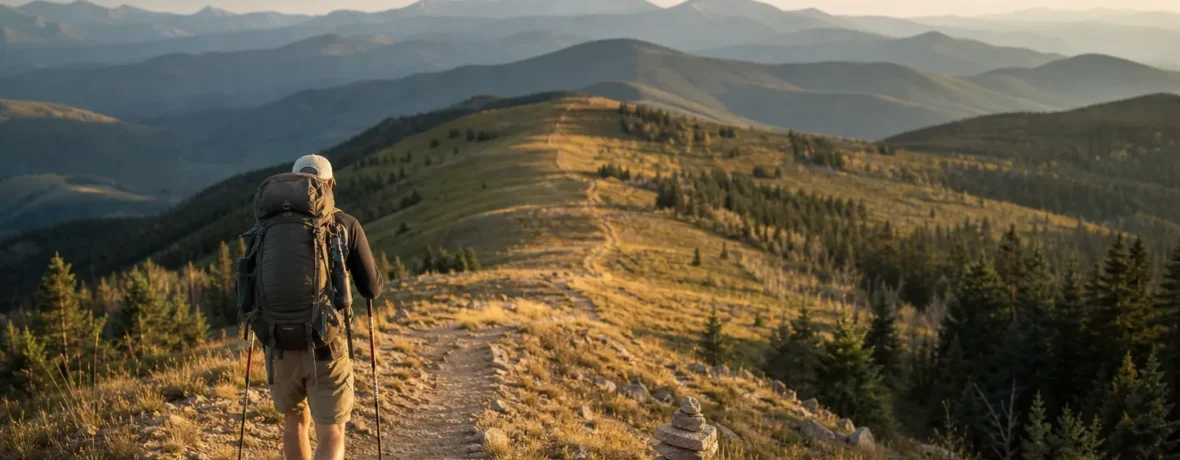
What is thru hiking? It is hiking an entire long-distance trail in one continuous trip, usually hundreds to 3,000+ miles [4,828+ km]. A thru-hike can take two weeks on a short route or five to seven months on a major trail, depending on distance, weather, permits, pace, and your body.
What is thru hiking on a long-distance trail?
Thru-hiking is end-to-end backpacking with a defined start, finish, and route.
You carry what you need, walk most days, sleep outside or in simple trail shelters, and resupply in towns along the way. The point is not one epic weekend. It is stringing together day after day until the whole trail is done.
On some trails, “continuous” means one season with pauses for rest, weather, injury, or logistics. On others, hikers debate the finer points: blue blazes, road walks, alternate routes, fire closures, flip-flops, and skipped miles. Do not get trapped there on day one. Start with the plain meaning: you are trying to walk the full trail, not sample it.
What is a thru hike?
A thru hike is the full trip: the route, the walking, the nights out, the town stops, and the finish.
The phrase usually applies to named long trails such as the Appalachian Trail, Pacific Crest Trail, Continental Divide Trail, Long Trail, Colorado Trail, or Arizona Trail. The length can vary wildly. A 272-mile [438 km] trail and a 3,100-mile [4,989 km] trail can both be thru-hiked, but they ask for very different time, money, weather strategy, and mental grit.
Here is how the common hiking styles stack up:
| Hiking style | What you complete | Typical time frame | Main challenge |
|---|---|---|---|
| Day hike | One trail or loop | Hours | Timing, weather, water |
| Overnight backpack | A short route or section | 1-3 nights | Carrying sleep gear and food |
| Section hike | A long trail in pieces | Months or years | Travel logistics |
| Thru-hike | The full trail in one trip | Weeks to months | Consistency, recovery, resupply |
How long does a thru-hike take?
A major U.S. thru-hike usually takes several months.
Distance is only one part of the clock. You also lose days to storms, snow, heat, swollen creeks, permits, blisters, town chores, gear repairs, and the occasional need to eat two dinners and stare at a laundromat wall.
As of November 2026, the Appalachian Trail Conservancy lists the 2026 Appalachian Trail length as 2,197.9 miles [3,537 km] and says a thru-hike typically takes six months. The Continental Divide Trail Coalition describes the CDT as 3,100 miles [4,989 km] between Mexico and Canada. That is why a “20-mile day” sounds simple on paper and feels very different after week eight.
A useful planning range:
- Short thru-hike under 100 miles [161 km]: 3-7 days for many fit backpackers.
- Medium trail, 100-500 miles [161-805 km]: 1-5 weeks.
- Long trail, 500-1,000 miles [805-1,609 km]: 1-3 months.
- Major national trail, 2,000+ miles [3,219+ km]: 5-7 months.
How do thru-hikers plan mileage each day?
You plan mileage by matching terrain, daylight, pack weight, water, and recovery.
New thru-hikers often obsess over daily averages. Fine. Numbers help. But the trail does not care about your spreadsheet. A flat 18 miles [29 km] can feel easy. A rocky 9 miles [14 km] with 4,000 feet [1,219 m] of climbing can chew up the same daylight.
Most hikers start lower, then build. The first two weeks are not the place to prove toughness. They are where feet harden, shoulders adapt, routines settle, and the body learns that tomorrow is not a rest day.
Use this simple approach:
- Pick your finish window based on weather and trail access.
- Divide total miles by available hiking days, not calendar days.
- Add zero days for rest, laundry, storms, and injury prevention.
- Check where water and legal campsites actually are.
- Rework the plan every few days as conditions change.
Do you need permits for a thru-hike?
Sometimes yes, and the answer changes by trail and land manager.
Long trails cross national parks, national forests, state lands, wilderness areas, tribal lands, towns, roads, and private easements. One trail can have several permit systems. Do not assume a social media comment covers your route.
As of November 2026, the Pacific Crest Trail Association says its PCT Long-distance Permit is for trips of 500 or more continuous miles [805 km] in a single trip, and permits are required in some, not all, areas along the PCT. As of November 2026, the CDT Coalition says hikers planning the full CDT should plan for permits including Blackfeet Nation recreation permission plus Yellowstone and Glacier backcountry camping permits.
Read the official trail association page first, then check the land agencies for the exact year you hike. Fire closures, flood damage, reroutes, reservation systems, and campsite rules can change fast.
How does resupply work on a thru-hike?
Resupply means getting more food, fuel, and basics before you run out.
You do not carry five months of meals from the start. You carry a few days, hike to a road or town, reload, and keep going. Some towns have full grocery stores. Others have a gas station with tortillas, peanut butter, instant noodles, and one heroic freezer full of burritos.
Common resupply methods include:
- Buying food in trail towns.
- Mailing boxes to post offices, hostels, or outfitters.
- Sending special items such as shoes, medication, maps, or dietary food.
- Combining town food with mailed boxes for remote stretches.
Do not overbuild the whole food plan from home. Your appetite will change. Foods you love in week one may disgust you by week four. Keep the plan flexible.
What gear do you need for thru-hiking?
You need reliable backpacking gear that you can carry all day.
The best thru-hiking kit is not the fanciest kit. It is the one that keeps you warm, dry, fed, hydrated, and moving without grinding your knees into dust. Weight matters because you lift it thousands of times with every climb, descent, and awkward step over deadfall.
Start with this checklist:
- Backpack that fits your torso and total load.
- Shelter: tent, tarp, hammock, or trail shelter plan.
- Sleep system rated for expected lows.
- Stove, pot, lighter, food bag, and odor control.
- Water filter, bottles, and extra capacity for dry stretches.
- Rain jacket, insulation, hiking layers, socks, and sleep clothes.
- Navigation: phone maps, backup power, and paper backup where smart.
- First-aid basics, blister care, sun protection, and headlamp.
What can end a thru-hike early?
The usual hike-enders are injury, money, weather, time, and morale.
Most hikers picture dramatic problems: bears, lightning, cliffs. Those matter. But the quiet killers are more common: infected blisters, shin pain, overuse injuries, loneliness, poor sleep, bad budgeting, and pushing too hard too soon.
Protect the hike by staying boringly consistent. Eat enough. Treat water. Dry your feet. Check for ticks. Stretch if it helps you. Sleep whenever you get the chance. The CDC recommends preventing tick bites with repellents, treated clothing, body checks, and prompt tick removal, especially in regions where Lyme disease occurs.
When to see a doctor
Get medical help fast for severe, worsening, or unusual symptoms on trail.
Do not try to tough out chest pain, trouble breathing, confusion, fainting, severe allergic reactions, spreading redness around a wound, fever with a bad bite, or symptoms that keep getting worse after rest. For heat illness, the CDC describes heat stroke signs such as confusion, altered mental status, slurred speech, seizures, and loss of consciousness as a medical emergency.
This is not a diagnosis. If your body is sending loud warning signals, stop hiking, get to shade or shelter if you can, contact emergency services, and use your satellite messenger or phone when service allows.
How do you start planning your first thru-hike?
Pick the right trail, then build the trip around time, fitness, and season.
Your first thru-hike does not need to be a 2,000-mile monster. A shorter trail teaches the same core skills: pacing, camping, resupply, weather calls, foot care, and the mental rhythm of waking up and walking again.
- Choose a trail that fits your available time.
- Study the season: snow, heat, monsoon storms, bugs, and hunting dates.
- Check current permits and closures from official sources.
- Plan rough resupply points, not every snack.
- Train with the shoes, pack, and load you will use.
- Do a shakedown overnight before the real start.
- Begin slower than your ego wants.
Related reading
- Who Are Thru-Hikers? Inside Long-Trail Culture
- How Thru-Hikers Resupply
- How Long Is the Appalachian Trail? Miles, States and Time
- How to Plan a Camping Trip
FAQ
Is thru-hiking the same as backpacking?
No. Thru-hiking is a type of backpacking where you attempt an entire long-distance trail in one trip. A weekend backpacking trip uses many of the same skills but does not have the same sustained mileage, resupply rhythm, or finish goal.
Can a beginner do a thru-hike?
Yes, if the trail matches your fitness, time, and preparation. A shorter thru-hike is usually a smarter first target than a five-month national trail.
How many miles do thru-hikers walk per day?
Many hikers land somewhere between 10 and 25 miles [16-40 km] per hiking day, depending on terrain and experience. Early miles are usually lower; later miles often rise after legs, feet, and routines adapt.
Do thru-hikers camp every night?
No. Many camp most nights, but they may also sleep in shelters, hostels, motels, cabins, or trail-town lodging. The mix depends on the trail, budget, weather, and local rules.
Do you have to hike every single step for it to count?
That depends on the trail’s recognition rules and your own standard. Some hikers follow a continuous footpath mindset; others take official alternates or detours for closures, safety, or land rules.
What is the hardest part of thru-hiking?
The hardest part is repetition. One hard day is simple compared with doing laundry in a sink, eating enough, managing sore feet, packing up wet gear, and walking again for the 47th day in a row.