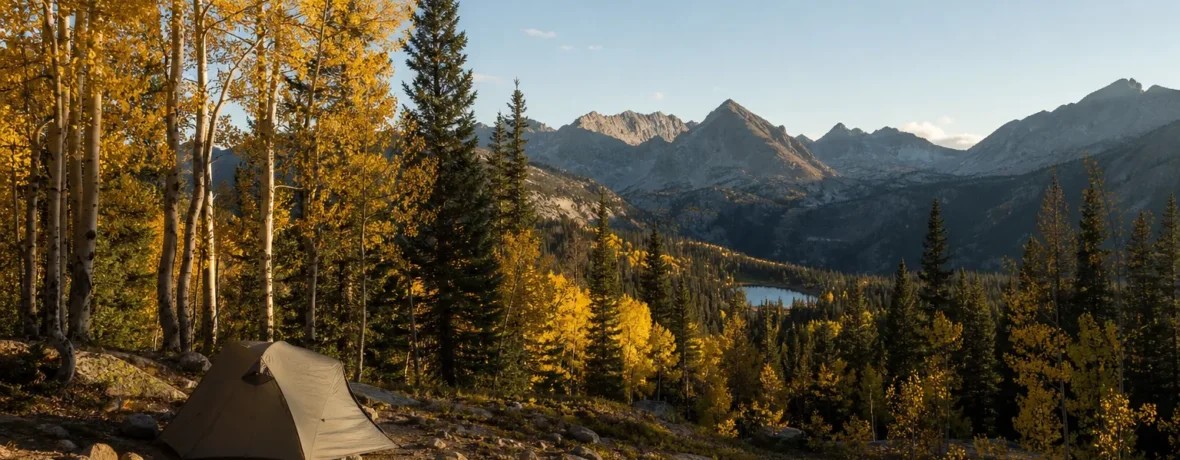
Dispersed camping in Colorado is legal on many National Forest and BLM lands, but not everywhere. As of November 2026, common limits are 14 days, camp at least 100 feet [30 m] from water in many forests, follow Motor Vehicle Use Maps, and obey all fire restrictions before you light anything.
Is dispersed camping legal in Colorado?
Yes, dispersed camping is legal in Colorado on many public lands, as long as the specific road, forest, district, or parcel allows it.
Most good sites sit on U.S. Forest Service land or Bureau of Land Management land. That does not mean every pullout is fair game. Colorado has private inholdings, wildlife closures, old mining claims, wilderness boundaries, county roads, state lands, and heavily used zones where camping is restricted to numbered sites.
The clean way to think of it: legal dispersed camping is camping outside a developed campground, on public land, in a place where overnight use is not closed or signed otherwise. No picnic table. No host. No water spigot. No trash can. Just you, your shelter, your food system, and your ability to leave the place looking untouched.
Before you drive in, confirm the land manager. National Forest, BLM, state wildlife area, state park, national park, county open space, and private land all play by different rules. If you cannot identify the manager, do not assume you can sleep there.
What are the Colorado dispersed camping rules as of November 2026?
The short version: stay within the posted limit, use legal roads, camp away from water, pack out everything, and move when your time is up.
Rules vary by forest and field office, but these are the ones you will run into again and again:
- Stay limits: On BLM-administered public land in Colorado, you may not camp longer than 14 days in any 30-day period at one location, and after reaching the limit you must move at least 30 air miles away, as of November 2026. Read the official BLM Colorado camping and occupancy regulations.
- Forest limits: On the Grand Mesa, Uncompahgre and Gunnison National Forests, dispersed campsites can be occupied for no more than 14 days, then moved at least 3 miles [4.8 km] away; camping is also limited to 28 days in a 60-day period, as of November 2026. See the Forest Service GMUG dispersed camping rules.
- Water setbacks: The same GMUG guidance says dispersed camping must not occur within 100 feet [30 m] of rivers, streams, ponds, or wetlands, as of November 2026.
- Vehicle access: Motor vehicles must stay on routes where motorized use is allowed. A legal-looking two-track can still be closed.
- Trash: Pack out all trash, food scraps, foil, cans, bottles, and broken gear. Do not burn garbage.
- Human waste: Use a toilet where one exists. Where allowed, bury waste in a cathole 6 to 8 inches [15 to 20 cm] deep and at least 200 feet [61 m] from water, camp, and trails.
- Fires: Check restrictions every trip. A cold spring weekend and a windy August weekend are not the same world.
Where is the best dispersed camping in Colorado?
The best areas are the ones that match your vehicle, season, hiking plan, and tolerance for rough roads.
Colorado is not one camping zone. The Front Range fills fast. The San Juans are steep and stormy. The Western Slope has desert heat, clay roads, and big views. High-elevation forests can hold snow well into early summer. Pick the region first, then the site.
| Area | Best for | Watch for |
|---|---|---|
| Grand Mesa, Uncompahgre and Gunnison National Forests | Lake basins, aspen, high-country hiking, cooler summer nights | Water setbacks, muddy roads, lightning, site-specific restrictions |
| San Juan National Forest | Big mountain scenery, backpacking access, fall color | Steep roads, monsoon storms, popular corridors near Durango and Silverton |
| Pike and San Isabel National Forests | Weekend trips from Denver or Colorado Springs | Crowds, fire restrictions, designated camping zones near busy roads |
| BLM land near Fruita, Grand Junction, and the Arkansas Valley | Shoulder-season camping, desert hikes, bike-and-hike trips | Heat, wind, cryptobiotic soil, limited shade, long distances between water sources |
If you want quiet, do not chase a viral pin. Look for legal spurs off less famous forest roads, then stop at an existing hardened site before you create a new scar. A flat dirt pad with an old rock fire ring is usually a better choice than a perfect meadow that has never been used.
Do you need a permit for dispersed camping in Colorado?
Usually no, but some Colorado public lands require permits, passes, reservations, or designated sites.
Most standard dispersed camping on National Forest and BLM land does not require a nightly camping permit. That changes fast in high-use areas, wilderness zones, state-managed lands, and national parks.
State Wildlife Areas are a common trap. They are not general free camping lands. Colorado Parks and Wildlife says visitors entering State Wildlife Areas must hold a current SWA pass or a valid hunting or fishing license, as of November 2026. Check the official Colorado State Wildlife Area rules and pass information before you plan to sleep anywhere near one.
National parks are different again. Rocky Mountain National Park requires a wilderness permit for overnight wilderness camping, and campfires are prohibited in wilderness campsites, as of November 2026. If your plan touches park land, use the park’s own wilderness camping page, not a random map pin.
How do you find a legal dispersed campsite in Colorado?
Use the land manager’s map first, then verify the site on the ground.
- Choose the public land unit. Start with a specific forest, BLM field office, or ranger district. “Near Breckenridge” is not specific enough.
- Download the Motor Vehicle Use Map. The MVUM shows where motorized travel is legal. If dispersed camping corridors are marked, follow those markings.
- Check current alerts. Look for closures, seasonal gates, wildfire restrictions, flood damage, timber work, and wildlife closures.
- Arrive before dark. You need time to read signs, turn around without chewing up soil, and reject bad sites.
- Use an existing site. Pick a hardened dirt or gravel pad. Avoid grass, tundra, willows, wetlands, and cryptobiotic soil.
- Park legally. Keep all tires on durable surfaces and do not block roads, gates, trailheads, or emergency access.
- Do the water check. If you can toss a rock into the creek from your tent, you are too close.
Offline maps help, but they do not overrule signs. If a post says “No Camping,” “Day Use Only,” “Designated Sites Only,” or “Restoration Area,” move on.
Can you have a campfire while dispersed camping in Colorado?
Sometimes, but you should treat every campfire as conditional until you check current restrictions.
Colorado fire rules change with wind, drought, fuel moisture, county orders, and land-manager decisions. The BLM maintains an official Colorado fire restrictions and closures page with an interagency fire restrictions map, as of November 2026. Check it before you leave cell service, then check the local forest, BLM office, and county sheriff pages for the exact place you will camp.
Even when fires are allowed, use restraint. Wind in Colorado can turn a lazy flame into a bad decision in seconds. A stove cooks dinner faster, leaves no black ring, and works when fire restrictions shut down open flames.
- Use existing fire rings only where fires are allowed.
- Never build a new ring in alpine tundra or desert soil.
- Keep flames small.
- Do not burn cans, glass, foil, plastic, or food trash.
- Drown, stir, and feel the ash until it is cold.
- Skip the fire when wind is pushing hard, even if it is technically legal.
What should you pack for dispersed camping in Colorado?
Pack for no services, fast weather swings, and a long self-rescue if your road turns ugly.
Colorado dispersed camping is not campground camping without the fee. You need water, shelter, sanitation, traction, navigation, and the discipline to turn around. Afternoon thunderstorms can drop hail on a bluebird morning. Desert roads can become greasy clay after one storm. High passes can freeze at night while Denver is still wearing shorts.
- Printed or downloaded maps, including MVUMs
- Full-size spare tire, jack, and tire plug kit
- Extra water for drinking, cooking, cleaning, and emergencies
- Water filter or purifier for backcountry travel
- Stove and fuel, even if you hope to have a fire
- Bear-resistant food storage where required or smart
- Trash bags and a backup bag for wet trash
- Trowel, toilet paper, hand sanitizer, and wag bags where catholes are not suitable
- Warm layers, rain shell, gloves, and beanie
- Headlamp with spare power
- First-aid kit and any personal medications
- Satellite messenger or emergency beacon for remote trips
When is the best season for dispersed camping in Colorado?
The best season depends on elevation: desert and foothills shine in spring and fall, while high forests are best in summer and early fall.
Many high-elevation roads do not melt out early. Gates can stay closed until roads dry enough to prevent damage. If you push through snow or mud, you can rut the road, get stuck, and give land managers another reason to close access.
For low-elevation BLM land on the Western Slope, spring and fall usually bring more comfortable camping than midsummer. For forests above 9,000 feet [2,743 m], July through September is the core window, though storms, snow, and closures can still hit. Fall is prime if you want aspen color and cold nights. Winter dispersed camping is possible in some places, but access shrinks to plowed roads, snowmobile routes, and lower country.
How do you camp responsibly in Colorado’s backcountry?
Camp like the next person matters, because they do.
The damage from one sloppy camp is small. The damage from thousands of sloppy camps is obvious: braided tracks, toilet paper blooms, hacked trees, illegal rings, trampled creek banks, and closed roads. That is how free camping disappears.
- Choose existing sites instead of making new ones.
- Keep camp compact.
- Store food so bears, marmots, foxes, mice, and birds cannot get it.
- Wash dishes away from streams and scatter strained graywater where allowed.
- Keep dogs under control and pack out dog waste.
- Respect quiet. Sound carries far in open basins.
- Leave artifacts, antlers, flowers, and live wood where they are.
- Move if your group is too large for the site.
When to see a doctor
Get medical help quickly if altitude symptoms are severe, worsening, or include confusion, trouble walking, shortness of breath at rest, chest tightness, or a cough with unusual fatigue.
Many Colorado camps sit above 8,000 feet [2,438 m]. The CDC says altitude illness symptoms can begin 2 to 12 hours after arrival at high altitude or after climbing higher, and travelers with heart, lung, sleep-breathing, or sickle-cell conditions should talk with a clinician before high-altitude travel. Read the CDC’s high-altitude travel and altitude illness guidance before sleeping high.
If someone feels worse at camp, do not push higher. Descend, keep the person warm, and seek care. This guide is not a diagnosis tool or a substitute for medical advice.
Related reading
- What Is Dispersed Camping and Where Is It Allowed?
- Dispersed Camping Apps Compared
- How to Plan a Camping Trip
- How to Start Camping: A Beginner's Guide
FAQ
Can you sleep in your car on public land in Colorado?
Yes, if you are on land where camping is allowed and your vehicle is parked legally. Sleeping in a car at a trailhead, pullout, town lot, national park road, or signed day-use area may be prohibited.
How long can you stay at a dispersed campsite in Colorado?
On BLM land in Colorado, the limit is 14 days in any 30-day period at one location, followed by a move of at least 30 air miles, as of November 2026. On many National Forest lands, 14 days is also common, but the move distance and total-period rule can vary by forest.
Is dispersed camping free in Colorado?
Often yes on standard National Forest and BLM dispersed sites. Fees, passes, or permits can apply in state wildlife areas, state parks, national parks, designated camping areas, reservation zones, and some special management areas.
Can you dispersed camp anywhere in a Colorado National Forest?
No. You can camp only where the forest, district, road, and site allow it. Check the local Motor Vehicle Use Map, posted signs, alerts, closures, and ranger district guidance before setting up.
What is the easiest mistake to avoid?
Do not camp too close to water. A dry, existing site set back from creeks, lakes, and wetlands protects water quality, wildlife movement, and your own sleep when storms roll through.
Are campfires allowed during Colorado dispersed camping?
Only when the land manager and local fire restrictions allow them. Check official fire restrictions before every trip, use a stove as your default, and skip fires during wind or dry conditions.