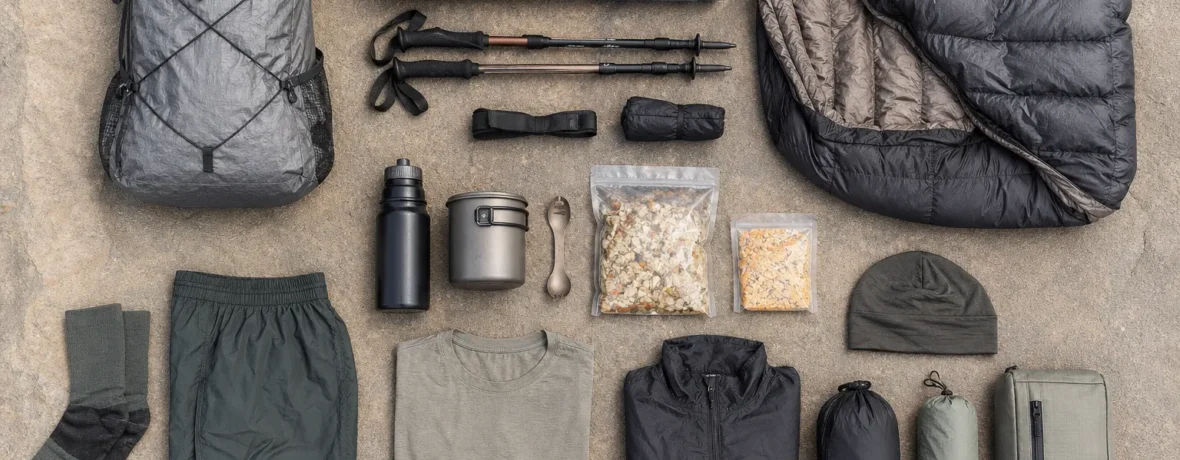
What is backpacking base weight? It is the weight of your packed backpack before food, water, fuel, and other consumables. A solid beginner base weight is often 20 to 25 lb [9.1 to 11.3 kg]; lightweight hikers aim for 10 to 20 lb [4.5 to 9.1 kg], and ultralight usually means under 10 lb [4.5 kg].
What does base weight mean in backpacking?
Base weight means everything in your pack except consumables.
That includes the pack itself, shelter, sleep system, stove, packed clothing, electronics, repair kit, first-aid kit, toiletries, maps, bear canister if carried, and every small thing hiding in a hip-belt pocket. It does not include food, water, fuel, or anything you wear while hiking.
The idea is simple: food and water change every day. Your tent does not. By separating fixed gear from variable supplies, you get a cleaner number to compare trips, gear lists, and upgrades.
What counts toward base weight?
Anything carried in your backpack that does not get used up counts.
Use this quick checklist when weighing your kit:
- Backpack, pack liner, and rain cover
- Tent, tarp, stakes, poles, footprint, and guylines
- Sleeping bag or quilt, sleeping pad, pillow, and pump sack
- Stove, pot, spoon, lighter, mug, and food storage bag or bear canister
- Packed clothing, rain jacket, insulation layer, extra socks, gloves, and hat
- Headlamp, power bank, cables, GPS, satellite messenger, and camera
- First-aid kit, repair kit, knife, trowel, toilet kit, sunscreen, and bug protection
- Maps, compass, permits, wallet, keys, and small personal items
The National Park Service Ten Essentials are a good safety framework, but they are not a license to pack duplicates of everything. Carry what matches the route, season, weather, and your skills.
What is not included in base weight?
Consumables and worn items are not included.
Consumables are things that shrink as the trip goes on: food, water, stove fuel, toothpaste, sunscreen, bug spray, and toilet paper. Some hikers count tiny toiletries as base weight because the difference is small. That is fine, as long as you stay consistent.
Worn weight is separate. Shoes, hiking shirt, hiking pants or shorts, underwear, socks, hat, sunglasses, trekking poles in your hands, and a watch are not part of base weight. If your rain jacket starts in your pack, it counts. If you put it on, your spreadsheet may say it disappeared, but your legs still carry it. Do not play games with the number. Use it to make better choices, not to win an imaginary internet trophy.
What is the difference between base weight, pack weight, and skin-out weight?
Base weight is only one way to measure what you carry.
| Term | What it includes | Best use |
|---|---|---|
| Base weight | Pack plus non-consumable gear | Comparing gear setups |
| Total pack weight | Base weight plus food, water, and fuel | Knowing what sits on your shoulders at the trailhead |
| Skin-out weight | Everything on your body and in your pack | Seeing the full load your body moves uphill |
For comfort, total pack weight matters most on day one. For gear planning, base weight is the cleaner number. For performance, skin-out weight tells the harsh truth: heavy boots, camera straps, and stuffed pockets still cost energy.
What is a good base weight for backpacking?
A good base weight is low enough to hike comfortably and high enough to stay safe.
Many traditional backpacking kits land around 20 to 30 lb [9.1 to 13.6 kg] before food and water. A lightweight setup usually sits from 10 to 20 lb [4.5 to 9.1 kg]. An ultralight setup is commonly described as under 10 lb [4.5 kg]; REI’s ultralight backpacking guide uses that same under-10-pound benchmark.
Do not chase a number without context. A 9 lb [4.1 kg] summer desert kit may be reckless on a cold, wet shoulder-season route. A 17 lb [7.7 kg] kit may be dialed if it includes a bear canister, warm insulation, rain gear, and a real shelter for exposed terrain.
Your target depends on:
- Trip length
- Expected low temperature
- Rain, snow, wind, and bug pressure
- Solo versus shared group gear
- Required food storage
- Your injury history and comfort needs
- Your budget
How do you calculate backpacking base weight?
Weigh every non-consumable item, then add the numbers.
- Empty the pack. Put every single item on the floor. Yes, even the lighter, lip balm, and mystery carabiner.
- Make three piles. Base gear, consumables, and worn items.
- Weigh each base gear item. Use a kitchen scale for small gear and a luggage scale for the loaded pack.
- Record the weight. Use ounces and pounds, or grams and kilograms. Do not mix systems halfway through.
- Add only the base gear. Leave out food, water, fuel, and the clothes you will wear while hiking.
- Weigh the finished pack. This catches missed items and tells you your real total before stepping onto the trail.
A spreadsheet works. So does a notebook. The best tool is the one you will actually update after the trip, when you know what stayed useful and what rode along for free.
How can you lower your base weight without cutting safety?
Start with the heaviest items, then remove duplicates.
The biggest savings usually come from the “big three”: shelter, sleep system, and backpack. After that, packed clothing, kitchen gear, electronics, and little extras can quietly eat pounds.
- Shelter: Choose a tent, tarp, or hammock system that fits the actual conditions, not the worst storm you can imagine on another continent.
- Sleep system: Match your bag or quilt rating to expected nighttime lows, and pair it with a pad that keeps you warm enough from the ground up.
- Backpack: Buy the pack last if you are rebuilding your kit. A smaller, lighter pack only works after the rest of your gear shrinks.
- Clothing: Pack layers that work together. Skip extra “just in case” outfits.
- Kitchen: One pot, one spoon, one stove, one lighter, plus a backup fire source where conditions call for it.
- Small stuff: Repackage repair tape, soap, sunscreen, and first-aid supplies into trip-sized amounts.
Plan light, not stupid. The Recreation.gov overnight backpacking planning guide points hikers toward careful preparation, route planning, and appropriate gear. The NPS Leave No Trace Seven Principles also start with planning ahead and preparing, which is exactly what a lighter pack demands.
What gear should you not cut just to lower base weight?
Do not cut the gear that keeps you warm, found, hydrated, and able to handle small problems.
A lighter pack feels great until you are wet, cold, off-route, or patching a torn shelter with nothing but optimism. Trim luxury first. Then trim redundancy. Be careful with safety gear.
Think twice before removing:
- Rain protection in wet or variable weather
- Insulation for expected lows and long stops
- Navigation tools you know how to use
- Headlamp and backup power or batteries
- First-aid and blister care basics
- Water treatment
- Repair tape, needle, cord, and a small knife
- Required food storage, including a bear canister where mandated
If a lighter item performs the same job, great. If a missing item creates a real problem when weather or terrain turns ugly, leave it in the pack.
Why does base weight matter so much?
Lower base weight gives you more room for food, water, and comfort.
On long dry stretches, water can dominate your total pack weight. On resupply-heavy trips, food does the same. A lean base kit gives you flexibility for those heavy carries without turning the first climb into a grind.
Base weight also reveals bad habits. Too many stuff sacks. Three knives. A full-size tube of toothpaste. Extra pants that never leave the pack. Once you see each item in ounces, the pile gets honest fast.
Still, the number is a tool. It is not your identity. A smart 14 lb [6.4 kg] base weight beats a fragile 8 lb [3.6 kg] kit that leaves you shivering at 2 a.m.
Related reading
- Base, Mid and Outer Layers Explained
- What Is Backpacking? Backpacking vs Hiking vs Camping
- How to Start Backpacking: First Overnight Trip Guide
- Backpacking Checklist: What to Bring on Your First Trip
FAQ
What is backpacking base weight?
Backpacking base weight is the weight of your pack and non-consumable gear before food, water, and fuel. It includes your backpack, shelter, sleep system, packed clothing, cook kit, electronics, and safety gear.
Does base weight include the backpack?
Yes, base weight includes the backpack itself. If the pack weighs 3 lb [1.4 kg], those 3 lb count before you add any gear inside it.
Does base weight include a bear canister?
Yes, a bear canister counts when you carry it in your pack. Food inside the canister is consumable, but the canister is fixed gear and belongs in your base weight.
Is 20 pounds a good base weight?
Yes, 20 lb [9.1 kg] can be a good base weight for a beginner, cold-weather trip, or gear list that includes required safety equipment. For warmer three-season trips, many hikers try to move below 20 lb [9.1 kg] over time.
Is ultralight backpacking always better?
No, ultralight is not always better. It works best when your skills, route, weather, and gear choices match; cutting weight without a plan can reduce comfort and safety.