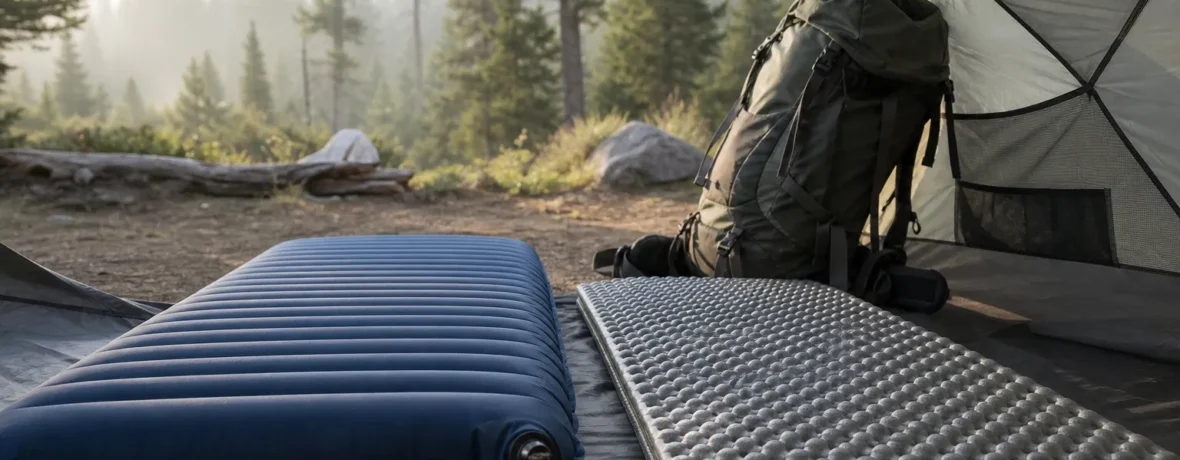
What is a sleeping pad? It’s the insulated cushion between you and the ground when you sleep outside. Yes, you need one if you want warmth and comfort: most backpacking pads are 1-4 in [2.5-10 cm] thick, and cold-weather pads usually use an R-value of 4 or higher.
What Is a Sleeping Pad Used For?
A sleeping pad keeps you warmer, softer, and more protected from the ground.
Your sleeping bag insulates the top and sides of your body, but the insulation under you gets crushed by your weight. Crushed insulation does very little. The pad takes over underneath, slowing heat loss into dirt, rock, snow, shelter floors, or tent platforms.
A good pad also smooths out roots, gravel, lumpy campsites, and those tiny pinecones that somehow feel like golf balls at 2 a.m. It gives your hips and shoulders a fighting chance, especially if you sleep on your side.
Think of your sleep system as three parts:
- Sleeping bag or quilt: warmth over and around you.
- Sleeping pad: warmth and cushioning under you.
- Shelter: weather protection from wind, rain, bugs, and splashback.
What Does Sleeping Pad R Value Mean?
R-value measures how well a pad resists heat moving through it.
The higher the number, the warmer the pad. A pad rated R-1 has little insulation. A pad rated R-5 blocks much more heat loss and makes sense for freezing nights, snow camping, or cold sleepers.
The outdoor industry uses ASTM F3340-22, a lab test method for the thermal resistance of camping mattresses. That matters because it lets you compare many modern pads across brands with the same basic yardstick, instead of guessing from marketing language.
Here’s a practical trail guide:
| R-value range | Best use | Typical conditions |
|---|---|---|
| 1.0-2.0 | Warm summer trips | Mild nights, low weight priority |
| 2.1-3.5 | Three-season backpacking | Cool spring, summer, and fall nights |
| 3.6-5.0 | Cold three-season use | Near-freezing temps, cold sleepers |
| 5.1+ | Winter camping | Frozen ground, snow, deep cold |
REI’s sleeping pad buying guide also points shoppers toward higher R-values for winter camping, with R-5.5 and up used for very cold conditions. Don’t treat the number like a magic guarantee, though. Your bag rating, base layers, wind exposure, campsite choice, metabolism, and dinner all play a role.
What Are the Main Types of Sleeping Pads?
The three main types are closed-cell foam pads, self-inflating pads, and air pads.
Each type has a personality. Some are tough and simple. Some are plush. Some are tiny in your pack but demand more care than a foam slab. Pick the tradeoff you can live with when you’re tired, hungry, and setting up camp in the dark.
| Type | Strengths | Tradeoffs |
|---|---|---|
| Closed-cell foam | Durable, cheap, fast setup, cannot deflate | Bulky, firm, lower comfort |
| Self-inflating | Stable feel, good comfort, easy to use | Heavier and bulkier than many air pads |
| Air pad | Light, compact, thick, comfortable | Can puncture, takes inflation, may be noisy |
Closed-cell foam pads
Closed-cell foam pads are the tough workhorses. They fold or roll up, strap to the outside of your pack, and do not care much about thorns, sharp granite, or dog claws. You can sit on them during breaks and use them under an inflatable pad in winter.
The downside is comfort. Most foam pads are thin and firm. If your hips dig into the ground, foam will not hide much.
Self-inflating pads
Self-inflating pads combine open-cell foam with an airtight shell. Open the valve, and the foam expands, pulling in air. You usually finish with a few breaths or a pump sack.
They feel stable and less bouncy than many air pads, which makes them popular for car camping, basecamp trips, and backpackers who hate the waterbed feeling. They do pack larger than ultralight air pads.
Air pads
Air pads are the standard for many backpackers because they pack small and sleep thick. Many are 2.5-4 in [6.4-10 cm] thick, so side sleepers get real space between hip bone and ground.
Insulated air pads use reflective layers, synthetic fill, internal baffles, or other construction to slow heat loss. Therm-a-Rest explains that modern pad warmth ratings are tested under the ASTM system on its R-value support page. The catch: an air pad can leak. Carry the repair kit.
How Thick Should a Sleeping Pad Be?
Most backpackers are happiest with a pad at least 2.5 in [6.4 cm] thick if they sleep on their side.
Back sleepers can often get by with thinner pads. Side sleepers need more depth because body weight concentrates at the hip and shoulder. Stomach sleepers usually want a flatter, less wobbly surface.
Thickness does not equal warmth by itself. A thick uninsulated air mattress can feel cold because air moves inside it and carries heat away. R-value tells you warmth. Thickness tells you cushioning.
How Do You Choose the Right Sleeping Pad?
Choose the pad that matches your temperature, sleep style, pack space, and tolerance for fuss.
Use this quick process before you buy:
- Pick your coldest expected ground conditions. Choose a higher R-value for frozen dirt, snow, high alpine camps, and shoulder-season trips.
- Match the pad to your sleep position. Side sleepers should look for thicker air or self-inflating pads. Back sleepers can go thinner.
- Check packed size. Foam pads are bulky. Air pads pack down small enough for narrow backpack pockets.
- Weigh durability against comfort. Foam survives abuse. Air pads sleep better for many hikers but need protection from punctures.
- Think about inflation. Pump sacks reduce moisture inside the pad and save your lungs after a steep climb.
- Test it at home. Inflate it, lie on it for 15 minutes, roll side to side, and check whether your hip touches the floor.
Can You Stack Sleeping Pads?
Yes, you can stack pads, and their R-values add together.
If you put an R-2 foam pad under an R-3.5 air pad, the combined insulation is R-5.5. That setup can stretch a three-season air pad into colder weather and gives you backup if the inflatable leaks.
Put the foam pad on the ground and the air pad on top for puncture protection and comfort. In snow, a foam pad also gives you a dry sitting pad for cooking and camp chores.
What Sleeping Pad Features Actually Matter?
The useful features are shape, width, valve design, fabric strength, noise level, and repairability.
Do not shop by weight alone. A 12 oz [340 g] pad that wakes you every hour is not light; it is a misery machine with a spec sheet.
- Shape: Mummy pads save weight. Rectangular pads give your knees and elbows more room.
- Width: Standard pads are often 20 in [51 cm] wide. Wide pads are commonly 25 in [64 cm].
- Length: Short pads save weight but leave your feet or lower legs off the pad.
- Valve: Flat valves are usually easier to use than old twist valves, especially for dumping air fast.
- Fabric: Higher-denier fabrics tend to handle abrasion better, with a weight penalty.
- Noise: Some insulated air pads crinkle. Try one indoors before trusting it on a weeklong trip.
- Repair kit: If it inflates, bring patches. No exceptions.
How Do You Care for a Sleeping Pad?
Keep it clean, dry, loosely stored, and away from sharp stuff.
Small habits make a pad last longer. Clear the tent floor before you inflate. Do not drag it across granite. Keep it away from sparks, cactus, crampons, and overeager camp dogs. If you use an air pad, inflate with a pump sack when possible to limit moisture inside.
After a trip, wipe off dirt and let the pad dry fully. Store self-inflating pads unrolled with the valve open. Store air pads loosely rolled or folded, not crushed at the bottom of a gear bin for months.
Related reading
- How to Choose a Sleeping Bag: Temperature Ratings, Fill and Shape
- How to Wash a Sleeping Bag at Home Without Damaging It
- How to Wash a Down Sleeping Bag and Restore the Loft
- How to Attach a Sleeping Bag to a Backpack
FAQ
Do you really need a sleeping pad for backpacking?
Yes, you need one for most overnight backpacking trips. A sleeping pad adds ground insulation and cushioning, and even a warm sleeping bag can feel cold without insulation underneath you.
Is a higher R-value always better?
No, not always. Higher R-value means more warmth, but it can add weight, bulk, and cost; for hot summer nights, an extremely warm pad can feel unnecessary.
What R-value sleeping pad do I need for 30°F [-1°C]?
For 30°F [-1°C], many hikers should start around R-3.5 to R-5. Cold sleepers, windy camps, wet ground, and quilts push you toward the higher end.
Are foam sleeping pads better than inflatable pads?
Foam pads are better for durability and simplicity. Inflatable pads are usually better for comfort, packed size, and thickness, but they can puncture and need a repair plan.
Can a sleeping pad be too warm?
Yes, but it is less of a problem than a bag that is too warm. A high-R pad blocks heat loss below you; if you overheat, vent your quilt or bag rather than removing the pad.
What is the best sleeping pad for side sleepers?
The best choice for side sleepers is usually a thick air pad or plush self-inflating pad. Look for at least 2.5 in [6.4 cm] of thickness, enough width for your elbows, and an R-value that matches the coldest ground you expect.