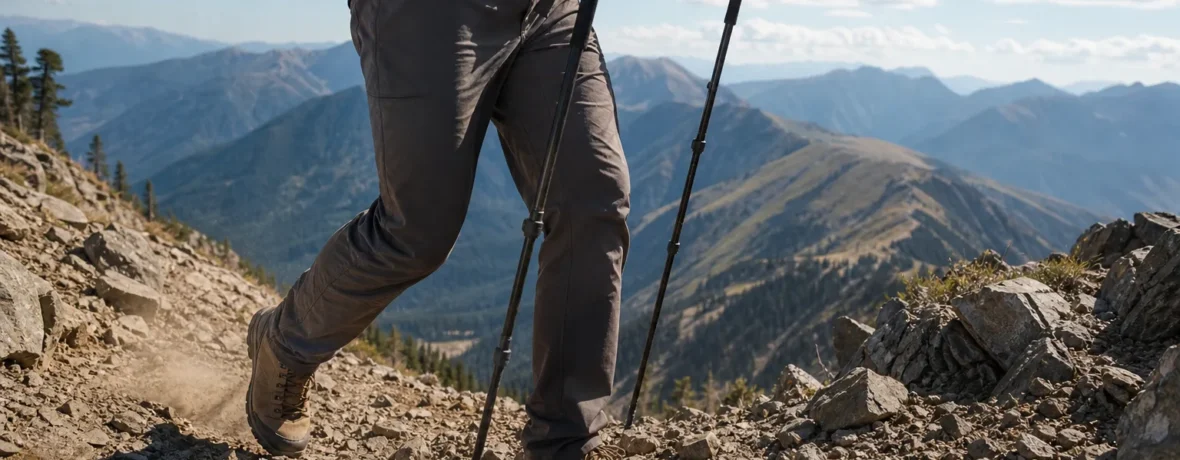
Yes. For most hikers, yes—especially on descents, loose trail, stream crossings, snow, or backpacking trips. Research shows poles can cut some downhill knee and leg loading by 12% to 25%, but they help most when you size them correctly and actually use them with good timing.
Are trekking poles worth it for most hikers?
Yes, if your hikes include elevation change, rough footing, or a loaded pack.
Trekking poles are not magic sticks. They will not turn tired legs into fresh ones. What they do well is spread some work from your legs into your arms and shoulders, give you two extra points of contact, and help you control braking on descents.
The strongest case is downhill hiking. A classic study in the Journal of Sports Sciences found significant reductions in ground reaction force, knee joint moment, and tibiofemoral forces during 25-degree downhill walking with poles, with reductions of 12% to 25%. A later study in Medicine & Science in Sports & Exercise found that poles reduced lower-extremity joint moments and knee/ankle power absorption during downhill walking, even when hikers carried packs equal to 15% and 30% of body weight.
| Trail situation | Poles usually help? | Why |
|---|---|---|
| Long downhill | Yes | They reduce braking load and help control steps. |
| Heavy backpack | Yes | They spread force across arms, shoulders, and legs. |
| Flat, smooth trail | Sometimes | They can add rhythm, but may feel unnecessary. |
| Scrambling or hands-on terrain | No | Your hands may be safer free. |
What are trekking poles for?
Trekking poles are for stability, load sharing, descent control, and rhythm.
Think of them as trail tools, not just walking accessories. On loose gravel, wet roots, muddy switchbacks, snowfields, and creek crossings, poles let you test the ground before your boot commits. On steep downhills, they help you plant, brace, and step instead of pounding straight into your knees.
They also earn their keep off the trail tread:
- Testing mud, snow, or water depth before stepping.
- Supporting some ultralight shelters.
- Improving balance while taking photos or adjusting layers.
- Creating a steady rhythm on long climbs.
- Helping with short step-downs when your legs are tired.
Do trekking poles help your knees?
Yes, poles can help reduce knee loading, especially while hiking downhill.
The best research points in the same direction: poles reduce some lower-body forces during downhill walking. That matters because descents create repeated braking forces. One small reduction per step can add up across thousands of steps on a mountain trail.
A review in Wilderness & Environmental Medicine found that trekking poles reduce lower-extremity loading in several hiking conditions, particularly downhill, while evidence on energy cost is mixed. Another study on in-vivo knee loading found that hiking-pole gait can offload the knee by transferring part of the force through the arms instead of the legs, published in the Journal of Orthopaedic Research.
Still, poles are not a treatment plan for knee pain. If your knees hurt on every descent, the fix may include strength work, footwear changes, shorter steps, pack-weight cuts, or medical advice—not just buying carbon poles.
Do trekking poles help or make hiking harder?
They can do both, depending on terrain and technique.
On moderate uphill grades and loaded walking, one study found that poles did not increase energy expenditure and may reduce perceived exertion, according to research indexed by PubMed. Other research found that energy cost and ventilation can rise in some conditions, especially downhill treadmill walking with poles.
Translation: poles may make your arms work more, but your hike can still feel easier because your legs take less punishment and your balance feels steadier. If you death-grip the handles and stab at the ground, they get annoying fast. If you relax your hands and let the straps carry part of the load, they feel natural.
How do you use trekking poles correctly?
Use a relaxed grip, plant opposite your forward foot, and shorten or lengthen the poles for slope angle.
Bad pole technique is noisy, tiring, and easy to spot. Good technique is quiet. The poles land where your body already wants support.
- Set the length on flat ground. Your elbow should bend close to 90 degrees when the pole tip touches the ground beside your foot.
- Use the straps from below. Put your hand up through the strap, then down onto the grip. This lets your wrist push into the strap instead of forcing your fingers to clamp all day.
- Walk naturally. Plant the right pole as your left foot steps, then the left pole as your right foot steps.
- Shorten for climbs. On sustained uphill, shorten each pole by 2 to 4 inches [5 to 10 cm] so your hands do not ride too high.
- Lengthen for descents. On downhill, lengthen by 2 to 4 inches [5 to 10 cm] so the tips reach the ground ahead of you without making you hunch.
- Remove straps in sketchy spots. Around talus, roots, blowdowns, or fast water, keep your hands free so you can ditch a pole if it catches.
What size trekking poles do you need?
You need poles that put your elbows near 90 degrees on flat ground.
Most adjustable poles cover a wide range, so sizing is not complicated. Stand tall in your hiking shoes. Hold the grip. Put the tip beside your boot. If your forearm is roughly level with the ground, you are in the zone.
Fixed-length poles are fussier. If you are between sizes, many hikers prefer slightly shorter poles for climbs and fast walking, while longer poles feel better on descents. Adjustable poles are the easy answer if your trips include both.
Are carbon or aluminum trekking poles better?
Carbon is lighter; aluminum is usually tougher when abused.
Carbon poles save weight and often feel less buzzy on hard ground. Aluminum poles usually bend before they snap, which can be friendlier on rocky routes and travel days. For most day hikers, either material works. For rough off-trail use, aluminum has a strong argument. For long-distance hiking where every ounce matters, carbon gets tempting.
- Choose carbon if: you count ounces, hike long miles, and mostly stay on trails.
- Choose aluminum if: you hike rocky terrain, travel often, or are hard on gear.
- Choose cork grips if: your hands sweat and you want a grip that shapes slightly over time.
- Choose foam grips if: you want lower weight and comfort in cold weather.
When should you not use trekking poles?
Skip poles when they make you less safe or more clumsy.
There are times to fold them, stash them, or carry them in one hand. If you need both hands for scrambling, ladders, chains, or a steep boulder field, poles can become trip hazards. The same goes for narrow trails with heavy brush where tips snag every few steps.
You should also think about trail etiquette. Keep pole tips away from other hikers, dogs, and fragile alpine plants. Use rubber tips on pavement or sensitive rock where metal tips would scrape and click.
When to see a doctor
See a doctor if pain, swelling, instability, or injury signs are more than normal trail soreness.
Trekking poles can reduce load, but they cannot diagnose knee, ankle, hip, or back pain. Mayo Clinic advises medical care for knee pain when you cannot bear weight, have marked swelling, cannot fully bend or straighten the knee, see a deformity, have fever with redness and swelling, or have severe pain tied to an injury; see the Mayo Clinic knee pain guidance.
If you are returning to activity after injury, surgery, or a long break, build gradually. The CDC adult activity guidelines recommend 150 minutes of moderate-intensity aerobic activity each week plus 2 days of muscle-strengthening work, which fits well with hiking prep.
Related reading
- How to Use Trekking Poles Properly Uphill and Downhill
- How to Choose Hiking Poles: Length, Locks and Materials
- Can You Bring Hiking Poles on a Plane? Carry-On vs Checked
- How to Attach Hiking Poles to a Backpack
FAQ
Are trekking poles worth it for day hikes?
Yes, if the day hike has descents, uneven footing, mud, snow, or stream crossings. On a flat, smooth 2-mile [3.2 km] park path, they may feel like extra gear.
Do trekking poles help going uphill?
Yes, they can help by bringing your arms and upper body into the climb. Shorten them slightly and plant them close to your feet so you are pushing down and back, not reaching forward.
Do trekking poles help going downhill?
Yes, this is where they shine. Research shows meaningful reductions in some downhill knee and leg forces when poles are used correctly.
Should you use one trekking pole or two?
Two poles give the best balance and load-sharing. One pole can still help on creek crossings, mild terrain, or when you want one hand free.
Are trekking poles bad for trails?
They can be if you jab fragile soil, moss, or alpine vegetation. Stay on durable surfaces, use rubber tips where appropriate, and avoid dragging tips along rock slabs.
Are expensive trekking poles worth it?
Sometimes, but not always. Pay more for lower weight, better locks, nicer grips, and packability; if you hike a few weekends a year, a sturdy mid-priced aluminum pair is usually enough.