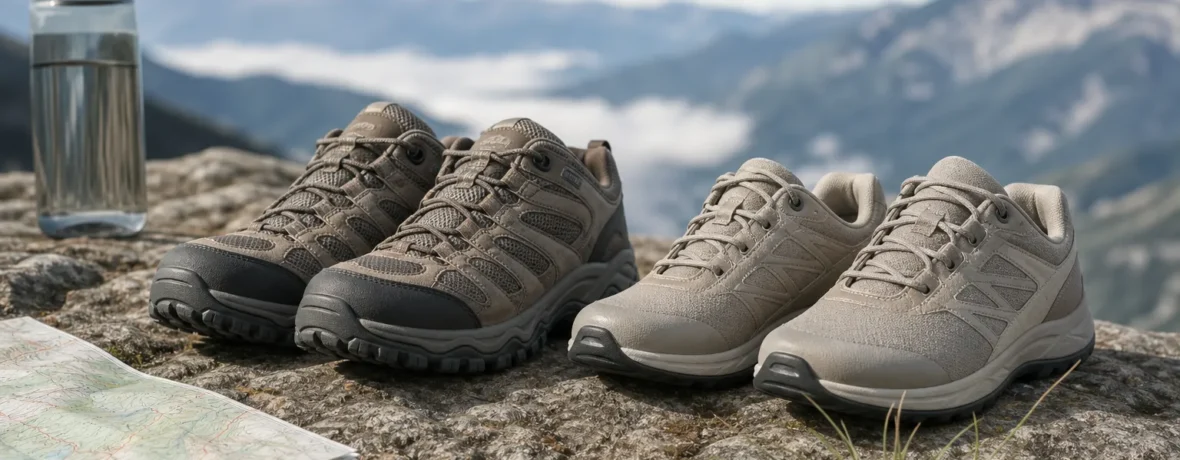
Hiking shoes vs walking shoes comes down to terrain: choose hiking shoes for dirt, rocks, mud, roots, slopes, and packs over 10 lb [4.5 kg]; choose walking shoes for pavement, gravel paths, treadmills, and casual walks under 3 miles [5 km]. Hiking shoes grip and protect better. Walking shoes flex and roll better.
What is the difference between hiking shoes vs walking shoes?
The difference is grip, structure, and protection.
Walking shoes are built for repeatable motion on even ground. Your foot lands, rolls forward, pushes off, and does it again. The sole can be smoother. The upper can be softer. The midsole can focus on comfort rather than torsion control.
Hiking shoes are built for messy ground. Trail tread changes every few steps: angled rock, wet leaves, loose gravel, mud, hardpack, roots, sand, creek crossings. A good hiking shoe fights sideways twisting, shields your toes, grips loose surfaces, and keeps the bottom of your foot from feeling every sharp edge.
That is the split. Walking shoes are road tools. Hiking shoes are trail tools.
| Feature | Hiking shoes | Walking shoes |
|---|---|---|
| Best surface | Dirt, rock, roots, mud, uneven trails | Pavement, sidewalks, treadmills, packed paths |
| Outsole | Deeper lugs for bite | Smoother tread for easy rolling |
| Midsole | Stiffer for stability and underfoot protection | Softer and more flexible for stride comfort |
| Upper | More abrasion resistance, often reinforced | Lighter mesh or knit, less armor |
| Toe protection | Rubber rand or toe bumper | Minimal toe bumper |
| Pack carrying | Better for daypacks and light backpacking loads | Best with no pack or a light everyday bag |
REI’s footwear guidance makes the same broad distinction: hiking footwear uses trail-focused outsoles, support, uppers, and protective components, while lighter shoes and trail runners trade some structure for speed and comfort. See REI’s guide to choosing hiking boots and hiking shoes for a deeper breakdown of uppers, midsoles, outsoles, and support.
Can you wear walking shoes for hiking?
Yes, but only on easy trails.
Walking shoes can work for flat dirt paths, dry park trails, rail trails, nature preserves, and short hikes where the ground feels closer to a sidewalk than a mountain trail. If the route is smooth, dry, and low-consequence, you do not need to overbuy.
They are the wrong tool when the trail gets steep, loose, slick, or rocky. The problem is not only traction. It is also foot fatigue. A soft walking shoe can fold around rocks and roots, forcing your foot muscles to work harder for stability. That feels fine for the first mile. By mile 5 [8 km], it can feel sloppy.
Use walking shoes for hiking when:
- The trail is dry and maintained.
- The route is under 3 miles [5 km].
- You are carrying water, snacks, and a light layer only.
- There are no long rocky sections.
- You can turn around easily if the shoes feel wrong.
Skip walking shoes when the route includes wet rock, steep descents, loose gravel, mud, stream crossings, snow patches, or a loaded pack. That is hiking-shoe country.
Are hiking shoes good for walking?
Yes, but they can feel stiff on pavement.
Hiking shoes are fine for walking the dog, traveling, errands, and gravel paths. Many people like them because they feel planted. The grippy sole, firmer platform, and protective toe make rough sidewalks, wet grass, and cobblestones less annoying.
The tradeoff shows up on long pavement walks. Deep lugs can feel clunky. A stiff midsole may not roll as smoothly as a true walking shoe. Some hiking shoes also run warmer because their uppers use tougher materials. If you walk 4 miles [6.4 km] every morning on sidewalks, a walking shoe usually feels smoother and less tiring.
There is another issue: tread wear. Pavement grinds down hiking-shoe lugs faster than dirt does. Once the lugs round off, you lose the very thing that made the shoe useful on trail. If you want one shoe for town and tame trails, choose a low hiking shoe with moderate lugs, not an aggressive mountain model.
Which shoes have better grip on dirt, rocks, and mud?
Hiking shoes have better trail grip.
The outsole is the easiest difference to see. Flip both shoes over. A walking shoe usually has shallow grooves made for pavement contact. A hiking shoe has lugs: raised rubber blocks designed to bite into dirt, shed mud, and brake on descents.
Look for these outsole features:
- Multi-directional lugs: forward-facing lugs help climbing; rear-facing edges help braking downhill.
- Open spacing: wider gaps help mud release instead of packing into the sole.
- Sticky rubber: softer compounds grip rock better but may wear faster on pavement.
- Defined heel brake: a squared-off heel edge adds control on steep descents.
Grip is not magic. Wet roots are slick. Algae-covered rock is slick. Fine gravel on hardpack acts like ball bearings. A hiking shoe gives you a better chance, not a license to stomp through bad footing.
The National Park Service includes proper footwear within broader trip preparation and safety thinking in its Ten Essentials guidance. That matters because traction is part of planning, not an afterthought you fix at the trailhead.
Which shoes give more support for your feet and ankles?
Hiking shoes give more underfoot support, but not true ankle support.
A low-cut hiking shoe does not wrap your ankle like a boot. It will not act like a brace. What it can do is create a more stable platform under your foot. That comes from a firmer midsole, a wider base, a shank or rock plate in some models, and a snugger heel hold.
Walking shoes flex more because pavement walking rewards smooth motion. On flat ground, that feels great. On a sidehill trail, too much flex can let the shoe twist. Your foot then has to correct every wobble.
If you have a history of ankle sprains, do not assume any shoe fixes the problem. Fit, strength, balance, load, fatigue, and trail choice all matter. A mid-cut hiking shoe or boot can add coverage around the ankle bones, but the sole platform and fit still do the heavy lifting.
For most day hikers, the support question comes down to this: if the trail is rough enough that your foot keeps bending around rocks, step up from walking shoes to hiking shoes.
Do hiking shoes protect your feet better?
Yes, hiking shoes protect better from trail abuse.
Protection shows up in small ways all day. A toe bumper saves you when you kick a root. A tougher side panel handles brush and rock scrape. A firmer midsole dulls sharp stones. A gusseted tongue can help keep grit out. None of that matters much on a sidewalk. It matters fast on a trail.
Walking shoes usually favor soft comfort. That is not a flaw. It is the design brief. Less armor means less weight, more flex, and more breathability. But when you step on a pointed rock with a thin walking shoe, your foot knows.
Choose more protection when:
- The trail is rocky for more than 1 mile [1.6 km].
- You hike in desert terrain with cactus, sharp gravel, or volcanic rock.
- You often stub your toes on roots or steps.
- You carry a daypack with camera gear, kid gear, or extra water.
- Your feet get sore from “stone bruised” pressure under the forefoot.
Are waterproof hiking shoes better than walking shoes in rain?
Waterproof hiking shoes are better on wet trails, but not always better for comfort.
A waterproof membrane helps when you hike through wet grass, shallow puddles, mud, and cold rain. It is useful when the outside of the shoe keeps getting splashed but water does not pour over the collar.
There are tradeoffs. Waterproof shoes breathe less than non-waterproof shoes. Feet sweat. Once water gets inside from the top, a waterproof shoe can dry slowly. In warm weather, a breathable non-waterproof hiking shoe may feel better because it vents and dries faster.
Walking shoes can be water-resistant, but many use soft mesh or knit uppers that soak quickly. That is fine for urban drizzle. It is less fun when the trail is wet for hours.
Use this simple filter:
- Cold and wet: waterproof hiking shoes make sense.
- Warm and wet: breathable hiking shoes often win.
- Dry pavement: walking shoes win for comfort.
- Wet pavement only: walking shoes with good rubber are usually enough.
Which shoes are more comfortable for long distances?
The most comfortable shoe is the one matched to the surface.
For 6 miles [9.7 km] on pavement, a walking shoe often feels better. It rolls smoothly, cushions repetitive impact, and flexes naturally through the forefoot. For 6 miles [9.7 km] on rocky trail, a hiking shoe usually feels better because it reduces foot strain and protects against sharp ground.
Comfort is not softness alone. Too soft can feel unstable. Too stiff can feel tiring. The sweet spot depends on your body, the trail, and the load.
Check comfort in these zones:
- Heel: locked in, no lifting with each step.
- Midfoot: snug, not squeezed.
- Toes: enough room to wiggle and enough length for downhill steps.
- Arch: supported without a hard ridge digging in.
- Forefoot flex: bends where your foot bends, not in the middle of the arch.
Try shoes late in the day if you can. Feet swell during activity. Wear the socks you plan to hike or walk in. Bring your insoles if you use them. Lace both shoes, walk on an incline if the store has one, and test downhill pressure at the toes.
How should hiking shoes and walking shoes fit?
Both should fit snugly, but hiking shoes need more downhill room.
A walking shoe can fit closer because your foot is not sliding forward on steep descents. A hiking shoe needs space in front of the toes so they do not jam into the end of the shoe. That space matters after your feet swell and the trail tilts downward.
Use this step-by-step fit check:
- Start with socks. Wear the exact sock thickness you will use outside.
- Check heel hold. Your heel should stay seated when you walk uphill.
- Test toe room. Stand and lightly tap the front of the shoe; your toes should not be pressed hard against the end.
- Walk downhill. On a ramp or stairs, your toes should not slam forward.
- Twist the shoe. A hiking shoe should resist twisting more than a walking shoe.
- Flex the forefoot. The bend should match the ball of your foot.
- Wear them indoors first. Keep them clean until you know they work.
Do not buy pain. A shoe may soften slightly, but a bad shape rarely becomes a good shape. Pinching, heel slip, toe bang, and arch pressure usually get worse on trail.
When should you choose hiking shoes over walking shoes?
Choose hiking shoes when the ground can trip, scrape, soak, or twist your feet.
That sounds blunt because the decision should be blunt. If the route has real trail conditions, wear trail footwear. If the route is built for strollers, casual sneakers, and steady pavement stride, walking shoes are enough.
Pick hiking shoes for:
- Rocky trails
- Rooty forest paths
- Mud, wet leaves, and slick dirt
- Steep climbs or descents
- Loose gravel or scree
- Daypacks over 10 lb [4.5 kg]
- Long trail days beyond 5 miles [8 km]
- Cold, wet, or shoulder-season hikes
Pick walking shoes for:
- Sidewalks
- Greenways
- Treadmills
- Travel days with lots of city walking
- Dry packed gravel paths
- Easy park loops
- Daily fitness walks
Can one pair of shoes work for both hiking and walking?
Yes, if your hiking is light and your walking is casual.
The best crossover shoe is usually a low hiking shoe or a trail-walking shoe with moderate tread. You want enough lug for dirt, enough cushion for pavement, and enough flex that it does not feel like a brick in town.
Avoid extremes. A smooth walking shoe is weak on rough trails. A burly hiking shoe is clunky on long pavement walks. The middle ground works best for people who walk during the week and hike mellow trails on weekends.
Look for these crossover traits:
- Low-cut design
- Moderate lugs, not deep mud lugs
- Breathable upper
- Rubber toe bumper
- Stable heel
- Forefoot flex that feels natural on pavement
- Enough width for swelling
If you split your time evenly between pavement fitness walks and rugged hikes, buy two pairs. Your feet will be happier, and both shoes will last longer because each one is used on the surface it was made for.
When to see a doctor
See a doctor promptly for severe pain, major swelling, numbness, or pain after an injury.
Shoes can cause blisters, pressure spots, and soreness, but they are not the answer to every foot problem. If foot or ankle pain changes how you walk, keeps returning, or includes burning, numbness, tingling, redness, warmth, or swelling, get medical advice instead of trying to solve it with another insole.
The Mayo Clinic’s guidance on foot pain and ankle pain lists symptoms that call for urgent care or an office visit, including severe pain, inability to bear weight, signs of infection, and numbness or tingling. Do not self-diagnose a persistent injury from shoe wear alone.
How to choose between hiking shoes and walking shoes
Match the shoe to the worst ground you expect, not the easiest mile.
A trail can start friendly and turn nasty after a turn, a storm, or a climb. The wrong shoe usually feels fine at the car. It announces itself later, when your feet are tired and the descent is still waiting.
- Name the surface. Pavement points to walking shoes. Dirt and rock point to hiking shoes.
- Check the elevation. Steeper routes need more traction and downhill toe room.
- Weigh your load. A heavier pack benefits from a more stable platform.
- Check weather and moisture. Wet trails need better rubber, tread, and upper materials.
- Think distance. Longer trail days reward protection; longer pavement days reward smooth flex.
- Know your feet. Wide forefoot, narrow heel, high arch, flat arch, bunions, and past injuries all affect the right choice.
- Test before the big day. Wear the shoes on shorter outings before trusting them for a full hike.
If you are still torn, choose hiking shoes for dirt and walking shoes for pavement. That single rule gets most people into the right pair.
Bottom line: which pair should you buy?
Buy hiking shoes if trails are your goal.
If your calendar has state parks, national parks, rocky overlooks, forest loops, desert washes, wet spring trails, or fall leaf hikes, hiking shoes make sense. You get grip, protection, and stability where walking shoes start to feel exposed.
Buy walking shoes if your miles are mostly paved. They are lighter, smoother, and better tuned for steady forward motion. For daily walks, travel, and fitness loops, they feel easier because they are built for that rhythm.
For mixed use, do not chase the toughest shoe. Chase the right compromise: low-cut, comfortable, grippy, moderately protective, and not so aggressive that pavement chews it up. Your feet do not care what the label says. They care how the shoe works under them.
Related reading
- Hiking Shoes vs Hiking Boots: Which Should You Buy?
- Are Hiking Shoes Good for Everyday Walking?
- Hiking vs Walking: Where One Ends and the Other Begins
- Softshell vs Hardshell Jackets for Hiking
FAQ
Can I hike in regular walking shoes?
Yes, you can hike in walking shoes on short, dry, easy trails. Choose hiking shoes when the route has rocks, mud, roots, steep grades, or loose gravel.
Are hiking shoes better than walking shoes?
Hiking shoes are better on trails. Walking shoes are better on pavement because they flex and roll more naturally on flat, predictable ground.
Do hiking shoes need to be waterproof?
No, hiking shoes do not always need to be waterproof. Waterproof models help in cold rain and wet grass, while breathable non-waterproof shoes often feel better in warm weather and dry faster after soaking.
Are hiking shoes heavier than walking shoes?
Usually, yes. Hiking shoes often use thicker rubber, reinforced uppers, toe protection, and firmer midsoles, which add weight but improve trail durability and protection.
Can hiking shoes be used for everyday walking?
Yes, hiking shoes can work for everyday walking, especially on rough sidewalks, gravel, or wet conditions. For long pavement walks, walking shoes usually feel smoother and preserve hiking-shoe tread for the trail.
Should hiking shoes fit bigger than walking shoes?
They should fit with more toe room, not sloppy extra size. Your toes need space for swelling and downhill movement, while the heel and midfoot still need to stay secure.