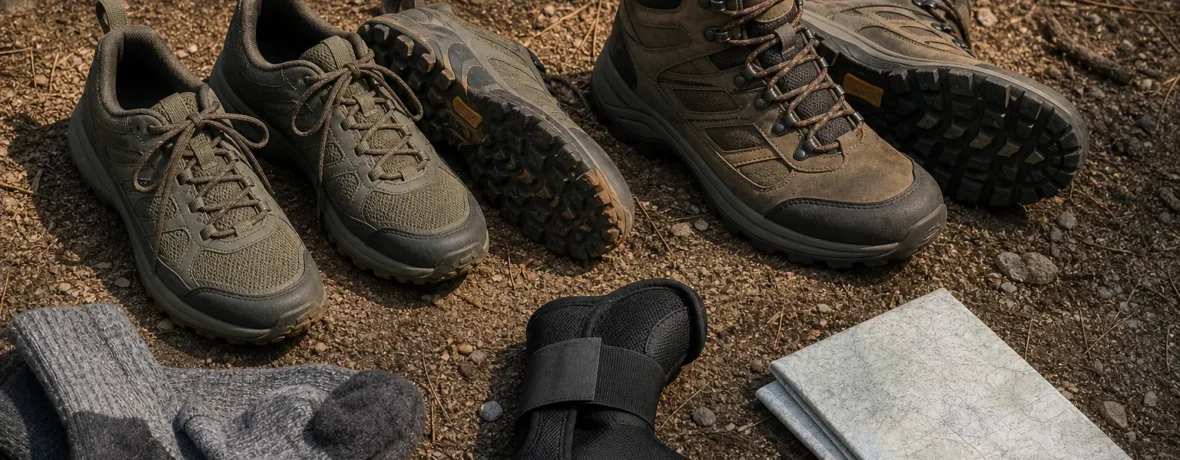
Buy hiking shoes for maintained trails, warm weather, day hikes, and packs under 25 lb [11 kg]. Buy hiking boots for off-trail travel, snow, mud, ankle protection, heavy backpacking loads over 25 lb [11 kg], or weak ankles. Most casual hikers are happier in low-cut hiking shoes.
Hiking shoes vs boots: what is the real difference?
The real difference is support, protection, weight, and weather coverage.
Hiking shoes usually sit below the ankle. They feel closer to athletic shoes, but with tougher uppers, grippier outsoles, and more underfoot protection. They flex more easily than boots, dry faster, and feel less clunky on long, rolling trails.
Hiking boots rise over the ankle. Some are mid-cut. Some are full-height backpacking boots. They usually have stiffer midsoles, more durable uppers, deeper protection around the foot, and better coverage in mud, snow, brush, and rock. REI’s footwear guide describes boots as the better match for heavier loads and rougher travel, while hiking shoes work well when speed and freedom of movement matter more than maximum support. REI’s hiking shoes and boots guide
Here is the clean split:
| Feature | Hiking Shoes | Hiking Boots |
|---|---|---|
| Cut height | Low-cut, below the ankle | Mid-cut or high-cut, around the ankle |
| Best use | Day hikes, maintained trails, fast hiking | Backpacking, rough terrain, cold and wet conditions |
| Weight | Lighter and quicker underfoot | Heavier, more protective |
| Break-in | Usually shorter | Often longer, especially leather models |
| Weather protection | Good in dry or warm conditions | Better for mud, snow, wet brush, and cold |
Are hiking shoes better than hiking boots?
Hiking shoes are better for many day hikers.
If your trails are dry, graded, and easy to follow, a good hiking shoe gives you traction without turning every step into leg day. You lift each foot thousands of times on a hike. Less weight on your feet means less fatigue, especially on rolling terrain where you are not kicking steps in snow or bracing under a loaded pack.
Hiking shoes also breathe better. That matters in summer. Hot, damp feet blister faster, and low-cut shoes let heat escape more easily than high boots. They also dry faster after creek splashes or wet grass. Waterproof hiking shoes exist, but non-waterproof mesh models often feel better in warm weather because they move sweat out instead of trapping it inside.
Pick hiking shoes if your hikes usually look like this:
- Maintained dirt trails
- Day hikes under 10 miles [16 km]
- Warm or mild weather
- Light pack under 25 lb [11 kg]
- No regular snow travel
- No history of ankle trouble
- You prefer a natural, flexible stride
The catch? Hiking shoes give up coverage. Your ankle bones are exposed. Your foot gets less side protection from rocks and deadfall. If you step into deep mud, the shoe fills faster. If you are sidehilling on loose scree with a heavy pack, that flexible comfort can start to feel sloppy.
Are hiking boots better for ankle support?
Hiking boots can give more ankle support, but only if they fit and lace correctly.
A high collar alone does not work magic. A soft, loose boot with lazy lacing will not protect you much. A stiffer boot that cups the heel, locks the midfoot, and laces firmly around the ankle can limit some rolling and give you more confidence when the trail gets ugly.
Boots also help by supporting the whole foot platform. The midsole is usually firmer. The sole resists twisting. The upper holds the foot in place better under load. That full system matters when you are descending loose rock with a backpack that shifts your center of gravity.
Boots make the most sense for ankle support when:
- You carry overnight loads
- You hike on talus, scree, roots, and uneven rock
- You have a history of ankle rolls
- You travel off trail
- You hike in snow, mud, or wet brush
- You want more shin and ankle protection from brush and rocks
If your ankles are healthy and strong, a lighter shoe may feel safer because you place your feet more precisely. If your ankles are cranky, boots may help, but trekking poles, strength work, pack weight, and pacing also matter.
Are hiking shoes or boots better for backpacking?
Boots are usually better for heavy backpacking, while shoes work for lighter backpacking.
Use pack weight as your first filter. If your loaded pack stays under 25 lb [11 kg] and the trail is maintained, hiking shoes can be a sweet setup. Plenty of lightweight backpackers prefer shoes because they move quickly, dry fast, and spare the legs from hauling heavy footwear.
Once your pack climbs past 25 lb [11 kg], boots start making more sense. The extra structure helps your feet stay stable through long descents, rocky steps, water bars, roots, and uneven campsites. With 35 lb [16 kg] or more on your back, small slips feel bigger. A stiffer boot can take some strain off tired feet.
Terrain can override pack weight. A 20 lb [9 kg] pack on a boulder field may call for boots. A 30 lb [14 kg] pack on a smooth forest path may still feel fine in shoes if your feet are conditioned. Don’t buy footwear for the fantasy trip. Buy it for the ground you will actually walk on.
Are hiking boots or shoes better in rain, mud, and snow?
Boots are better in cold wet conditions; shoes are better when drying speed matters.
Waterproof boots protect best when the weather is cold, the trail is muddy, or snow sits on the ground. A higher collar helps keep splashes and slush out. Pair boots with gaiters and you get much better coverage in wet grass, spring snow, and sloppy shoulder-season trails.
Waterproof hiking shoes protect less because the opening is low. Step into ankle-deep water and they flood. Once water gets inside, the membrane slows drying. That is why many warm-weather hikers choose breathable, non-waterproof shoes and accept wet feet. The shoe gets soaked, drains, then dries on the move.
For snow, boots win. Not always huge mountaineering boots, but at least a supportive hiking boot with enough stiffness for traction devices when conditions demand it. The National Park Service advises hikers to match footwear to trail conditions and avoid open-toed shoes or flip-flops on hikes. NPS Hike Smart guidance
Use this weather rule:
- Hot and dry: breathable hiking shoes
- Hot and wet: fast-drying non-waterproof shoes
- Cool rain and mud: waterproof hiking shoes or light boots
- Cold rain: waterproof boots
- Snow: insulated or waterproof boots with suitable traction
Do hiking boots last longer than hiking shoes?
Boots usually last longer because they use tougher materials.
Leather boots and burly backpacking boots can take more abuse than lightweight mesh hiking shoes. They shrug off rocks, brush, and repeated scraping better. Many can also be cleaned and treated to extend the life of the upper.
Hiking shoes trade some durability for lower weight. Mesh panels can tear. Soft midsoles can pack out. Lightweight outsoles wear faster on granite, asphalt approaches, and abrasive desert trails. That does not make shoes a bad value. If they keep your feet happy and you hike more often, they are doing the job.
Think in terms of failure points:
- Outsole: worn lugs reduce grip on loose dirt and wet rock
- Midsole: packed-out foam feels flat and harsh underfoot
- Upper: torn mesh or cracked leather lets debris and water in
- Heel cup: sloppy heel hold creates rubbing and instability
- Waterproof membrane: leakage can develop before the rest of the shoe looks dead
If you hike rocky trails every weekend, boots may save money over time. If you hike mostly smooth dirt and value comfort, shoes may be the better buy even if they wear sooner.
How should hiking shoes or boots fit?
They should feel snug at the heel and midfoot, with toe room for descents.
Fit beats every other feature. A premium boot that pinches your toes is junk for your feet. A budget hiking shoe that fits perfectly can carry you farther with fewer problems.
The American Podiatric Medical Association recommends fitting shoes to the larger foot and making sure shoes fit well at the front, back, and sides. APMA footwear fit guidance For hiking, that means your heel should stay planted, your toes should not hit the front on downhill steps, and your foot should not slide sideways when you edge across a slope.
Use this fitting process:
- Shop late in the day. Feet swell after standing and walking, just like they do on trail.
- Wear your hiking socks. Thick socks change volume. Thin socks change heel hold.
- Try both feet. Most people have one foot that is longer or wider.
- Check toe space. Stand with full weight on both feet. You should be able to wiggle your toes.
- Lock the heel. Walk uphill and downhill if the store has a ramp. Heel lift means blisters are coming.
- Test edges. Step side to side. Your foot should not roll over the platform.
- Wear them indoors first. Keep them clean until you know they are keepers.
Do not assume you need the same size as your running shoes. Hiking footwear brands shape their toe boxes, heels, arches, and insteps differently. Try wide sizes if your toes splay. Try a lower-volume model if your heel swims.
Should beginners buy hiking shoes or boots?
Most beginners should start with hiking shoes.
Beginner hikes usually happen on popular trails, state parks, local preserves, and short mountain routes in decent weather. Hiking shoes are lighter, easier to break in, and more comfortable straight away. That removes one common excuse to stay home.
Buy boots as a beginner if your first hikes involve muddy forests, rocky mountains, cold weather, or overnight packs. Also buy boots if your ankles need the confidence of a higher collar. Just do not buy the stiffest boot on the wall because it looks serious. Overbuilt footwear can make easy trails less fun.
A beginner-friendly shoe or boot should have:
- A grippy rubber outsole with defined lugs
- A stable heel cup
- Enough toe protection for rocks and roots
- A midsole that does not fold like a slipper
- A fit that works with your sock choice
- No hot spots during a 20-minute indoor test walk
How do you choose between hiking shoes and hiking boots?
Choose based on trail, load, weather, feet, and pace.
Forget the campfire debate. Use a simple decision tree. Your footwear should match the hardest part of your hike, not the first mile [1.6 km] of smooth trail from the parking lot.
- Look at the trail surface. Smooth dirt points toward shoes. Rock, roots, scree, and off-trail travel point toward boots.
- Weigh your loaded pack. Under 25 lb [11 kg] favors shoes. Over 25 lb [11 kg] leans toward boots.
- Check the weather. Heat favors breathable shoes. Cold rain, mud, and snow favor boots.
- Know your ankles. Strong, healthy ankles can use either. Unstable ankles may need a supportive boot and trekking poles.
- Match your pace. Fast hikers usually like shoes. Slow, steady backpackers often like boots.
- Try before committing. Fit problems beat spec sheets every time.
If you are stuck between the two, try a mid-cut hiking shoe or lightweight hiking boot. This middle category gives you more ankle coverage than a low shoe without the tank-like feel of a backpacking boot.
When to see a doctor
See a doctor if foot pain, swelling, numbness, or a blister shows signs of infection.
Blisters are common on hikes, but they should improve with basic care and reduced friction. Mayo Clinic advises medical care when a blister has spreading color changes, increasing pain, pus, or warm skin. Mayo Clinic blister first aid
Get professional help if pain changes your walking pattern, keeps returning in the same spot, or continues after switching footwear and resting. Do not try to “tough out” numb toes, sharp heel pain, or swelling that gets worse during a hike.
Final buying advice: which one should you buy?
Buy the lightest footwear that still protects you for your hardest realistic hike.
That sentence saves money. If your weekends are local trails, summer day hikes, and a small pack, buy hiking shoes. You will move easier, sweat less, and probably enjoy the trail more.
If your plans include backpacking, rough mountain terrain, snow, cold rain, or heavy loads, buy hiking boots. Your feet will appreciate the structure when the trail turns loose, wet, steep, or long.
If you can only own one pair, choose based on the roughest conditions you will regularly face. Not once a year. Regularly. A light hiker can handle easy trails better than a low shoe can handle repeated snow, talus, and loaded backpacking.
For many hikers, the ideal gear closet has both: breathable hiking shoes for dry day hikes and supportive boots for bad weather and backpacking. Start with the pair you will wear most. The right choice is the one that gets dirty often.
Related reading
- Hiking Shoes vs Walking Shoes: Key Differences
- How to Clean Hiking Boots Without Ruining Leather or Membranes
- How Should Hiking Boots Fit? The Thumb Rule and Other Checks
- Softshell vs Hardshell Jackets for Hiking
FAQ
Can I wear running shoes for hiking?
Yes, you can wear running shoes on easy, dry, maintained trails. Switch to hiking shoes or boots when you need better traction, toe protection, lateral stability, or durability on rocks and roots.
Are trail runners the same as hiking shoes?
No, trail runners are usually lighter and more flexible than hiking shoes. Hiking shoes tend to add more toe protection, side support, and underfoot structure for walking with a pack.
Do hiking boots need to be waterproof?
No, hiking boots do not always need to be waterproof. Choose waterproof boots for cold rain, mud, wet brush, and snow; choose breathable non-waterproof footwear for hot weather and fast drying.
How long does it take to break in hiking boots?
Light hiking boots may feel ready after a few short walks, while stiff leather backpacking boots can take multiple outings. Wear them on neighborhood walks and short hikes before trusting them on a long trip.
Should hiking boots feel tight at first?
No, hiking boots should not feel painfully tight at first. They should feel secure at the heel and midfoot with enough toe room for downhill walking, but pinching, numbness, and hot spots are warning signs.
What is better for summer hiking: shoes or boots?
Hiking shoes are usually better for summer hiking. They breathe better, feel lighter, and dry faster, while boots make more sense in summer only if the trail is rough, muddy, brushy, or loaded with backpacking gear.