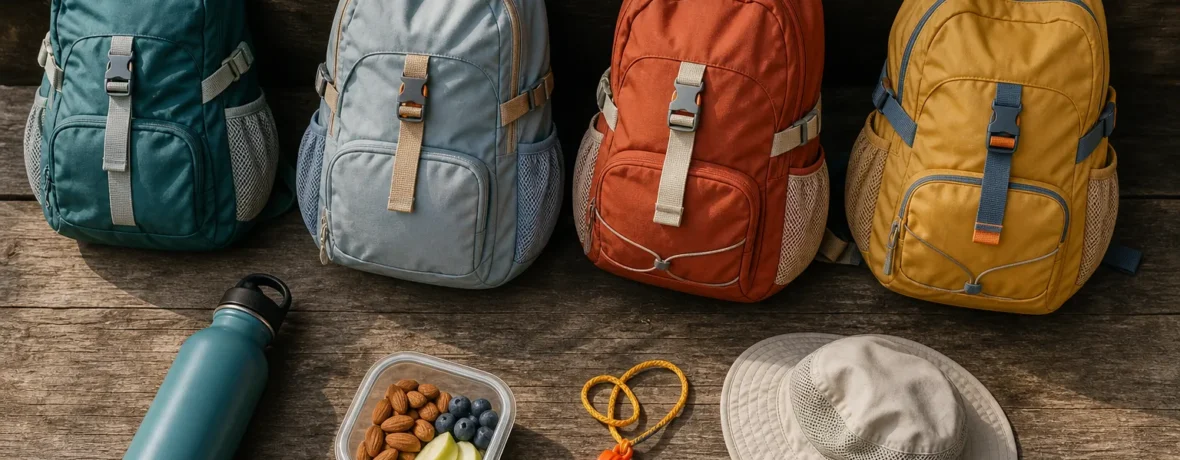
The best kids hiking backpack for most families is the Osprey Jet 18 because it gives school-age kids 18 liters of useful space, a real hipbelt, hydration compatibility, and a 5-15 lb [2.3-6.8 kg] load range without feeling oversized. Choose smaller 9-12 liter packs for kids under 7 or short hikes.
We may earn a commission when you buy through links on this page.
Quick Picks
Start here if you already know the kind of hiking your kid does.
| Category | Model | Weight | Key feature |
|---|---|---|---|
| Best overall | Osprey Jet 18 | 1.11 lb [0.50 kg] | 18 L hiking build with hipbelt and reservoir sleeve |
| Best budget | REI Co-op Tarn 12 | 12 oz [340 g] | Trail-ready 12 L pack for ages 4-7 |
| Best value daypack | REI Co-op Tarn 18 | 1 lb [454 g] | Hipbelt pockets, 18 L capacity, kid-friendly buckles |
| Best lightweight crossover | Osprey Daylite Jr. | 0.69 lb [313 g] | Simple 9 L pack for trail, travel, and daily use |
| Best tough simple pack | Deuter Junior | 14.1 oz [400 g] | Durable 18 L body with Airstripes back system |
| Best technical daypack | Deuter Climber 22 | 1 lb 6 oz [620 g] | 22 L alpine-style pack with compression and gear loops |
| Best hydration pack | CamelBak Mini M.U.L.E. | 15 oz [425 g] | 1.5 L reservoir included, 3.5 L gear capacity |
| Best first overnight pack | REI Co-op Tarn 40 | 2 lb 7 oz [1.11 kg] | 40 L internal-frame pack with adjustable torso |
What is the best kids hiking backpack for most families?
The Osprey Jet 18 is the best all-around pick for most school-age hikers.
A good kid pack needs to do three things well: fit a smaller torso, carry water without drama, and stay stable when the trail gets bumpy. The Osprey Jet 18 checks those boxes cleanly. It has an 18 L capacity, a real padded hipbelt, an adjustable sternum strap with safety whistle, side bottle pockets, and an external reservoir sleeve sized for a 1.5 L bladder. Osprey lists its load range at 5-15 lb [2.3-6.8 kg], which is a practical ceiling for many kids on day hikes.
That does not mean every child needs 18 liters. A 5-year-old carrying a fleece, snack, and tiny water bottle will be happier with a 9-12 liter pack. A strong 10-year-old on all-day hikes may use every inch of an 18-22 liter pack. And for backpacking, daypacks are the wrong tool. You want an internal frame, an adjustable torso, and enough volume for soft but bulky gear.
How we chose
We chose these packs by comparing published specs, materials, fit features, verified owner feedback, and expert reviews.
This guide is research-based rather than a wear test. Instead, this buyer’s guide focuses on what you can verify before buying: volume, empty weight, torso fit, load range, hydration setup, pocket layout, hipbelt design, fabric, and the kinds of complaints that show up repeatedly in owner feedback. We gave extra weight to kids’ hiking-specific designs rather than ordinary school bags with outdoor colors.
For sizing and load guidance, we leaned on brand specs plus child-backpack safety advice from the American Academy of Pediatrics through HealthyChildren.org. Their guidance says a loaded backpack should not exceed 15% of a child’s body weight and should sit close to the body with both shoulder straps used.
We prioritized packs that have:
- Kid-specific shoulder straps, not adult straps shrunk in name only
- A sternum strap to keep shoulder straps from sliding outward
- Side bottle pockets or hydration compatibility
- A hipbelt or waistbelt on packs meant for longer hikes
- Easy-access pockets for snacks, layers, and small treasures
- Durable fabric on the bottom panel
- A realistic capacity for the intended age and trip length
Osprey Jet 18 – Best for most day hikes
The Osprey Jet 18 suits school-age kids who are ready to carry their own water, layers, snacks, and small safety items without hauling a backpacking pack.
This is the most balanced hiking daypack here. The 18 L capacity is big enough for a rain shell, fleece, lunch, headlamp, small first-aid kit, and nature finds, but it is not so huge that a kid is tempted to carry half the car. The AirScape-style back panel adds ventilation, the padded hipbelt stabilizes the load, and the external reservoir sleeve makes refills easier than digging through the main compartment.
- Capacity: 18 L / 1,098 cu in
- Weight: 1.11 lb [0.50 kg]
- Load range: 5-15 lb [2.3-6.8 kg]
- Best use: Day hikes, nature walks, camp, travel
- Price tier: Mid-range
Pros
- Useful 18 L size for real day hikes
- Hipbelt and sternum strap help control bounce
- Hydration-compatible design with external sleeve
- Side mesh pockets and front stash pocket are kid-friendly
Cons
- Too tall and roomy for many preschoolers
- No integrated rain cover
- Top-loading access is not as easy to organize as a panel zip
- More pack than you need for short neighborhood walks
Skip it if… your child is under 6, dislikes waistbelts, or only needs to carry a snack and a small water bottle.
REI Co-op Tarn 12 – Best for younger hikers
The REI Co-op Tarn 12 suits younger kids who need a real trail pack that still feels small, light, and easy to manage.
The Tarn 12 is built for the small-pack years. REI lists it as optimized for ages 4-7, and the 12 L capacity is right for kids who should carry only light items: a layer, snack, whistle, tiny stuffed trail mascot, and water. The current model has a tuck-away waistbelt, adjustable chest strap, hydration sleeve for a 1.5 L reservoir, side pockets, reflective details, and easy-open buckles.
- Capacity: 12 L / 732 cu in
- Weight: 12 oz [340 g]
- Best use: Short hikes, park trails, camp, travel
- Hydration: Reservoir-compatible, 1.5 L sleeve
- Price tier: Budget to mid-range
Pros
- Light enough for younger kids
- Waistbelt tucks away when not needed
- Good pocket layout for snacks and layers
- Kid-friendly buckles and printed packing list inside
Cons
- Too small for bulky cold-weather layers
- Not built for heavy loads
- Waistbelt is low-profile, not load-hauling
- Can be outgrown quickly by tall kids
Skip it if… your child is already carrying a full lunch, rain shell, fleece, and 2 L of water on longer hikes.
REI Co-op Tarn 18 – Best for value
The REI Co-op Tarn 18 suits kids who need more room than a starter pack but do not need a technical alpine-style build.
The Tarn 18 is one of the easiest packs to recommend for families who hike often. It has 18 L of space, a 1 lb [454 g] empty weight, six exterior pockets plus the main compartment, a hydration sleeve for a 2 L reservoir, and hipbelt pockets sized for snacks or small finds. The current version is optimized for ages 6-12, which gives it a longer useful life than most smaller kids’ packs.
- Capacity: 18 L / 1,098 cu in
- Weight: 1 lb [454 g]
- Best use: Day hikes, scout outings, school-trail crossover
- Hydration: Reservoir-compatible, 2 L sleeve
- Price tier: Budget to mid-range
Pros
- Strong feature set for the weight
- Hipbelt pockets are great for snacks
- Large front stuff pocket handles a shed layer
- Durable side pockets and compression straps
Cons
- Still frameless, so it has limits with dense loads
- No included rain cover
- Can look large on smaller 6-year-olds
- Top access is simple but not suitcase-easy
Skip it if… you want a tiny preschool pack or a true overnight backpacking pack.
Osprey Daylite Jr. – Best for trail-to-school use
The Osprey Daylite Jr. suits kids who need one small backpack for easy hikes, travel days, library runs, and after-school adventures.
This is the light, simple option. Osprey’s current Daylite Jr. is 9 L and weighs 0.69 lb [313 g]. It has a panel-loading main compartment, side mesh bottle pockets, a small front pocket, an internal name tag, and a hydration-compatible sleeve. It is less supportive than the Jet 18, but that is the point. It feels like a small everyday pack that can handle the trail.
- Capacity: 9 L / 549 cu in
- Weight: 0.69 lb [313 g]
- Best use: Short hikes, travel, school, everyday carry
- Hydration: Internal hydration-compatible sleeve
- Price tier: Mid-range
Pros
- Very light and easy for kids to manage
- Panel-loading design is simple to pack
- Side pockets hold small bottles
- Works beyond hiking, which helps justify the buy
Cons
- No real hipbelt for load transfer
- 9 L is tight for all-day hikes
- Less structured than hiking-first packs
- Side pockets may not secure tall bottles as well as deeper pockets
Skip it if… your kid regularly carries more than water, snacks, and a thin layer.
Deuter Junior – Best for tough simplicity
The Deuter Junior suits kids who are hard on gear and need a straightforward 18 L pack with a comfortable back panel.
The Junior keeps things clean: one main compartment, side pockets, a front stretch stash pocket, a lid pocket, sternum strap, and Deuter’s Airstripes back system. Deuter lists it for kids ages 7 and up, with a body-height range of 51-66 in [130-168 cm]. At 400 g, or roughly 14.1 oz, it is light for an 18 L pack.
- Capacity: 18 L
- Weight: 14.1 oz [400 g]
- Dimensions: 16 x 9 x 8 in [41 x 23 x 20 cm]
- Best use: Day hikes, camp, travel, rugged kid use
- Price tier: Mid-range
Pros
- Good capacity-to-weight ratio
- Airstripes back panel adds ventilation
- Simple pocket layout kids can understand
- Durable fabric mix for rough handling
Cons
- No padded hipbelt
- Less organization than the Tarn 18
- No included rain cover
- Not ideal for carrying dense or heavy loads
Skip it if… you want hipbelt pockets, a load-bearing waistbelt, or technical attachments.
Deuter Climber 22 – Best for technical day hikes
The Deuter Climber 22 suits older kids who scramble, climb, snowshoe, or need a more secure pack for rougher trails.
The Climber 22 is the most technical daypack in this guide. It has a close-fitting Alpine back system, side compression straps, compact hip fins, stretch side pockets, lid compartments, pole attachments, and docking loops for extra gear. Deuter lists a recommended load of 6.6-13.2 lb [3-6 kg], which gives you a clearer boundary than most kids’ packs.
- Capacity: 22 L
- Weight: 1 lb 6 oz [620 g]
- Recommended load: 6.6-13.2 lb [3-6 kg]
- Best use: Rugged day hikes, alpine-style outings, snow play
- Price tier: Mid-range
Pros
- Stable fit for rougher movement
- More technical attachment points than basic daypacks
- Compression straps help control partial loads
- 22 L capacity handles bigger layers
Cons
- Too much pack for casual walks
- Hip fins are compact, not plush backpacking support
- External features may be overkill for young kids
- Top-lid style is less familiar than school-pack zippers
Skip it if… your child mostly hikes flat trails and wants quick zipper access over technical features.
CamelBak Mini M.U.L.E. – Best for hydration
The CamelBak Mini M.U.L.E. suits kids who drink more reliably from a hose than from a bottle.
For hot hikes, bike-path rambles, and kids who never remember to stop for water, a hydration pack can be the fix. The Mini M.U.L.E. carries 1.5 L of water in an included Crux reservoir and adds 3.5 L of gear capacity for snacks, a thin layer, and small essentials. It also has a breathable mesh back panel, stretch overflow pocket, reflective strips, and a sternum-strap whistle.
- Gear capacity: 3.5 L / 214 cu in
- Reservoir: 1.5 L / 50 fl oz included
- Weight: 15 oz [425 g]
- Best use: Hot hikes, bike rides, short trail outings
- Price tier: Mid-range
Pros
- Reservoir is included
- Encourages frequent sipping
- Compact size discourages overpacking
- Good for hiking and biking
Cons
- Not much room for layers
- Reservoirs require cleaning and drying
- No bottle-pocket backup on some setups
- Less versatile than an 18 L daypack
Skip it if… your child needs to carry a jacket, lunch, extra gloves, and trail essentials in one pack.
REI Co-op Tarn 40 – Best for first overnights
The REI Co-op Tarn 40 suits kids who are ready to carry bulky but lightweight gear on short backpacking trips.
Do not send a kid backpacking with a regular daypack stuffed to bursting. The Tarn 40 is an internal-frame pack with an adjustable torso, hipbelt pockets, top access, front storage, hydration compatibility, and a 40 L capacity. REI lists the current version at 2 lb 7 oz [1.11 kg], with a 12-16 in [30-41 cm] torso fit and 24-34 in [61-86 cm] waist/hip fit.
- Capacity: 40 L / 2,441 cu in
- Weight: 2 lb 7 oz [1.11 kg]
- Torso fit: 12-16 in [30-41 cm]
- Best use: First backpacking trips, camps, overnights
- Price tier: Premium for kids’ packs
Pros
- True internal-frame support
- Adjustable torso extends fit life
- Good 40 L size for short youth backpacking trips
- Hipbelt pockets and multiple exterior pockets
Cons
- Too large for day hiking
- No included rain cover
- Must be packed carefully to avoid overloading a child
- Not sized for very small kids
Skip it if… you are not backpacking; a 40 L pack is too much for ordinary day hikes.
How big should a kids hiking backpack be?
Most kids need 9-12 liters for short hikes, 18 liters for full day hikes, and 38-40 liters only for backpacking.
Capacity is where parents overshoot. Bigger looks more useful in the store. On trail, bigger often means heavier, sloppier, and stuffed with things the child should not be carrying. Match volume to the job first. Then check the fit.
| Pack size | Best for | Typical load |
|---|---|---|
| 3-5 L | Hydration-first short hikes | Water, snack, tiny layer |
| 9-12 L | Ages 4-7, short trails, travel | Water, snack, fleece, small essentials |
| 18 L | School-age day hikers | Water, lunch, rain shell, fleece, headlamp, small first-aid kit |
| 22 L | Older kids, technical day hikes, cold weather | Bulkier layers, gloves, extra food, traction or accessories |
| 38-40 L | First backpacking trips | Sleeping bag, clothing, shared lightweight gear |
For many families, 18 L is the sweet spot once a child can hike several miles and carry a meaningful load. It has room for the hiking version of the “Ten Essentials” without turning the kid into a pack mule. The National Park Service has a plain-language Ten Essentials guide that works well as a packing checklist for family hikes.
How much weight should a child carry hiking?
Keep a child’s loaded pack below 15% of body weight, and go lighter for younger kids, steep trails, heat, or long days.
That 15% ceiling is a maximum guideline, not a goal. A 60 lb [27 kg] child would top out at 9 lb [4.1 kg]. Many kids will be happier carrying less. Water gets heavy fast: 1 liter weighs 2.2 lb [1 kg] before you count the bottle or reservoir. Add a fleece, rain shell, lunch, and random rocks, and a small pack can get silly in five minutes.
Use this trail check before you leave the parking lot:
- Load the pack with water, food, layers, and safety items.
- Weigh the full pack on a bathroom scale.
- Compare that number with the child’s body weight.
- Put the pack on both shoulders and fasten the sternum strap.
- Watch your child walk 50 yards [46 m].
- Remove weight if they lean forward, shrug, complain of shoulder pressure, or keep adjusting the straps.
Let kids carry pride items. A whistle. A snack. Their own fleece. Maybe the map. Do not make them carry dense shared gear just because it fits.
How should a kids hiking backpack fit?
A kids’ pack should sit close to the back, ride above the hips, and stay stable without forcing the shoulders upward.
Fit beats brand. Always. A beautiful premium pack that sits on the neck or hangs below the hips is the wrong pack. The shoulder straps should wrap smoothly without gaps. The sternum strap should cross the upper chest, not the throat. A waistbelt or hipbelt should land where it can stabilize the pack; on smaller kids, some belts act more like anti-bounce straps than true load-transfer belts.
Check these fit points:
- Back length: The pack should not hit the back of the head or sag far below the waist.
- Shoulder straps: Straps should curve around the shoulders without pinching the neck.
- Sternum strap: It should keep shoulder straps in place without restricting breathing.
- Hipbelt or waistbelt: It should stabilize the pack, not ride up into the ribs.
- Side pockets: Your child should be able to reach water without a wrestling match.
- Empty weight: A heavy empty pack steals too much of the child’s comfortable carrying limit.
Try the pack with hiking layers on. A pack that fits over a T-shirt may feel tight over a puffy jacket.
Is a Kelty kids hiking backpack a child carrier or a pack kids wear?
Most Kelty kid-focused hiking models are child carriers for adults, not daypacks worn by children.
If you are searching for a Kelty kids hiking backpack, you are probably seeing the Journey PerfectFIT line. That is a framed child carrier for adults carrying toddlers. It is useful for a very different stage: the child rides in the pack instead of carrying one. Kelty lists the Journey PerfectFIT with a 48.5 lb [22 kg] maximum load for child, gear, and pack combined, and a child weight range of 16-40 lb [7.25-18 kg].
Choose a child carrier when your kid cannot hike the route safely under their own power. Choose a kid-worn hiking backpack when your child can walk the distance and carry a light, age-appropriate load. Those are separate tools. Do not buy a toddler carrier expecting it to solve the same problem as an Osprey Jet, REI Tarn, or Deuter Junior.
What features matter most in a kids hiking backpack?
The most useful features are fit adjustability, easy hydration, stable straps, and pockets your child can actually use.
Kids do not need a pile of adult backpacking features on a day hike. They need simple gear that works while they are distracted by mud, lizards, snacks, and the urgent need to pick up every shiny rock.
Look for these features first:
- Two padded shoulder straps: Non-negotiable. Sling bags are poor hiking packs for kids.
- Sternum strap: Keeps narrow shoulders from shedding straps all day.
- Hipbelt or waistbelt: Helpful for 12 L and larger packs, essential for backpacking packs.
- Hydration access: Side bottle pockets are easier to clean; reservoirs help some kids drink more often.
- Front stash pocket: Great for a rain shell, fleece, hat, or gloves.
- Reflective details and whistle: Small safety features that weigh almost nothing.
- Durable bottom fabric: Kids set packs in dirt, gravel, puddles, and worse.
- Simple zippers and buckles: If a kid cannot open it with cold fingers, it is not kid-friendly.
Do not overbuy for features your child will not use. Ice axe loops on a pack for nature-center walks? Silly. A whistle on the sternum strap? Smart.
Should kids use bottles or a hydration reservoir?
Bottles are simpler to clean, but reservoirs often help kids drink more consistently while hiking.
There is no single right answer. Bottles are cheap, visible, and easy to refill. You can see exactly how much water is left. The downside is access: some kids cannot reach side pockets while wearing the pack, so they wait too long to drink.
Reservoirs solve that by putting the hose near their mouth. The tradeoff is maintenance. You need to rinse and dry the reservoir and hose after use, and sugary drinks make cleaning worse. For most hikes, water only is the cleanest plan.
| Hydration style | Best for | Main downside |
|---|---|---|
| Side bottles | Easy cleanup, short hikes, younger kids | Hard for some kids to reach while walking |
| Hydration reservoir | Hot hikes, steady sipping, biking | Needs careful cleaning and drying |
| Both | Longer day hikes and backup water | Adds weight quickly |
When to see a doctor
See a pediatrician if backpack-related pain is persistent, recurring, or shows up when your child is not wearing the pack.
Backpacks can cause discomfort when they are too heavy, poorly fitted, or worn on one shoulder, but do not guess your way through ongoing pain. The American Academy of Orthopaedic Surgeons advises parents not to ignore back, neck, or shoulder pain during or after backpack use and to consider a pediatrician visit if back pain does not improve.
Get medical advice if your child reports numbness, tingling, weakness, pain that wakes them at night, pain after a fall, or pain that continues after you lighten the pack and adjust the fit. This guide can help you choose gear. It cannot diagnose injuries or medical conditions.
How do all the best kids hiking backpacks compare?
The best pack depends on trip length, child size, and how much structure your kid needs.
| Model | Capacity | Weight | Best for |
|---|---|---|---|
| Osprey Jet 18 | 18 L | 1.11 lb [0.50 kg] | Best overall day hiking pack |
| REI Co-op Tarn 12 | 12 L | 12 oz [340 g] | Younger hikers and short trails |
| REI Co-op Tarn 18 | 18 L | 1 lb [454 g] | Value-focused day hikes |
| Osprey Daylite Jr. | 9 L | 0.69 lb [313 g] | Light trail-to-school use |
| Deuter Junior | 18 L | 14.1 oz [400 g] | Simple, durable day hiking |
| Deuter Climber 22 | 22 L | 1 lb 6 oz [620 g] | Technical trails and older kids |
| CamelBak Mini M.U.L.E. | 3.5 L gear + 1.5 L water | 15 oz [425 g] | Hydration-first short outings |
| REI Co-op Tarn 40 | 40 L | 2 lb 7 oz [1.11 kg] | First backpacking trips |
If you want the safe middle choice, get an 18 L hiking pack with a sternum strap, waistbelt or hipbelt, and easy water access. If your child is very young, go smaller. If your child is backpacking overnight, go framed and adjustable.
Related reading
- How to Pack a Hiking Backpack: Weight Zones and a Simple Diagram
- How to Choose a Hiking Backpack: Volume, Torso Length and Fit
- How to Attach a Sleeping Bag to a Backpack
- How to Adjust Backpack Straps for a Comfortable Carry
FAQ
Here are the quick answers parents usually need before buying.
What size backpack is best for a 6-year-old hiking?
A 9-12 L pack is usually best for a 6-year-old. Choose 12 L if they carry a layer and water; choose 9 L if the hike is short and you carry most shared gear.
Can kids use an adult daypack?
Usually, no. Adult daypacks are often too long in the torso and too wide in the shoulder straps, which makes them bounce, sag, and rub.
How heavy should a kid’s hiking backpack be?
Keep the loaded pack under 15% of the child’s body weight, and go lighter for young kids. If your child leans forward, complains, or keeps shrugging the straps, remove weight.
Is a hydration pack good for kids?
Yes, if your child drinks more consistently from a hose. Bottles are easier to clean, but a 1.5 L reservoir can work very well for hot hikes and bike-path adventures.
Do kids need a hipbelt on a hiking backpack?
For tiny loads, no. For 12-18 L packs and longer hikes, a waistbelt or hipbelt helps stabilize the pack; for overnight packs, a real padded hipbelt is essential.
What is the best backpack for a child’s first overnight hike?
Choose an adjustable internal-frame pack around 38-40 L. The REI Co-op Tarn 40 is a strong pick because it has a youth fit, adjustable torso, 40 L capacity, and backpacking-specific support.